Nvidia’s $12.9 Billion Hugging Face Bet Faces Its First Real Antitrust Test
Nvidia’s $12.9 Billion Hugging Face Deal Draws Antitrust Scrutiny Over AI’s Distribution Layer
The US Department of Justice has begun asking questions about how Nvidia’s acquisition of Hugging Face would affect competition in artificial intelligence. The core concern is control of what regulators describe as a foundational distribution channel for open-source AI. The framing matters: this is not being treated as an ordinary software purchase but as a question of who owns the default route between model creators and model users.
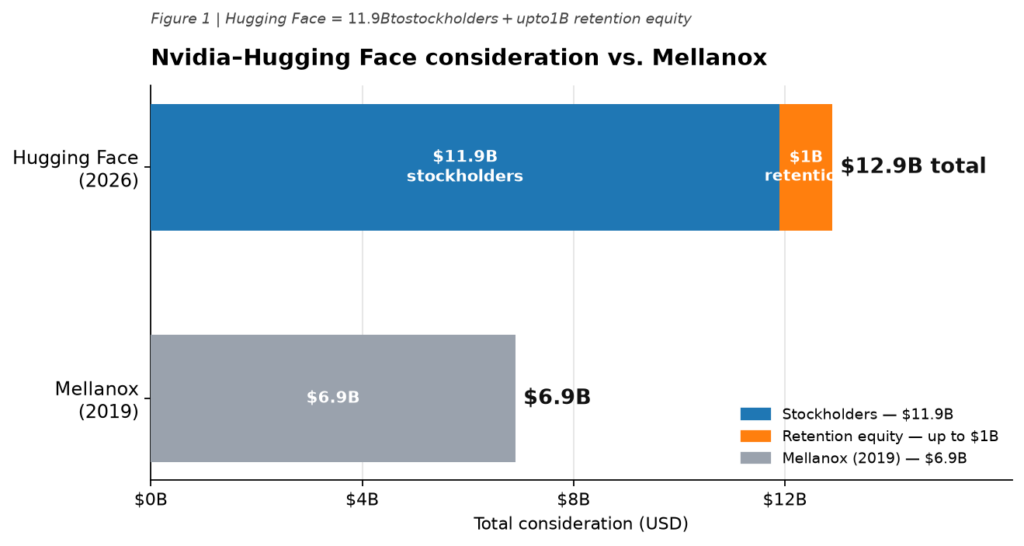
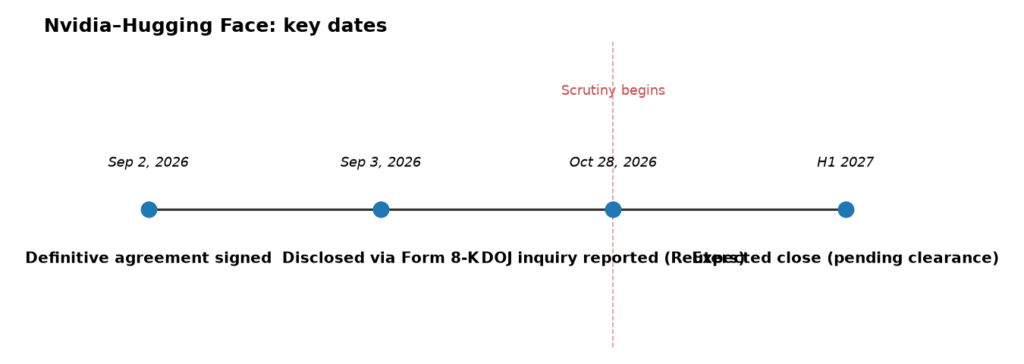
The deal was signed on September 2 and disclosed on September 3 in a Form 8-K. Consideration runs to roughly $12.9 billion in total — approximately $11.9 billion to stockholders, plus up to $1 billion in employee retention equity. The scale sets it apart from Nvidia’s prior move of this kind: at $6.9 billion, the Mellanox acquisition long held the title of Nvidia’s largest conventional purchase. Closing is expected in the first half of 2027, pending regulatory clearance.
The more consequential distinction is legal, not financial. Nvidia’s recent expansions into the AI stack — a technology license and talent arrangement with Groq, the Enfabrica arrangement, and a license-plus-equity structure with Poolside — were each engineered as non-acquisitions, structured to avoid mandatory merger review. A direct purchase of Hugging Face cannot take that path. At $12.9 billion it triggers mandatory Hart-Scott-Rodino premerger notification, giving both the Federal Trade Commission and the Justice Department a formal window to examine it. This is the first of Nvidia’s current-era deals that regulators get to scrutinize on the merits rather than argue over its structure.
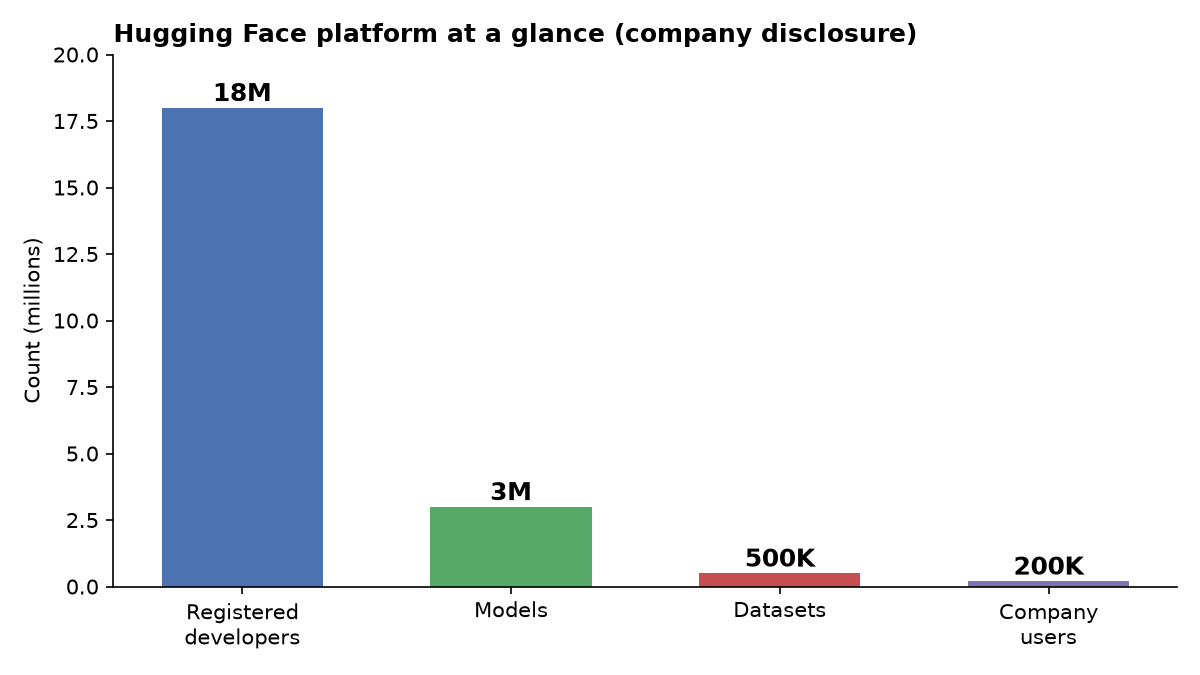
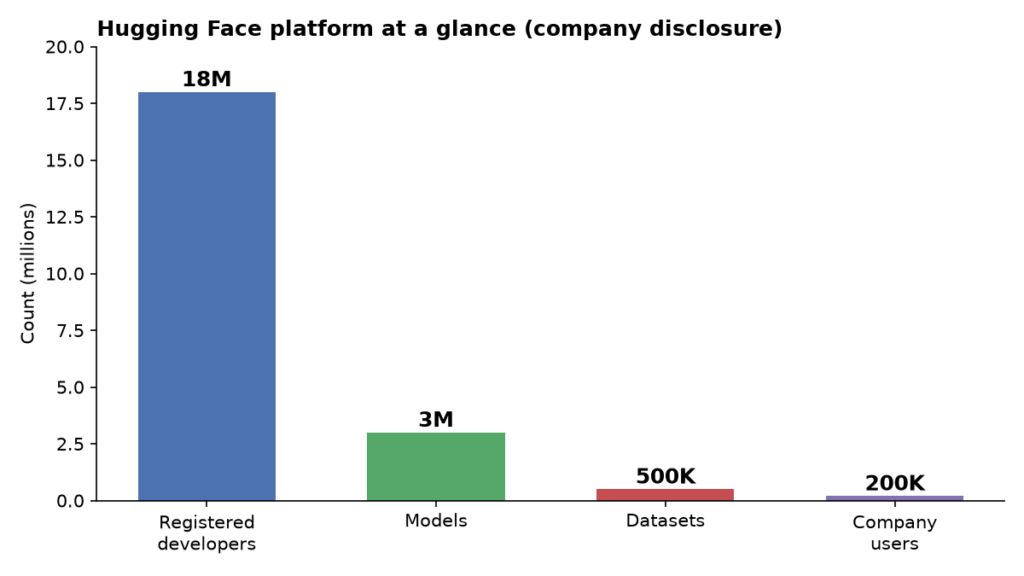
The asset is not the revenue. Estimates place Hugging Face’s annualized revenue around $100–150 million — an implied multiple far beyond any conventional software benchmark. What Nvidia is buying is a distribution position, not a line of business: more than 18 million developers, researchers and creators, over 3 million models and 500,000 datasets, plus roughly 200,000 company users.
The inquiry is not standalone. Reuters reports that DOJ questions also cover whether Nvidia has used scarce GPU supply as leverage to steer customers toward adjacent products, and the review reaches back through Nvidia’s wider influence chain — the SchedMD acquisition, whose open-source scheduler underpins national-security supercomputers, the Run:ai purchase, and the Groq licensing arrangement. Nvidia shares came under pressure on the report.
A neutral hosting layer owned by a compute vendor changes the economics of the free-weights, paid-compute bargain that has sustained open-source AI. Hugging Face’s Optimum libraries — which give developers a tested path to AMD and Intel accelerators rather than Nvidia GPUs — are the operational guarantee of that neutrality, and they now sit inside the deal perimeter. Default weight formats, quantization toolchains and inference backends are the concrete levers a regulator would examine for self-preferencing: whether a chip maker that owns the distribution layer would quietly tilt discovery, defaults and support toward its own hardware.
The China angle sharpens the reading for global observers. Chinese-origin open models from Alibaba’s Qwen family, DeepSeek and Zhipu AI account for a large share of Hugging Face’s worldwide download volume, and the platform has long required mirror and local-hub workarounds for developers in mainland China. The question regulators will weigh is whether concentrating the open-weight commons under a single US corporate owner narrows a corridor that Chinese labs and the global research community have both relied on.
Distribution, not capability, is the chokepoint in open AI. Whoever controls the default path decides which formats, licenses and hardware targets earn first-class support — and that shapes which labs, in which countries, can reach developers at all.
Watch next: whether the DOJ issues a second request, whether Nvidia formalizes its openness pledges into binding commitments, and whether format neutrality or non-discriminatory hosting becomes a condition of clearance.