How to Get Cited by ChatGPT, Gemini and Perplexity — Without the False Promises
Everyone in marketing says GEO now. Fewer can define it without reaching for a deck. Fewer still can produce a number that survives a second look.
So instead of the pitch decks, I went through the 2026 evidence: platform-level referral data, retailer transaction data, China’s official internet statistics, and a 45-study academic review published in July. What comes out the other side is more useful than the hype and less comfortable than the sales calls. GEO is real. It also works smaller, slower and far more conditionally than the people selling it admit.
The short answer, before the nuance
Generative engine optimization is the practice of making a brand’s information easy for AI answer systems to find, understand and reuse. That is the whole of it, minus the packaging.
The systems in scope are ChatGPT, Google AI Overviews and Gemini, Perplexity, Claude, Copilot, Grok, plus the assistants that dominate in China: Doubao, Qwen, Yuanbao, Quark and DeepSeek. They behave differently from each other, which matters more than most guides admit.
The phrase also hides three separate outcomes. Mixing them up is where most strategies quietly fail.
- Discoverability: does the engine retrieve your page at all?
- Citation: does it name you, or link to you?
- Absorption: does your framing, your number, your definition end up inside the answer?
Only the third one changes what a buyer believes. Referral traffic is a fourth outcome, and a separate business problem with its own budget.
One acronym, five jobs
The term has a specific origin. A preprint posted in November 2023 and later published at KDD 2024 tested nine optimization methods against a benchmark of generative engine queries and reported visibility gains of up to 40 percent. That single number traveled further and faster than the paper’s caveats ever did.
Then the vocabulary split. Answer engine optimization, AI optimization, LLMO, AI visibility, GEO. Some practitioners mean “get cited inside ChatGPT.” Some mean “get recommended.” Some mean “get the click.” Vendors tend to prefer whichever version sounds like a channel they can invoice for.
Here is the definition worth keeping: GEO is citation plus absorption. Traffic stays its own KPI, measured its own way, on its own timeline. Blur those together and you end up reporting a feeling.
The mechanics, without the mystique
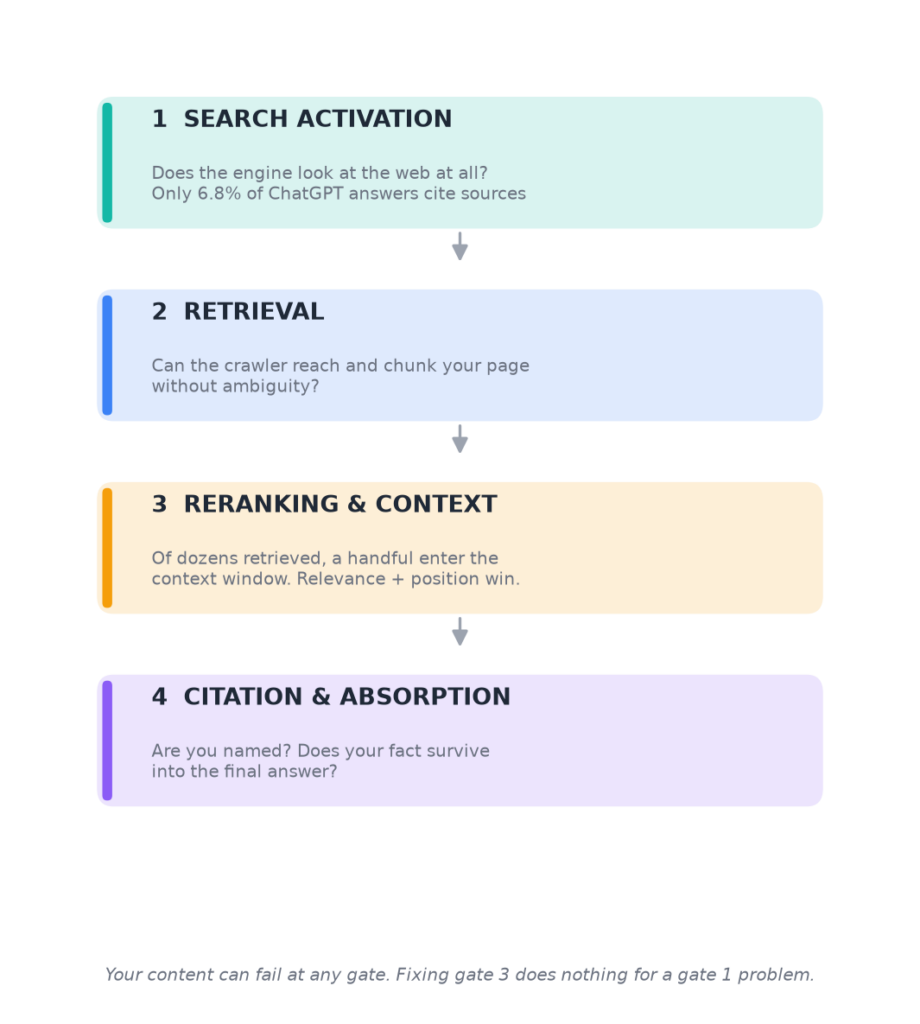
An AI answer is not a search result with a summary bolted on top. Think of it as four gates, each with a different failure mode. Your content can die at any one of them, and the fix at gate three does nothing for a problem at gate one.
Gate one: the engine has to decide to look
Plenty of answers never touch the web. When a model responds from parametric memory, there is no index, no retrieval, no slot to win. Similarweb’s platform data for May 2026 puts web citations at 6.8 percent of ChatGPT conversations overall, and 22.6 percent in travel. That spread is the point.
So the first diagnostic question is not “how do I rank.” It is “which questions in my category even trigger a search.” This is the most under-measured variable in the entire field, and it is cheap to test: run the prompts, log whether citations appear.
Gate two: retrieval
Retrieval means crawling, chunking, matching. If the crawler cannot reach the page, or the page resolves into chunks that answer nothing in particular, the rest of this article is decoration.
The academic review flags a trap here that nobody selling GEO will mention: rewriting content to be more quotable can impair retrieval. Prose polished for citation sometimes stops matching the vocabulary people actually use. You win the quote and lose the query.
Gate three: reranking and context allocation
Dozens of passages get retrieved. A handful get placed in the context window. Most of what gets published about this stage is guesswork dressed as a formula. The review’s finding is blunt: topical relevance and context position are the levers that replicate, and generic heuristics transfer poorly across engines.
That is not a satisfying finding. It is, however, a reproducible one.
Gate four: citation, then absorption
A 2026 measurement preprint ran 602 controlled prompts across ChatGPT, Google AI Overviews and Gemini, and Perplexity, collecting 21,143 search-layer citations and successfully fetching 18,151 pages across 72 features. Its central observation is cleaner than any tactic list.
Citation breadth and citation depth diverge. Google and Perplexity cite more sources per answer. ChatGPT cites fewer, but the pages it cites carry higher average influence. And high-influence pages share a profile: longer, better structured, semantically aligned with the question, and dense with extractable evidence — definitions, numerical facts, comparisons, procedural steps.
That last sentence is the most actionable thing in the literature. Not “write better.” Write things that can be lifted out and reused without you present.
What 45 studies actually add up to
The critical survey (an arXiv preprint covering November 2023 through July 2026) reviewed 45 studies and relevant retrieval work. Three findings deserve to be printed and taped above a monitor.
First, the founding result holds inside its test harness. It shows that a source already sitting in a fixed context can improve its own visibility. It says nothing about whether an engine would ever find that source, and nothing about durable traffic.
Second, no reviewed technique demonstrates a stable, longitudinal, cross-platform causal effect on organic discoverability or downstream behavior. None.
Third, commercial audits find low source overlap between engines, substantial run-to-run variation, and persistent fidelity gaps between what a page says and what the answer repeats.
Read that as an operating manual. You are optimizing a stochastic pipeline you cannot see, against competitors doing the same thing, inside a window that resets with every update. Variance is not a bug in your dashboard. It is the product.
One controlled experiment did produce a number worth noting: a 2026 preprint that engineers document architecture, information chunking and visual emphasis reports a 17.3 percent relative lift in citation rate and 18.5 percent in judged content quality across six engines. Directional, single team, not yet replicated. Take it as a hypothesis with a decimal point, not a target.
The traffic reality check
The click side
Pew Research Center’s analysis of real Google search sessions, published in July 2025, found that when an AI summary appeared, users clicked a traditional result in about 8 percent of visits, against 15 percent when no summary appeared. The same study put clicks on links cited inside the summary at roughly 1 percent of visits.
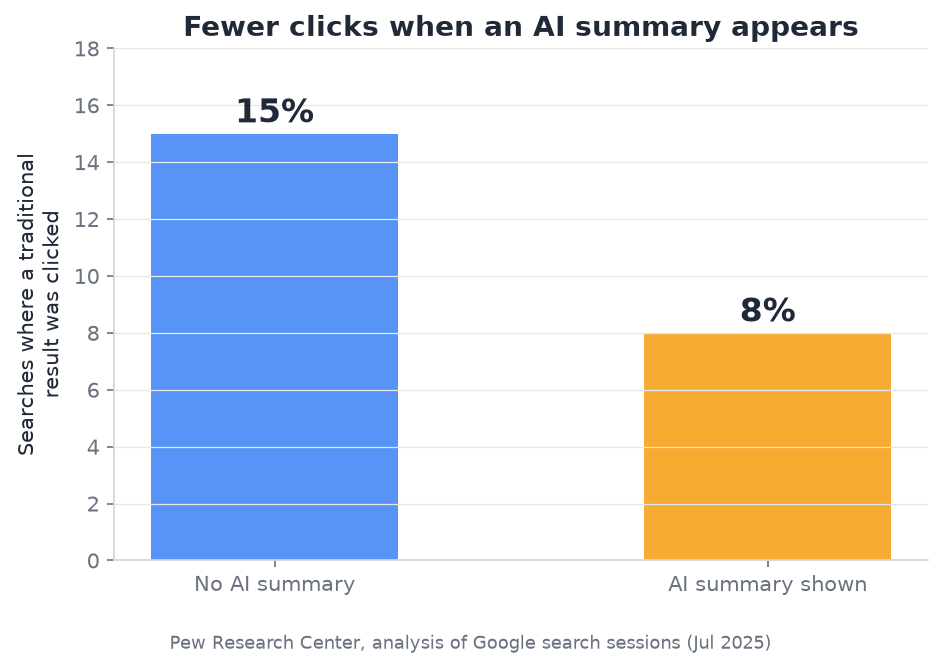
That is a behaviour finding, not a channel-size finding, and it explains the split-screen mood of 2026: publishers report collapses while retailers report records.
Google publicly disputes the traffic-loss narrative and argues that AI features still route billions of clicks. Both claims can hold at once. Fewer clicks per search, more searches overall, and a redistribution toward the queries where someone has to open a link to finish the job. If your category is not one of those, you will feel the loss first and see the explanation later.
The volume side
Similarweb’s 2026 landscape report measured an average of 770.7 million AI referral visits per month worldwide between June 2025 and May 2026, up 117.4 percent year over year. Big growth. Still roughly one percent of a typical site’s visits.
Panels disagree with each other — published estimates in 2026 range from about 0.2 percent to above 1 percent — because referrer stripping, panel composition and bot filtering all differ. Any single percentage you read is a measurement convention, not a law of nature. Quote the methodology with the number or quote neither.
Where the traffic lands
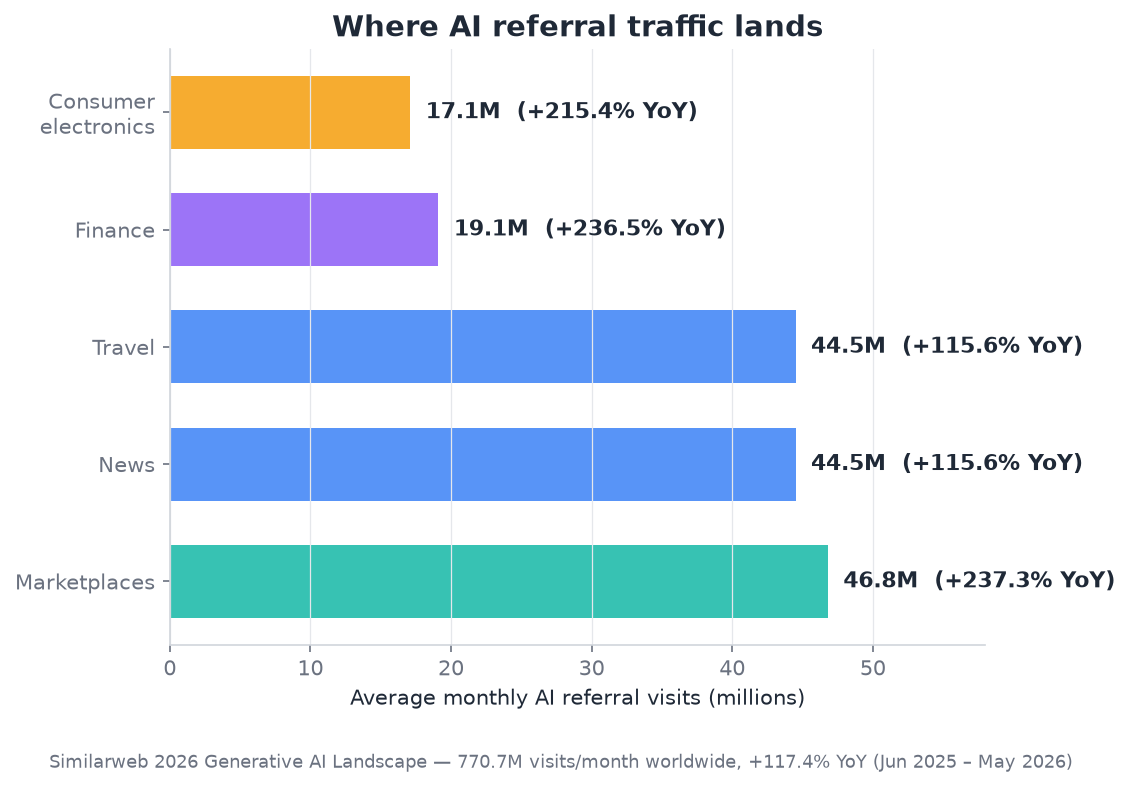
Marketplaces lead with 46.8 million average monthly AI referral visits, with news and travel essentially tied just behind at 44.5 million each. Every tracked category at least doubled: beauty up 312.5 percent, fashion 278.2, finance 19.1 million visits at 236.5, consumer electronics 17.1 million at 215.4.
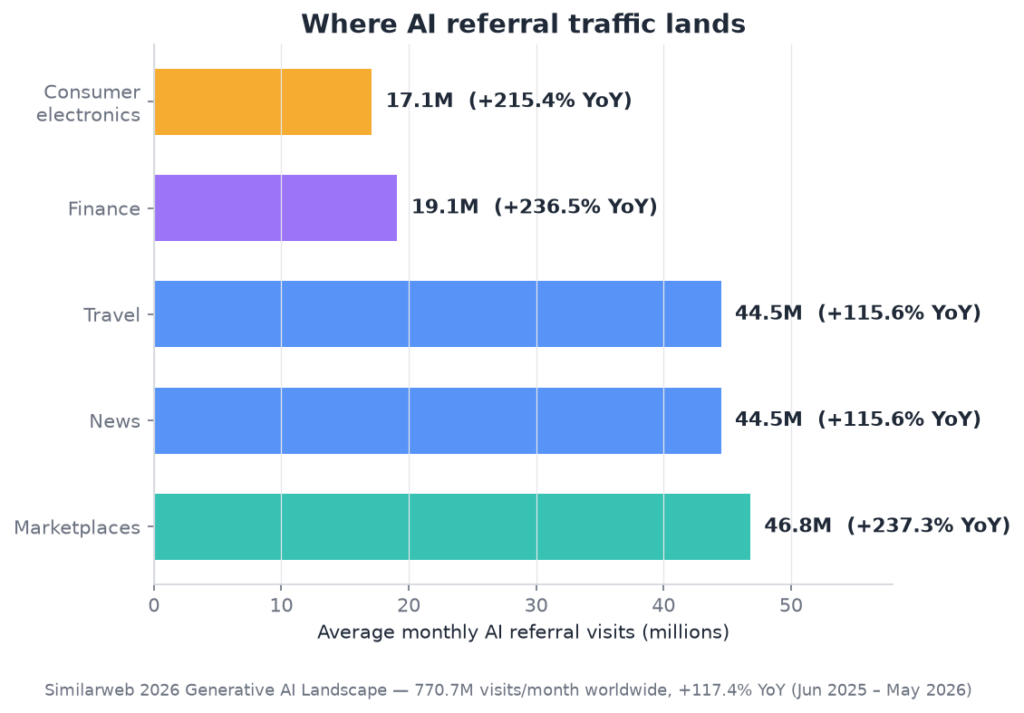
The volume ranking and the growth ranking are close to inversions, and base size decides what a percentage is worth. A 312 percent rise on a small base and a 116 percent rise on 20.6 million visits are different budget conversations, not the same headline.
The report also concedes a floor problem: visits arriving without referrer data get filed as direct traffic, so referral counts understate the channel.
The quality counterweight
Adobe’s transaction-level retail data adds the other half of the story. AI-driven traffic to US retail sites rose 693.4 percent year over year during the November to December 2025 holiday window. Those referrals converted 31 percent better than other sources, and 54 percent better on Thanksgiving Day. Visitors arriving from AI assistants were 33 percent less likely to leave immediately, spent 45 percent more time on site and viewed 13 percent more pages. Revenue per visit from AI traffic was up 84 percent from January to July 2025.
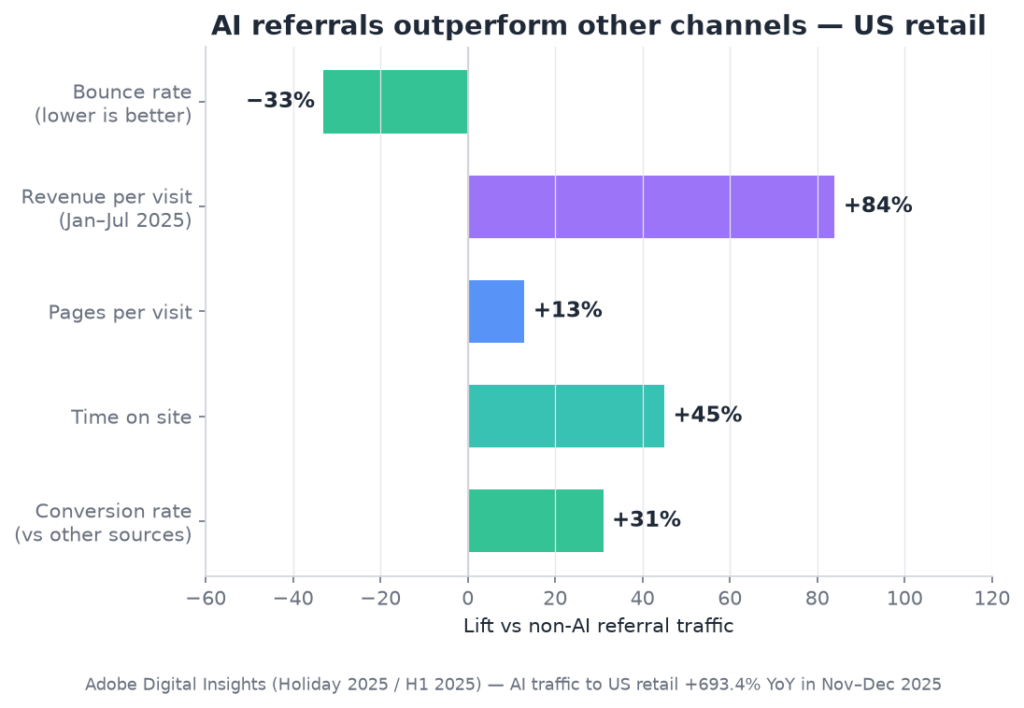
And the intent is self-reported too: 64 percent of shoppers using AI assistants for shopping said they were satisfied with the links they received, and more than 55 percent said they actively click them.
Small, high-intent, compounding. That is the honest description of this channel in 2026, and it is a better argument for measuring it early than any projection.
China moved the starting line
China’s official numbers reset the frame. The 57th national internet report, released in February 2026, put the country at 1.125 billion internet users and 80.1 percent penetration. Generative AI users reached 602 million by December 2025 — 42.8 percent of internet users, up 141.7 percent in twelve months from 249 million at the end of 2024.
By the first half of 2026, the same institute’s dedicated generative AI report put the figure above 700 million, with penetration past 50 percent.
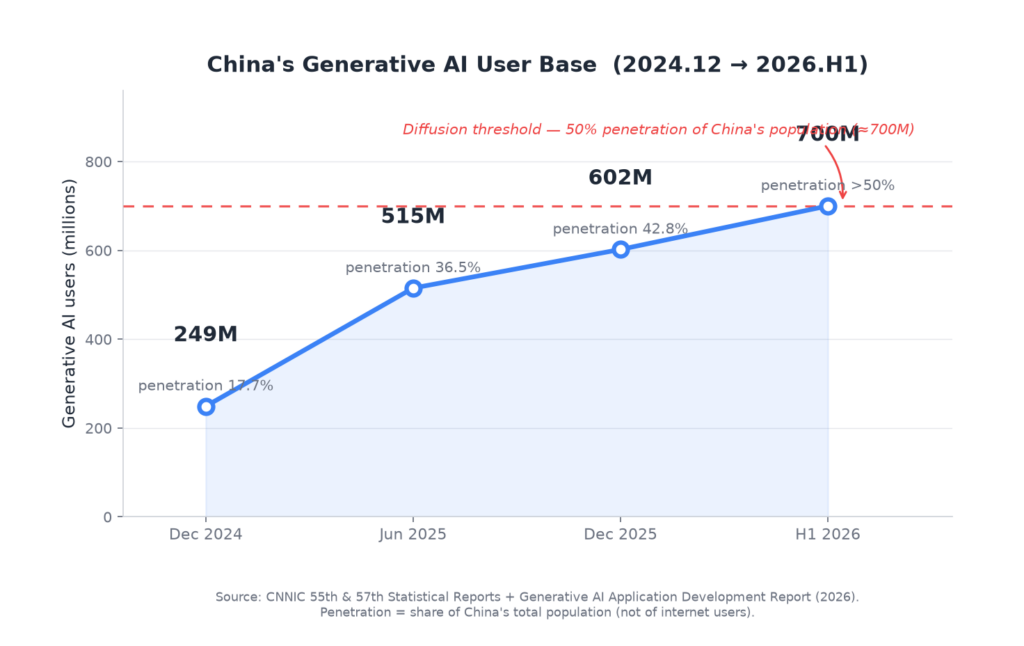
Fifty percent is the diffusion threshold where a technology stops being early and starts being normal. It changes the brief. In a market of that size, the assistant is not an experimental side door, it is the front door for a large share of research.
The structural difference matters more than the headline. China’s assistants sit inside apps people already open every day, and the answer is often the destination: browse, compare, order, pay, all without a click. QuestMobile’s mid-2026 half-year report put monthly active users of AI-native apps at 499 million as of May 2026, with Doubao — the market leader — at 383 million in June, up 172.1 percent year over year. A single quarter earlier, the same tracker counted 440 million.
For anyone marketing outside China, the transferable lesson is narrower than it looks. Citation logic travels. The KPI does not. Where retrieval usually ends inside the assistant, share of answer replaces share of traffic — and there are fewer independent sources for a model to cross-check a claim against, so consistency does more work than cleverness.
What GEO is not
It is not a ranking system. There is no page one, no position three, no climb. There is a generated answer that may or may not mention you, worded differently each time.
It is not a content trick. Keyword stuffing, doorway pages, invisible text and synthetic reviews all fail at gate two, and several fail at the trust layer before they ever reach a model.
It is not a one-time fix. The window resets, models update, competitors publish. A citation you earned in March is a memory by June.
It is not SEO with new vocabulary. SEO competes for a position in a list a human scans. GEO competes for a sentence inside an answer a human reads and stops at. Different goal, different evidence, different failure.
And it is not a promise. Anyone quoting a guaranteed citation rate is describing their own test harness, not your market.
What actually moves the needle, ranked by reproducibility
Ordered by how often independent teams reproduce the effect, not by how good it sounds on a webinar.
- Topical and entity relevance. Being unambiguously about the thing, with a name used consistently everywhere, is the only lever with broad replication behind it.
- Context position and freshness. Recency and placement inside retrieved context do measurable work. Both are largely outside your direct control, which is why you influence them with publishing cadence rather than tricks.
- Structure that survives chunking. Explicit headings, one idea per block, tables where the question is a comparison. Structure is the only part of this that is fully yours.
- Extractable evidence. Definitions with units, numbers with dates and ranges, side-by-side comparisons, numbered procedures. Opinion is cheap to generate, so it is rarely worth citing.
- Fidelity and consistency across sources. A wrong figure travels faster than a missing one and poisons an entity. Keep the facts identical on your site, your profiles, your directories and your partner pages.
- Independent corroboration. Models synthesize consensus. If the consensus does not exist outside your owned properties, you are asking a model to invent it, and it will not.
Two honest caveats. These are ranked by reliability, not by size of effect. And they are partly zero-sum: when a competitor executes the same list, individual gains compress.
How to measure it without lying to yourself
Four metrics, each answering a different question.
- Search activation rate: how often does the engine retrieve anything at all for your category’s prompts? If this is low, nothing downstream matters.
- Citation share: across a fixed prompt set, how often are you named or linked, relative to the competitive set?
- Absorption share: when you are cited, how often does your specific fact or framing survive into the final answer? This is the one that predicts influence.
- Referral traffic and conversion: the commercial outcome, tracked separately, and compared against non-AI sources.
Three method rules keep the numbers honest. Run each prompt more than once and log the date, because answers drift by design. Use paraphrases of the same question; a single phrasing measures one string, not a topic. Never compare raw citation counts across platforms, since breadth differs by engine — compare your share within each platform.
A sensible first ninety days
Skip the audit-industrial complex. This is enough to learn something real.
- Build a fixed prompt set: 50 to 100 questions your buyers actually ask, at decision stage, not just discovery stage.
- Run it twice, a week apart, and record whether an answer cites anything, who it cites, and which of your facts survive.
- Fix entity basics before writing anything new: one canonical name, one set of facts, consistent structure across your properties.
- Rewrite 10 to 15 existing pages into extractable form: a direct definition at the top, numbers with dates, a comparison table where the question implies one.
- Tag AI referrals properly in analytics and compare their conversion against your other channels for a full quarter before drawing conclusions.
- Re-run the prompt set monthly. Track share, not screenshots.
Expect the traffic line to stay flat for a while. Expect the citation share to move first. That sequence is normal, and fighting it wastes the budget you need later.
Bottom line
GEO is not a channel you buy. It is a set of conditions you make true: clear entities, structured pages, extractable evidence, consistent facts, and enough independent corroboration that a model has something to agree with.
The measurable upside in 2026 is real but modest. About one percent of visits on average, growing at triple-digit rates, converting noticeably better than everything else, and concentrating in categories where an answer has to hand the user off to a website.
The measurable downside of ignoring it is slower and sneakier: a share of the answer that quietly goes to whoever wrote the paragraph the model preferred.
So treat it as insurance with a growth curve attached. Build the conditions now, measure share of answer rather than clicks, and stop waiting for a dashboard that will never be precise. Nobody can see inside the pipeline. Everyone can count what comes out of it.
Five questions people actually ask
Is GEO just SEO with a new name? No, though they overlap. SEO competes for position in a list a person scans. GEO competes for inclusion and framing inside a generated answer that a person reads once. Shared inputs — crawlability, relevance, structure — different outputs.
How long before GEO produces traffic? Longer than the decks suggest. Citation share typically moves before referral volume, and referral volume stays small for most sites even after it moves. Budget a quarter for learning, two for compounding.
Do backlinks still matter for AI answers? Less directly, more indirectly. Links are a weak signal inside the answer itself but a strong input to whether a page is retrieved and trusted in the first place. The practical version is corroboration: credible mentions elsewhere raise the odds that a claim gets repeated.
Can I measure this without buying an enterprise tool? Yes, at small scale. A fixed prompt set, two runs per month, a spreadsheet with the date, the platform, the cited domains and whether your fact survived. That will not give you market share, but it will tell you whether you are moving, which is more than most dashboards do.
Is GEO different in China? Structurally, yes. Retrieval often ends inside the assistant, super-app search is a parallel universe with its own rules, and answers frequently complete the transaction without a click. The citation mechanics are familiar. The KPI and the measurement tools are not, so don’t port a Western dashboard and expect it to mean the same thing.