The Compliance Moat: What China Teaches About Winning AI Search
What China’s GEO Crackdown Teaches Global Marketers
Meta Description: China’s AI content rules are not red tape. They show why compliance, not tricks, is the durable moat in generative engine optimization.
If you read the headlines, you would think China just declared war on AI content. Filing systems, registration lists, mandatory disclosure, algorithm audits — it sounds like a bureaucratic cage built to slow everything down. Most Western marketers file this under “another reason to avoid the China market” and move on. That instinct is exactly why they miss the real story.
China is not trying to kill AI content. It is quietly turning compliance into the default rule of the AI ecosystem — and in doing so, it is showing every global marketer what generative engine optimization will eventually look like everywhere. The market that gets this first wins the moat. Everyone else fights over table scraps.
The Headline Everyone Misreads
Here is the framing you have probably absorbed: regulators are cracking down on AI-generated content, and brands that optimized for AI answers are the target. It makes a tidy villain story, which is why it spreads. But it is backwards.
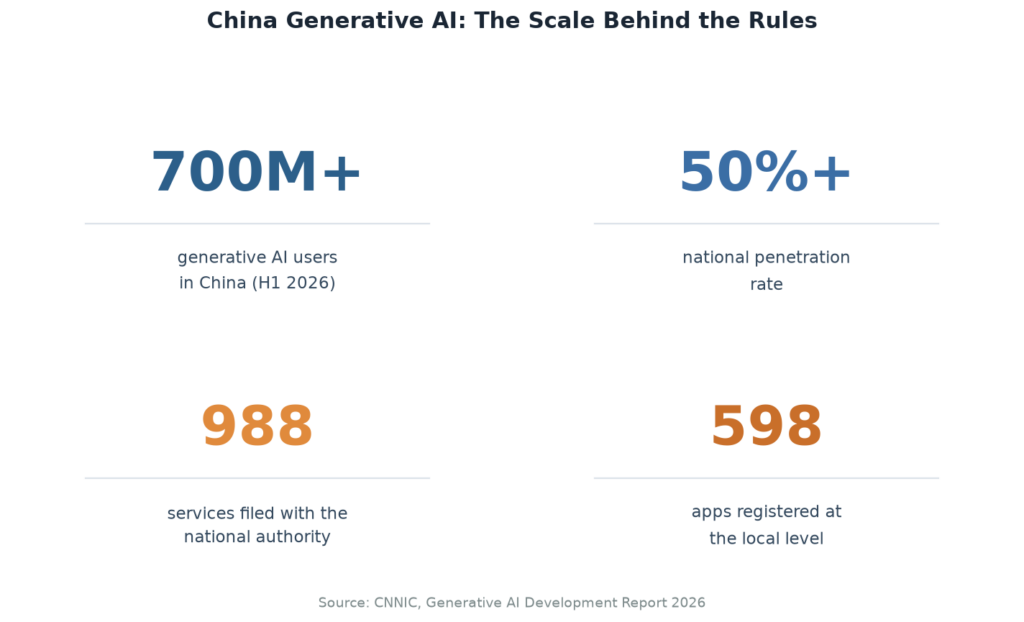
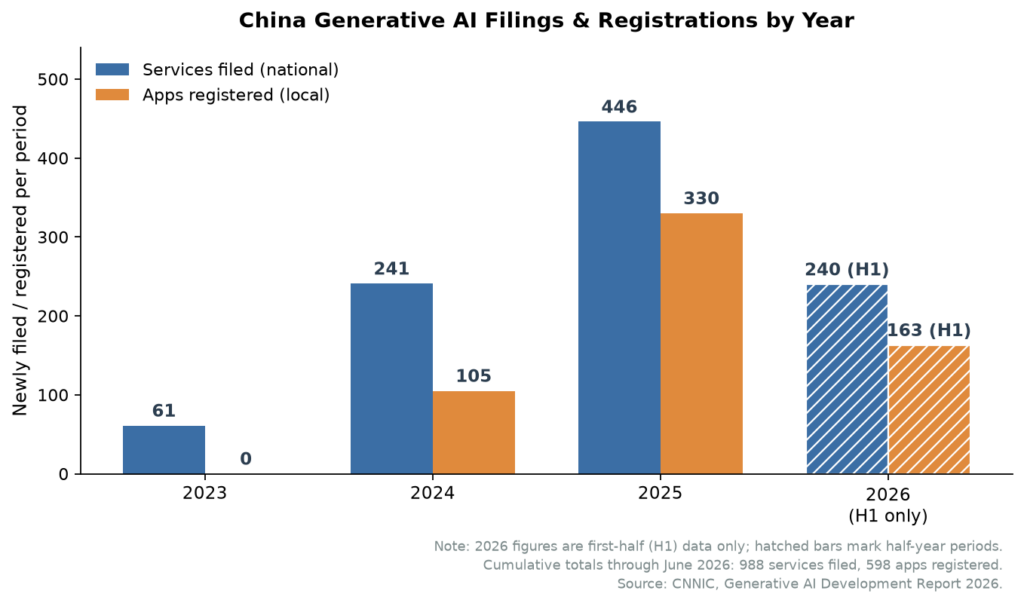
Look at what actually happened on the ground. As of June 2026, China had 988 generative AI services registered with the national cyberspace authority and another 598 applications or functions registered at the local level, according to CNNIC’s 2026 report on generative AI applications. That is not a market being strangled. That is a market being structured — and it is growing explosively. China’s generative AI user base passed 700 million people in the first half of 2026, with penetration above 50 percent.
You do not get to 700 million users by making everyone fill out forms before they can type a prompt. You get there because the rules made the ecosystem legible, and legible ecosystems scale. That is the insight hiding in plain sight.
What the Filing System Actually Does
Let us demystify the mechanism, because most commentary never bothers. China’s generative AI framework, anchored in the interim measures that took effect on August 15, 2023, separates providers into layers. Large foundation models register at the national level. Applications and features built on top of those models register locally.
The 2026 data shows how quickly this became the norm. Filings and registrations jumped 85.1 percent and 214.3 percent respectively in 2025 compared with 2024, before stabilizing in the first half of 2026. A system that nearly triples its registered applications in a year is not a barrier — it is a queue everyone wants to be in.
What registration actually requires is what matters, and the scope deserves precision. Providers must confirm content safety, file their algorithms, and run security assessments — with the latter two obligations applying specifically to services that carry public opinion influence or social mobilization capacity. Separately, generated images, video, and other synthetic media must be labeled as AI-produced under China’s deep synthesis rules. None of this is about blocking content. It is about making every piece of content attributable. Someone made it, someone can be held responsible for it, and you can tell the difference between human and machine output.
Traceability as a Feature, Not a Burden
Here is where the reframe lands. In most Western conversations, traceability is framed as a compliance cost — something you endure to stay out of trouble. China treats it as infrastructure. When every registered service carries a label and an accountable party, the entire ecosystem gains something it never had: a trust layer.
Think about what that does to the economics of attention. When a user asks an AI assistant a question, the answer has to come from somewhere. In a system where provenance is visible, the assistant has an incentive to draw on sources it can verify. A source that is traceable, dated, attributed, and accountable is a source the model can defend. A source that is anonymous, scraped, and unverifiable is a liability.
That is not speculation about the future. It is already how the incentive structure tilts. Verification becomes cheaper than deception, and everything downstream follows from that.
Why Trust Becomes the Ranking Signal
Every marketer alive understands that Google rewarded authority, links, and relevance for two decades. The new question is what generative engines will reward — and the answer is emerging with unusual clarity. They will reward what they can trust.
A generative engine does not want to cite a wrong answer. Every hallucinated statistic, every fabricated study, every anonymous claim that turns out to be false erodes user trust in the assistant itself. So the engines have a hard, selfish reason to prefer verifiable sources: their own retention depends on it.
This is why compliance and optimization converge. The content most likely to be cited is precisely the content that can survive scrutiny — attributed, dated, consistent with authoritative sources, and free of the kind of fakery that unravels on contact. China’s system institutionalizes that scrutiny. Global engines are converging on the same outcome through user behavior rather than regulation. Different route, same destination.
Lessons for Global GEO Practice
So what do you actually do with this? The first lesson is that GEO is not a new bag of tricks. It is the old discipline of authority-building, re-priced for a new distribution channel. If your strategy for getting cited by ChatGPT, Perplexity, Gemini, or Google’s AI Mode depends on gaming a ranking factor, you have already lost — because the factor itself is moving toward verifiability.
The second lesson is about scale. China reached 700 million generative AI users while running the most structured compliance regime on earth. That is the proof that trust infrastructure does not suppress adoption. It enables it. Marketers who internalize this stop treating disclosure as friction and start treating it as a distribution advantage.
Disclosure Is Not Optional Anymore
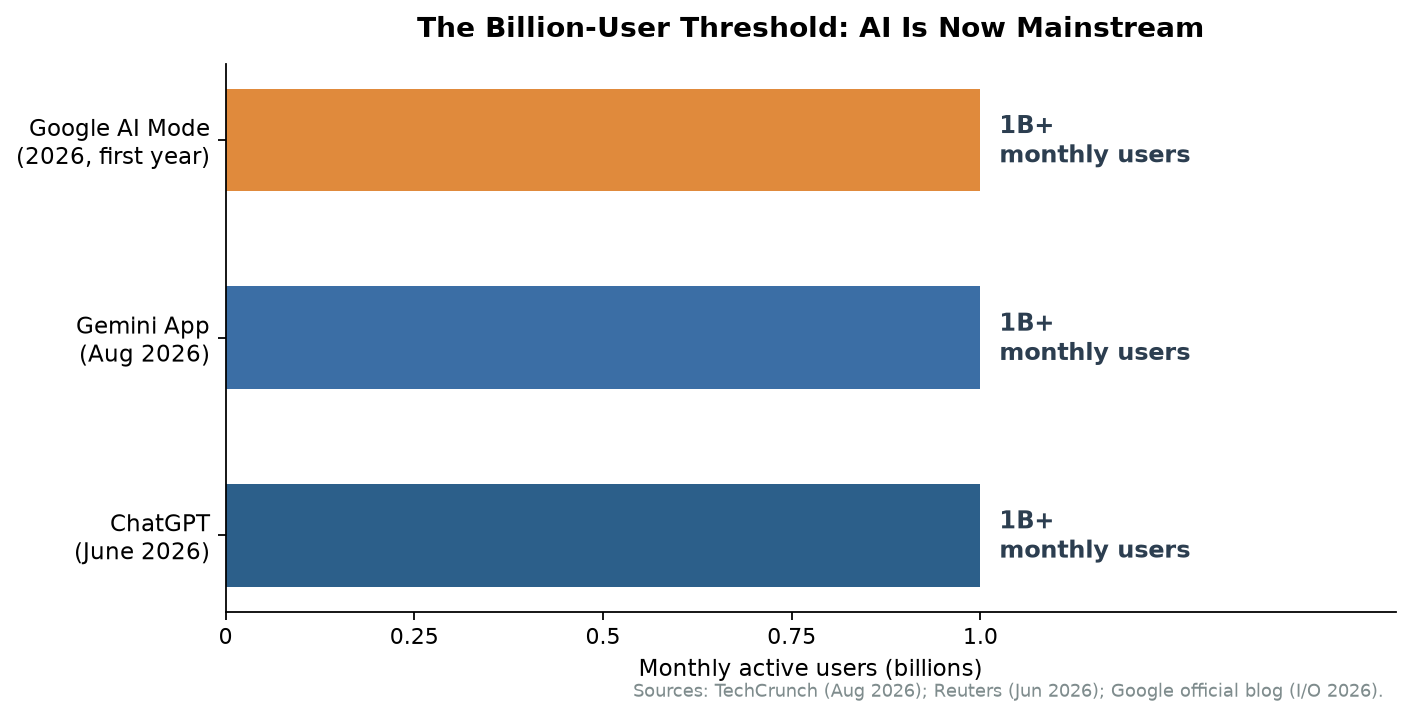
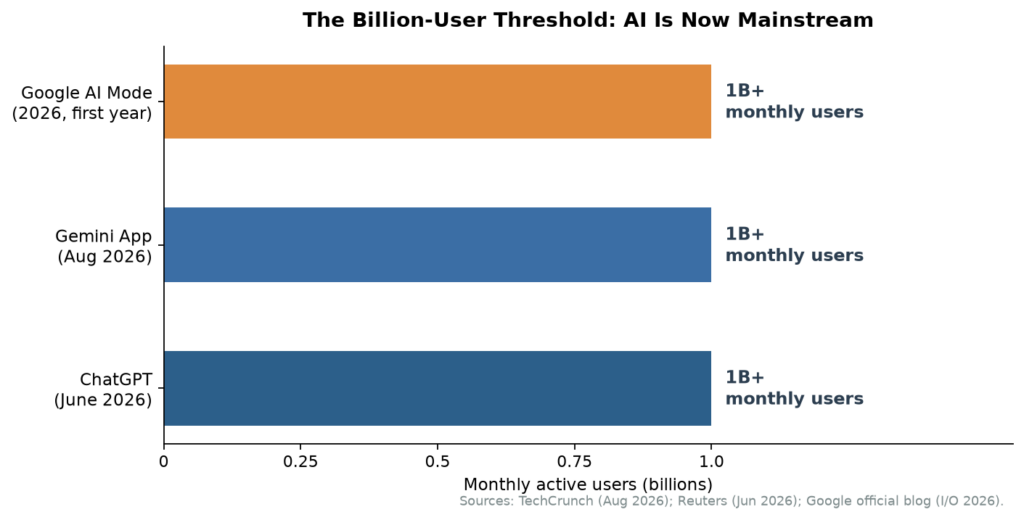
Let us be blunt about where this is heading. The global market has crossed a threshold. Google’s Gemini app passed one billion monthly users in 2026, and ChatGPT crossed the same mark earlier in the year. Google’s AI Mode in Search — its most direct answer to AI-powered discovery — surpassed a billion monthly users just one year after launch. AI is no longer a niche for early adopters. It is the default research layer for a mainstream audience, and it is arriving faster than most teams have adjusted.
When a billion people are asking questions through a generative interface, the label on your content stops being a compliance checkbox and becomes a competitive signal. Disclosing AI involvement, citing real sources, dating your material, and naming your authors is not bowing to regulators. It is signaling to every engine — and every reader — that your content is the one worth quoting.
The Risk of Black-Hat GEO
There is a reason every gold rush produces a market for fake maps. The rise of generative search has already spawned a shadow industry selling “guaranteed AI citations,” prompt-optimized spam, and content engineered to sound authoritative without being true. The playbook is predictable: flood the training and retrieval surface with low-quality but confident-sounding material, and hope the model cannot tell the difference.
The problem is that the model — or more accurately, the next model — can tell the difference. Generative engines are not static. They get retrained, their citation sources get audited, and their providers face the same pressure every platform does: if users catch you recommending garbage, they leave. Black-hat GEO has a half-life. It works until the first hallucination gets publicly attributed, and then the entire strategy collapses at once.
Compliance-first is not the boring option. It is the only option that compounds. Every piece of verifiable content you publish makes the next one slightly more likely to be cited, because the engine’s confidence in you is cumulative. Black-hat tactics reset that confidence to zero the moment they are detected.
Building a Compliance-First Content System
So what does the system look like in practice? It is a set of habits, not a one-time project. Every piece of content you publish should be able to answer five questions without hesitation: Who wrote it, when was it written, what sources does it rely on, is AI involvement disclosed, and can a reader verify the claims independently.
That sounds like a lot of overhead until you realize it is just editorial rigor, the same discipline good publishers always had. The difference is that now it has a direct payoff in AI citations, not just in human trust. The brands that already run a tight editorial process are discovering they have been doing GEO by accident for years. The brands that skipped it are discovering the gap is not easy to close retroactively.
What Western Teams Keep Missing
There is a specific blind spot worth naming. Western teams tend to treat AI regulation as a European or Chinese phenomenon — something that constrains those markets while leaving everyone else free. That framing misses the mechanism entirely.
The forces converging on verifiability are not primarily legal. They are behavioral. Users punish engines that hallucinate. Engines punish sources that mislead. Regulators codify what the market already demands. By the time a rule appears in the EU AI Act or a US state law, the underlying shift has already happened — the regulation is just the lagging indicator. Waiting for a law to tell you to build trust is like waiting for a doctor to tell you to stop eating badly. The market already told you.
A Global Marketer’s Compliance Map
How does this translate across regions? The map is more consistent than the headlines suggest. China leads with the most explicit regime: mandatory filing, algorithm registration, and AI content labeling, now covering close to a thousand services and hundreds of applications. The filings cluster where the industry does — Beijing, Shanghai, and Guangdong account for roughly 25.7 percent, 17.1 percent, and 16.6 percent of filed services respectively, with Zhejiang and Jiangsu adding another 9.7 percent and 9.3 percent. Europe is building its own layered framework around transparency obligations and risk classification. The United States remains the most fragmented, with sector-specific and state-level rules rather than a single national standard.
For a marketer running global campaigns, the practical takeaway is that you cannot optimize for one region’s rules and ignore the rest. But you do not need to. The underlying requirements converge on the same handful of practices: attribute, date, cite, disclose, verify. Build once, comply everywhere. The team that treats these as a shared baseline — rather than a patchwork of local annoyances — is the team that scales.
The Long Game: Moat, Not Hack
Here is the thesis in one line, because it deserves to be stated plainly: compliance is not a cost of doing AI marketing. It is the moat.
Every moat works the same way. It does not stop a determined competitor from trying. It makes the attempt expensive, slow, and easy to see coming. A brand with a deep archive of attributed, verifiable, consistently cited content is expensive to copy — you cannot fake ten years of trust overnight. A brand chasing the latest prompt hack is cheap to copy, because anyone can buy the same tool.
China’s regulators understood something marketers keep forgetting: a system where everyone is accountable is a system where reputation compounds. In the AI answer economy, reputation is the ranking signal. That is why the teams treating compliance as strategy, not overhead, are quietly pulling ahead — and why the teams treating it as a nuisance will spend the next few years wondering what happened.
What to Do This Quarter
Enough theory. Here is the ninety-day plan. First, audit your existing content against the five questions above and mark everything that fails. You will find more than you expect. Second, fix the highest-value pages first — the ones most likely to be cited, which usually means your data-heavy, definitional, and comparison content. Third, publish a sourcing and disclosure standard for everything going forward, and make it non-negotiable. Fourth, start producing the kind of content engines can verify: original research, dated statistics, named authors, and claims that link back to authoritative sources.
None of this requires a new tool or a bigger budget. It requires a decision — that you would rather own a moat than rent a hack. China’s market already made that decision for itself. The global market is making it now. The only question left is which side of the moat you plan to stand on.