The Answer Era Is Rewriting the Rules of Search
When users get answers instead of links, does ranking still matter? The honest answer is yes — but the job description has fundamentally changed.
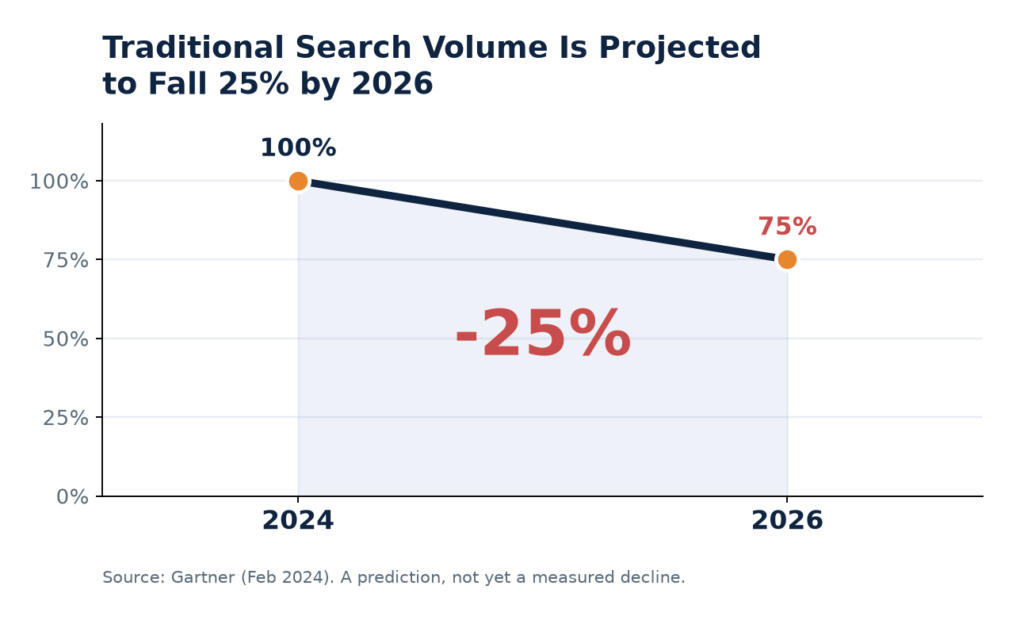
The number that keeps marketing directors up at night comes from Gartner. In February 2024, the research firm predicted that traditional search engine volume would drop 25% by 2026, with search marketing ceding share to AI chatbots and other virtual agents. To be precise, that is a forecast, not yet a measured decline — but it is the forecast an entire industry is now building around. If a quarter of the queries that once flowed through Google, Baidu, and Bing dissolve into an answer box, what is left of a discipline we spent two decades perfecting?
The answer is not “nothing.” It is “something different.” SEO is not dying; it is being renegotiated. What is changing is not whether being findable matters, but the mechanism through which findability converts into visibility.
The Query-to-Answer Shift
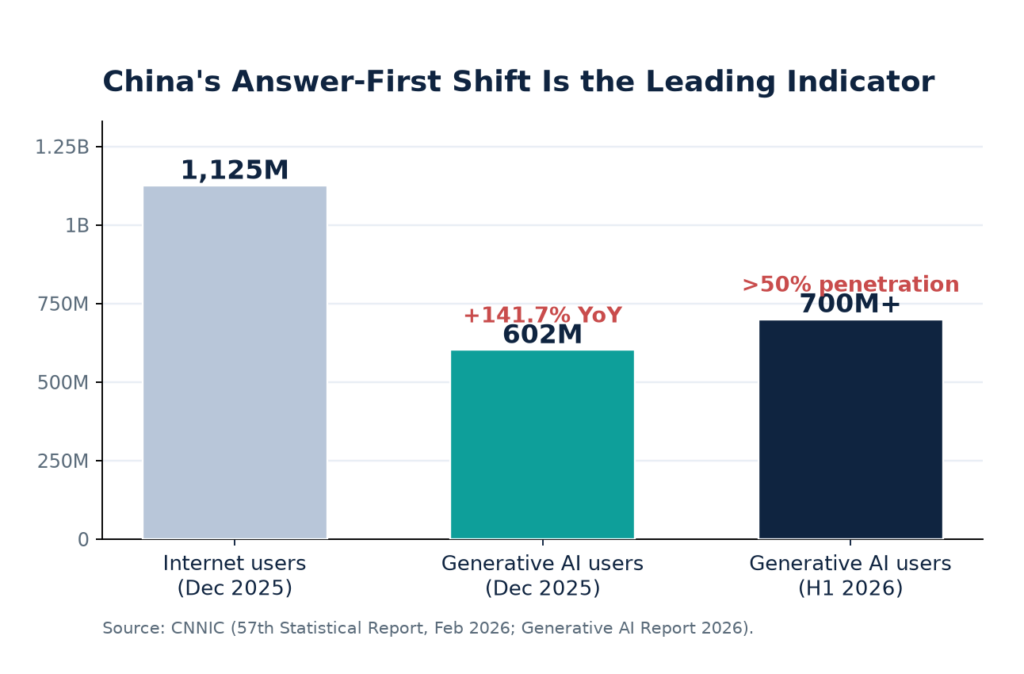
For a leading indicator of where the rest of the world is heading, look at China. CNNIC, the country’s official internet statistics body, counted 1.125 billion internet users as of December 2025 — the largest single online population on the planet. What is more striking is how quickly that base has turned to machines for answers rather than lists of links.
Generative AI users in China reached 602 million by the end of 2025, a jump of 141.7% in a single year, with penetration climbing to 42.8%. By the first half of 2026, that figure crossed 700 million — more than half of all Chinese internet users — according to CNNIC’s generative AI development report. Roughly three in four of those users turn to generative AI to answer questions.
China matters as a signal because it compresses what Western markets are experiencing in slow motion. In the West, the query-to-answer shift arrived as AI Overviews draped over the top of Google results, and as standalone chatbots carved out daily habits of their own. In China, it has been more radical: a generation of AI search products built natively around synthesized answers — not ranked blue links — accumulated hundreds of millions of users in months rather than years.
The directional signal is unambiguous. When a majority of internet users in the world’s largest online market receive answers instead of rankings, the economics of attention shift with them.
What Still Works: Crawlability Is the Price of Admission
Here is the uncomfortable truth that keeps SEO from being dead: AI systems do not generate answers from a vacuum. They generate them from a corpus of text and data that, in most cases, was crawled from the open web.
Which means the old, unglamorous fundamentals of SEO matter more than ever, not less.
- Technical accessibility. If a bot cannot crawl, render, and index your content, you are invisible to every answer engine that matters.
- Clear structure. Headings, semantic markup, and explicit passages are what allow a model to extract your content cleanly.
- Authority signals. Models weight sources that are repeatedly cited, linked, and referenced across the web.
- Freshness and precision. Answer engines increasingly favor recent, specific, well-attributed claims over stale or vague prose.
In short, the plumbing of SEO — crawlability, indexability, site architecture, structured data — remains a non-negotiable prerequisite. What has changed is the destination. You are no longer optimizing to appear at position three in a list. You are optimizing to be the source an answer engine quotes when it speaks.
Where Ranking Stops: The Answer Layer
And that is precisely where classic SEO hits its ceiling.
Ranking — the discipline of climbing a list of ten links — assumes a list of ten links exists. The moment a query produces a single synthesized answer, the list collapses to one position: cited, or not cited. There is no second place in a paragraph.
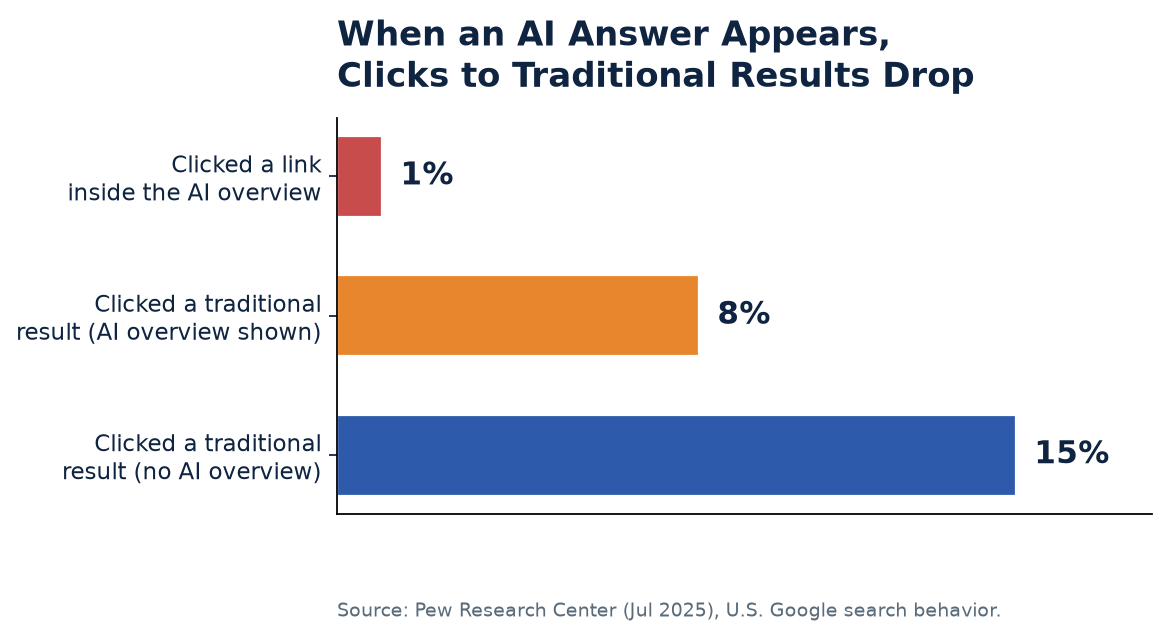
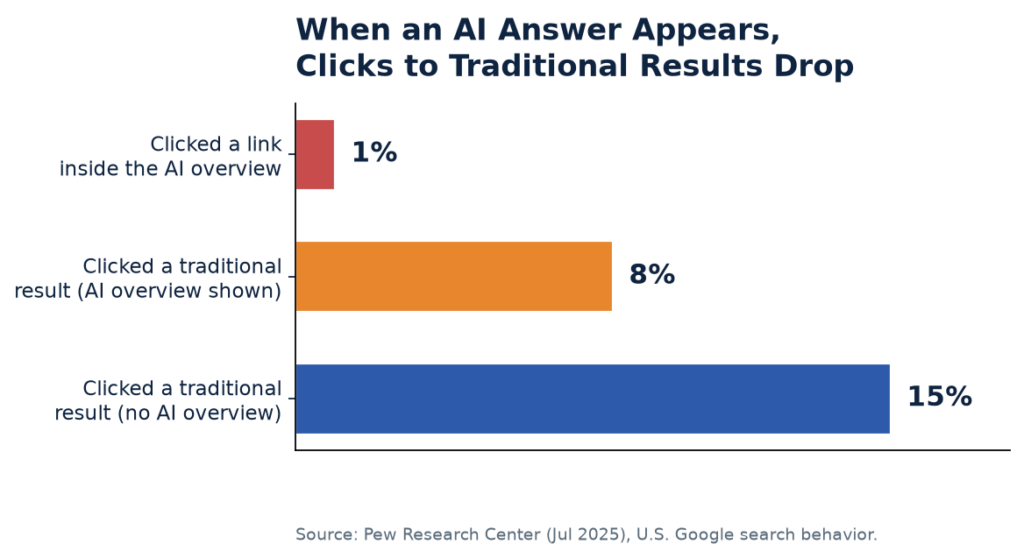
The scale of this shift is now measurable. Research from the Pew Research Center found that when Google displays an AI Overview, users click through to a traditional result just 8% of the time — compared with 15% when no AI Overview is present. Meanwhile, only 1% of users click a link inside the AI Overview itself. And the answer layer is everywhere now: by mid-2026, AI Overviews were appearing in roughly 39% of U.S. desktop searches, according to Comscore data.
Think of the system as two layers.
- The answer layer, where a model generates a response and cites a handful of sources. This is where user attention actually lands.
- The index layer, where the same model draws its raw material from crawled, indexed content. This is where most SEO effort has historically been spent.
SEO is highly effective at the index layer. It is largely invisible at the answer layer — because at that layer, the model, not the marketer, decides what gets said.
What Replaces Rank: Citation Share
If ranking is no longer the metric that matters, what is?
The answer emerging from both academic research and early practice is citation share — the frequency and prominence with which a brand’s content appears as a named source inside AI-generated answers.
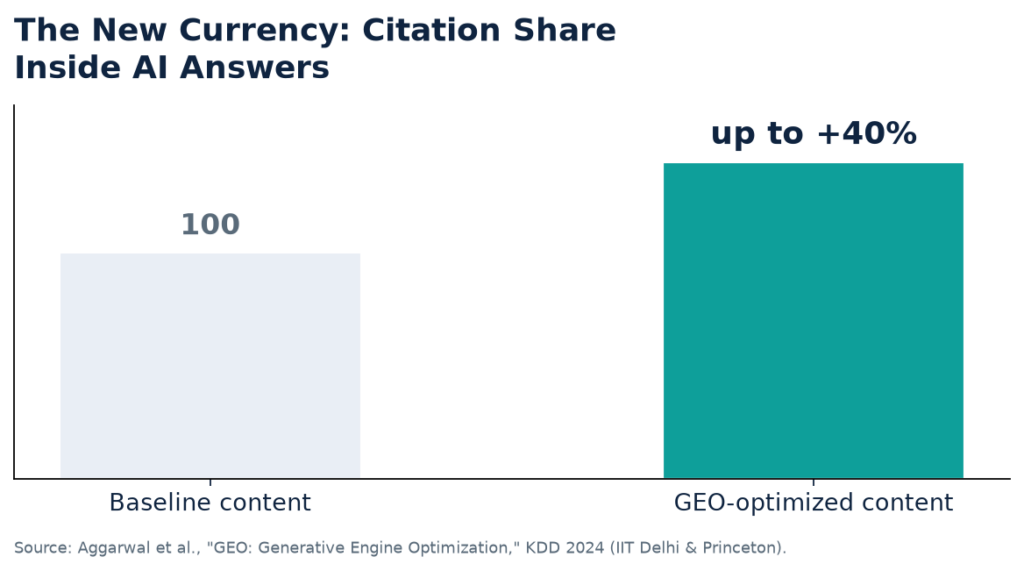
This is not a vague aspiration. It is measurable. The landmark paper that launched the field of Generative Engine Optimization — now widely called GEO — came from researchers at IIT Delhi and Princeton University, and was published at the ACM SIGKDD conference (KDD 2024). Their core finding: targeted optimization techniques can lift a piece of content’s visibility inside generative engine responses by up to 40%.
To be fair, that is an experimental result, not a universal guarantee — every brand, engine, and query behaves differently. But the direction is what matters. A meaningful improvement in how often you get cited inside an AI answer is, functionally, the new page one. It is not about ranking. It is about being quoted.
Citation share reframes the entire discipline:
- Ranking asked, “Am I near the top of the list?”
- Citation share asks, “When the answer is generated, is my content among the sources the model trusts and names?”
The skills that produce the first do not automatically produce the second.
The New Optimization Playbook
So what actually moves citation share? The early evidence points to a set of practices that feel different from classic SEO — and, in some respects, more demanding.
Be quotable, not just readable. Models extract and reuse content that is stated crisply. A clean, self-contained sentence that states a fact, a statistic, or a recommendation is far more likely to be lifted into an answer than a rambling exploration. Write the quote you want the AI to use.
Signal authority explicitly. Classic SEO chased links as a proxy for trust. GEO rewards explicit authority signals — named authors with credentials, cited sources, statistical precision, and verifiable claims. A model prefers to quote content that already looks like it knows what it is talking about.
Optimize for entities, not just keywords. Answer engines reason about topics, brands, people, and concepts, not merely string matches. Being unambiguously associated with the entity a user is asking about — in consistent, structured, machine-readable ways — matters more than keyword density ever did.
Add structure that machines can parse. Headings, lists, tables, question-and-answer formats, and schema markup all make it dramatically easier for a model to locate and extract the specific passage it wants to cite.
Keep content fresh and factual. Stale, vague, or contradictory content gets filtered out. Answer engines increasingly favor recent, specific, well-sourced statements — which rewards the brands that actually update their material.
So, Is SEO Dead?
No. SEO is not dead. It has been promoted.
The parts of SEO that were always about plumbing — crawlability, structure, authority, accessibility — have become table stakes for a much bigger game. The parts that were about winning a position in a list are being replaced by a new objective: winning a spot inside the answer.
The practitioners who thrive over the next few years will not be the ones asking, “How do I rank higher?” They will be the ones asking, “How do I get quoted?” — and then doing the precise, structural, unglamorous work that makes quoting them easy.
Rank still matters. It just is not the point anymore.