AI Agents Won’t Replace Marketers — They’ll Sort the Work
AI Agents in Marketing: From Writing Copy to Running Campaigns
From Tool to Teammate
Think back to how you described AI to your team eighteen months ago. It was a drafting assistant, a faster way to get first drafts of emails, ads, and blog posts. You prompted it, it wrote, you edited. The machine waited for you.
That arrangement is already outdated. Today a growing share of marketing software does not just produce copy on command. It opens the message, reads it, decides what the next step is, and takes that step on its own. It moves work forward without being asked twice.
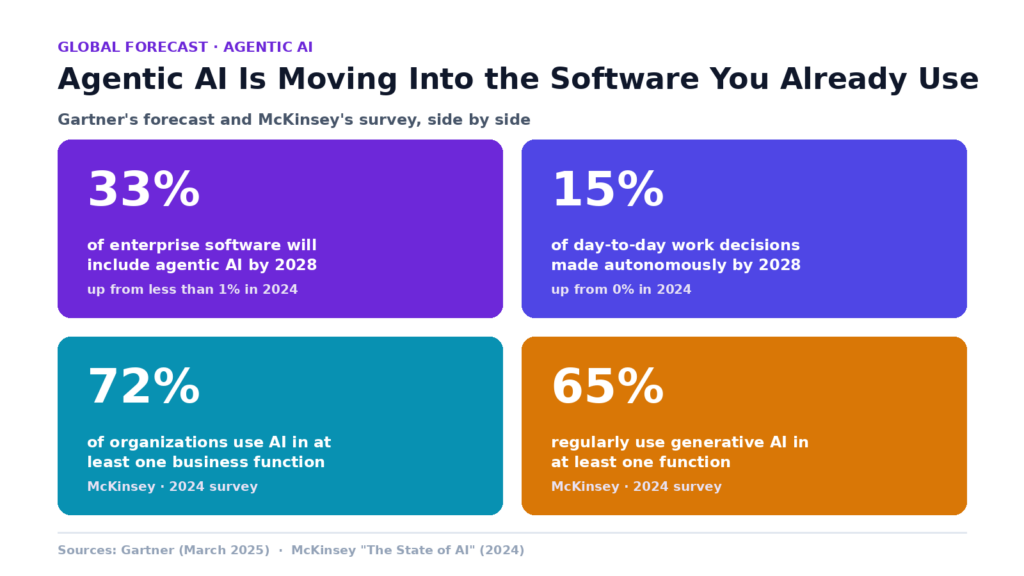
The shift is visible in the numbers. Gartner forecasts that by 2028, a third of enterprise software applications will include agentic AI, up from less than one percent in 2024, and that fifteen percent of day-to-day work decisions will be made autonomously. That is not a far-off forecast. It is a description of what marketing teams are assembling right now.
This article is about where that shift is real, where it breaks, and how to decide what to hand over. It draws on research from both the global market and China, where agent adoption is moving unusually fast.
What “Agent” Means in Marketing
Most people misuse the word. A chatbot that answers a customer question is not an agent. An automation that sends a cart-abandonment email is not an agent. An agent, in the practical sense that matters here, is software that can pursue a goal across several steps, make small decisions along the way, and only escalate to a human when it hits something it was not designed to handle.
Three properties separate an agent from the tools you already use. First, it plans. It can break a vague instruction into ordered actions. Second, it acts. It can call other tools, send messages, update records, and trigger workflows. Third, it recovers. When a step fails, it tries a different route instead of stopping.
Notice what is not on that list. An agent does not set strategy. It does not know your brand voice at the level of taste. It does not carry accountability for a bad campaign. Those limits matter, because they tell you exactly where the boundary between delegation and abdication sits.
McKinsey’s 2024 global survey found that about seventy-two percent of organizations use AI in at least one business function, and roughly two-thirds use generative AI regularly. The question is no longer whether marketing adopts this. The question is which parts of the workflow you are willing to let a machine run end to end.
The Closed-Loop Scenarios That Work
Here is the single most useful idea in this whole topic: agents succeed in closed loops. A closed loop is a task with a clear trigger, a defined set of steps, and an unambiguous endpoint. When all three exist, an agent can own the loop. When any one is missing, it stumbles.
Think of it as the difference between giving someone a map and giving them a destination with no roads. Agents are excellent with maps. They follow the route, handle the detours, and arrive at the checkpoint. They are poor at inventing a destination that was never specified.
That is why the breakthrough uses are not glamorous. They are things like reading an inbound inquiry, looking up the customer, drafting a response that fits policy, and sending it for approval. Or monitoring a campaign budget, spotting an overspend, pausing an ad set, and logging the action. Each is a loop. Each has a finish line. Each is now within reach of an agent.
The marketing leaders getting the most value are not the ones who announced a fully autonomous growth engine. They are the ones who identified three or four tight loops and let agents own them quietly.
Office Agents: Communication to Execution
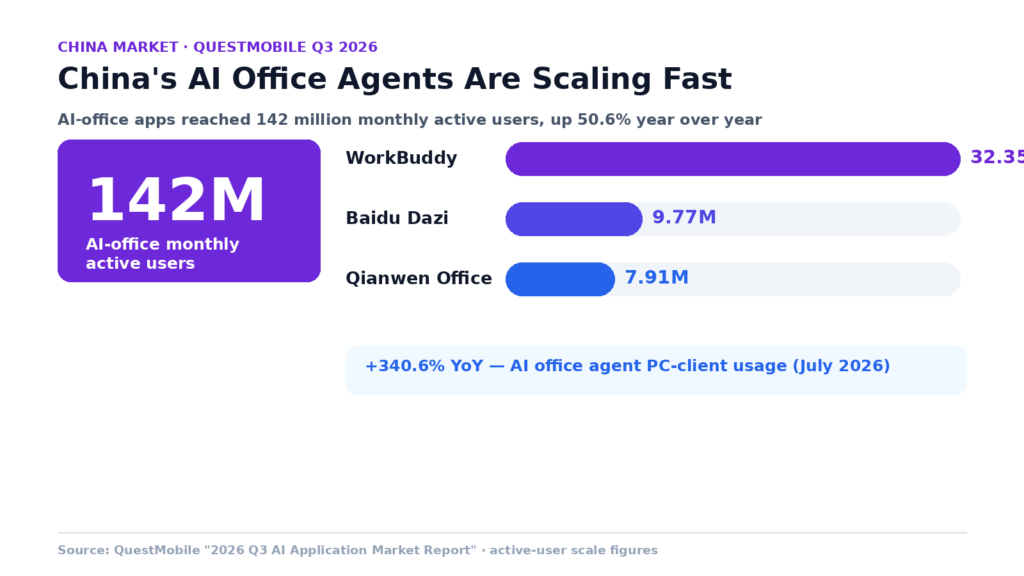
The clearest proof that agents have moved from writing to doing comes from workplace software. In China, this shift is measurable. QuestMobile’s third-quarter 2026 report put AI-office apps at 142 million monthly active users as of September, up 50.6 percent from a year earlier. Among individual products, WorkBuddy reported an active-user scale of 32.35 million, ahead of Baidu Dazi at 9.77 million and Qianwen Office at 7.91 million. Separate QuestMobile data showed PC-client usage of AI office agents growing 340.6 percent year over year in July 2026.
What is happening under those numbers is more interesting than the numbers themselves. Office agents now bridge the gap between conversation and execution. An assistant like WorkBuddy sits inside a messaging environment, turns a chat instruction into a task, and completes the task across connected tools. The same pattern appears in DingTalk and Feishu, where an agent can book a meeting, draft the agenda, pull the relevant documents, and follow up on action items without a human re-entering the information in five different places.
For marketers, this is quietly consequential. The connective tissue of marketing has always been operations, the thousand small handoffs between brief, approval, production, and reporting. Agents are beginning to carry those handoffs. That is not the end of the marketer’s job. It is the removal of the part of the job that was never really the job.
Commerce Agents: Pre-Sale to Fulfillment
The other loop that works especially well is the front door of e-commerce. Pre-sale questions are repetitive, urgent, and time-sensitive. A customer wants to know about sizing, shipping, or a return policy, and they want the answer now, often at an hour when no human is online.
Agents are built for this. They answer the question, pull up the product details, compare options, apply the store’s policies, and either close the sale or hand off to a person when the conversation goes somewhere unusual. This is a closed loop with a clear endpoint, and it has been one of the first places where commerce agents earn their keep.
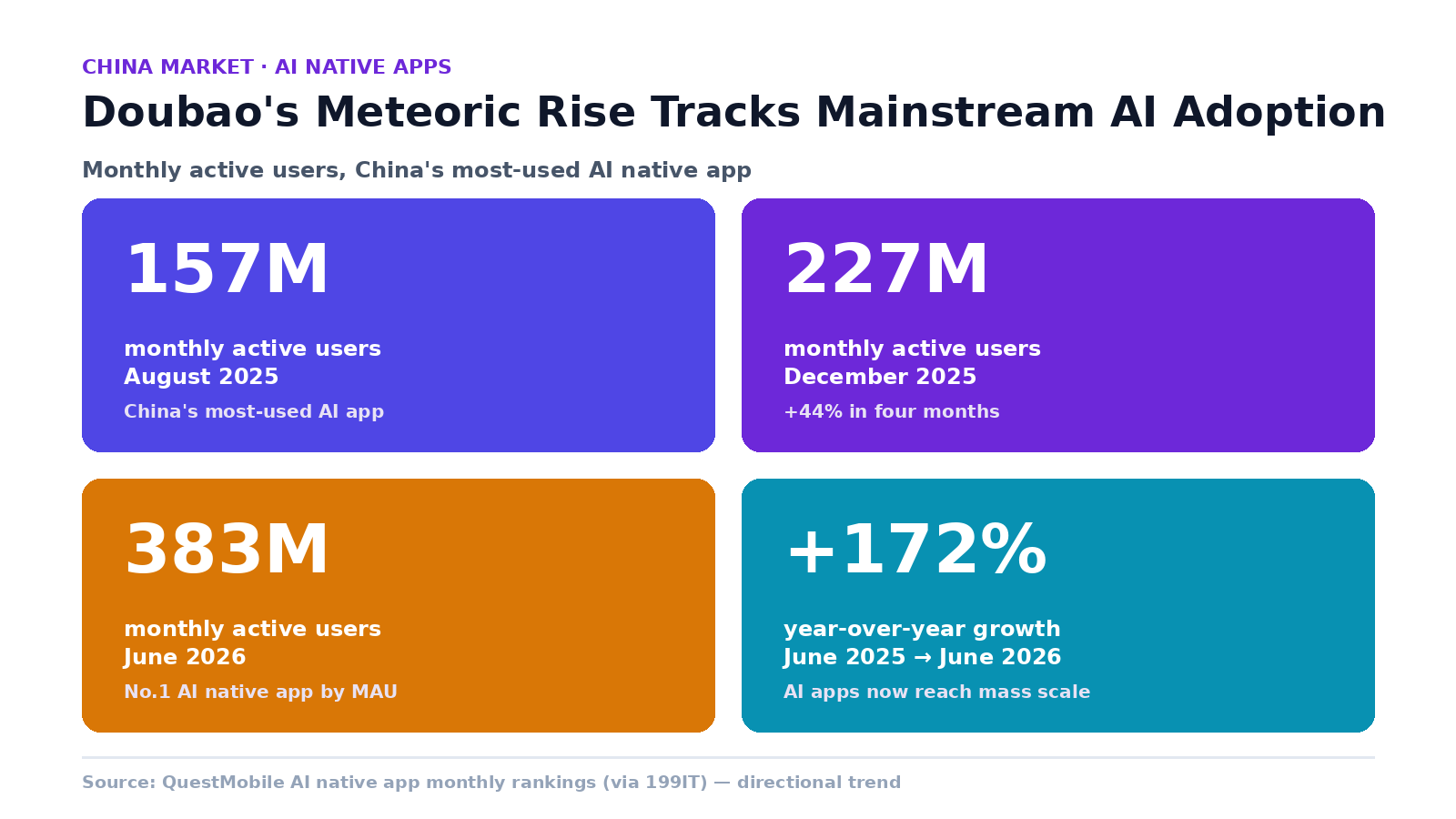
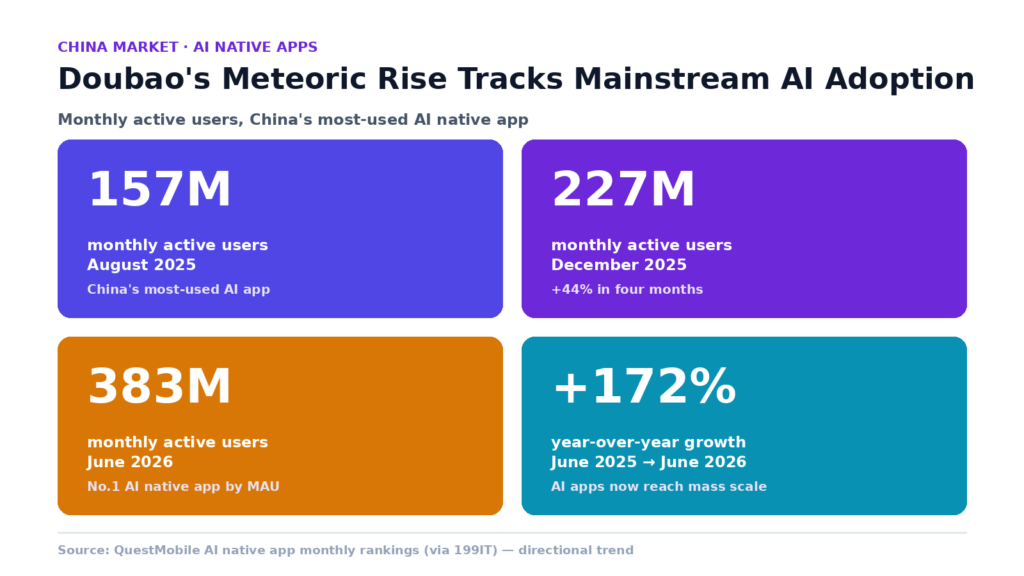
China’s AI shopping assistants have pushed this further. Doubao, the country’s most-used AI native app, climbed from roughly 157 million monthly active users in August 2025 to 227 million by December, then to 383 million by June 2026, a rise of more than 170 percent year over year, according to QuestMobile’s monthly rankings aggregated by 199IT. A meaningful share of that traffic is now shopping and purchase-related queries, which means millions of people are already being guided through buying decisions by an agent rather than a person.
The lesson for marketers everywhere is that the pre-sale loop is not theoretical. It is live, at scale, and customers have already gotten used to it.
Where Autonomy Still Breaks
So where do agents fail? Predictably, in the open loops.
Strategy is an open loop. There is no finish line called “the right positioning.” Brand voice is an open loop. It is governed by taste and judgment, not by steps. Crisis response is an open loop. It demands accountability and a human who will answer for what was said.
Agents also break when the data is bad. An agent that cannot tell the difference between a reliable source and a rumor will confidently produce a confident mistake. An agent that cannot access the systems where decisions actually live will take actions that look right and are wrong. Autonomy without clean, connected data is just a faster way to make errors at scale.
And they break when the cost of a wrong answer is high. An agent can be wrong on a sizing question and the damage is a returned order. An agent that is wrong on a legal claim or a price promise creates liability that no one wants to own by proxy.
The pattern to remember: the tighter the loop and the lower the cost of error, the safer the delegation. The more open the loop and the higher the stakes, the more human judgment stays in charge.
Human-in-the-Loop Is Not Optional
Some teams hear “agent” and imagine a dashboard where they watch software run the department. That is the wrong frame, and it is also a compliance and quality problem waiting to happen.
The practical architecture is human-in-the-loop, not human-on-the-sidelines. An agent drafts, a person approves. An agent flags, a person decides. An agent executes the routine, a person handles the exceptions. This is not a compromise between old and new. It is the only way autonomous systems ship responsibly in a field where the output is public-facing and the mistakes are visible.
Gartner’s 2026 outlook for China makes the same point in its own vocabulary. One of its ten trends is the rise of a scalable agentic workforce, and it frames the work not as replacing people but as converting raw model intelligence into agents that a person directs and supervises. The emphasis is on capability that is designed, measured, and managed, not unleashed.
Treat the human check as a feature, not a bottleneck. It is what lets you sleep after an agent sends a hundred emails.
A Maturity Model for Teams
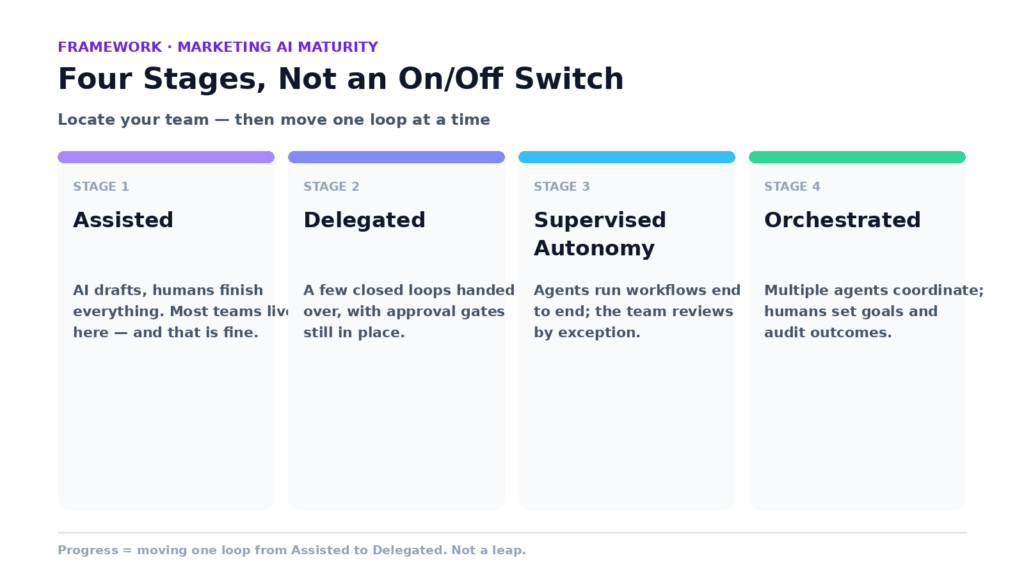
If you want a way to locate your team, think in four stages rather than a single on-off switch.
The first stage is assisted. AI drafts, humans finish everything. This is where most marketing teams still live, and it is a perfectly reasonable place to be.
The second stage is delegated. You have identified a few closed loops and handed them over, with approval gates still in place. The agent does the repetitive middle, you keep the edges.
The third stage is supervised autonomy. Agents run whole workflows end to end, and your team reviews by exception. You spend time on the things that did not fit the pattern, because those are where the insight is.
The fourth stage is orchestrated. Multiple agents coordinate, and your job shifts to defining goals, setting guardrails, and auditing outcomes. Few teams are here, and almost none need to be.
The value of the model is not the labels. It is the reminder that you do not have to leap. Moving one loop from assisted to delegated is progress. Moving nothing but pretending otherwise is just theater.
Piloting Your First Agent
Start with the smallest loop you can name. The best first candidates share three traits: they happen often, they have clear steps, and their failure is cheap.
A good pilot is something like responding to a common inbound request, or routing leads, or drafting and scheduling a recurring report. A bad pilot is anything touching strategy, brand voice, or crisis.
Define the finish line before you build anything. If you cannot say what “done” looks like, the task is not yet agent-shaped. Then write down the approval point. Who looks at the output before it leaves the building, and what are they checking for?
Run the agent alongside your current process for a few weeks, not instead of it. Compare outcomes, not vibes. Measure time saved, error rate, and the quality of what a human had to fix. If the human fixes too much, the loop is not ready. If the human fixes almost nothing, widen the loop slightly and watch again.
The discipline here is boring on purpose. Boring is how you earn the right to delegate more.
Risk and Control Levers
Autonomy needs rails, and the rails are not complicated. They are just specific.
Scope is the first lever. Give the agent a narrow mandate and a hard boundary. It can answer questions about orders but not about refunds. It can draft but not publish. Boundaries are what make autonomy safe, not what make it weak.
Permissions are the second. An agent should only touch the systems it needs, and it should do so with the least privilege that lets the task run. Do not give a copywriting agent the keys to your billing system.
Audit is the third. Every agent action should leave a trace you can read later. If you cannot reconstruct what the agent did and why, you cannot trust it at scale, and neither can your compliance team.
Human escalation is the fourth. Define in advance what “not my job” means for the agent and where it routes. The best systems fail loudly toward a person, not silently into a queue.
None of this is exotic. It is the same discipline you already apply to any vendor, tool, or junior hire. Apply it to the agent and most of the fear around autonomy evaporates.
The Delegation Rule of Thumb
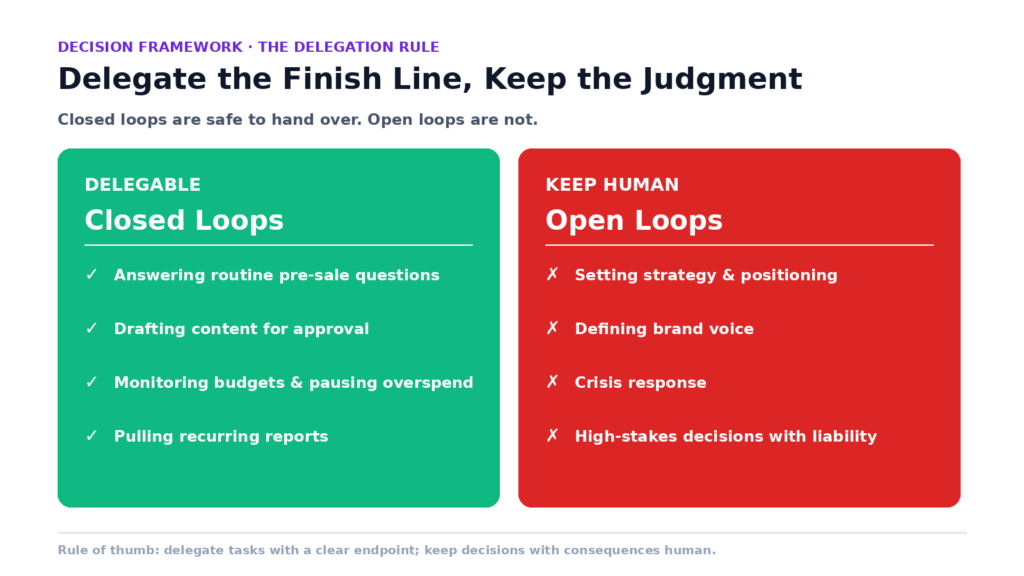
If you remember one sentence from this article, make it this: delegate tasks that have a clear finish line, and keep everything else human.
A task with an endpoint is delegable. A decision with consequences is not. Copy that fits a brief is delegable. Copy that defines a brand is not. Answering a customer question is delegable. Deciding who you are as a company is not.
This rule does not change as the technology improves. What changes is the size of the thing that counts as “a clear finish line.” A year from now, tasks that feel too open today will have closed enough to delegate. That is the real trend to watch, and it is a good one.
What 2027 Might Look Like
The honest forecast is less dramatic than the headlines and more significant than the skepticism.
By 2027, the marketing team that has adopted agents will look structurally different from the one that has not, not because people are gone, but because the work has been sorted. The repetitive middle of marketing, the handoffs, the follow-ups, the first drafts, the routine responses, will largely run themselves. The human work will concentrate at the two ends: the strategic front, where goals and voice are set, and the judgment back, where exceptions and high-stakes calls are handled.
The competitive gap will not come from having more AI. Everyone will have it. It will come from having cleaner data, tighter loops, and clearer lines between what the machine runs and what the human owns. The teams that figure out that division first will move faster than the teams that are still debating whether to let an agent send a single email.
That is the real story of agents in marketing. Not a takeover. A sorting.
Summary
Marketing agents have crossed from drafting copy to running closed loops. The measurable evidence is here, in both global forecasts and China’s rapidly scaling adoption. But the useful progress is not full automation. It is the disciplined delegation of tasks with clear endpoints, while strategy, taste, and accountability stay human.
The teams that win will be the ones that treat agents like a capable colleague with a narrow mandate, clean data, and a human on the loop. The teams that lose will be the ones that either refuse to delegate anything or hand over everything and call it innovation. Most of the value sits in the boring, careful middle.