From SEO to GEO: A Marketer’s Guide to China’s Six AI Search Tastes
The State of AI Search: Six Platforms, Six Different Tastes
Ask the same question to six Chinese AI assistants and you get six different answers. Not just different phrasings. Different emphases, different sources, different ideas about what you were actually trying to accomplish. One answer trims everything down to three clean steps. Another walks you through a chain of reasoning. A third pulls a half-forgotten passage out of a forty-page document you shared last month.
Your content, right now, is being read by all of them. And each one is tasting it differently.
If you market to a Chinese audience, or if your brand is referenced by the AI tools that Chinese users increasingly rely on, you can no longer optimize for a single search experience. You have to understand the palate of each platform. This is the new SEO literacy, and most teams have not learned it yet.
One Question, Six Answers
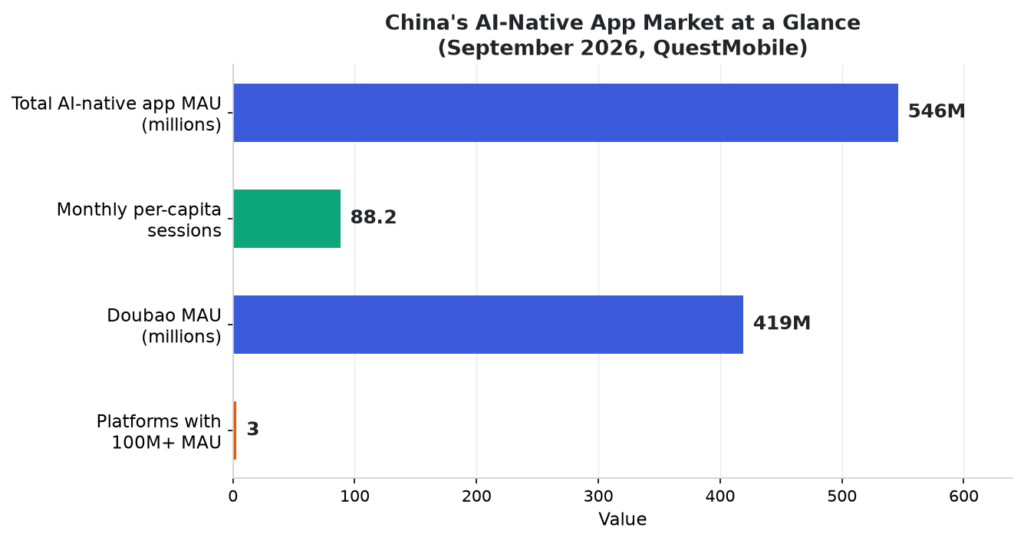
Before we go further, let us be precise about the stakes. QuestMobile, the most widely cited third-party research firm for China’s mobile internet, released its Q3 2026 AI application report in late October. The numbers are startling.
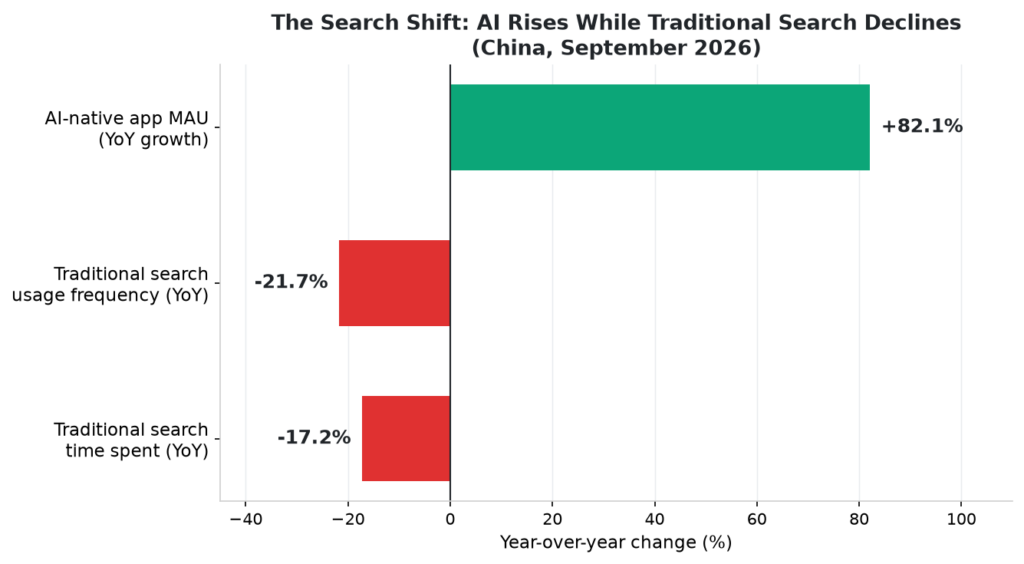
China’s AI-native apps reached a combined 546 million monthly active users in September 2026, up 82.1 percent year over year. Monthly per-capita usage hit 88.2 sessions, up 59.3 percent. Meanwhile, traditional search apps saw per-capita usage frequency fall 21.7 percent and time spent fall 17.2 percent versus August of the previous year. The shift is not theoretical. People are moving their questions, and their decisions, into conversational AI.
Here is where the taste metaphor earns its keep. That 546 million is not one audience. It fragments across platforms that are built on fundamentally different philosophies.
Why Platform Taste Matters for GEO
Generative engine optimization, or GEO, is the practice of shaping content so that AI assistants cite it, summarize it, or recommend your brand inside their answers. The mistake marketers make is treating GEO like SEO with a new name: write good content, sprinkle in entities and statistics, and wait for every AI to find you.
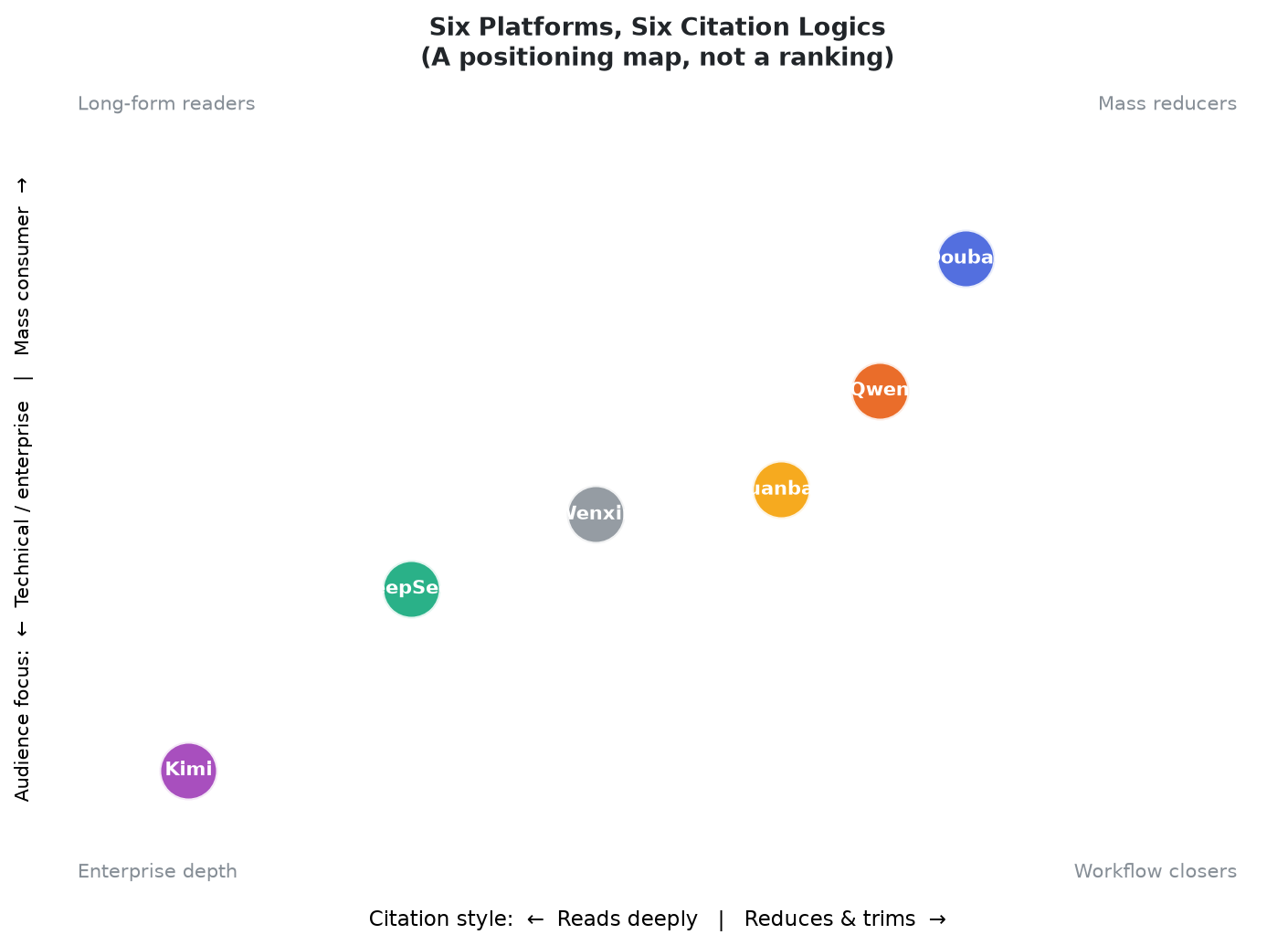
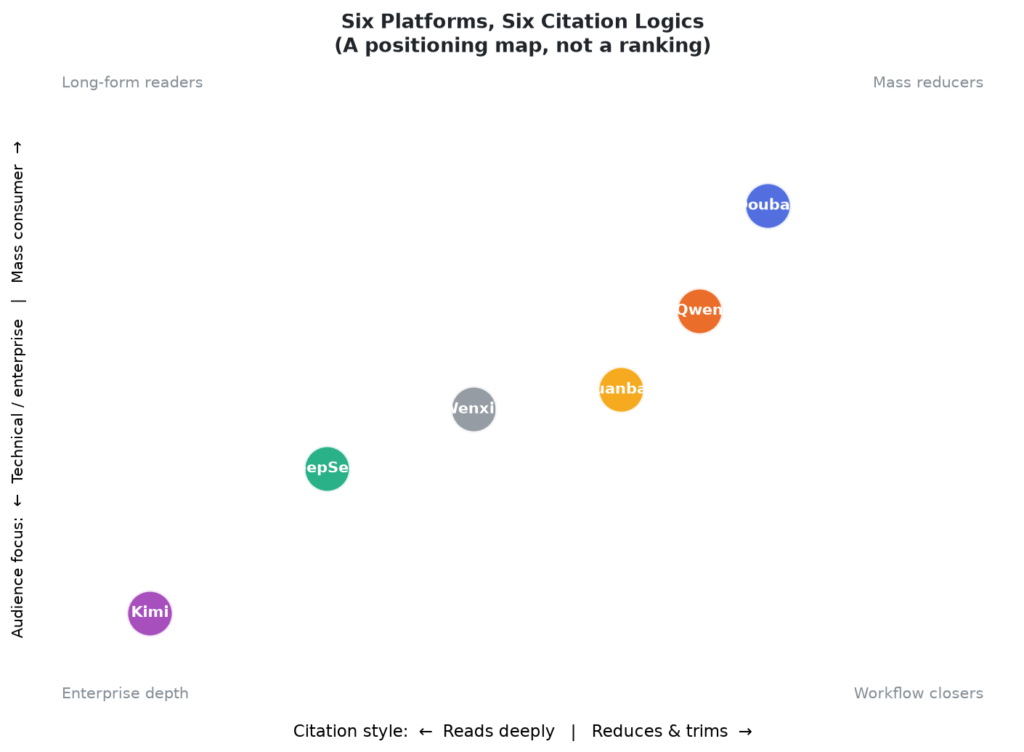
The problem is that each AI has its own citation logic. Doubao trims. DeepSeek reasons. Qwen closes a workflow. Kimi reads deeply. Yuanbao rides the social graph. Wenxin balances against its search legacy. The same content lands differently in each.
If you write one piece of content and hope all six will love it, you are cooking one dish for six very different guests. Some will find it too rich, others too bland. Understanding the palate is the whole game.
Doubao: The Ecosystem-Native Reducer
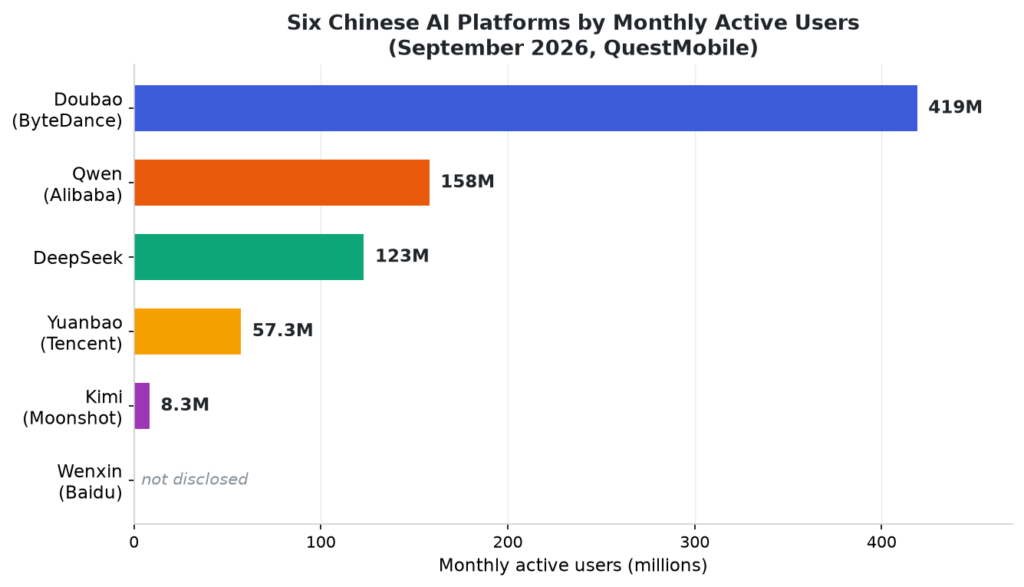
Doubao, from ByteDance, is the giant. In September 2026 it reached 419 million monthly active users, up 143.6 percent year over year, with 181 million daily active users. Its monthly per-capita usage sits at 72.0 sessions and 132.5 minutes. To put that in perspective, Doubao alone is roughly three-quarters of the entire Chinese AI-native app market by scale, though overlapping users across apps mean these figures should not be naively summed into market share.
Doubao is not trying to be the smartest assistant in the room. It is trying to be the most useful, which for ByteDance means the most frictionless. The platform’s signature move is reduction: stripping an answer down to its actionable core, collapsing a complex question into steps you can execute immediately.
For content creators, the implication is uncomfortable. Doubao rewards content that is already pre-digested. Clear hierarchies, short paragraphs, direct answers up front, and zero decorative fluff. If your content forces Doubao to do heavy extraction work, it will either paraphrase you beyond recognition or skip you for a source that did the work already.
ByteDance’s ecosystem shapes this too. Doubao pulls heavily from its own properties and from content that is structured for rapid consumption. The taste here is home-cooked and efficient. Give it something it can serve immediately, and it will bring you to the table.
DeepSeek: The Open Reasoner
DeepSeek is the outlier that refuses to play the scale game. Its monthly active users sat around 123 million in September 2026, but its influence vastly exceeds that number because it is the platform developers, researchers, and technical users turn to when they want to see the reasoning, not just the answer.
DeepSeek’s brand is built on open-source strength and visible chain-of-thought reasoning. When it cites something, it tends to favor content with internal logic it can follow: claims that are supported by evidence, comparisons that are fair, arguments that hold up under scrutiny. It is less impressed by polish and more impressed by structure.
The taste here is strong black coffee. No sugar, no cream. For a marketer, that means your content needs to survive being read slowly and skeptically. Vague value propositions and unsupported superlatives do not travel well into DeepSeek’s answers. Precise claims with clear backing do.
One nuance matters: DeepSeek’s consumer app growth has softened as ByteDance and Alibaba poured billions into distribution, and its next-generation models have been slow to ship. But its citation behavior, and its grip on the technical and developer audience, remains disproportionately important for anything that touches engineering, data, or product decisions.
Qwen: The Office-Closure Builder
Qwen, from Alibaba, is the fastest mover in the field. Its monthly active users reached 158 million in September 2026, up an astonishing 5,076.6 percent year over year. In the first quarter of 2026 it added roughly 126 million users in a single quarter, jumping from sixth place to second.
Qwen’s growth was not bought with cash giveaways alone. It was built on a transaction loop. Alibaba wired Qwen into Taobao, Alipay, and Fliggy, then ran campaigns that taught users to complete real tasks, ordering a milk tea through a conversation, booking a flight, managing a document, rather than just chatting. The result is a platform whose answers are biased toward closure: turning a question into a finished, purchasable, schedulable outcome.
For content, this means Qwen favors material that plugs into workflows. Comparisons that help a purchase decision, how-to content that ends in a concrete action, structured data that can be dropped into a document or a spreadsheet. The office closure is literal. Alibaba positions Qwen inside DingTalk as the workplace layer, so much of what Qwen cites is expected to be useful inside a business context.
The taste here is a banquet. Courses are served in order, each one leading to the next, and the meal ends with a decision. If your content is a beautiful but abstract essay, Qwen may taste it and ask, what do I do with this.
Yuanbao: The Super-App Native
Yuanbao, from Tencent, is the quiet contender. Its first-quarter 2026 monthly active users reached 57.3 million, placing it fourth, though it slipped out of the top three for the first time after holding that position for four straight quarters. Its precise September figure is not separately disclosed in the public QuestMobile report, which is itself a signal worth reading: the top three are the ones being measured loudly, and the rest are fighting for position.
What makes Yuanbao distinct is its home turf. Tencent owns WeChat and QQ, the two apps that define Chinese social life. Yuanbao’s answers are shaped by that social graph, favoring content that is shareable, conversational, and useful in the flow of messaging. It leans toward recommendations that feel like a friend’s suggestion rather than a database query.
For a marketer, Yuanbao rewards content that is quotable in one or two sentences, structured so a snippet can survive being forwarded in a chat. The taste here is afternoon tea. Light, social, easy to pass along. If your content is dense and scholarly, Yuanbao will struggle to break it into something people actually forward.
Kimi: The Deep-Context Reader
Kimi, from Moonshot AI, is the most fascinating case because it proves that user scale and citation influence are not the same thing. Its monthly active users fell to around 8.3 million in the first quarter of 2026, down four consecutive quarters from a peak of over 21 million. By raw audience size, it has fallen out of the top ten entirely.
And yet Kimi may be the most important platform for a certain kind of content creator. Moonshot made a deliberate strategic turn away from consumer app scale and toward deep enterprise and agent work. Its Kimi K3 model carries 2.8 trillion parameters and a one-million-token context window, the largest open-source model in the world at its release, and the company is pushing toward a two-billion-dollar annualized revenue target while preparing a Hong Kong listing.
Kimi reads. That is its identity. It ingests entire documents, entire codebases, entire research libraries, and answers from within that deep context. For content creators, this is gold. Long-form, authoritative, well-structured content that other platforms trim into oblivion is exactly the material Kimi is built to consume and cite.
The taste here is a slow-simmered stew. It needs time and depth, but the flavor it extracts is unmatched. If you write a genuinely deep piece, an industry explainer, a technical deep-dive, a well-researched trend analysis, Kimi is where that investment pays off, because it is the one platform whose whole value proposition is reading the long version.
Wenxin: The Search-Legacy Balancer
Wenxin, from Baidu, is the most understated of the six, and in some ways the most strategic. Baidu spent two decades as China’s dominant search engine, and that legacy shapes everything Wenxin does. Its precise standalone monthly active users are not separately disclosed in the public QuestMobile AI report, which reflects Baidu’s decision to integrate Wenxin into search, the browser, maps, and its broader content network rather than fight for a standalone app’s ranking.
What Wenxin offers is balance. It spreads its attention across text, images, and search results, and it is more likely than the others to blend AI-generated answers with traditional search citations. For content, this means classic SEO fundamentals still matter inside Wenxin in a way they do not elsewhere. Keywords, crawlability, structured data, and domain authority all retain real weight.
The taste here is a buffet. Everything is represented, nothing dominates. If your content is strong on traditional search fundamentals, Wenxin will keep finding it long after the newer AI-native platforms have moved on to fresher formats. It is the bridge between the search world you know and the AI world you are entering.
How Citation Logic Differs
Let us make this concrete, because the differences are what drive optimization decisions.
Doubao and Qwen are reducers and closers. They want content that is already condensed and action-ready. They will cite the source that requires the least transformation, and they will likely paraphrase it into something shorter. If you want to be cited, hand them a version of your argument that is already cut to the bone.
DeepSeek is a reasoner. It wants evidence it can trace, and it will cite content that survives logical inspection. It is the platform most likely to quote you accurately, and the one most likely to reject you if your claims do not hold up.
Kimi is a reader. It wants depth and will reward the long version. It is the platform most likely to pull your specific passage out of a long document and use it correctly, because its context window lets it see the whole thing.
Yuanbao is a sharer. It wants snippets that travel. It will cite content that is quotable in a chat thread, favoring punch over precision.
Wenxin is a balancer. It wants traditional search signals plus AI readiness. It will blend your content with its search results, and it will favor sources that already rank.
Six logics. One piece of content cannot serve all of them equally, but it can be built so that each logic finds what it needs.
What This Means for Content Structure
The practical upshot is that content structure stops being a cosmetic choice and becomes a distribution decision.
If you lead with a direct answer, follow with evidence, and close with an action, Doubao and Qwen can use you immediately. If you lay out your reasoning step by step with linked support, DeepSeek can trust you. If you offer a genuinely deep, well-organized long read, Kimi can mine you. If you write quotable one-liners, Yuanbao can pass you around. If you keep your on-page SEO fundamentals intact, Wenxin will keep surfacing you.
The trick is not to write six articles. It is to write one article with six layers: a crisp summary at the top, a reasoned middle, quotable takeaways, deep supporting detail, and clean technical markup underneath. Then each platform simply eats the layer it prefers.
A Per-Platform Optimization Map
Here is how the map looks, platform by platform.
For Doubao, lead with the answer in the first sentence, use short paragraphs and clear headings, and strip every decorative sentence. Write as if the reader has five seconds.
For DeepSeek, make every claim traceable. Use precise numbers, name your sources, and do not oversell. Write as if a skeptical engineer is reading.
For Qwen, end every piece with a decision or an action. Connect your content to a transaction, a workflow, or a template. Write as if the goal is to get something done today.
For Kimi, invest in the long version. Do not cut the deep section. Structure it so a model with a million-token window can find the specific passage it needs. Write as if someone will cite your exact paragraph.
For Yuanbao, craft quotable sentences. One or two punchy lines that survive being forwarded in a group chat. Write as if your content is a message, not a document.
For Wenxin, keep your fundamentals. Keywords, metadata, schema, internal links, and domain authority still count. Write as if classic SEO never died, because inside Wenxin it did not.
Cross-Platform Consistency Rules
Even as you optimize per platform, a few rules hold across all six.
Be factually solid everywhere. A platform that trims will cut you to a claim that must stand on its own. A platform that reasons will expose a weak claim. A platform that reads deeply will find your contradictions. There is no platform that rewards sloppiness.
Name your entities clearly. Every platform needs to know who you are and what you are talking about. Full names, explicit subjects, and unambiguous terminology help every citation logic do its job.
Structure for extraction. Headings, lists, tables, and clean separation between summary and detail serve every platform, even if each one extracts differently.
Keep claims self-contained. Because AI answers strip context, every key sentence should make sense on its own. If your claim depends on the paragraph above it, it will be mangled in citation.
Where Western Platforms Fit In
The Western picture is the same principle in a different key, and you should treat it qualitatively rather than chasing numbers that shift by the week across unreliable aggregators.
ChatGPT remains the global reference point, with a16z’s sixth consumer AI report putting its weekly active users near 900 million as of early 2026, roughly 2.7 times Gemini’s web traffic. It is a generalist with strong reasoning and a huge reach. Gemini is the Google-ecosystem answer, deeply tied to search and increasingly the default in Google’s own surfaces. Claude is the thoughtful reasoner that skews toward technical and long-form work, the closest Western analogue to Kimi’s depth-first identity. Perplexity is the citation-first researcher, the one most explicitly built around source attribution.
The lesson that transfers cleanly from China to the West is this: do not optimize for a single AI. Optimize for a set of citation logics, reducers, reasoners, readers, sharers, and balancers, that happen to reappear in every market. The platform names change. The tastes do not.
The Literacy Marketers Need Now
What marketers actually need now is not another tool or a new acronym. It is a shift in mental model.
The old model asked one question: how do I rank. The new model asks a more demanding question: how do I get cited, by whom, and in what form. That question has no single answer, because it depends entirely on the palate of the platform doing the citing.
The teams that will win are the ones that stop treating AI assistants as a monolithic black box and start treating them as six different readers, each with its own taste. Write once, but layer your content for six different appetites. That is the literacy that separates the teams that show up in AI answers from the teams that keep wondering why they do not.
Summary
China’s AI search market is not one experience but six distinct tastes. Doubao, at 419 million monthly users, is the ecosystem-native reducer that rewards pre-digested, action-ready content. DeepSeek, the open reasoner, rewards traceable, evidence-backed argument. Qwen, the office-closure builder, rewards content that ends in a decision or a transaction. Yuanbao, the super-app native, rewards quotable snippets that travel through social chat. Kimi, the deep-context reader, rewards the long, authoritative version that other platforms trim away. Wenxin, the search-legacy balancer, rewards classic SEO fundamentals that still carry weight inside Baidu’s ecosystem.
The total market is 546 million monthly users growing 82 percent a year, while traditional search usage declines. That is the scale of the shift, and the reason the new literacy matters. You optimize not for one AI but for six citation logics, reducers, reasoners, readers, sharers, and balancers, that reappear in every market including the West. Write once, layer your content for six appetites, and let each platform taste the layer it was built to enjoy.
FAQ
Which Chinese AI search platform should I optimize for first?
Start with the platform where your audience already lives, not the one with the most users. B2C brands with broad consumer reach should prioritize Doubao and Qwen. Technical, developer, or data-focused brands should prioritize DeepSeek. Brands investing in genuinely deep, authoritative content should prioritize Kimi. Most teams should run a baseline across all six rather than picking one.
Why do the platforms give different answers to the same question?
Because each is built on a different core philosophy. Doubao trims for efficiency, DeepSeek reasons for correctness, Qwen closes a workflow, Yuanbao rides the social graph, Kimi reads deeply, and Wenxin balances against its search legacy. The same input is processed through six different citation logics, which is why the same question produces six different emphases.
Is Kimi better for long-form content even though its user base is small?
Yes, and this is the single most counterintuitive insight in Chinese GEO. Kimi has fallen out of the top ten by monthly users, but its entire product identity is deep reading with a million-token context window. It is the platform most likely to correctly cite a specific passage from a long document. For long-form, research-heavy, or technical content, Kimi offers the highest citation leverage per word despite its smaller audience.
How does DeepSeek’s citation behavior differ from Doubao’s?
Doubao compresses and paraphrases, favoring content it can serve immediately with minimal transformation. DeepSeek preserves more of the reasoning and favors content with traceable evidence it can follow. Doubao rewards pre-digested structure; DeepSeek rewards logical integrity. Content that wins with one often fails with the other, which is why layering matters.
Should I treat these platforms as separate SEO targets or as one combined channel?
Treat them as one combined channel with six distinct citation logics. You should not build six separate content programs, but you should build every piece of content with six layers: a crisp summary for the reducers, a reasoned middle for the reasoner, quotable takeaways for the sharer, deep detail for the reader, action-oriented closes for the closer, and clean technical fundamentals for the balancer. One asset, six layers, six appetites.