From 245.9% to 18%: How Live Commerce Became China’s Retail Infrastructure
China Live Commerce in 2026: Market Size, Growth Rate, and Why AI Hosts Now Run the Night Shift
Data Story · Data vintage: Q3 2026 (China) / 2025–2026 (global benchmarks) · Channel: China Data Story, weekly
In short
Live commerce is still China’s fastest large retail channel, but its growth has settled near 18 percent a year after peaking at triple digits in 2020. Its advantage is structural: attention, demonstration, price and payment share one screen. The discount engine is being rebuilt, the shelf has returned as the settlement layer, and AI hosts now carry the long-tail hours at roughly 500 to 1,300 yuan a month. Humans keep the peak, the trust-sensitive categories and the judgment calls.
The number that opens this story
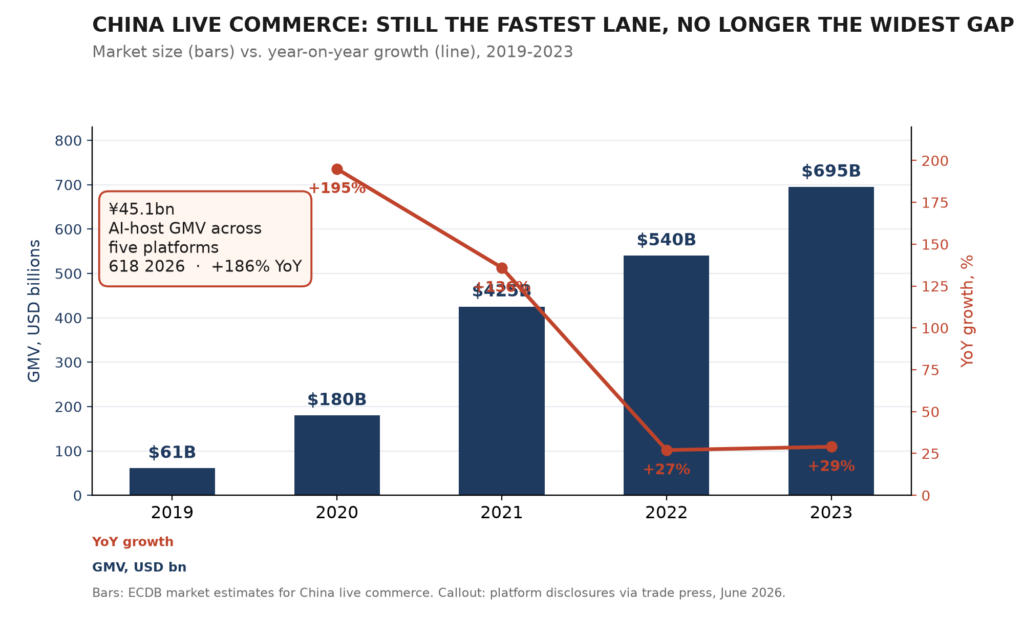
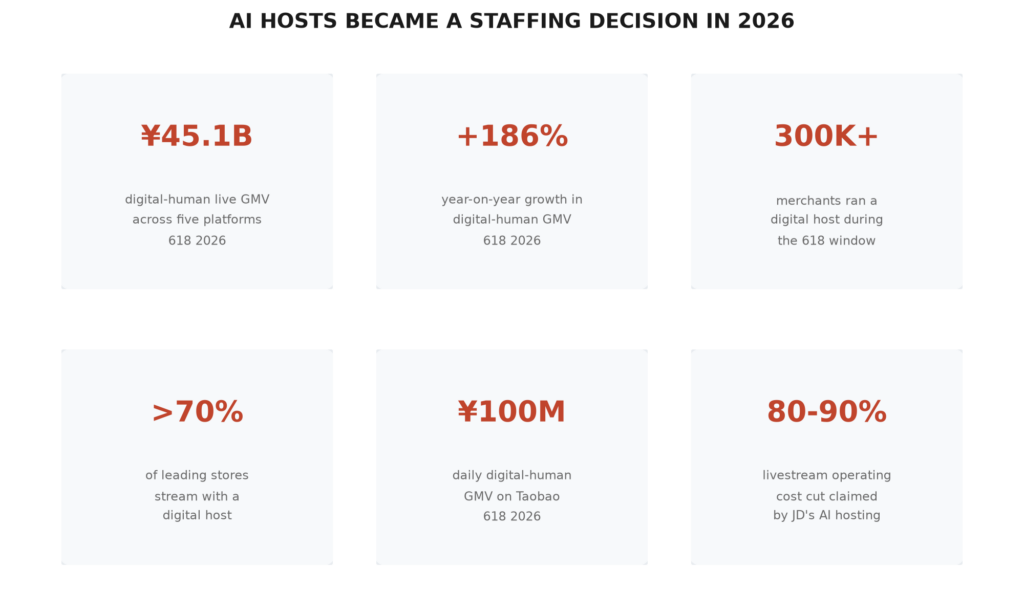
45.1 billion yuan. That is what digital-human hosts sold across five major Chinese platforms during the 618 shopping window in June 2026, up 186 percent year on year. More than 300,000 merchants ran a synthetic presenter at some point in those weeks, and among leading stores, more than 70 percent put one on camera.
Now set it beside the growth rate of live commerce as a whole. iResearch expects the channel to expand at roughly 18 percent a year across 2024 to 2026. The 245.9 percent figure still quoted in decks belongs to 2020, the lockdown year. Different market, different story.
So the interesting question is no longer whether livestreaming dominates Chinese retail. It does, and it will keep doing so. The question is who holds the camera, and who absorbs the returns.
What the old outline got right, and what it got wrong
The original line read: “Live streaming remains China’s highest-velocity conversion channel.”
Half of that survives contact with the data. Livestreaming compresses the distance between seeing a product and paying for it. It does so because the stream, the coupon, the checkout and the wallet all sit on one screen. No new tab, no new session, no price comparison in a second window.
The other half needs surgery. Velocity is not the same as value. Citi’s 29 October 2026 note on the Double 11 season points out that platforms have moved away from bundle arithmetic toward direct price cuts, partly to curb fake order inflation and partly to bring return rates down. When the largest promotional event of the year needs a discount-structure rewrite to protect margin, “highest-velocity” describes the mechanism, not the outcome.
The second line from the outline, “the fusion of entertainment, discount and instant purchase drives it,” is broadly correct and incomplete. The force that actually keeps the channel standing is inventory depth plus settlement speed. Entertainment gets attention. A warehouse in the right city and a coupon that clears in two seconds gets the order.
The chart we can build, and the one we cannot
The outline asked for live commerce GMV share against other channels, with a growth trend. No institution publishes that share on a consistent, deduplicated basis. Platforms report paid GMV with their own definitions. Research houses estimate the category with their own scope. Subtract one from the other and you get a number that looks authoritative and means nothing.
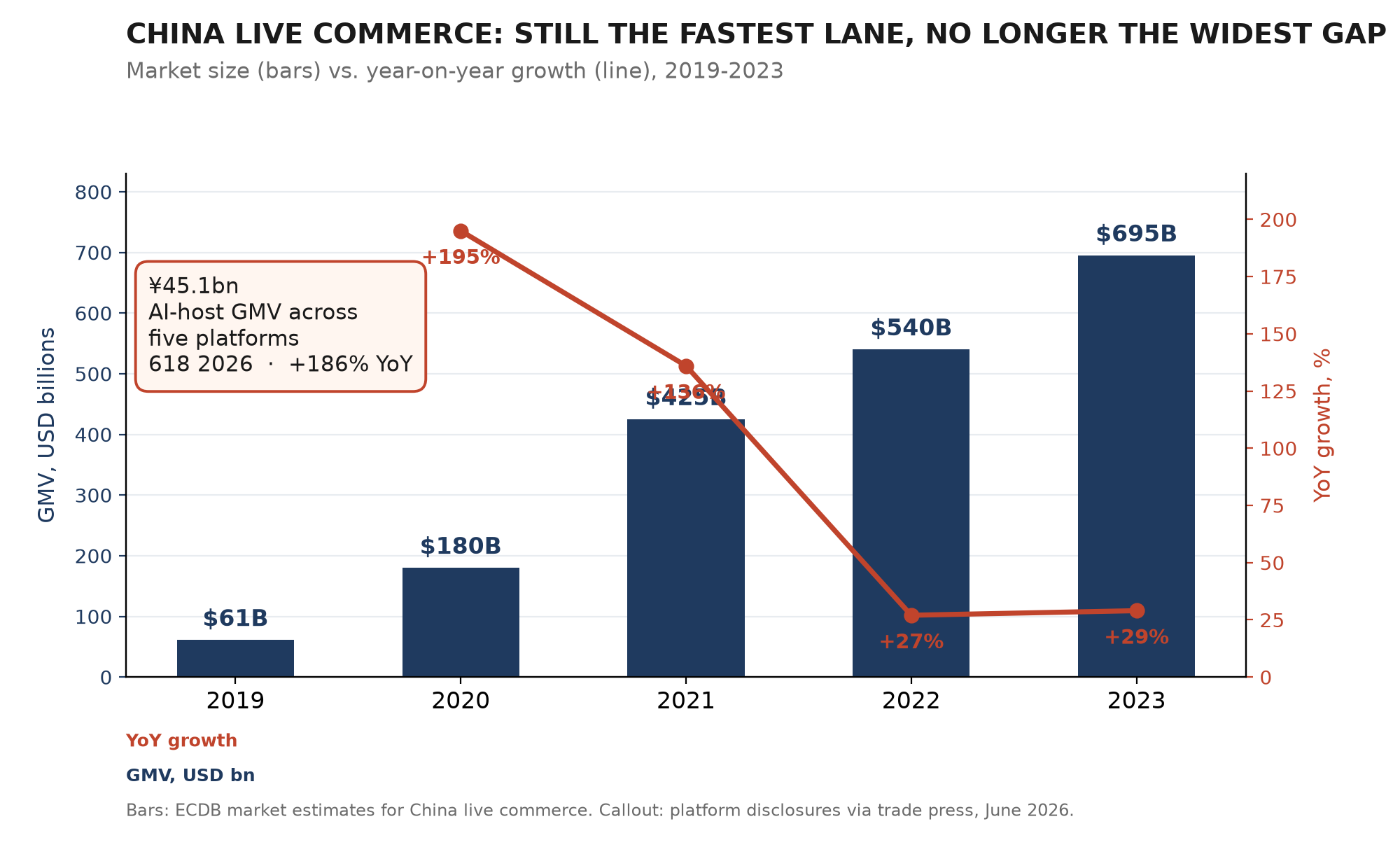
What is published, and what holds up, is the market series. ECDB tracks China’s live commerce market in dollars.
| Year | China live commerce GMV (USD) | Year-on-year change |
|---|---|---|
| 2019 | 61 billion | — |
| 2020 | 180 billion | +195% |
| 2021 | 425 billion | +136% |
| 2022 | 540 billion | +27% |
| 2023 | 695 billion | +29% |
Read the right-hand column and the whole story of the last three years appears. The channel went from tripling annually to compounding in the twenties, and then to the high teens. That is not decline. That is a market growing up, which is harder to sell internally than a market exploding.
Anchor the base while you are here. China’s online retail reached 15.97 trillion yuan in 2025, the thirteenth consecutive year the country has ranked first globally on that measure, according to the Ministry of Commerce. Live commerce is no longer a novelty riding on top of that base. It is one of the load-bearing beams.
Why velocity is a systems problem, not a charisma problem
Strip the personalities out and the channel’s advantage is boring and durable. Four things happen inside one interface: attention capture, product demonstration, price revelation, transaction. Each of those steps normally loses people in shelf-based commerce. Put them on one screen and the leakage shrinks.
That is why the format survived the departure of its biggest stars. It is also why the format survives the arrival of synthetic ones. The mechanism does not care whether the face is flesh or a render.
The discount engine is running out of fuel
Here is the part the growth charts hide. Accenture’s China consumer research found that product features, promotion strength and novelty of marketing each gained around ten percentage points in their ability to attract new customers, while the pull of host recommendation and celebrity endorsement fell away. Consumers learned to price-check the stream against the shelf.
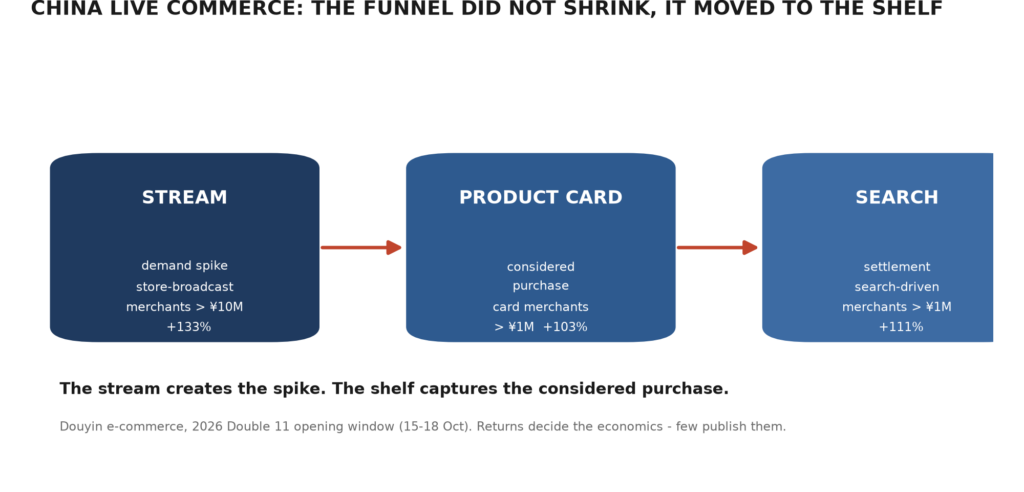
The platforms read the same signal. Douyin’s store-broadcast push is the clearest evidence: during the first four days of the 2026 Double 11 period, the number of merchants whose store-run livestreams passed ten million yuan in sales rose 133 percent year on year, and merchants crossing the same threshold on product-card sales rose 103 percent. Store broadcast means the brand’s own account, on camera, without a hired star. Citi expects total Double 11 GMV growth to land in the low-to-mid single digits this year. The channel is still the fastest lane. The lane is just narrower than it was.
Shelf commerce did not die. It became the settlement layer
The more useful correction to the “livestream everything” narrative is what happens after the stream ends. Douyin reported that in the same 2026 Double 11 opening window, merchants whose search-driven sales passed one million yuan grew 111 percent year on year. Product cards and search are where the customer who saw the stream last week goes to buy this week.
Picture the funnel honestly. The stream creates the demand spike and the product knowledge. Search and the product card capture the delayed, considered purchase at a lower cost per order. Brands that fund only the first half of that journey are paying twice for the same customer.
AI hosts stopped being a demo and became a staffing decision
The 618 numbers are not a pilot. They are capacity. Taobao’s digital-human streams alone averaged more than 100 million yuan in daily GMV during that window. On JD, the count of merchants streaming with a digital host multiplied five times over the year.
Follow the money and you find the reason. JD made its AI hosting service free to merchants in December 2025, and independently estimates that AI hosts cut livestream operating costs by 80 to 90 percent. On Taobao, standard digital-human subscriptions are priced at 499 yuan and 1,299 yuan a month. Compare that with a human anchor, a co-host, a camera operator and an overnight shift premium.
At that price, a synthetic presenter stops being a marketing experiment and becomes a line item in the operating budget.
What a synthetic presenter can actually do
Three jobs, mostly.
It holds the long tail of hours nobody wants to staff. Between 1 a.m. and 6 a.m., the audience is small and the labour cost is not.
It repeats standardised explanation without drift. Ingredients, sizes, warranty terms, shipping windows. Scripts that a tired human starts to paraphrase at hour nine.
It answers the same question forty times an hour without losing patience.
Standardised categories respond best: beauty, personal care, consumer electronics, household goods. That is also where margins are thin enough that a 90 percent cost cut is decisive.
What it cannot do, and why the ceiling is real
Trust, for one thing. A shopper who gives height and weight and asks which size to buy is not asking for a lookup table. She is asking someone to take responsibility for the answer. A model can produce size M. A good host produces a reason, a caveat and a return promise.
Judgment under ambiguity is the second gap. Live selling is full of exceptions: the shade that runs warm, the batch that shipped late, the customer who bought the wrong thing last time. Handling those moments is where repeat purchase is won.
Which is why the honest reading of the 70 percent adoption figure is not replacement. It is coverage. The camera is on more hours than it has ever been. Human attention is spent on the hours that pay.
Regulation arrived before the market finished maturing
The rules landed faster than most operators expected, and they landed in three waves.
Generative AI labelling rules took effect in September 2025, requiring synthetic content to be marked. Douyin went further and banned fully AI-generated livestreams while requiring disclosure whenever a digital host appears.
In July 2026, the interim measures governing anthropomorphic AI interaction services came into force, tightening what an AI persona may say and how it must identify itself. Around the same time, the State Administration for Market Regulation and the Cyberspace Administration issued the supervisory measures for live commerce, assigning obligations across four parties: platforms, studio operators, hosts, and the agencies behind them.
Read together, the three instruments move compliance cost from a variable to a fixed cost. That kills the cheapest play in the market, which was an unattended room looping a recording. It also makes the on-screen label a purchase consideration, not a legal footnote.
The vendor layer is already telling you where this goes
In October 2026, Alibaba Cloud announced it would wind down its virtual-human product line, nine years after entering the category. The stated reason was strategic focus on models, chips and cloud capacity. The commercial reason is visible in the price list: when a lifelike face costs 499 yuan a month, a standardised avatar product has no moat.
The category itself is still growing. iMedia Research puts China’s core virtual-human market at 48.06 billion yuan in 2025, heading for 93.56 billion by 2030, with e-commerce accounting for 19.71 percent of enterprise adopters in 2026. Growth and commoditisation are happening at the same time. That combination always pushes value toward workflow, integration and accountability, and away from the asset everyone can now buy.
The global mirror: a format, not a channel
Outside China, live commerce is being rebuilt as a feature inside existing marketplaces rather than a destination of its own. In October 2026, Morgan Stanley named live commerce the missing piece in its top pick on an established Western marketplace. The same marketplace’s chief executive told a Goldman Sachs conference that its live business grew eightfold year on year in the most recent quarter, that nine in ten sellers who try it keep going, and that those sellers grow three times faster. That is the same conclusion China reached six years earlier, arriving from the other direction.
The AI layer is moving in parallel. Bain found that AI referrals already account for up to a quarter of referral traffic for some retailers while remaining under one percent of total traffic, and that roughly half of consumers still refuse to hand an agent a purchase end to end. Adobe measured AI-referred traffic to US retail sites up 693 percent over the 2025 holiday season, with those visits converting 31 percent above other traffic.
Put the two datasets side by side and the pattern is consistent. Machine-mediated commerce converts well and travels badly. It works where the interface already holds the wallet. In China that interface is the marketplace. Elsewhere it is still being built.
Three numbers to watch this quarter
One. Whether digital-human GMV holds anywhere near 186 percent growth through the 2026 Double 11 window, or reverts toward the channel average. If it reverts, the 618 surge was a pricing event, not a behaviour change.
Two. The ratio of store-broadcast sales to star-led sales on Douyin. Store broadcast growing faster than the headline is the quietest signal that brand-owned media is replacing rented audiences.
Three. The gap between paid GMV and settled GMV. Returns are where the channel’s economics are decided, and almost nobody reports them at the category level.
What this means if you sell into China
Treat the livestream as a merchandising calendar, not a channel. It has peaks, and the peaks are scheduled months ahead.
Buy workflow, not a face. The avatar is a commodity at 499 yuan a month. What is not a commodity is the connective tissue between the stream, the product card, the search query and the return desk.
Budget the synthetic shift for coverage hours and standardised categories. Do not budget it for the moments that decide repeat purchase.
Count net, not gross. A stream that generates record GMV and a 70 percent return rate in apparel is a logistics event with a marketing invoice attached.
Label early. The disclosure requirement is now part of the customer experience, and brands that treat it as a design element rather than a legal chore lose less trust at the moment of discovery.
What we cannot verify
No public institution publishes live commerce as a share of total online retail on a deduplicated basis. The ECDB series is a market estimate, not an audited figure.
Platform GMV definitions differ, and the difference between paid GMV and settled GMV is rarely disclosed. Any year-on-year comparison across platforms is approximate.
The 186 percent growth figure rests on one promotional window and a low prior-year base. It should not be extrapolated as an annual rate.
The 45.1 billion yuan 618 figure, the 300,000-merchant count and the 70 percent adoption rate come from platform disclosures carried by trade press, not from audited filings. Read them as directional.
Cost-reduction ranges of 80 to 90 percent come from platform disclosure, which is directional rather than audited.
Forecasts for a trillion-dollar global social commerce market circulate widely. The public methodology behind most of them is thin, so they are excluded here.
Bottom line
Live commerce still dominates Chinese retail because it solved a structural problem: it put attention, demonstration, price and payment on one screen and kept them there. That advantage does not depend on any individual host, which is exactly why the channel outlived its stars and absorbed synthetic ones.
The growth has normalised, the discount engine is being rebuilt, the shelf has been reinstated as the settlement layer, and the camera is now staffed by software for most of the clock. None of that is decline. It is the shape a channel takes when it stops being an event and becomes infrastructure.