The Rise of AI Shopping Assistants
Data Story · Data vintage: December 2025 (China) / 2025 holiday season (US benchmark)
The number that opens this story
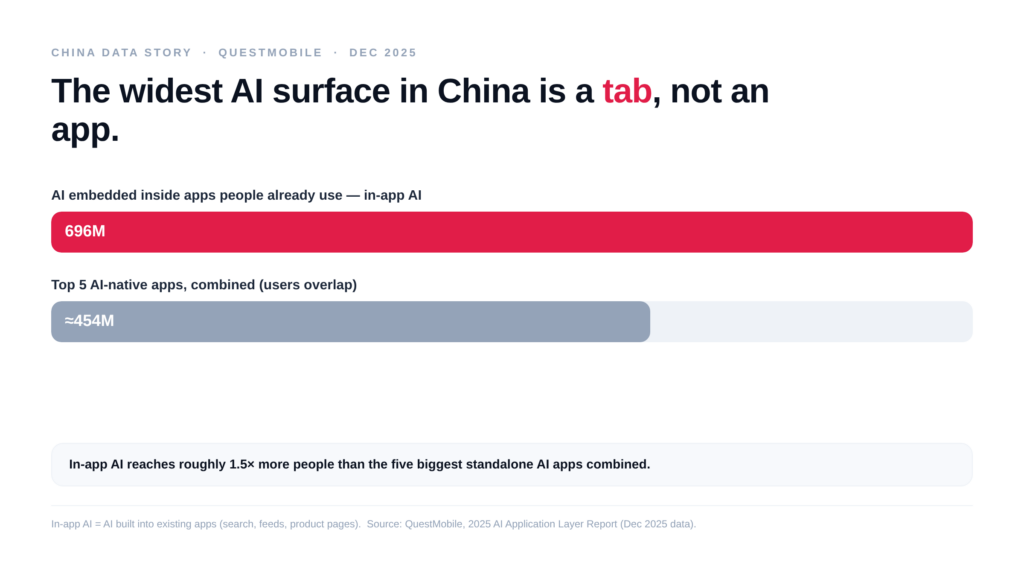
696 million. In December 2025, that is how many people in China used AI that sat inside an app they already had open — a search box, a feed, a product page — rather than downloaded as a separate app.
Set it beside the standalone AI apps and the contrast sharpens. The five largest AI-native apps in China — Doubao at 226 million monthly users, DeepSeek at 135 million, and three smaller ones — sum to roughly 454 million. The embedded surface is about 1.5 times larger. One caveat before anyone screenshots this: 454 million is a sum across five apps whose users overlap, so read it as a size signal, not a deduplicated headcount.
That comparison reframes the phrase “AI shopping assistant.” In the United States it names a destination people travel to. In China it names furniture — a model sitting in the room where the purchase already happens.
The chart we can actually stand behind
The first draft asked for a trend line of assistant MAU or query volume. Nobody publishes that series. QuestMobile tracks AI usage by app category, not by whether the underlying intent was commercial; marketplaces do not disclose assistant query volume; and any line drawn through estimates would be a chart of our own assumptions wearing a data label.
The defensible version is two bars and one callout:
| Bar | Value | Basis |
|---|---|---|
| In-app AI users, China, December 2025 | 696 million | QuestMobile, 《2025年AI应用层发展核心报告》 |
| Top five AI-native apps, combined, December 2025 | ≈454 million | Same report; sum across apps, overlapping users |
Callout: 696M, with the sub-line “the widest AI surface in China is a tab, not an app.” If the layout allows a companion panel, use Adobe Analytics on year-over-year change in AI-referred traffic to US retail sites during the 2025 holiday season: retail +693%, travel +539%, financial services +266%, tech and software +120%, media and entertainment +92%.
Three shapes of assistant, and only one grows where you expect
- Embedded — a model inside a marketplace, content app or map, answering while the shopper is already inside the funnel.
- Standalone — a chat or AI search product the shopper opens instead.
- Agentic — an assistant that finishes the transaction, not just the shortlist.
China’s volume is concentrated in the first shape. The US and Europe are watching the second turn into the third.
The funnel did not get shorter; it got absorbed
China’s growth in this shape has a structural cause. Super apps already hold the cart, the wallet, the delivery address and the loyalty balance. A model dropped into that stack inherits purchase intent instead of paying to rebuild it.
The official count puts the scale in context. CNNIC reported 515 million generative-AI product users in China as of June 2025, a 36.5% adoption rate. QuestMobile, measuring December 2025, puts the mobile internet at 1.276 billion monthly users, spending an average of 7.96 hours a day, up 6.0% year over year, with AIGC usage time up 176.7%. Attention did not migrate to a new app. It deepened inside the old ones. Over the same twelve months, the monthly per-capita usage count for in-app AI rose 229.8%, against 80.1% for standalone AI apps.
Across all four AI form factors, mobile AI reached 722 million users, phone-maker assistants 559 million, and PC AI apps 205 million. The category with the widest reach is the one without a download button.
A correction we owe the first draft
The original outline said Chinese consumers “increasingly ask AI what to buy instead of searching.” Half of that holds. The other half does not.
AI search has not replaced search. It has been wired into it, and in China the AI search products are themselves among the most-used embedded tools. The marketplace did not retire the search box; it put a model behind the box and let people type sentences instead of keywords.
Here is the defensible formulation: the question “what should I buy” is increasingly asked in natural language, inside the app, and answered by a model rather than by a ranked list of links. That we can stand behind. “Instead of searching” we cannot.
The global mirror: AI referrals convert, they do not just browse
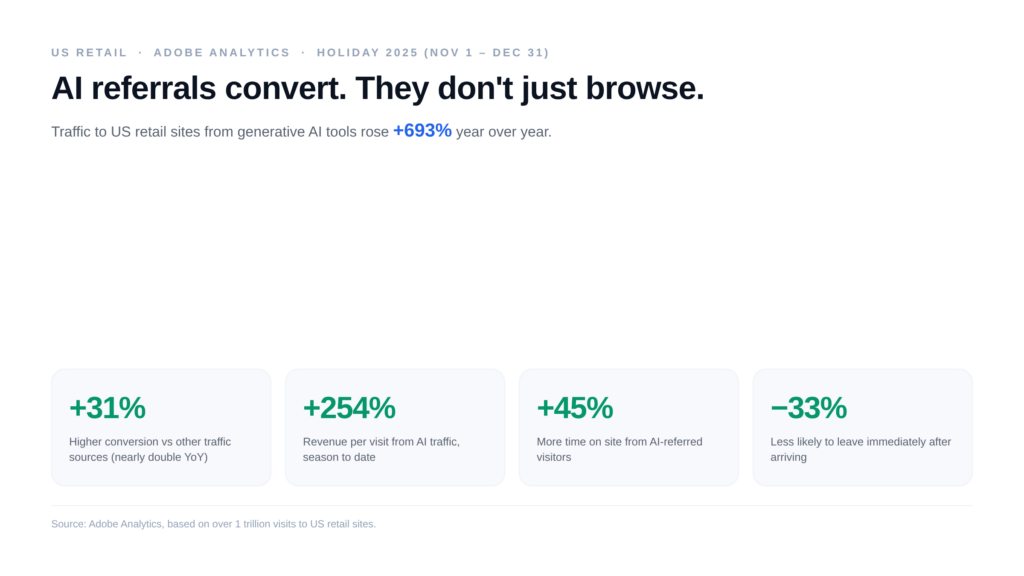
Adobe Analytics, US retail, holiday season 1 November to 31 December 2025:
- Traffic to retail sites from generative AI tools rose 693.4% year on year, and 670% on Cyber Monday.
- AI-sourced visits converted 31% higher than other traffic, nearly double the gap a year earlier.
- Revenue per visit from AI traffic was up 254% for the season to date.
- AI-referred visitors were 33% less likely to leave immediately, spent 45% more time on site, and viewed 13% more pages per visit.
- 81% of shoppers who used AI assistants said it improved the experience; 47% said they trust AI results; 65% felt more confident buying; 68% said they were less likely to return the item.
Retail led every industry, but it was not alone: travel +539%, financial services +266%, tech and software +120%, media and entertainment +92%.
Now the number that should worry a CFO. Bain and Company, working with Similarweb in November 2025, found AI referrals already account for up to 25% of referral traffic for some retailers while staying under 1% of total traffic. High value per visit, negligible volume today, compounding on a schedule nobody planned for.
Trust is the gate, and it is unevenly distributed
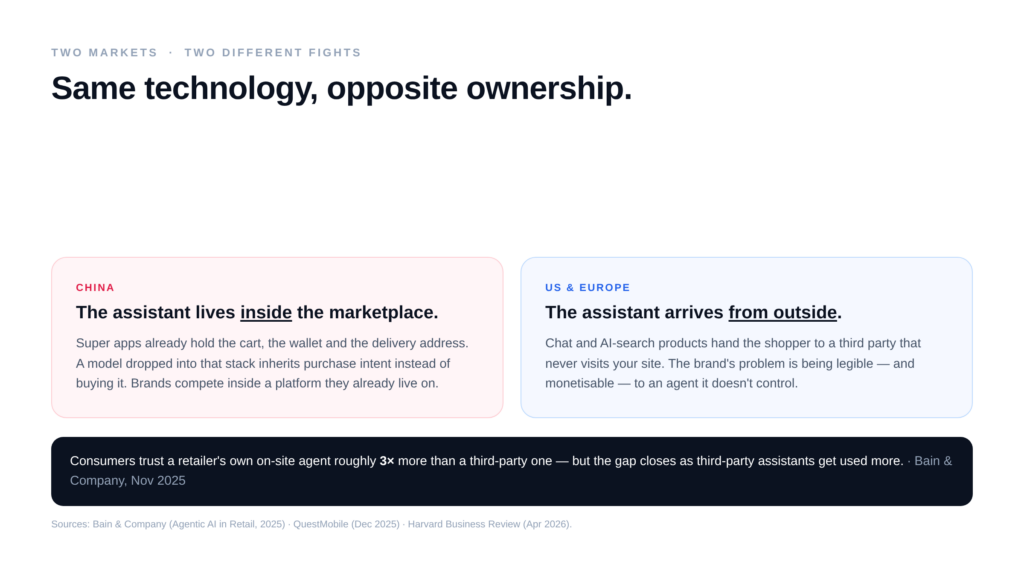
Around half of US consumers still will not hand an agent a purchase end to end. But they trust a retailer’s own on-site assistant roughly three times more than a third-party one. That inverts the usual panic. The incumbent holds a trust asset it can spend — for now. Trust gaps close with familiarity, and familiarity is a function of how often the third-party assistant gets used, not how good the retailer’s own one is.
From shortlist to checkout
In September 2025 OpenAI moved chat from recommendation to transaction. Instant Checkout runs on the Agentic Commerce Protocol, an open standard co-developed with Stripe that keeps the merchant as merchant of record, and it sits in front of an interface used by more than 700 million people each week.
When an agent executes rather than recommends, three decisions happen before a shopper ever sees a brand: availability, price, and whether the product data is machine-readable at all. The third one is the quiet bottleneck.
Two markets, two different fights
In China the assistant is a tenant inside the marketplace. The brand’s problem is the retrieval logic of a platform it already lives on, plus how well its catalogue answers a sentence. In the US and Europe the assistant arrives from outside. The brand’s problem is being legible, and monetisable, to a third party that never visits its site.
Harvard Business Review’s April 2026 research on agentic commerce in China states the shift plainly: companies now compete to be selected by agents, not merely noticed by customers. It is the same technology in both markets with opposite ownership, and a playbook copied from one to the other breaks at the checkout step.
What this means for a brand team
AI visibility has become a purchase-channel question rather than a brand-awareness question. It decides whether a product enters the consideration set at all.
- If the assistant sits inside the platform, the platform’s retrieval logic is the creative brief.
- If it sits outside, the product feed is the storefront and the schema is the signage.
Five moves worth doing this quarter
- Run a machine-readability audit before anything else. Adobe’s companion analysis found many US retail sites are not machine-readable, which suppresses AI visibility and conversion. If an agent cannot parse stock, price tiers and return terms, no amount of prompt-friendly copywriting will rescue the listing.
- Split AI out of organic in attribution. A referral from a chat interface and a referral from a blue link carry different session quality. Merging them hides both.
- Write product facts for a model. Structured specs, unit economics, lead times, warranty, compatibility. Prose persuades people; attributes persuade agents.
- Choose where you want to be selected, not just found. Exclusive assortment, service bundling and loyalty pricing are the things an agent cannot easily replicate.
- Protect first-party data and checkout control. Watermark content, negotiate sharing terms, keep pricing accurate at the point of transaction.
How to measure it without fooling yourself
Instrument three things: session quality from AI referrers — revenue per visit, return rate, time on site; the share of product-page traffic arriving with no referrer string; and the percentage of the catalogue that passes a structured-data validation test. The third one is the leading indicator. It predicts the other two, usually by a quarter.
What we still cannot verify
- China-side figures here are December 2025 snapshots. No public deduplicated series for shopping-specific AI usage exists, so month-over-month claims should be avoided.
- Adobe’s dataset covers US retail transactions only. It is the most granular AI-referral data in public, and it is also regional.
- Bain’s 25% figure describes “some retailers,” not the market.
- Trillion-dollar forecasts for agentic commerce circulate widely. The public methodology behind most of them is thin, so they are excluded.
Bottom line
The shopping assistant is not a channel layered on top of the old ones. It is a new gate in front of them. In China the gate is built by the marketplace a brand already depends on. In the US and Europe it is being built by platforms the brand does not control. Either way the work ahead is unglamorous and specific: make the catalogue legible, keep the checkout yours, and measure revenue per visit before the volume arrives.
Frequently asked questions
Is AI replacing search in China?
No. AI is being embedded in search, commerce and content surfaces rather than substituted for them. The query language changed; the intent to search did not disappear.
Why is in-app AI bigger than standalone AI apps in China?
Distribution. Super apps already own the cart, the wallet and the delivery address, so a model inherits intent instead of buying it. Standalone apps must earn a download and a habit first.
Should budget shift to AI because conversion looks strong?
Not yet. Conversion and revenue per visit are strong, but volume is still under 1% of total traffic for most retailers. Fund legibility work now, media shifts later.
Where does agentic checkout actually change the game?
At the moment the agent completes the order. Availability, price and machine-readable product data then decide the outcome before creative does.
What is the single fastest diagnostic?
A machine-readability test on the fifty highest-traffic SKUs. If an agent cannot read them, nothing downstream matters.