Why Baidu Priced Its Search API Under DeepSeek — and What It Means for RAG
Baidu Slits Its Search API to RMB 4.9 Per 1,000 Queries — and Bets the Comeback on a Loop That Retrains Itself
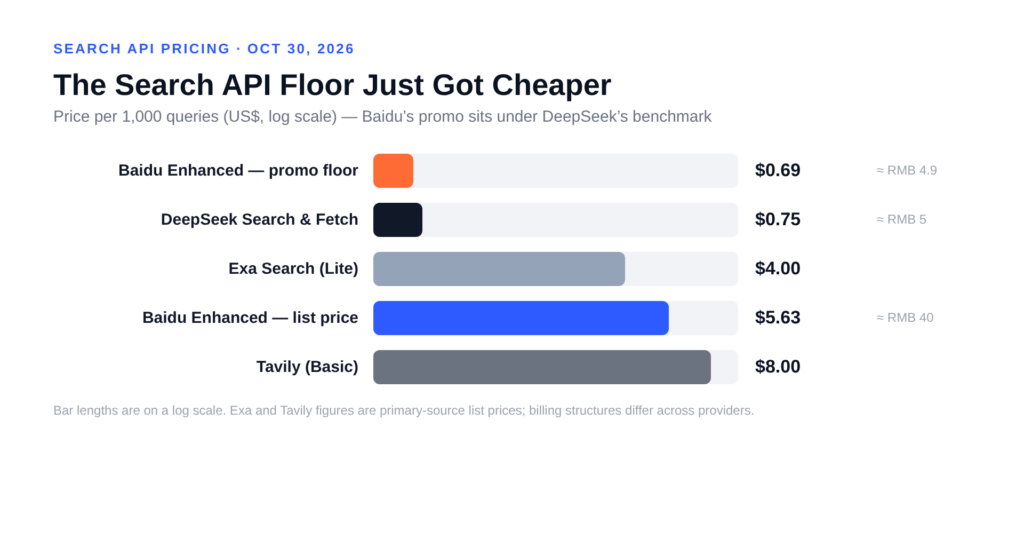
Baidu rebuilt the search box inside its flagship app and, on 30 October in Beijing, attached the least-discussed number to the loudest launch: a search API priced at a promotional floor of RMB 4.9 per 1,000 queries — under US$0.70 at recent exchange rates. That single figure does more explanatory work than the four feature upgrades stacked around it, because it lands roughly two weeks after DeepSeek opened its own Search and Fetch endpoints at $0.75 per 1,000 and quietly reset the floor for machine-readable retrieval. Baidu’s price now sits underneath it.
The Four-Layer Stack and the Self-Retraining Loop
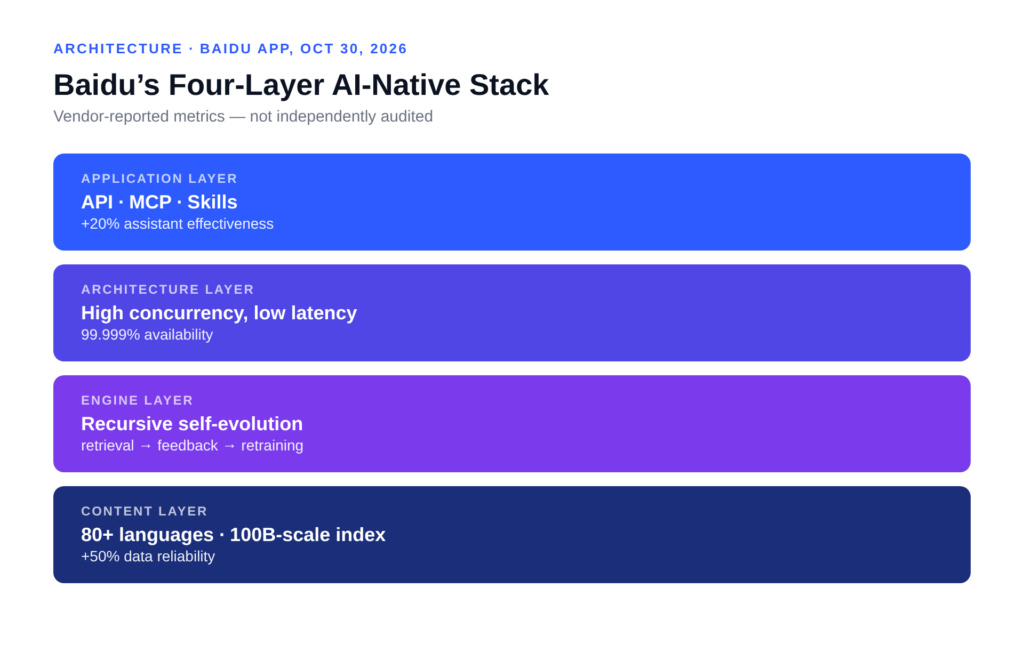
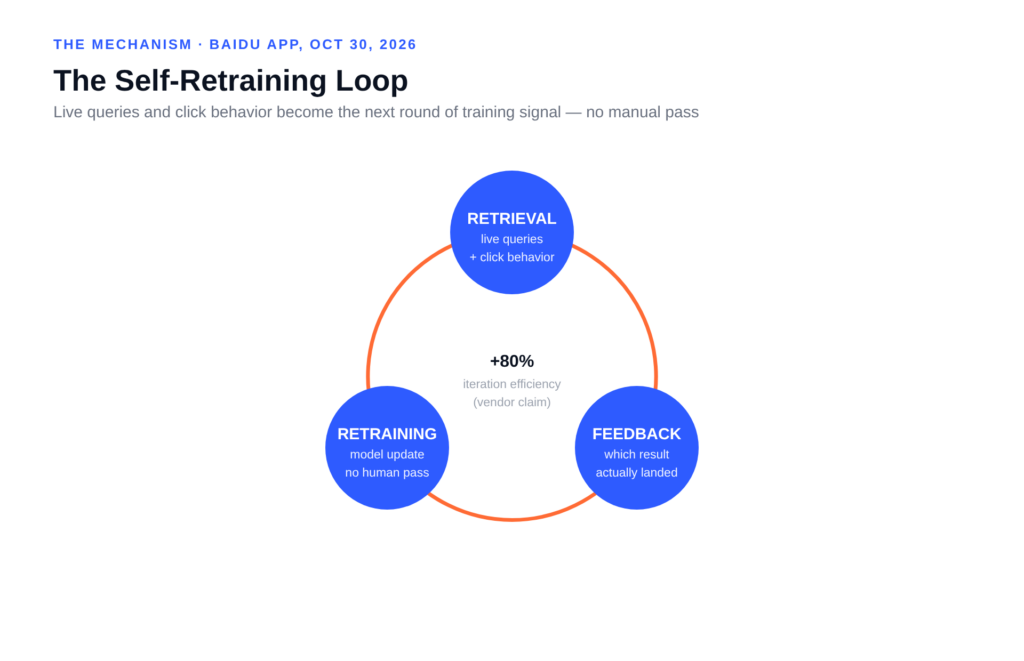
Baidu describes an AI-native architecture in four layers. The content layer maintains an index spanning more than 80 languages on a hundred-billion-scale set of entries, a build the company says lifted data reliability by over 50%. The engine layer runs what Baidu calls a recursive self-evolution loop: live queries and click behavior get captured as training signal, folded into a retrieval-feedback-retraining cycle, and pushed back into the model without a human tuning pass in between. The company claims this lifts overall iteration efficiency by more than 80%.
Strip the marketing and the claim is structurally sound. Model labs cannot keep hand-labeling their way past the high-quality public data that runs out. Search engines already sit on something labs have to synthesize or buy: the actual distribution of what people ask, and the click-through that reveals whether an answer landed. Turning that stream into continuous training signal is the one feedback loop at real internet scale — and it is the loop a search incumbent holds and a chat-only lab does not.
From Answers to Task Delivery
The product shifted from one question, one answer toward multi-step task completion. Baidu now routes through more than 170 tool scenarios, compressing find-jump-act sequences into a single delivery, and can persistently monitor a user-specified topic, firing proactive alerts when something changes. The delivery format moves from a list of links to the verified result, and then to an ongoing watch.
Visual and structured-input capability expanded alongside it. Camera input handles simultaneous multi-target recognition, dynamic tracking and live dialogue, including nine Chinese dialects. Structured-data wiring reached more than five billion authoritative records across 20-plus industries for interactive charting, with GUI coverage Baidu says grew fivefold. At the application layer, the upgraded stack accepts APIs, MCP and Skills, and the company reports a 20% effectiveness gain when its own assistant is routed through it.
Why the Price Is the Story
A retrieval call at a fraction of a US cent pushes retrieval-augmented generation below the marginal cost of a structured query. For developers building agents on Chinese infrastructure, web-grounded retrieval stops being a line item worth optimizing and starts resembling a utility — the same water-and-electricity framing Chinese coverage used. When the raw feed costs nothing to reason about, the competitive battle moves up the stack, to the agents sitting on it.
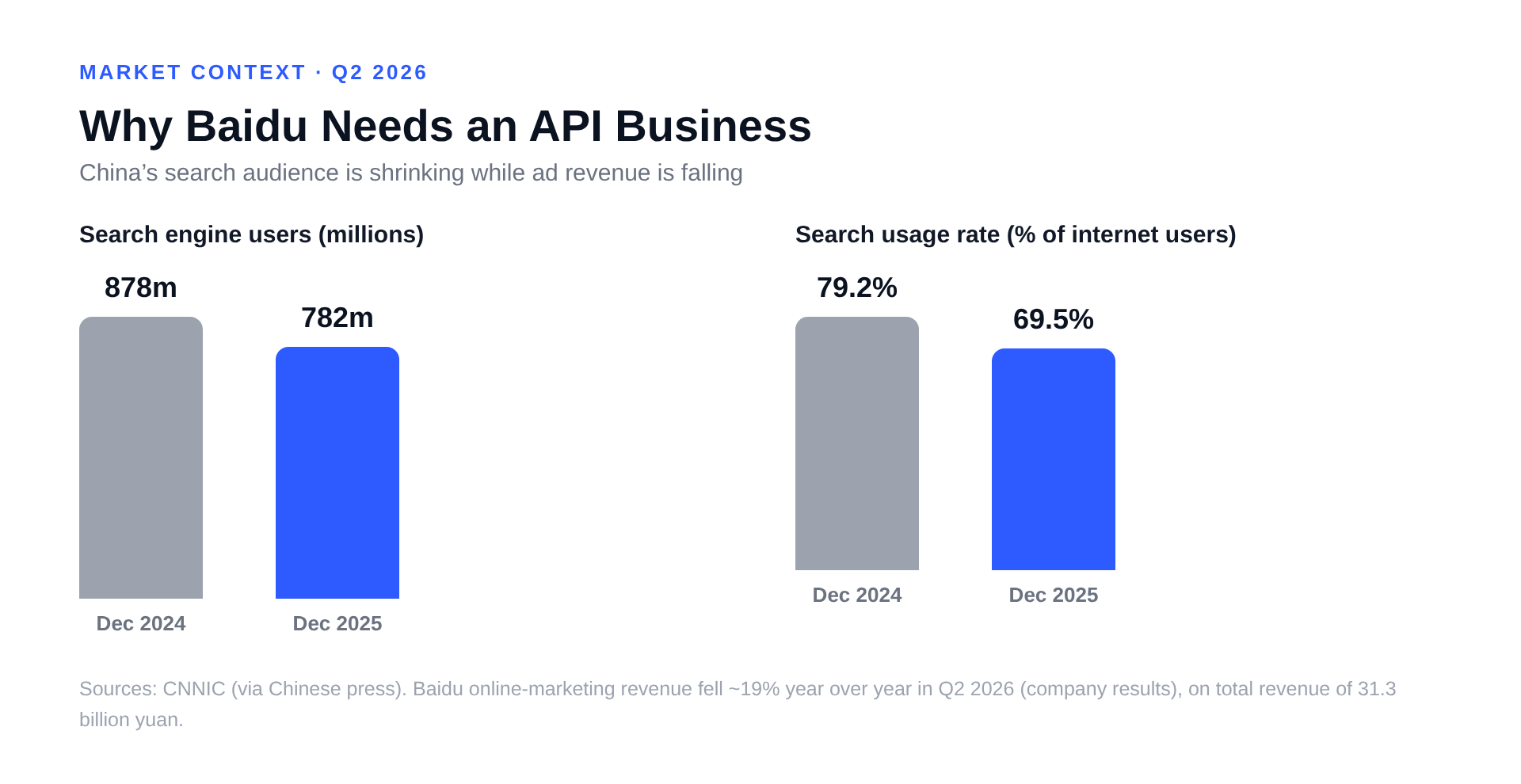
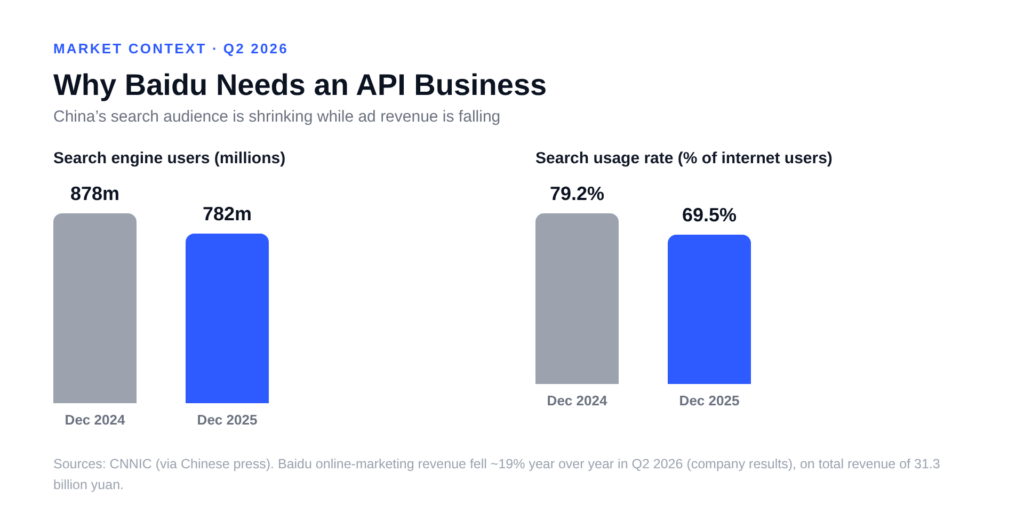
The motivation reads plainly in Baidu’s numbers. Total revenue in the second quarter of 2026 came in at 31.3 billion yuan, below expectations, as online-marketing revenue fell about 19% year over year. The structural headwind is broader than one company: China’s own internet statistics body reports the country’s search engine user base shrank from 878 million to 782 million year over year, with usage among internet users dropping from 79.2% to 69.5%. Selling retrieval capacity to third-party products is a way to monetize the index even when users never open Baidu.
Caveats Worth Carrying
Every performance and efficiency figure here — the 80%, the 50%, the 20% — is vendor-reported and unaudited, with no methodology or third-party test published. The RMB 4.9 is explicitly a promotional floor, capped at cumulative usage during the window, after which it reverts to the standing rate. DeepSeek’s $0.75 is itself a launch price that can move. And a self-training loop that ingests raw user feedback eventually risks reinforcing its own errors at scale, a failure mode no launch deck addresses.
What to Watch
Two signals decide whether this is a price war or a pricing reset. First, whether anything near RMB 4.9 survives past the promotional window, since the standard tier sits roughly eight times higher. Second, whether Baidu publishes evaluation backing for the recursive-evolution claim before competitors copy the framing instead of the math. Either way, the durable takeaway is the repositioning: search is no longer the page a user lands on, but the execution substrate agents call underneath them.