Distribution Beat Model Quality: China’s AI App Rankings, Explained
Data vintage: September 2026 (China) / August–October 2026 (global benchmarks) · Channel: China Data Story, Data Tables
Key figures in one block
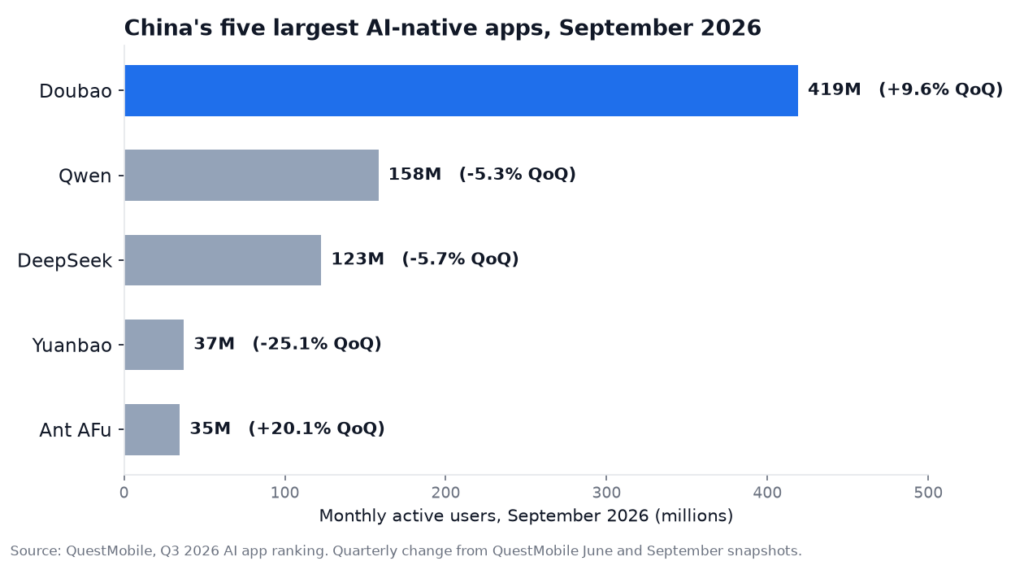
- Doubao monthly active users, China, September 2026: 419.08 million, up 143.6% year on year and 9.6% quarter on quarter, owned by ByteDance.
- Qwen app same month: 158.17 million, owned by Alibaba.
- DeepSeek same month: 122.65 million, down 15.2% year on year.
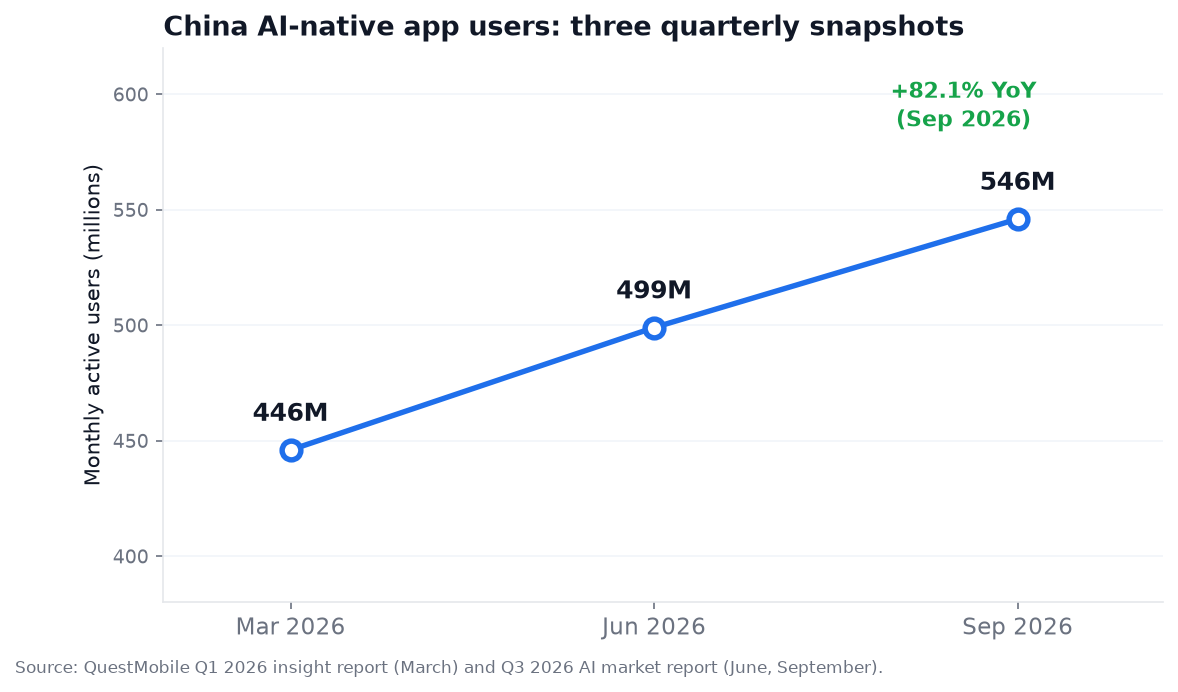
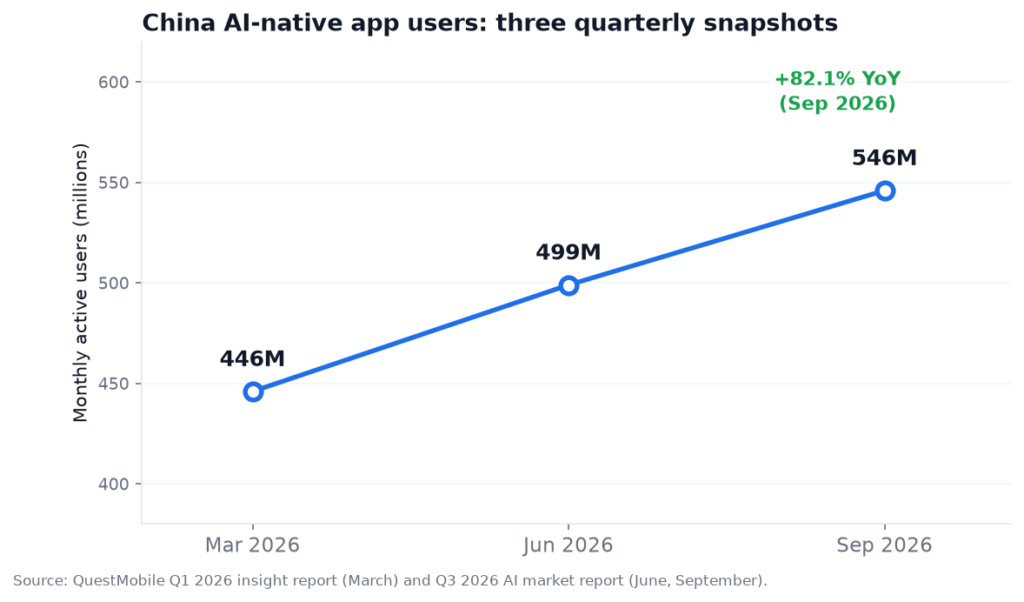
- All AI-native apps in China, September 2026: 546 million monthly users, up 82.1% year on year.
- Usage depth: 88.2 sessions and 173.5 minutes per user per month, up 59.3% and 44.2%.
- Generative AI users in China, June 2026: more than 700 million, above 50% penetration.
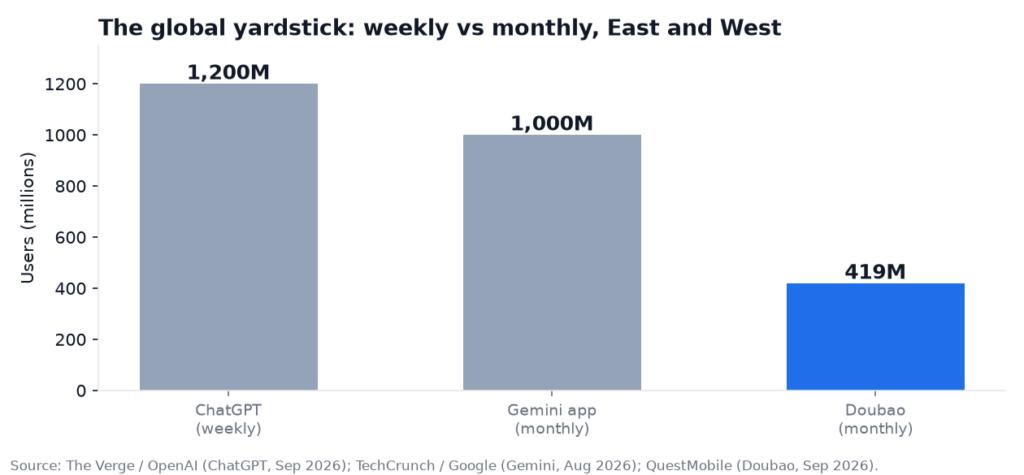
- ChatGPT weekly users, September 2026: 1.2 billion. Gemini app monthly users, August 2026: 1 billion.
- China model-as-a-service revenue, H1 2026: 10.63 billion yuan, up 889.4% year on year.
The number that opens this story
419.08 million. That is how many people opened Doubao in an average month this September, according to QuestMobile. China counted 1.125 billion internet users at the end of 2025. Do the division and you get roughly one in three of them using one chatbot.
Now put that number beside the category it belongs to. Every AI-native app in China together reached 546 million monthly users in September. Doubao alone accounts for 77% of that pool. If you are looking for a concentration story, that is the whole story. If you are looking for a market story, it is only the first paragraph.
What the outline said, and what the data says now
The brief behind this table carried a one-line takeaway: Doubao leads the mass market, DeepSeek owns the technical niche. Half of it still holds. The other half has expired.
DeepSeek spent most of 2025 in second place. In March 2026 it sat third at 127 million users. Six months later it was still third, at 122.65 million, down 15.2% year on year. Monthly downloads have now fallen for four consecutive quarters. What that tells you is uncomfortable for anyone who believes model quality is a consumer moat: the most technically respected team in the market has a shrinking distribution footprint.
The app that took the second slot is Alibaba’s Qwen, at 158.17 million. It got there with subsidy, catalogue depth and a checkout rail, not with benchmark scores. Qwen climbed from sixth place in November 2025 to second by March 2026, adding 126 million users in a single quarter while Doubao added 100 million. The category itself added more than 130 million in the same window. That is not growth. That is a migration.
China’s ten largest AI-native apps, September 2026
| Rank | App | MAU (Sept 2026) | QoQ | YoY | Owner | Primary use |
|---|---|---|---|---|---|---|
| 1 | Doubao | 419.1M | +9.6% | +143.6% | ByteDance | General-purpose assistant |
| 2 | Qwen | 158.2M | −5.3% | +5,076.6% | Alibaba | Assistant with commerce and payment rails |
| 3 | DeepSeek | 122.7M | −5.7% | −15.2% | Independent | Search-style reasoning and technical Q&A |
| 4 | Yuanbao | 37.3M | −25.1% | n/d | Tencent | Office-and-social assistant tied to Tencent content |
| 5 | Ant AFu | 34.8M | +20.1% | +342.9% | Ant Group | Health assistant (Ant’s AQ app) |
Quarter-on-quarter change is calculated from QuestMobile’s June and September snapshots except where the agency published the figure itself. Ranks four and five are the last entries with disclosed absolute values; every app below them sits under 25 million monthly users.
Note what the fifth column does to the shape of the table. Three of the five leaders are owned by companies whose core business is something other than AI. The only independent lab on the podium is the one losing users. That is not a coincidence and it is not temporary.
The tier under 25 million, where the market’s edge is sharpest
| Rank | App | MAU | Growth signal | Owner | Primary use |
|---|---|---|---|---|---|
| 6 | Xiaoyuan AI | under 25M | −5.8% YoY | Yuanfudao | K-12 tutoring |
| 7 | Doubao Learn | under 25M | +9.5% QoQ | ByteDance | Study companion and grading |
| 8 | Jimeng AI | under 25M | negative QoQ | ByteDance | Image and video generation |
| 9 | Lovekey | under 25M | +228.6% YoY | Not disclosed | Companion and conversation |
| 10 | Baidu Dazi | under 25M | +1,567.5% QoQ | Baidu | Task and workplace assistant |
QuestMobile does not publish absolute monthly figures below rank five, and this piece will not invent them. What the agency does publish is direction, and the direction is extreme. Only three apps in the entire top ten grew quarter on quarter: Doubao, Ant AFu and Doubao Learn. Every other name on the list went backwards in the third quarter. A market that looks like a land grab from the outside is, from the inside, one product pulling away and nine products defending.
Growth rates here are two different instruments
Read the year-on-year column and you will draw the wrong conclusion twice.
Qwen’s 5,076.6% is not organic growth. The app was relaunched under the Qwen name in late 2025, which means the comparison base is almost empty. It is a launch artefact dressed as a trend. Useful for confirming the launch worked, useless for predicting next quarter.
Doubao’s 143.6% is real but decelerating. The Spring Festival push, the gala exposure, the subsidy campaigns: those produced a step change in the first quarter and a flattening curve after it.
Quarter-on-quarter is the honest lens, and it says something the annual column hides. Qwen at 158 million is below where it stood in June, at 167 million. DeepSeek is lower again, down from 130 million in June. Yuanbao has lost a quarter of its users in three months, having already dropped out of the top three earlier in the year. Distribution decides who arrives. Quarterly retention decides who stays, and the retention scores are not evenly distributed.
Why the podium moved
Three mechanics, all of them visible in the data.
Distribution. ByteDance placed seven products in the first-quarter top twenty, not one: Doubao as the entry point, then Jimeng, Doubao Learn, Xiaoyunque, Coze, Maoxiang and a medical assistant. An entry point plus a vertical matrix. The entry point absorbs intent; the verticals harvest the moment it becomes specific. Alibaba runs the same play with Qwen wired into Taobao, Amap and Alipay, and DingTalk carrying the workplace version. Tencent’s workplace agent reached 32.35 million monthly users across surfaces in September, up 647.1% in a quarter, from a low base.
Subsidy. In the first quarter Qwen averaged 72.18 million downloads a month, up 954.3% quarter on quarter, with February alone pushing 170 million, on the back of a campaign that traded cash for behaviour: say one sentence, get a free drink. It was not the largest budget in the market. It was the most direct route from download to a completed transaction. Doubao went the other way, buying reach through the Spring Festival broadcast and letting the model do the persuading.
The cost of being only a model. DeepSeek’s quarterly slide is the cleanest evidence in the dataset that a strong model with no owned surface competes on borrowed ground. Its users arrive through search, social feeds and word of mouth. None of those channels belong to it, and none of them charge in attention alone.
The app is the smallest of three surfaces
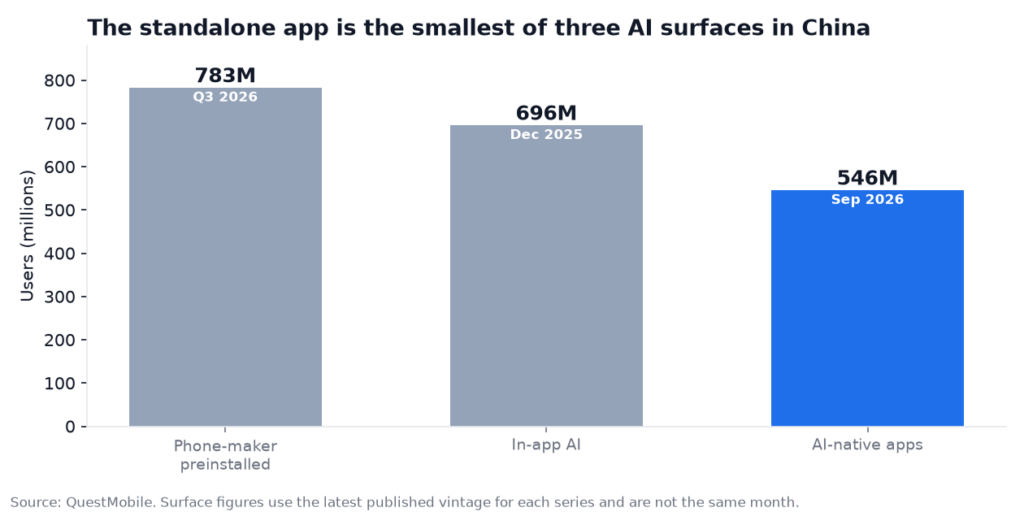
Here is the part the leaderboard hides. The 546 million figure counts standalone apps only. Three surfaces compete for the same habit in China, and the app is the narrowest of them.
- Pre-installed assistants shipped by phone makers reached 783 million users in Q3 2026, the largest of the three.
- AI embedded inside existing apps hit 696 million in December 2025, the last figure the agency published for that surface, and it grew faster than standalone apps on almost every measure through 2025.
- Standalone AI-native apps reached 546 million in September 2026, up 82.1% year on year.
An overseas reader will look at this and assume the app is the market. In China the app is the shop window. The warehouse is the tab inside an app people already had open.
Depth held while reach exploded
When you add users at 82% a year, per-user engagement should fall, because new users are lighter than veterans. In China it almost did not. Average sessions reached 88.2 a month and time in app reached 173.5 minutes in September, up 59.3% and 44.2% year on year, and essentially flat against the 87.1 sessions and 173.3 minutes recorded in March, when Spring Festival spending had every mainstream app inflated. Reach grew faster than depth this year. Depth simply refused to give ground.
The daily picture says the same thing in a sharper register. After the festival settled, Doubao held roughly 140 million daily active users, Qwen about 30 million and Yuanbao about 9 million. A product with 419 million monthly and 140 million daily users is not a landing page. It is a daily surface, and creative that works there has to survive repetition. That is a different brief from feed advertising, and most brand teams have not written it yet.
700 million users, 546 million monthly actives, and a definition gap
China’s official count is larger than the platform count, and both are correct.
CNNIC reported more than 700 million generative AI users in June 2026, with penetration past 50% of the population, up from 602 million and 42.8% at the end of 2025. QuestMobile reported 546 million monthly users of AI-native apps in September.
The gap is not error. It is scope. The official figure counts anyone who used a generative model anywhere, including inside a commerce app, a map, a browser. The agency figure counts only standalone apps. Roughly 150 million people use generative AI in China without opening an AI app in a given month. Any media plan built on app rankings alone is addressing two thirds of the audience.
The global yardstick
Outside China the same threshold was crossed from a different direction.
ChatGPT passed 900 million weekly users in February 2026, one billion in July, and 1.2 billion by 29 September. Gemini’s app went from 750 million monthly users in February to 950 million in late July, and crossed one billion on 11 August. On mobile, ChatGPT holds roughly a 2.5 times lead over Gemini in monthly users and a 14 times lead over Claude. Claude, for its part, has moved past DeepSeek and Perplexity on global web traffic to take third place.
Set Doubao against that field and the comparison is more flattering than the domestic conversation suggests: 419 million monthly against a billion-plus monthly puts the Chinese leader around 40% of ChatGPT’s base, in a country where the app surface is the smaller of three. The Chinese leader is not a smaller ChatGPT. It is a differently housed one.
Where the money is not
Traffic and revenue have separated.
AI-native apps added 82% more users. China’s model-as-a-service market grew 889.4%, to 10.63 billion yuan in the first half of 2026, on 2,857.9 trillion tokens consumed, up 432.5%. Video generation alone contributed 32.7% of that revenue. Enterprise buyers are paying for output. Consumers, mostly, are not.
The consumer side runs on advertising and thin subscriptions. China’s internet ad market reached 793.08 billion yuan in 2025, up 4.6%, and AI app owners are already among its most aggressive buyers: of the hard-ad budget placed by AI app companies, 70% went to three products, with Yuanbao at 38.5%, Ant AFu at 21.2% and Qwen at 12.6%. In the United States, 4.5% of consumers held an active paid subscription to ChatGPT, Gemini or Claude as of August 2026. Reach is being bought. Revenue is being earned somewhere else.
For a brand, that asymmetry has a practical consequence. The platforms with the largest audiences are the ones with the least proven commercial model, which means placement inventory will stay cheap for a while and will stay volatile for longer.
What this means if you buy attention in China
Buy the matrix, not the app. The entry point is one placement. The verticals behind it are where the intent actually converts, and they price differently. ByteDance’s seven products in the top twenty are not redundant. They are a segmentation system with separate rate cards.
Treat 77% concentration as coverage, not as choice. One product reaches most of the addressable audience. That is efficient for a reach buy and dangerous for a frequency cap. The second tier is where incremental reach and defensible pricing sit.
Plan quarterly, not annually. Yuanbao lost a quarter of its users between June and September. Qwen lost five per cent. Any annual audience commitment signed in the spring was wrong by the autumn. Contract on measured delivery, not on a forecast.
Separate the assistant from the destination. The tab inside an existing app reached more people than any standalone product. If your plan only names apps, it is missing the surface where the purchase intent already lives.
Measure sessions, not reach. 88 sessions a month is a habit. Habit inventory needs creative that holds up on the twentieth exposure, and it needs measurement in frequency rather than impressions.
What the numbers cannot tell you
QuestMobile is a panel estimate, not an audited count. It is the best series available and it is still an estimate.
Sums across apps are not deduplicated. The five leaders in September add up to 772 million, about 1.4 times the 546 million people the category counts, because the same person can sit inside three products. Read the top-five sum as a size signal, never as a headcount.
No platform discloses revenue per app, so MAU cannot be converted into average revenue per user with any public method. Any such figure in circulation is an assumption with a decimal point.
QuestMobile lists the Ant Group entry as 蚂蚁阿福; the company’s English-language disclosures use AQ for the same health app brand. Those documents report 150 million users and about 20 million health queries a day in September 2026, which is a registered-user count and cannot be compared directly with QuestMobile’s 34.79 million monthly actives.
Pre-2026 comparisons for Qwen do not exist in any usable form, because the product did not exist in its current form.
Three numbers to watch this quarter
One. Whether Doubao clears 450 million by December, and whether the category clears 600 million. A flattening here would be the first genuine signal that the app surface has found its ceiling in China.
Two. Whether Qwen’s quarterly change turns positive again. It fell between June and September after a launch-driven surge. If it recovers, ecosystem bundling is durable. If it keeps sliding, the surge was a promotion.
Three. Whether DeepSeek’s line flattens after its latest model release. The decline has been structural for a year. A single quarter of stability would be the most interesting data point in the table, because it would tell us how much distribution actually matters.
Bottom line
China’s AI app market is not a race between ten products. It is one product absorbing a category, three conglomerates using distribution as a weapon, and a handful of verticals fighting for the hours nobody else wants.
The leader has 419 million users and 88 sessions a month. The challenger has a launch curve, a checkout rail and an owner with a shopping app attached. The independent lab has the best model per parameter and a shrinking audience. None of those three facts is about technology. All three are about where the user already was.
If you sell into this market, the leaderboard is a starting point and not a strategy. The surface is wider than the app, the habit is deeper than the reach, and the revenue is in a different room.
Frequently asked questions
Does Doubao really reach a third of China’s internet users?
In September 2026 it reported 419.08 million monthly users against an internet population of 1.125 billion measured at the end of 2025, which is about 37%. The comparison mixes two measurement systems and a nine-month gap. Read it as an order of magnitude, not a precise share.
Why did DeepSeek fall if its models are well regarded?
Because consumer distribution is not a function of benchmark scores. DeepSeek’s users arrive through surfaces it does not own, and its product cycle has been slower than the ecosystem players adding features and rail integrations. Its download count has fallen for four consecutive quarters, which is a distribution problem rather than a capability problem.
Is Qwen’s 5,076% growth rate real? The arithmetic is real; the interpretation is not. The app relaunched in late 2025, so the base is close to zero. What matters for planning is the quarterly change, which was negative in the third quarter of 2026.
Do standalone apps still matter if the embedded surface is larger?
For reach, the embedded surface is larger. For depth, the app wins: 88 sessions and 173 minutes a month is app behaviour, not tab behaviour. The two surfaces do different jobs, and brands need both in the plan.
What is the single most useful metric for a foreign brand entering this market?
Quarterly retention of the placement, not monthly reach of the platform. Audience bases in this market move by double digits within ninety days, and a campaign optimised on last quarter’s ranking will be buying the wrong inventory this quarter.