AI Solved Supply. Judgment Is Now the Expensive Part.
Generative AI has solved creative supply: Google alone reports 1.5 billion ad assets a quarter, up more than 7× year on year. The scarce inputs are now judgment and memorability — which is why the strongest 2026 case studies reward optimisation, not generation.
Creative After Abundance
When one platform produces 1.5 billion ad assets a quarter, craft stops being the bottleneck — and judgment becomes the whole job.
The bottleneck moved. Most teams are still staffing for the old one.
For most of the past twenty years, every marketing org chart rested on the same quiet assumption: we can only make so much stuff. Budget, headcount, the number of people who could write a headline or frame a shot — these set the ceiling on how many ideas could reach the market. Strategy got the best people. Production got everyone else, plus a spreadsheet.
That ceiling is gone. Look at what three platforms said in the same quarter.
The supply shock, in three numbers
At Alphabet’s Q3 2026 earnings call, chief business officer Philipp Schindler said Gemini models had helped advertisers generate more than 1.5 billion campaign assets in the quarter — more than seven times the year-earlier figure.
On Meta’s call, chief financial officer Susan Li said nearly 10 million advertisers had used at least one of its generative creative tools in Q3. Adoption of its video-generation tools grew 25% quarter on quarter.
Amazon took a different route and arrived at the same place. At its unBoxed event, it did not launch a creative generator; instead, it renamed its ad console Amazon Ads Agent and rebuilt the buying platform around agents.
And the supply is no longer confined to the duopoly. OpenAI said more than 100,000 advertisers had run campaigns inside ChatGPT, and that it had extended ChatGPT Ads to 26 more markets.
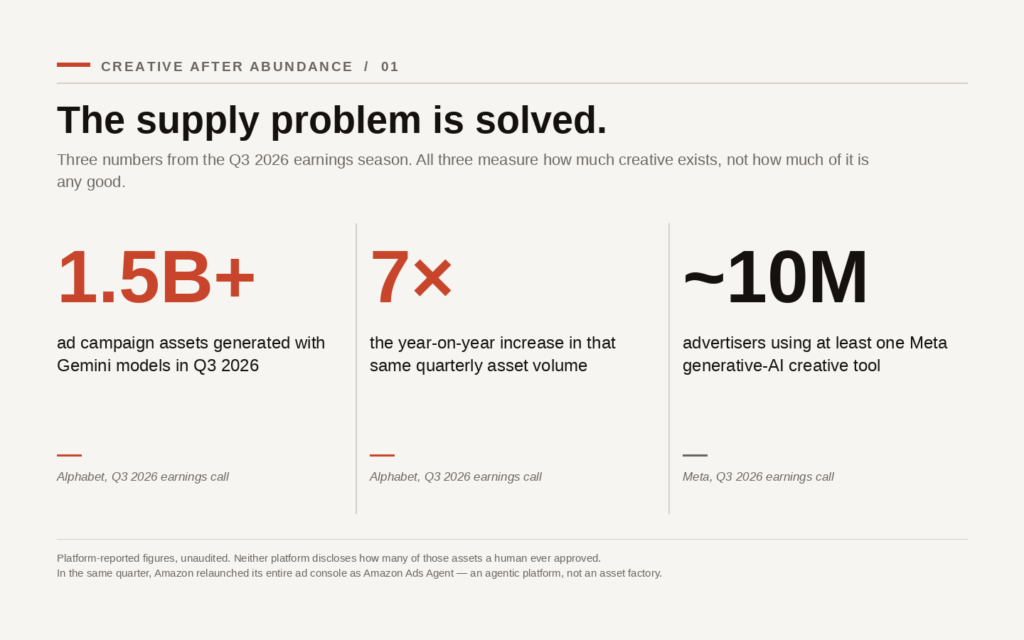
A number that size deserves scepticism, so let us be precise about the unit. An “asset” is not an ad. That 1.5 billion is a count of headlines, crops, captions, cutdowns and localisations — the raw material of campaigns, not the campaigns themselves. That distinction matters, because it is exactly where the waste lives. Nobody ever wanted forty cutdowns. They wanted the two that worked.
The number that should actually interest you
Now put the supply figure next to a result.
Telstra, the Australian telecoms group, used Google’s AI Max to capture long-tail and multilingual queries. According to Google, it recorded a 52% increase in conversions and a 36% reduction in cost per order. Those figures are platform-reported and unaudited, which is reason enough to treat them as a directional signal rather than a benchmark.
But look at what produced them. AI Max is an optimisation system. The creative did not get better. The matching did.
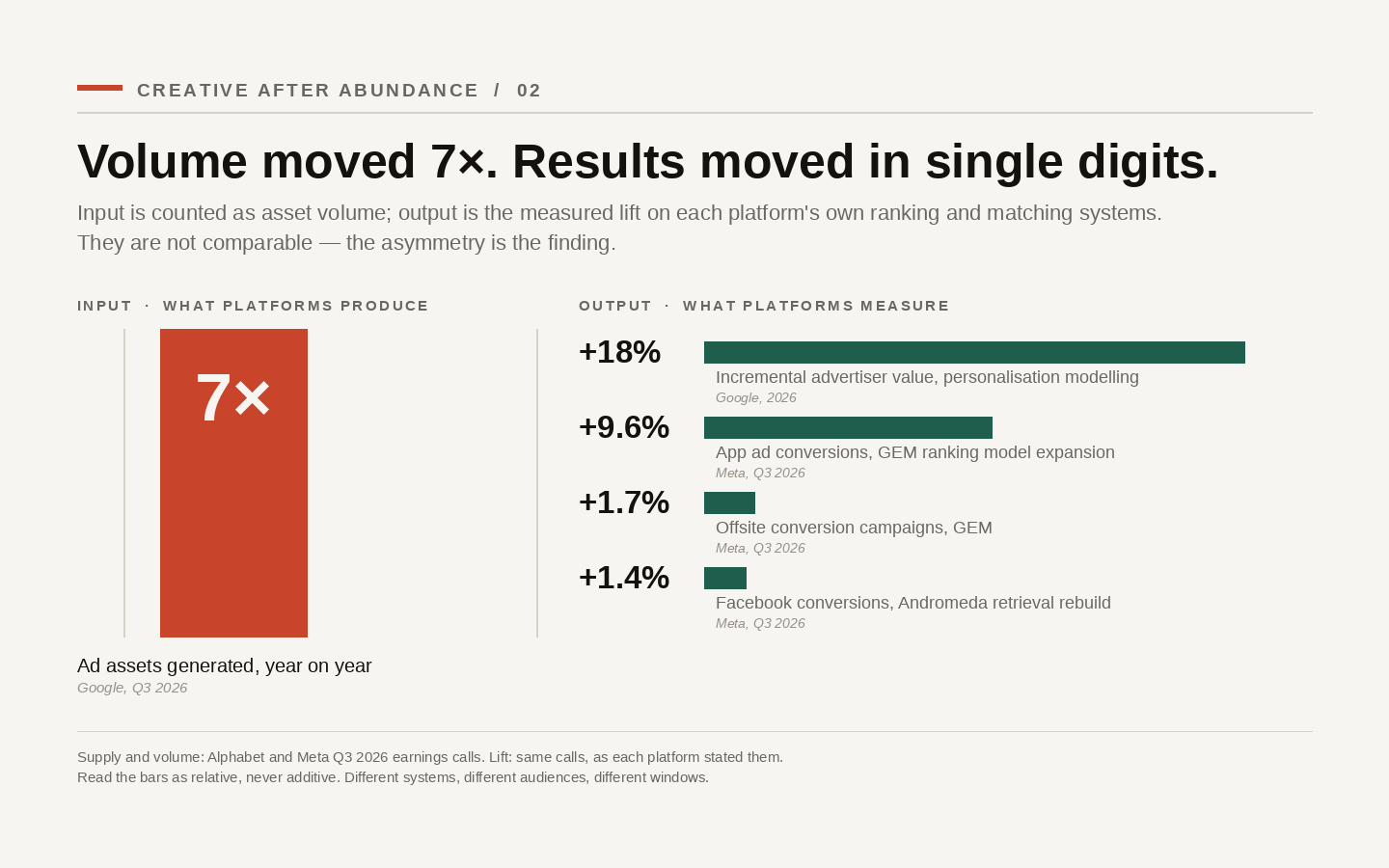
The same pattern shows up in the engineering numbers. Meta’s GEM ranking model, extended to more surfaces, lifted offsite conversion campaigns by 1.7% and app ad conversions by 9.6%. Its Andromeda retrieval rebuild added 1.4% on Facebook. Google says personalisation modelling delivered 18% incremental advertiser value in 2026.
Read the two sets of numbers together. Supply multiplied by seven. Performance moved in single digits.
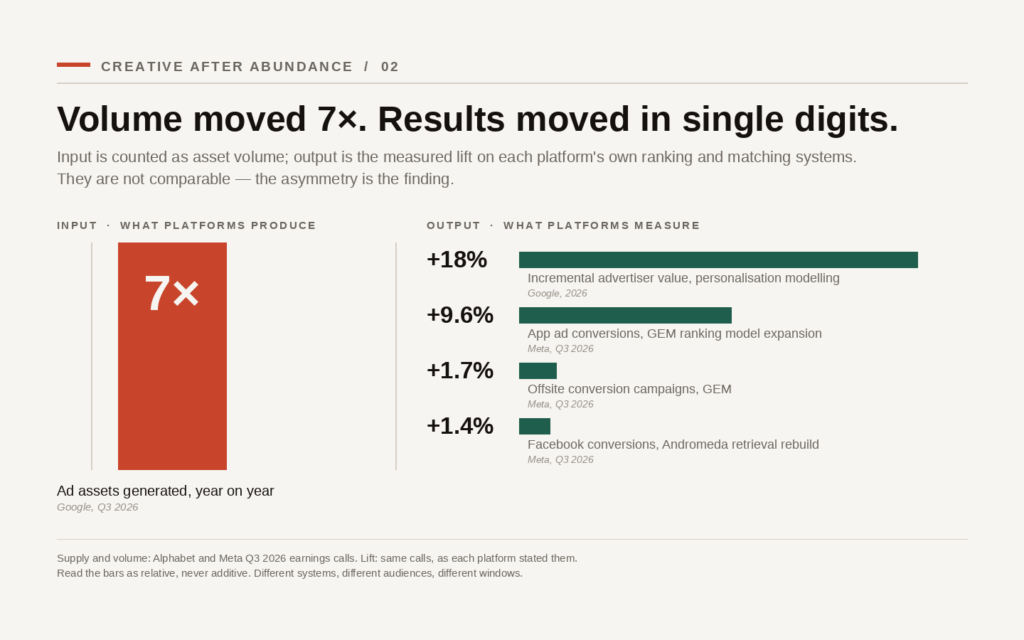
That is not a contradiction. It is the shape of the new market. Creative has become the input; the allocation system is the product. The platforms are not really selling you the ability to make more ads. They are selling you the ability to find the two that work among the thousands — on their terms, not yours.
Consequence one: homogenisation is now a default setting
In October, Bookshop.org discovered that a Meta account update had opted it into a generative feature, and that the feature had added an AI illustration to a human-made ad without the bookseller’s knowledge. It switched off every AI ad feature Meta offered.
The commercial terms that took effect on 30 October make the pattern explicit: advertisers are now “solely responsible” for whatever Meta’s AI features create or change, including features they never switched on. Some agencies have responded by disabling the platform’s automation altogether. “If every one of those isn’t manually unchecked,” Ryan Adams of the agency Exverus told Adweek, “the enhancements still apply.”
The compliance problem is interesting. The strategic problem is worse. When every advertiser optimises towards the same predicted-response surface, output converges. You do not end up with ten million different ads. You end up with ten million versions of the same ad, because the model was trained on what already worked and is now aimed at the same audience graph as every other advertiser’s model.
Consequence two: your test signal is decaying
Volume was never free, and one of the things it bought you was statistical discipline. If a variant cost real money to produce, you tested three, not three hundred, and you thought hard about which three.
At 95% confidence, a hundred variants will hand you roughly five “winners” that are pure noise. Your dashboard cannot tell the difference between a genuine insight and a rounding error. The old discipline — change one variable, hold everything else — was enforced by scarcity. From here on it has to be enforced deliberately, by someone with the authority to call the test over.
Consequence three: the attention threshold rises
Every additional unit of supply raises the price of being noticed, and that price is paid in relevance rather than in frequency. This is the part that never shows up in a creative-volume dashboard: as the median ad becomes better produced and less remembered, the cost of the first second rises for everyone.
Attention is the one input nobody has learned to manufacture. You can rent it. You cannot generate it.
What stays scarce
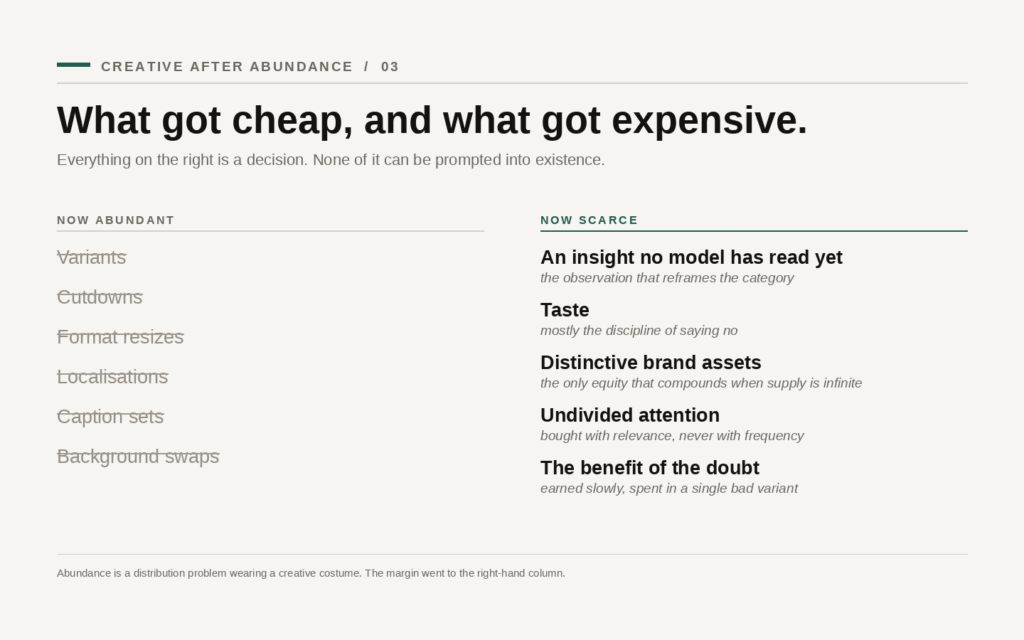
Three things, and none of them is a deliverable.
Insight
A true and non-obvious thing about the customer, usually found somewhere the model has not read: a service call, a returns log, a store aisle, a competitor’s pricing page. Models are extraordinary at reorganising what has already been written down. They are useless at noticing what has not.
Taste
Which in practice means the discipline of saying no. Generation is additive by default. Judgment is subtractive. Every team now owns a machine that will happily produce a hundred options; almost none has anyone empowered to delete ninety-eight of them.
Memory structures
The distinctive assets that let a two-second exposure do the work of a thirty-second one. This is the only equity that compounds when supply is infinite, and the only one that gets actively damaged by automated “enhancements” that nobody reviewed.
What this does to a team
The ratio inverts. If output is cheap, the expensive person should be the one deciding what not to make.
Stop briefing volume. “We need forty cutdowns by Friday” is a request a tool can now satisfy, which means it has stopped being a strategy. Brief the one idea that must survive.
Split the producer role. The old production generalist becomes two jobs: an editor who owns judgment across a large body of machine-made options, and an operator who owns the systems that generate and route them. Most teams have hired the second and skipped the first.
Hire for reading. The most valuable creative hire of the next two years may be the strategist who can sit with a results table and tell you the difference between a real effect and a five-variant fluke.
Give someone the asset register. Distinctive brand assets — the jingle, the colour, the character, the layout — need an owner with veto power, not a shared drive.
A working rule set for AI-assisted creative review
Five rules I would apply tomorrow.
1. Run the distinctive-asset test first. Before anyone argues about the hook, ask whether the asset would still be recognisably yours with the logo removed. If the answer depends on the logo, the variant has failed regardless of its click-through rate.
2. Pre-register the hypothesis and the kill criteria. Write down what you expect, and what result would make you stop, before you generate anything. This is the cheapest defence against the multiple-comparisons problem described above.
3. Cap the variants. Change one thing. A hundred options do not produce a learning; they produce a shortlist. Constrain the test to what your sample size can actually resolve.
4. Sign off on anything the platform changed on your behalf. Given the new terms, unreviewed auto-enhancement is both a brand risk and a legal one. Treat platform defaults as a supply chain you are responsible for.
5. Judge on memory, not just on response. A variant that wins the click and loses the brand is a slow loss booked in a different quarter from the win. Measure both, or you will optimise your way into being forgettable.
The uncomfortable conclusion
The industry spent a decade treating creative as the expensive, unpredictable part of marketing, and media as the scientific part. Generative tools have inverted that. Media buying has been largely absorbed into automated bidding, and the unpredictable, expensive part — the part that decides whether anyone remembers you — is exactly where the humans still are.
Abundance is a tax on attention. The teams that win the next two years will not be the ones who produce the most. They will be the ones who can prove, variant by variant, that the thing they kept was worth keeping.