Own the Record or Own the Conversation: China’s Split From Western CRM
The word that does not translate
Try explaining domain to a colleague in Austin and watch the sentence fall apart halfway through. The dictionary answer is “private domain,” three words that in English suggest a gated community, a members-only forum, or something faintly illegal. None of them describe what a Chinese retailer means when she says it.
What she means is blunter and more useful: the list of people she can still message on a Tuesday afternoon without paying anyone for the privilege.
That is the whole idea. Everything else — the tools, the dashboards, the org charts, the agency decks — is scaffolding built around that one capability.
Now the comparison. Western marketing answers the same question with a different instrument, Customer Relationship Management. Both sides claim to “own” the customer. They mean entirely different things by the verb, and that difference explains why a brand with immaculate CRM hygiene can still feel invisible to the people who bought from it last spring.
The short answer
If you read only one section, read this one.
- CRM sells memory. It accumulates structured facts about a person, normalises them, and makes them survive staff turnover and channel changes. Its promise is continuity of knowledge.
- Private domain sells presence. It keeps the customer inside a conversation the brand controls, so the next contact costs almost nothing. Its promise is continuity of access.
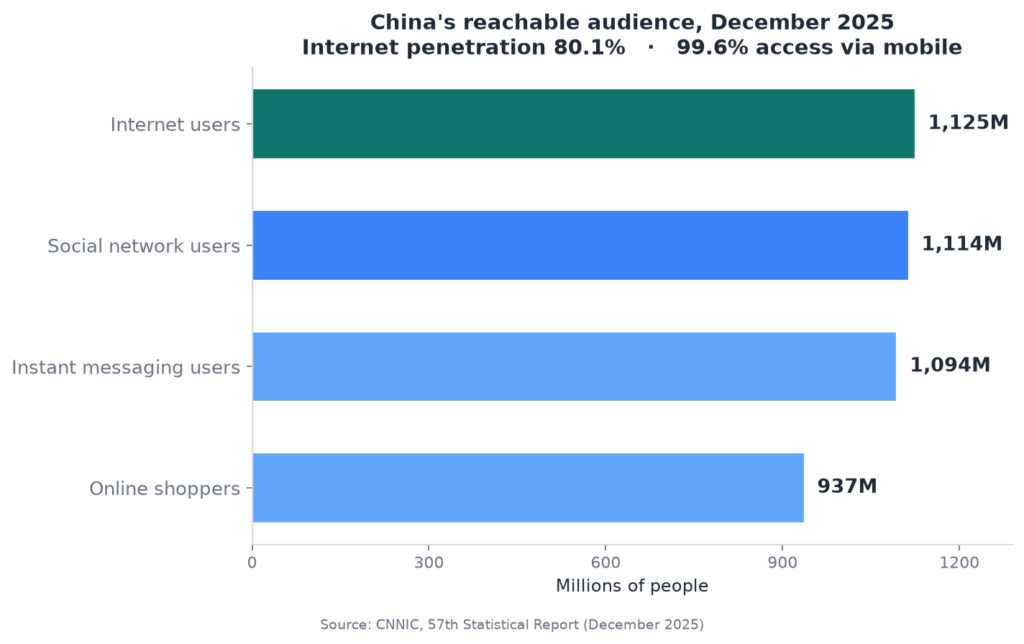
- China built the second model because the terrain demanded it. By December 2025, 1.125 billion Chinese were online at 80.1 percent penetration, and 1.094 billion of them used instant messaging — 97.2 percent of all netizens. When nearly everyone is reachable in a chat app, building your own destination and waiting for visitors is an odd way to spend a budget.
- The two are converging, not competing. Asia-Pacific is the fastest-growing CRM region at 16.3 percent through 2033, and China is already the largest CRM market inside it. Chinese brands never abandoned the database. They put presence on top of it.
Ownership by database: what CRM actually sells
CRM grew up around a promise that sounded like engineering and behaved like accounting. Collect enough structured facts — name, account, order history, ticket count — and you can predict the next purchase and automate the follow-up. The center of gravity is the record. A customer is a row. A relationship is a timeline of events the software logged.
That model fit Western markets because Western brands built their own real estate. They owned websites, bought email lists, rented attention on Google and Meta, and measured everything through pixels. The CRM sat in the middle and answered one question: what do we know, and what should we do next?
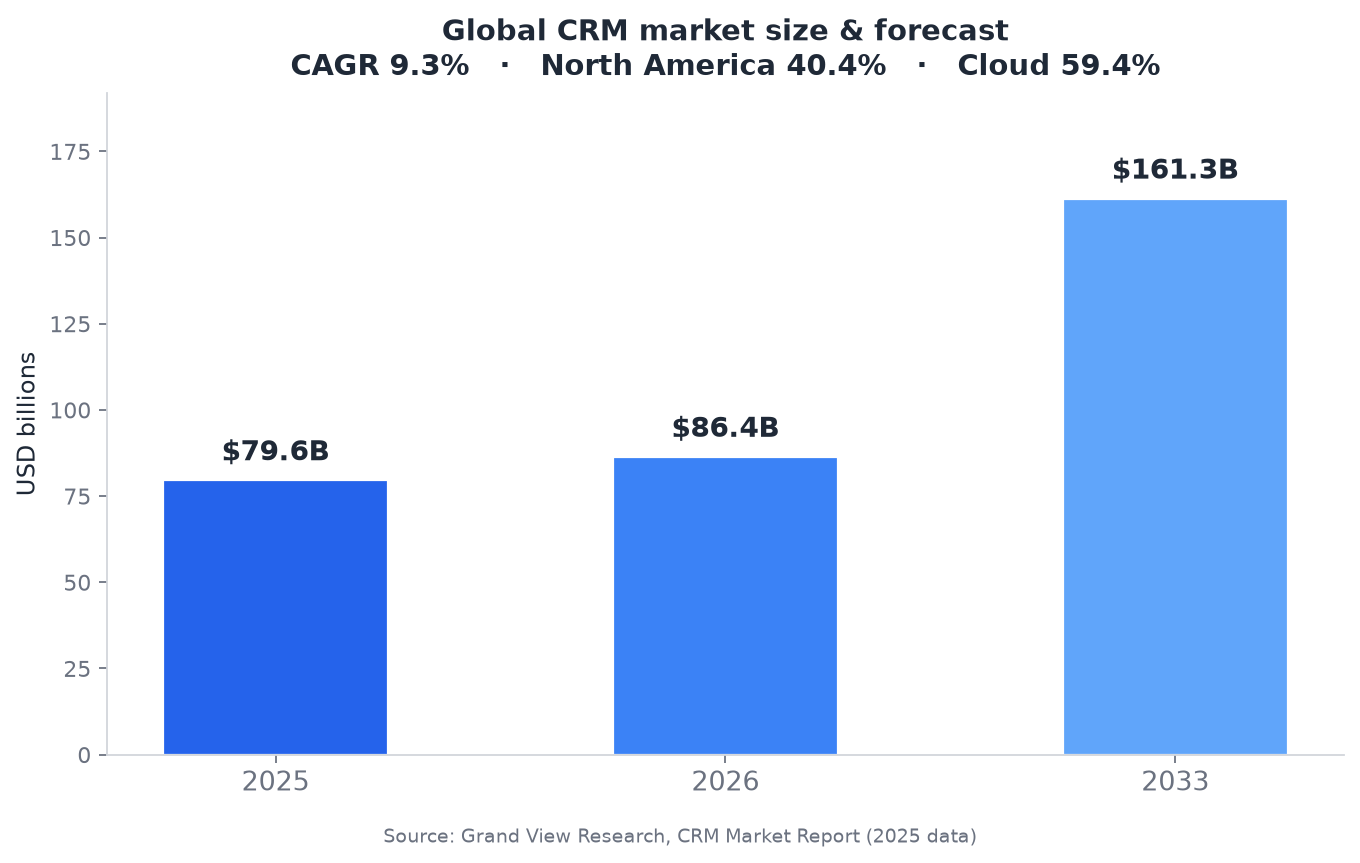
The market for that answer is vast and still growing. Grand View Research estimates global CRM spending at USD 79.6 billion in 2025, USD 86.4 billion in 2026, and USD 161.3 billion by 2033, a 9.3 percent compound annual rate. North America took 40.4 percent of 2025 revenue; cloud deployment accounted for 59.4 percent. Treat those as one firm’s estimate rather than scripture — research houses disagree wildly on the total — but the direction is not in dispute.
What CRM sells, stripped of the sales deck, is deep memory. Standardised memory. Memory that outlives the account manager. And it sells that memory as licensed software, operated by the buyer, sitting in the buyer’s back office.
Ownership by relationship: what private domain actually is
Private domain inverts the unit of ownership. The customer is not a record you query. The customer is a person you can still talk to tomorrow. The word “private” refers to control of the audience, not secrecy: the brand holds the connection directly and does not re-buy access every time it wants to say something.
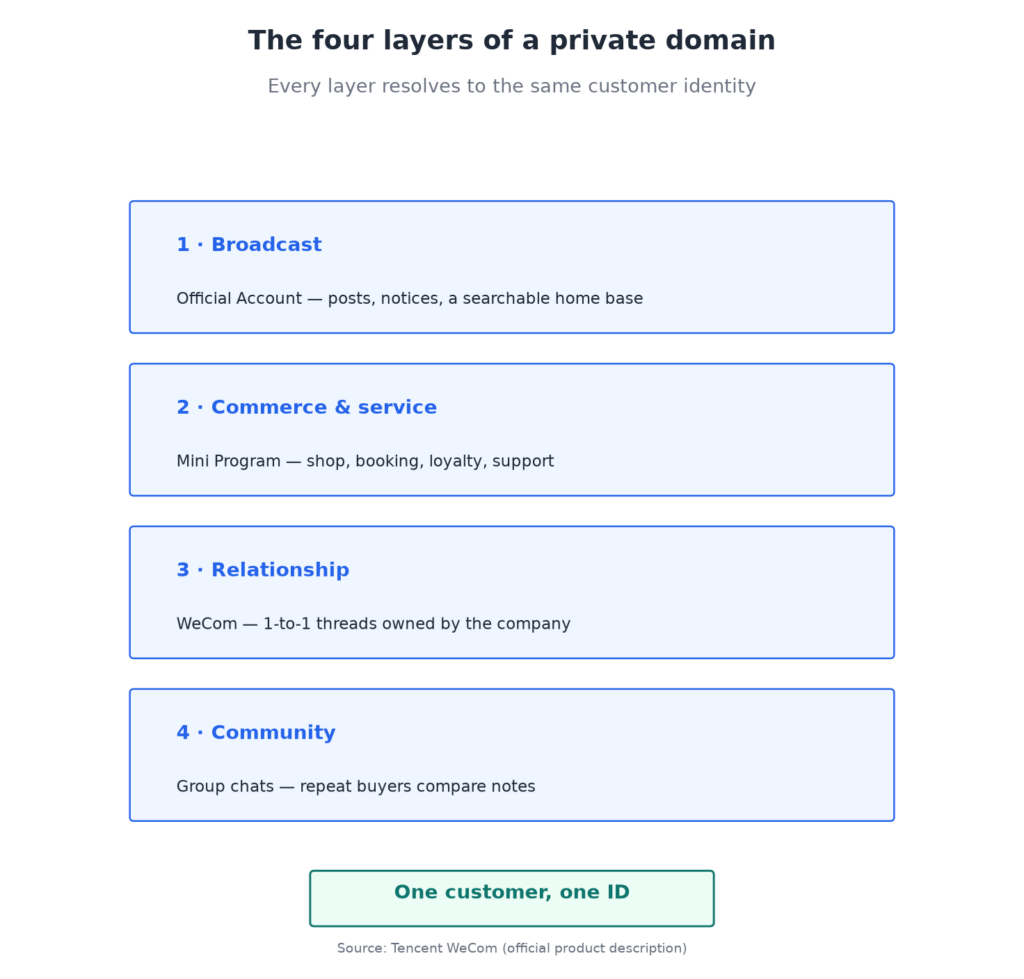
In China the container for that connection is almost always WeChat. A brand’s private domain is the sum of four things — Official Account followers, Mini Program visitors, WeCom connections, and the group chats where repeat buyers gather. None of it sits on a server the brand owns. All of it sits inside Tencent’s ecosystem, which the brand operates as though it were the front lawn.
One clean sentence separates the models: a CRM is a system of memory, and a private domain is a system of presence.
Memory compounds slowly and quietly. Presence decays quickly and loudly. That is why the two feel similar on a slide and behave nothing alike in a quarter.
The ownership clause nobody reads
Worth pausing on a detail buried in Tencent’s own documentation for WeCom, the enterprise messaging layer. The product is described as connecting staff to customers on Weixin, running Mini Programs and Weixin Pay inside the app, exposing more than 200 APIs for custom applications — and then, almost as an afterthought, this: the customer relationship is owned by the company and is preserved even after the employee moves on.
Read that again. A platform vendor is advertising the exact property CRM vendors have sold for thirty years: continuity of the relationship independent of whoever happens to be managing it. In the West that promise arrives as a database feature. In China it arrives as a chat product with a clause.
The clause answers the objection any Western buyer raises within ten minutes. If the relationship is a human conversation thread, what happens when the human resigns, gets poached, or simply stops replying? The answer inside the Chinese stack is that the thread belongs to the company, not the employee. That single mechanism is what turns a tactic into an asset.
It is also, as we will see, the most fragile part of the argument, because the ownership is contractual rather than technical.
Where the two overlap
Neither model is the other’s enemy. Both answer one question: how do you keep a customer after the first sale without renting them back from an ad network every quarter?
Both store contact data. Both track behaviour. Both chase repeat purchase. Both lean harder on automation each year. A CRM segments and triggers; a private domain segments and messages. On paper the objectives are identical, which is exactly why teams confuse the tools.
They look like siblings until you ask who controls the front door.
| Dimension | CRM (memory model) | Private domain (presence model) |
|---|---|---|
| Primary channel | Email, owned site, ad platforms | WeChat, WeCom, Mini Programs, group chats |
| Unit of ownership | The contact record | The open conversation |
| What accumulates | Structured facts | Conversational history and social proximity |
| Cost of the next touch | Low but variable, tied to deliverability | Near zero once connected, inside the app |
| Relationship temperature | Logged and episodic | Continuous and ambient |
| Core metric | Pipeline, retention, lifetime value | Repurchase rate, reply speed, activity |
| Infrastructure | Licensed software you operate | A super-app layer you rent and operate |
| Failure mode | The record goes stale | The conversation goes cold |
That last row is the one to memorise. A neglected CRM fails silently: the data degrades, the segments rot, and nobody notices for two quarters. A neglected private domain fails in public. People leave the group, mute the account, archive the contact, and the damage is visible in a week.
Why China’s terrain produced private domain
China did not build private domain out of contrarianism. It built it because the Western stack did not fit the ground.
Start with where the people are. The China Internet Network Information Center’s 57th statistical report, covering December 2025, counts 1.125 billion internet users and 80.1 percent penetration, up 1.5 percentage points in a year. Inside that population, 1.094 billion use instant messaging — 97.2 percent of all netizens — and 1.114 billion use social networks. Mobile access reaches 99.6 percent of users.
Commerce rides the same rails. Online shoppers hit 937 million by the same month, 83.2 percent of netizens. Food delivery reached 630 million, adding 37.5 million users in a year and 2.6 points of penetration. People do not leave the app to buy. They buy where they already are.
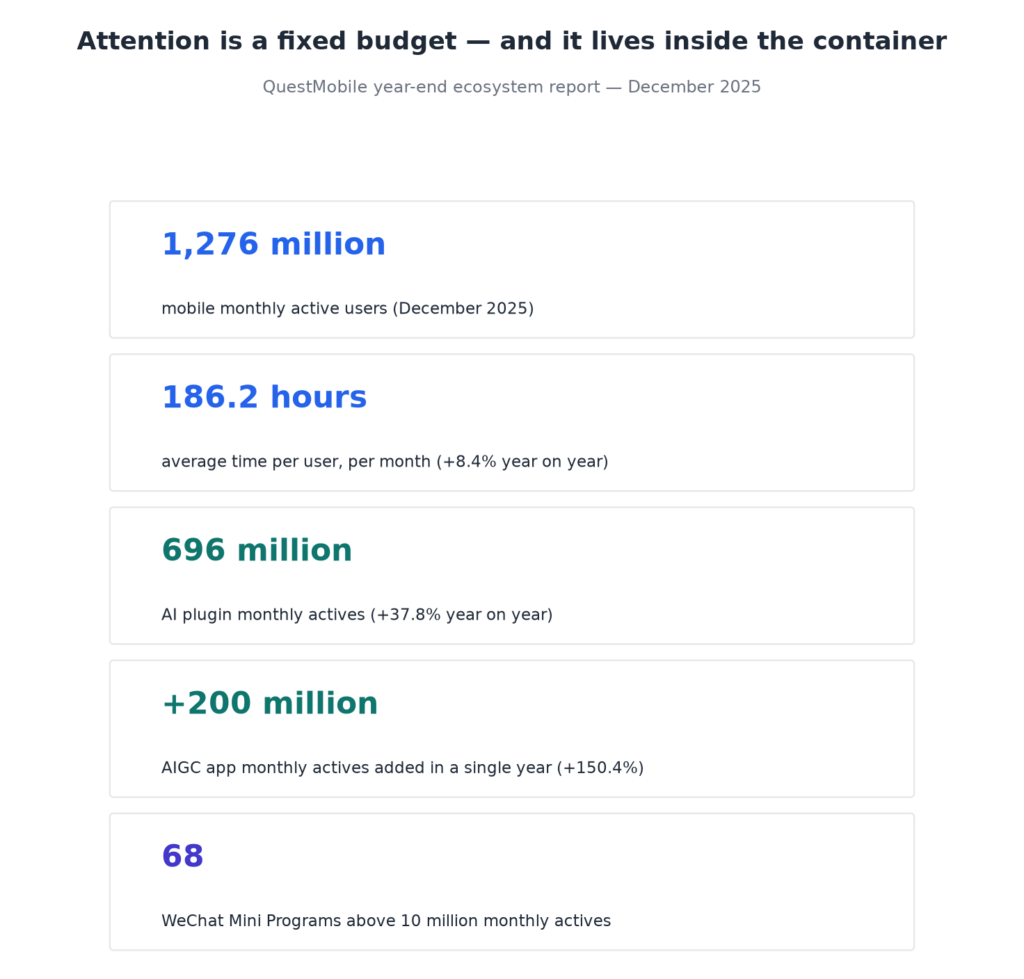
Then consider attention, which is the only resource a marketer truly competes for. QuestMobile’s year-end ecosystem report puts China’s total mobile monthly actives at 1.276 billion in December 2025, with average time per user at 186.2 hours a month, up 8.4 percent year on year. Six hours a day, spent inside a handful of containers. A brand that wants a share of that budget has to live in the container, not send mail to it.
And the service layer is where the transactions land. QuestMobile counts 68 WeChat Mini Programs above 10 million monthly actives — more than the equivalent APP ecosystem produces. A storefront with ten million monthly visitors, running inside a chat app, with no app store, no download, no install prompt.
Put those three facts side by side and the logic stops being exotic. Private domain was not some clever idea somebody had. It was the only sensible response to an internet where the audience, the payment rail, and the conversation all share one address.
The stack, layer by layer
Private domain is not a tool. It is a stack, and each layer does a different job on the same identity.
- Official Account — the broadcast layer. Posts, notices, a searchable home base that behaves like a slow-moving publication.
- Mini Program — the commerce and service layer. A shop, a booking engine, a loyalty card, a support ticket, without leaving the app.
- WeCom — the relationship layer for staffed businesses. One employee, or an assistant standing in for one, talking to one customer, with the thread owned by the company.
- Group chats — the community layer. Repeat buyers compare notes, complain, recommend, and the brand listens in.
What makes this a stack rather than a pile is the shared identity. One person, one ID, moving from a public post to a checkout to a one-to-one thread to a group. The brand sees one continuous human instead of four disconnected logs. That continuity is the product. Lose it and you are just running four unrelated channels badly.
What AI changed, and what it did not
The obvious 2026 story is that AI made conversational marketing affordable at scale. The less obvious story is where the AI physically sits.
Watch the deployment pattern. QuestMobile recorded AIGC apps adding more than 200 million monthly actives in a single year, growth of 150.4 percent, while AI packaged as a plugin inside existing apps reached 696 million monthly actives, up 37.8 percent. The plugin number is the interesting one. In China, AI arrived inside the container rather than beside it: a button in a chat app, an assistant inside a mini program, not a separate destination asking for a download.
That placement changes the economics of presence. Drafting the opening line of a WeCom conversation, condensing a thousand group messages into three product signals, answering the first question before a human sees it — these were the tasks that made private domain expensive to run at scale. Each used to require a person. Now each requires a person to check the work.
The West is converging from the other direction, but not by copying the mechanics. Grand View Research attributes CRM’s forecast growth to AI, automation, and omnichannel engagement built into the platform, and flags Asia-Pacific as the fastest-growing region at 16.3 percent through 2033, with China already the largest CRM market in that region.
Which is the tell. China never abandoned CRM. It layered presence on top of it — and the AI it deploys sits in the layer where the customer actually is.
Reactivation without buying attention again
The practical difference that keeps Western marketers awake sits in the price of the second conversation.
In a CRM-plus-ads model, reaching a lapsed buyer usually means buying the attention again: another send, another retargeting pool, another auction, another creative refresh. Every reactivation carries a media line item, and every media line item needs a forecast.
In a mature private domain the second conversation is nearly free. The person is already in the group, already following the account, already one tap from a storefront. A restock note, a group-only drop, a question asked at the right hour — none of it carries incremental media spend. The cost was paid once, at the moment of connection.
Which is why Chinese operators treat the first purchase as enrolment rather than conversion. The sale opens the relationship; it does not close the funnel. That reframing travels across borders more easily than any specific tool.
Metrics that move here
Measure a private domain with CRM instruments and you will read the wrong dashboard. Open rate and pipeline value say almost nothing about whether a community is alive.
The numbers that move are activity numbers, and they are unglamorous: the share of group members who spoke this week; median time to a human reply in a WeCom thread; the share of Mini Program visitors who return within thirty days; repurchase rate among connected users compared with unconnected ones; and the negative indicators nobody puts on a slide — mute rate, archive rate, exit rate.
Western CRM optimises for records getting richer. Private domain optimises for relationships getting warmer. Both are measurable. They are simply not the same scoreboard, and borrowing the wrong one is how good operators end up defunding the thing that was working.
What a CRM cannot replicate
A CRM can store a WeChat ID. It cannot live inside WeChat. The constraint is structural, not technical.
The super-app is the destination; the CRM is the back office. When a person’s messaging, payments, content, and customer service all happen in one app, the system sitting outside it is always one step removed from the action. The CRM can confirm that a message went out. It cannot feel the conversation.
There is also an assumption gap, and it is wider than the software gap. CRM assumes the customer will come to a branded channel: a website, an app, an inbox. Private domain assumes the brand must go to the customer’s channel and stay there. No licence, no integration, no API closes that gap. Only presence does.
Four risks worth naming before you commit
Platform dependency. The relationship lives on rented land. Terms change, reach changes, and a brand whose entire customer base sits inside one company’s ecosystem carries a single point of failure that no contract removes.
Ownership is contractual, not technical. The clause that “the company owns the relationship” is a platform promise, not an engineering fact. It holds as long as the terms of service hold. Read them before you build a seven-figure business on top of them.
Relationship fatigue. Message too often, sell too hard, and the closeness that made the model work curdles into noise. Groups go quiet, accounts get muted, contacts get archived. Your most valuable asset is also the easiest to ruin.
Measurement blur. The journey crosses accounts, mini programs, chats, and groups, so attribution gets muddy. Did the repurchase come from the group drop or the coupon? A brand that cannot answer that ends up funding activity it cannot defend in a budget meeting.
The hybrid model, which is where this ends
The operators doing well in 2026 are not picking a side. They run both, with a division of labour.
Put the record in a CRM so the business has a system of truth: finance, pipeline, cross-channel history, the audit trail, the stuff a CFO asks about. Put the relationship in a private domain so the customer stays reachable and warm. The CRM answers what do we know. The private domain answers can we still talk to them tomorrow.
For a Western brand entering China, that means treating WeCom and Mini Programs as a front-end layer sitting on the global CRM that already runs the back office. For a Chinese brand expanding outward, it means exporting the discipline — continuous, conversational, presence-first — into email, messaging apps, and owned apps the West already uses. The channel changes. The habit does not have to.
When to use which
| Situation | Lead with | Why |
|---|---|---|
| High value, infrequent purchase, long consideration (enterprise software, B2B services) | CRM | The record and the pipeline carry the deal; conversation is a courtesy |
| Repeat purchase, low ticket, high frequency (consumer retail, education, local services) | Private domain | The second conversation is the growth lever, and media cost destroys the margin |
| Audience already clustered inside one super-app | Private domain | Presence beats destination when everyone is already in the room |
| Audience spread across many channels and countries | CRM | A record travels further than a chat thread |
| Heavily regulated category with audit obligations | CRM, with private domain attached | Provenance beats proximity in an examination |
Most readers will need both. The mistake is assuming they are the same instrument with a different accent — and then hiring for one while running the other.
Frequently asked questions
What is private domain in a single sentence?
It is a marketing model in which a brand operates its own audience inside a super-app — mainly through Official Accounts, Mini Programs, WeCom connections, and group chats — so that reaching a customer again does not require buying their attention again.
Is private domain just CRM with Chinese characteristics?
No. A CRM stores the customer as a record and reaches them through channels the brand owns or rents. A private domain keeps the customer inside an open conversation on a platform the customer already uses daily. One accumulates knowledge; the other accumulates access. The distinction matters most when the buyer goes quiet for six weeks, because only one of the two models can restart the relationship for free.
Why didn’t China build the website-and-email playbook first?
Because the audience arrived somewhere else. Instant messaging reached 1.094 billion people, 97.2 percent of China’s netizens, while the country’s mobile internet was still consolidating. By the time brands had budget for owned channels, the owned channel that mattered was already someone else’s app. The economics pointed at presence rather than destination.
Can a brand outside China build the same thing?
The principle travels; the mechanics do not. Outside China the equivalent is owned community plus first-party messaging: a branded app or membership space, a messaging channel the brand controls, and a staffed relationship layer with the company — not the individual — holding the thread. What does not travel is the convenience of one app owning identity, payment, and conversation at once.
Where does AI actually fit?
Inside the conversation layer, not beside it. In China, AI deployed as a plugin inside existing apps reached 696 million monthly actives, far more than standalone AI apps accumulated. The use case is not generating campaigns at scale; it is keeping thousands of one-to-one conversations alive without hiring thousands of people, while a human checks the work.