Shorter Funnels, Same Abandonment: What Actually Transfers From China’s Checkout Model
Why China’s Conversion Funnels Are Shorter, and What Breaks When You Copy Them Abroad
In China, a purchase can finish inside the app where it started. You see a product in a feed or a live room, you tap the buy button, you confirm with a fingerprint, and the order is placed. No new account, no card entry, no shipping form, no second website opening in a browser tab.
Move that same design into the United States or the European Union and the sequence falls apart at the first tap. The button opens a checkout owned by a merchant the buyer has never visited. The page asks for an account. It asks for an address the social platform never collected. It asks for a card number, and the buyer hesitates, because a stranger is asking for a sixteen-digit commitment with no history behind it.
The marketing did not change between those two scenes. The infrastructure underneath it did.
A short funnel is not a better-optimized funnel. It is a funnel with fewer companies inside it.
That sentence is the argument. The sections below explain where the missing companies went, what their absence costs, and what a team outside China can honestly build in their place.
What “short” actually measures
Most funnel diagrams count stages: awareness, consideration, purchase. Stage counting hides the expensive part, because stages are cheap to relabel and handoffs are not.
A handoff occurs every time the buyer crosses out of one company’s system and into another’s. Feed to landing page. Landing page to cart. Cart to payment gateway. Gateway to fraud screening. Screening to warehouse. Each crossing forces the buyer to restate something a previous system already knew: name, address, card, intent.
China’s consumer internet removed most of those crossings by concentrating four layers in one place. They work like rails, the way track carries a train instead of the train inventing its own route.
Rail one: identity belongs to the platform
A Chinese buyer’s login, phone number, real-name verification, and social graph usually belong to the platform rather than to the merchant. Mini-programs make the consequence visible: China counted 1.023 billion monthly active mini-program users in June 2026, and WeChat mini-programs alone reached 962 million, according to QuestMobile. A merchant operating inside that environment inherits a logged-in customer. It does not have to acquire one at the point of payment.
Rail two: payment is a confirmation, not a form
WeChat Pay and Alipay already hold the card, the bank account, and the biometric. Checkout therefore asks for a decision rather than for data. This is the largest single structural difference between the two markets, and the benchmark evidence below shows what it is worth in revenue.
Rail three: the storefront is the content
Livestream commerce in China generated more than 5 trillion yuan of GMV in 2025, close to one-third of online retail, with an audience of roughly 660 million users, according to the 2025 livestream e-commerce white paper published by the State Administration for Market Regulation’s Development Research Center together with the Chinese Academy of Social Sciences. Reuters reported in September 2026 that livestream shopping’s share of online retail had risen above 36%, up from under 18% in 2021.
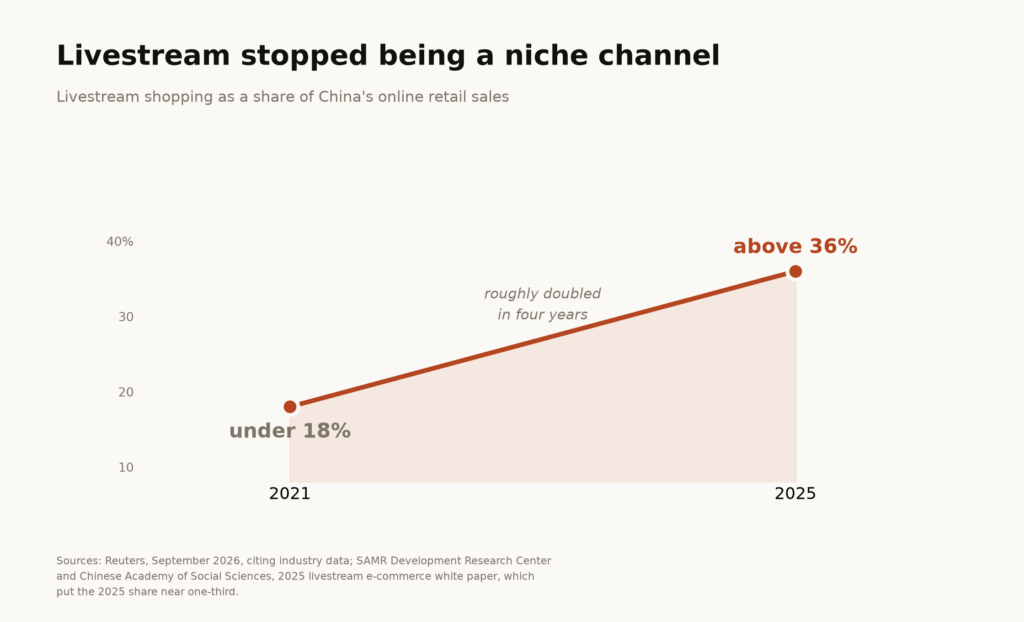
Read that as a funnel statement rather than a media statement. Roughly a third of Chinese online retail happens inside a surface that also functions as advertising. There is no separate conversion stage to hand off to, because the content stage and the checkout stage occupy the same screen.
Rail four: disputes are settled inside the app
The least discussed rail, and the one Western copies most often skip. Returns, refunds, and dispute resolution sit in the same application as the purchase, and the platform holds the merchant’s settlement, which gives it leverage to enforce an outcome. The buyer does not hunt for a support address.
This is why trust in a Chinese transaction functions as a platform product. In a Western transaction, trust is a merchant-by-merchant gamble, and buyers price it accordingly.
The scale that lets bundling work
Bundling only pays off when nearly everyone already sits inside the bundle.
China had 1.125 billion internet users at the end of 2025, an 80.1% penetration rate, according to the China Internet Network Information Center’s 57th statistical report. Mobile internet monthly actives reached 1.278 billion in August 2026, up 0.9% year on year, according to QuestMobile. Digital consumption involved 958 million users in the first half of 2025, or 85.3% of all internet users, according to CNNIC’s Digital Consumption Development Report. National online retail reached 15.97 trillion yuan in 2025, up 8.6%, and physical-goods online retail equaled 26.1% of total retail sales, according to the National Bureau of Statistics.
Those are not marketing statistics. They are the preconditions that allow a super-app to treat checkout as a utility instead of a project.
What the missing rails cost, quantified
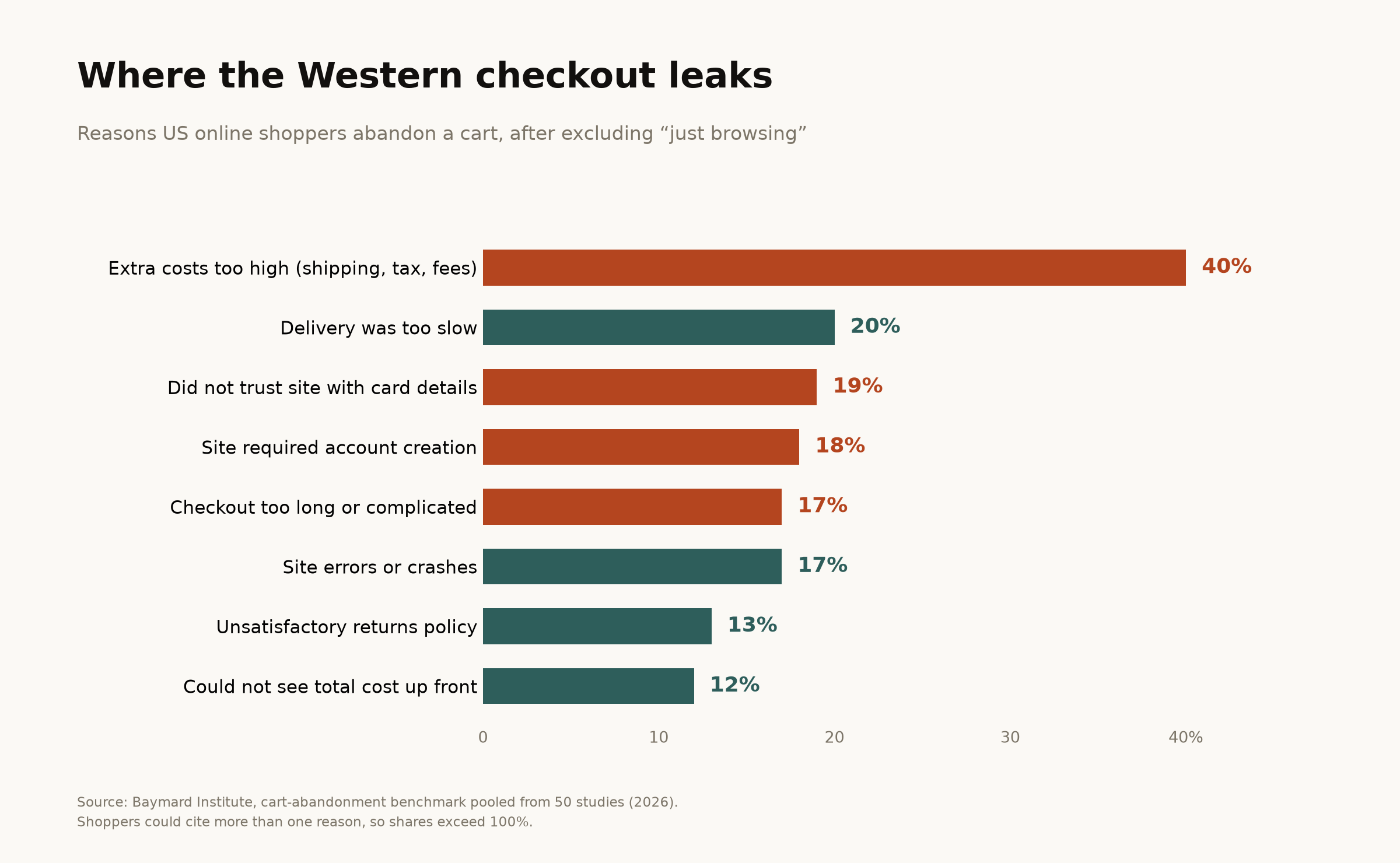
Baymard Institute has run large-scale checkout testing on US and EU retailers for more than a decade. Its current benchmark, pooled from 50 studies, puts the average documented cart abandonment rate at 70.22%. Another 42% of abandonments are attributed to shoppers who were only browsing, which is not a defect. Set that group aside, and the fixable causes take over: extra costs lead at 40%, followed by slow delivery at 20%, distrust of the site with card details at 19%, forced account creation at 18%, and a checkout that is too long or complicated at 17%. An unsatisfactory returns policy accounts for 13%, and an unclear order total for 12%.
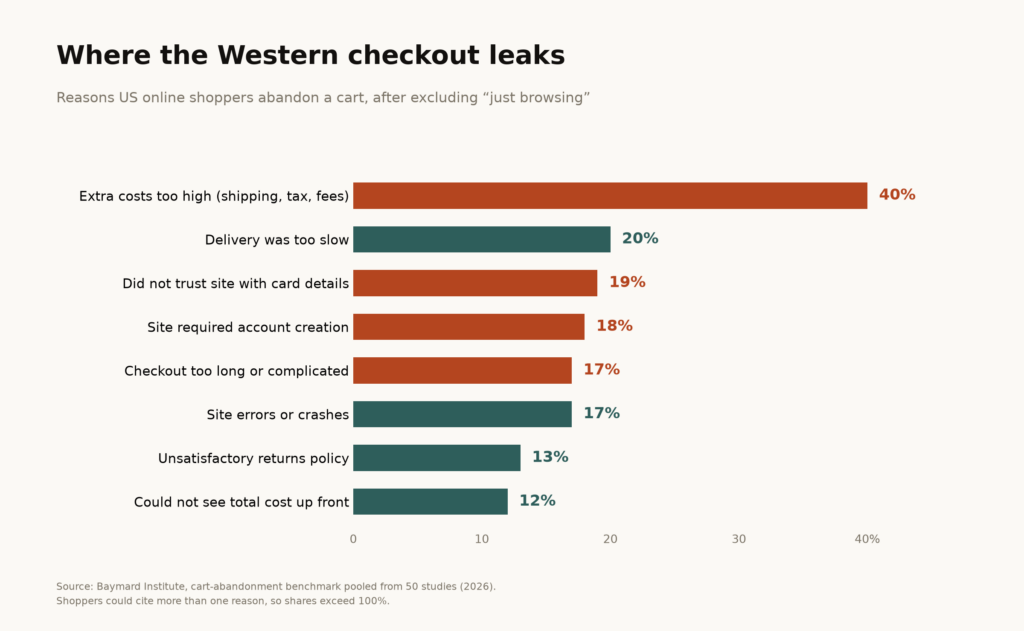
Most of those reasons are plumbing rather than persuasion, and three of them—card distrust, forced accounts, and checkout length—describe exactly what China’s bundled layer removes.
The same research quantifies the design gap. An ideal checkout can run 12 to 14 form elements, or 7 to 8 counting only input fields. The average US checkout displays 23.48 elements by default. Baymard estimates that fixing documented checkout problems alone could lift conversion by 35.26% at a large retailer, and that roughly $260 billion of orders across the US and EU combined could be recovered.
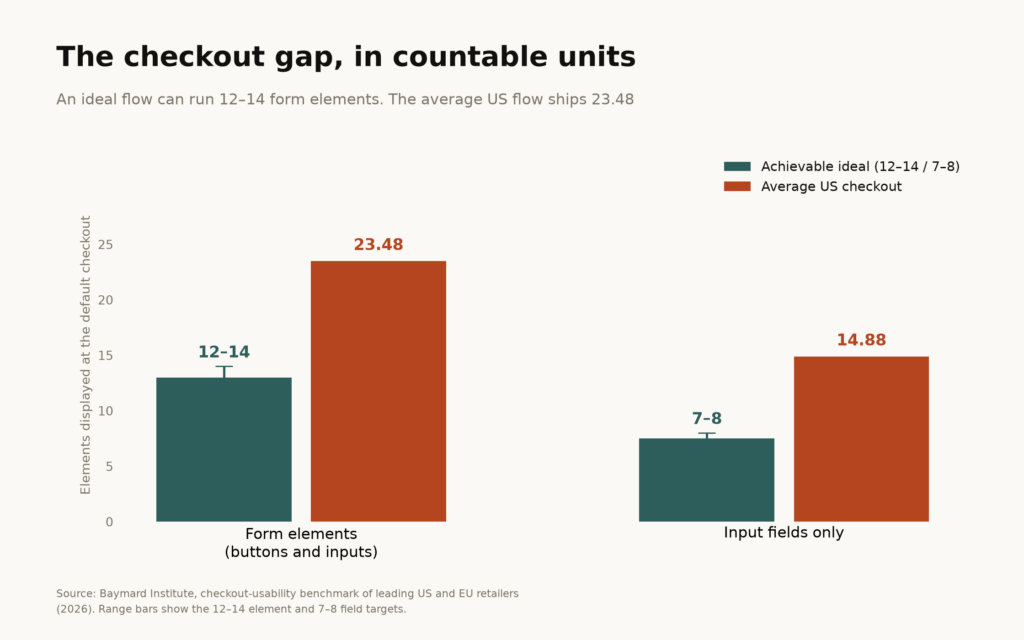
So the Western funnel does not leak because marketers are worse at persuasion. It leaks at the seams, in the places where one company passes the buyer to another.
Why the two markets are not on the same curve
Set the two systems against a single measure, and the difference stops looking like consumer temperament.
In China, 26.1% of retail sales were physical goods bought online in 2025. In the United States, e-commerce accounted for 17.1% of total retail sales in the second quarter of 2026, according to the Census Bureau’s quarterly series. China is further along, but not by an order of magnitude.
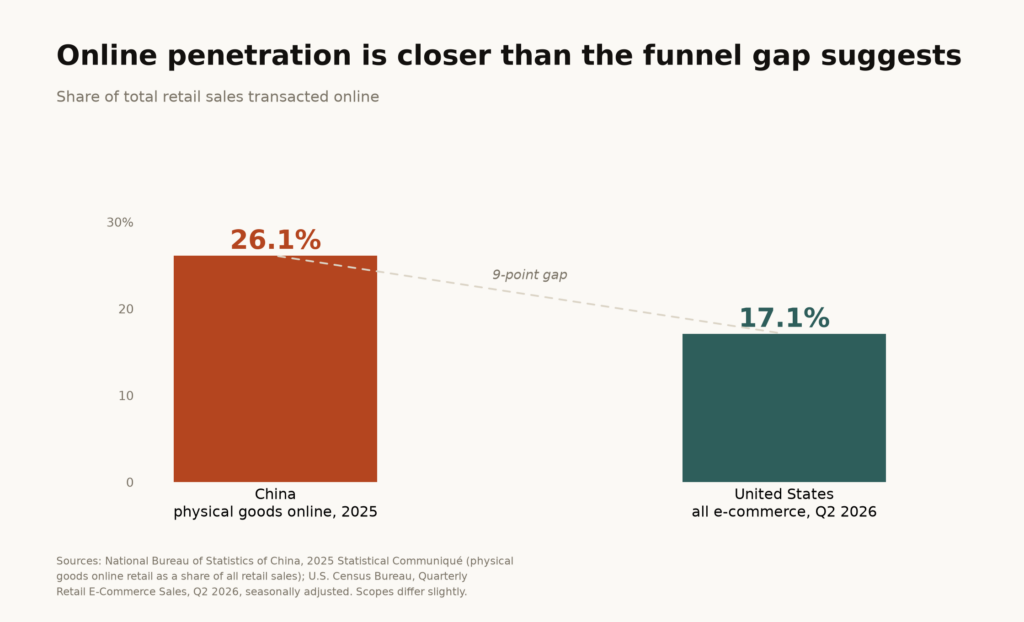
The genuine divergence sits one level lower, in who owns the checkout. In the US, the checkout belongs to the merchant, and at the moment of a first purchase that merchant is a stranger to the buyer. In China, the checkout belongs to the platform, which already knows the buyer, the address, and the payment instrument. The two markets sit at comparable online penetration, yet the friction at the point of payment is radically different. That gap in friction, rather than the gap in penetration, is what produces the difference in abandonment.
The 2026 correction: demand is softer, content is cheaper
Any honest version of this argument has to include what happened during 2026, because China’s funnel has not become easier to copy. It has become harder to run profitably.
Retail sales grew 0.4% year on year in August 2026 and 1.1% across January to August, according to Reuters. The industry now talks about a “stable and healthy phase” instead of explosive growth. A short funnel compresses the distance to a purchase. It does not manufacture demand, and it offers no protection when household spending stalls.
Meanwhile, the content rail is being automated. JD.com made its AI hosting service free to merchants in December 2025, and AI hosts can cut livestream operating costs by 80% to 90%, according to the same reporting. Regulation moved in parallel: China’s rules on labeling AI-generated content took effect in September 2025. Douyin has gone further, banning fully AI-generated livestreams and requiring hosts to disclose when a digital presenter is on screen.
Two consequences matter for anyone planning a copy. Content volume is no longer a moat, because the marginal cost of always-on selling is collapsing. Differentiation shifts to what an AI host cannot fake: product specificity, returns handling, and a named human accountable for a claim.
Four places the tactic breaks abroad
Teams transplanting the short funnel tend to fail in four predictable spots.
The payment gap. The tap lands on a checkout that requests a card and an address the social platform never held. The 19% distrust figure and the 17% long-checkout figure survive intact.
The account gap. Western platforms are walled off from one another and from payment. No single identity travels from a feed to a storefront to a wallet, so every hop reintroduces a form, and every form reopens the 18% account-creation objection.
The trust gap. Chinese buyers extend platform trust to the merchant. Western buyers extend site trust one site at a time, and a first-time visitor has none to extend.
The returns gap. A shortened funnel raises purchase velocity without raising confidence. If the return path is slow or opaque, the buyer learns that once, and the shortcut stops working on the second visit. Baymard attributes 13% of abandonment to an unsatisfactory returns policy, which is the visible tip of that problem.
None of the four is a creative failure. They are plumbing failures, and no amount of copy testing repairs plumbing.
What survives the trip
The portable part is a principle rather than a playbook.
Compress the distance between intent and payment. Fewer screens, fewer fields, fewer identities. This travels anywhere and can be measured anywhere.
Put the transaction where the persuasion happened. Shoppable video, in-feed checkout, an embedded buy button. The surface can be Western even when the rails underneath are still yours to build.
Absorb trust one layer above the merchant. Platform-level verification, buyer protection that pays out without a fight, and visible dispute outcomes. This is the rail Western teams skip most often and need most.
What does not travel is the assumption that the rails exist on arrival. They do not. You build them market by market, and you pay for them in integration work rather than in media spend.
When a short funnel is the wrong bet
Shortening is not universally correct. It fits low-consideration, low-price, easily returned goods, which describes most of what moves inside a live room. It fits badly in three cases:
- High-consideration purchases, where deliberation is how the buyer builds confidence, and speed reads as pressure.
- Regulated categories, where identity checks, age gates, and mandated disclosures have to happen at checkout.
- Complex configurations, where a form is doing genuine specification work instead of collecting data you already possess.
In those cases the goal is not fewer steps. It is fewer redundant steps, with the necessary ones designed so the buyer never enters the same information twice.
A friction audit for the next quarter
Run this against your own funnel before copying anything. Each item is pass or fail, not a score.
- Count your checkout elements. Log in, add one product, and count every field and button before payment confirmation. Anything above 14 is designed-in leakage.
- Buy as a stranger. Use a clean browser, a new email address, and a card the site has never seen. Note every point where you had to look something up.
- Test guest checkout to the confirmation page. If guest checkout exists but buries the order inside a new account afterward, it is not guest checkout.
- Buy twice. If the second purchase asks for the same data as the first, you have no identity rail.
- Time the purchase on a phone over mobile data, from first impression to paid order. Office wifi hides the problem you are trying to find.
- Read your returns page as a buyer. If a reasonable person cannot answer “how do I get my money back” within ten seconds, treat that as a checkout defect.
- Map ownership of every screen. Confirm which company owns the payment page, the fraud check, and the confirmation email. Each change of owner is a place where the buyer can drop out.
How to measure a short funnel
Conversion rate on its own will mislead you, because it hides how much work the buyer performed to get there.
| Metric | What it reveals | Where it comes from |
|---|---|---|
| Steps to purchase | Structural friction | Manual funnel walk |
| Time to purchase | Whether the shortcut is real | Event timestamps |
| Surface continuity | Share of orders completed where the impression happened | Referrer and session data |
| Repeat purchase without re-entry | Whether identity is genuinely stored | Account and payment logs |
| Form elements per checkout | Designed leakage | Checkout audit |
| First-time versus returning completion | Where the account wall bites | Cohort comparison |
A funnel that converts 2.9% in twelve steps and a funnel that converts 2.9% in three are not equivalent businesses. The second has room to cut further. The first has already spent its budget on friction.
What to do next
Start with the cheapest rail. For most Western teams, that means identity: persistent login, a saved payment method, and address memory across sessions. It costs engineering time and wins back the 18% who refuse to create an account.
Then bring the checkout into the 12-to-14 element range Baymard treats as achievable. Then move one conversion surface into the content itself and measure whether continuity holds. Keep that order, because a buy button on a video without a payment rail underneath only relocates abandonment to a more visible place.
China’s funnel is short because four companies’ worth of work was consolidated into one. You are not consolidating four companies. You are becoming all four of them at once, which makes this a roadmap rather than a tactic.
The short version
China’s conversion funnel is short because identity, payment, content, and dispute handling sit inside a single app, so the buyer never crosses a company boundary. Livestream commerce carried more than 5 trillion yuan in 2025, close to one-third of online retail, while Western carts still abandon at an average rate of 70.22%, and the average US checkout displays 23.48 form elements. Copying the visible tactic without the rails reproduces the abandonment inside a tighter and more expensive window. What transfers is the principle: fewer companies between intent and payment, the transaction placed inside the persuasion surface, and trust absorbed one layer above the merchant. What does not transfer is the assumption that the rails will be waiting when you land.
FAQ
Why are China’s conversion funnels shorter than Western ones?
Because the steps are removed by infrastructure rather than by consumer psychology. Identity, payment, content, and dispute handling all live inside the same super-app, so a buyer never leaves the environment where the product was discovered. The funnel is short because it contains no company-to-company handoffs.
Can a Western brand copy the short-funnel model?
The mechanics can be rebuilt; the rails cannot be borrowed. Shoppable video, embedded checkout, and one-tap payment all exist in Western markets. What is missing is a platform-level identity and payment layer that already knows the buyer, plus dispute handling with enforcement power. Budget for integration work, not for a plug-in.
What breaks first when a Chinese-style funnel is transplanted?
Payment. The tap leads to a checkout asking for card and address data the originating platform never collected, and the buyer stalls exactly where the design was supposed to remove hesitation. Account creation and per-site trust failures follow immediately.
Is livestream commerce still growing in China?
It is growing, but no longer explosively. Retail sales rose 0.4% year on year in August 2026. Livestream’s share of online retail has climbed past a third, AI hosts cut operating costs by 80% to 90%, and Douyin now requires hosts to disclose a digital presenter. Volume has become cheap; differentiation has not.
How should a short funnel be measured?
Track steps to purchase, time to purchase, and the share of orders completed inside the surface where the impression happened. Conversion rate alone hides how much work the buyer did, and that workload is the variable a short funnel exists to change.