Digital Hosts Don’t Close Sales. China’s Data Proves It.
At three in the morning, a livestream studio somewhere in Hangzhou is still selling. The camera is live, the comments are moving, and a synthesized voice is answering the same question about a ¥39 phone case for the fourteenth time tonight. Nobody is in the room.
That scene is not science fiction in China. It is a line item in an operating budget, and it has been one for about two years.
The short answer
AI livestream commerce in China is real, deployed at industrial scale, and now tightly regulated. It is also, in almost every case, a staffing solution rather than a selling solution. Digital hosts cover the hours nobody wanted to staff, repeat a pitch that does not change, and sit on product pages too small to justify a human. They do not replace the presenters who close high-consideration sales, and no published data shows that they do.
The distinction matters because the purchase decision is usually framed wrong. Buyers ask whether the technology works. The better question is whether the labor it displaces is worth more than the conversion it might lose. Those are different questions with different answers by category.
Key numbers, before the argument
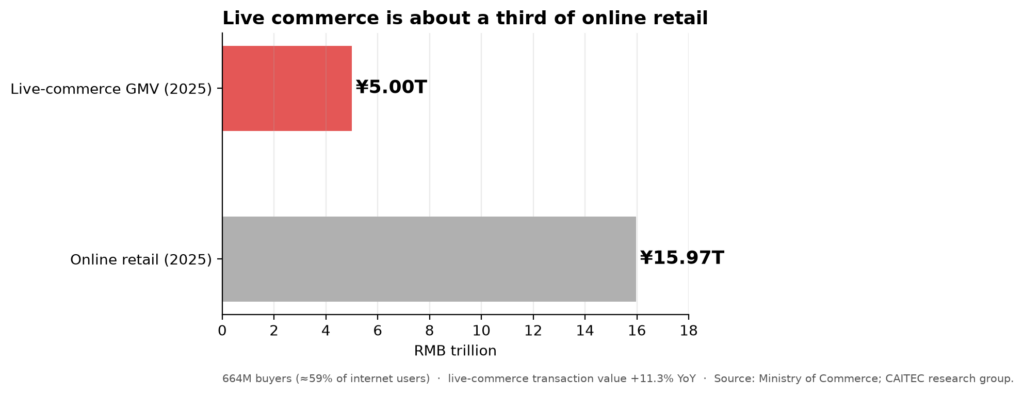
- China’s livestream commerce gross merchandise value passed ¥5 trillion in 2025, close to one third of all online retail, with roughly 664 million buyers taking part.
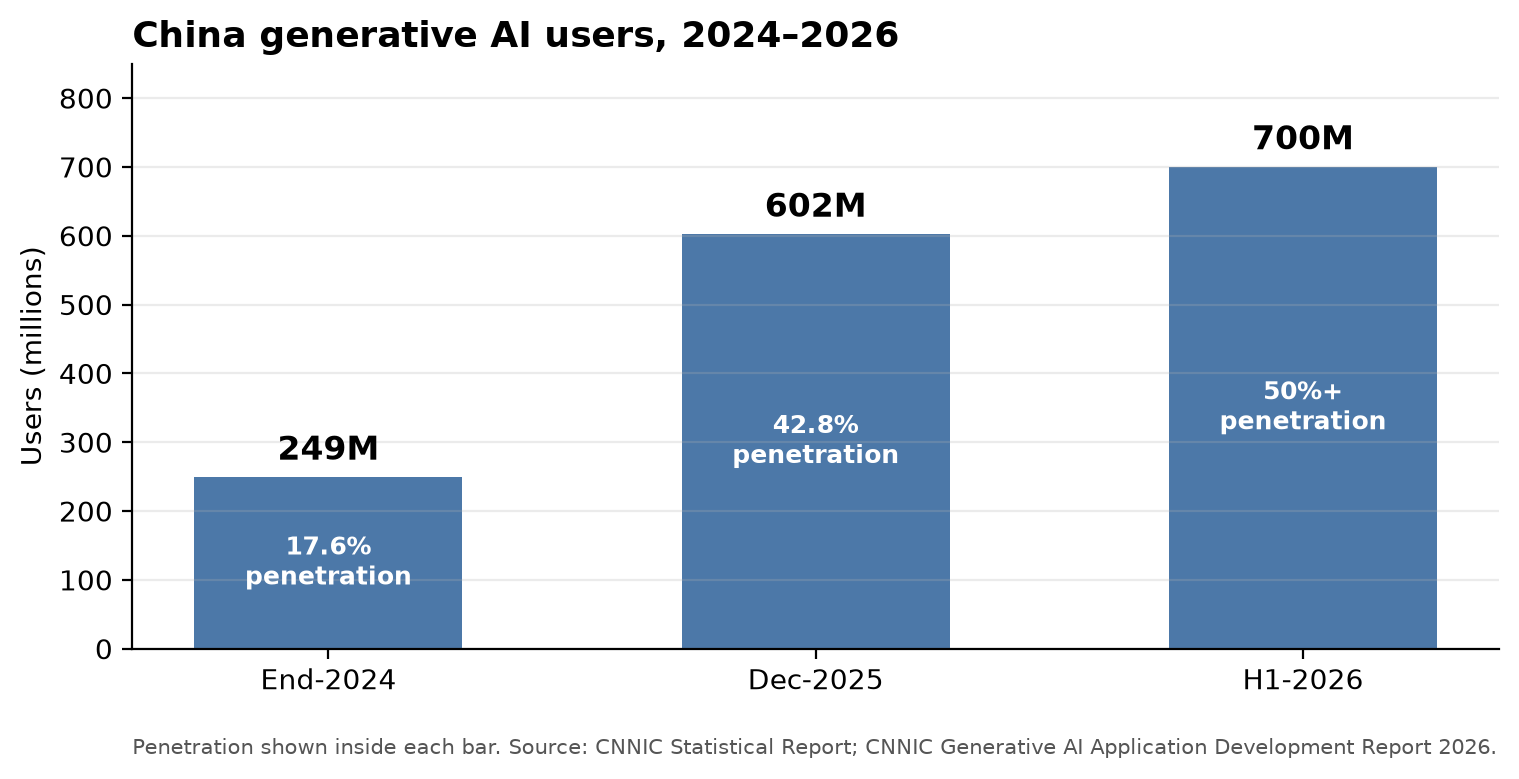
- China had 602 million generative AI users at the end of 2025, or 42.8 percent of the population, and more than 700 million by mid-2026.
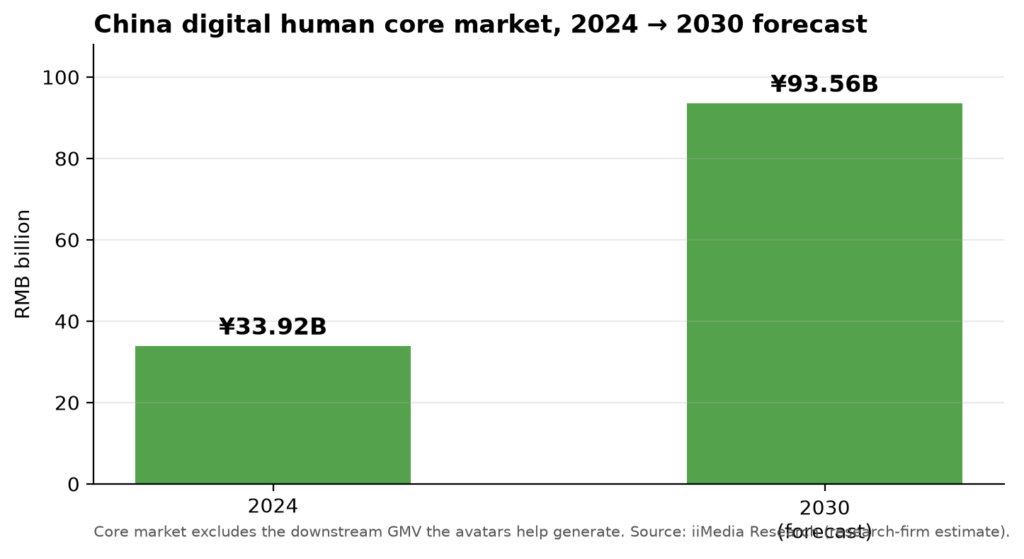
- Research firm iiMedia sizes China’s digital human core market at ¥33.92 billion in 2024, forecast to reach ¥93.56 billion by 2030.
- The cost of putting a digital human on camera has fallen to roughly one tenth of a human presenter, according to one of the country’s largest e-commerce platforms.
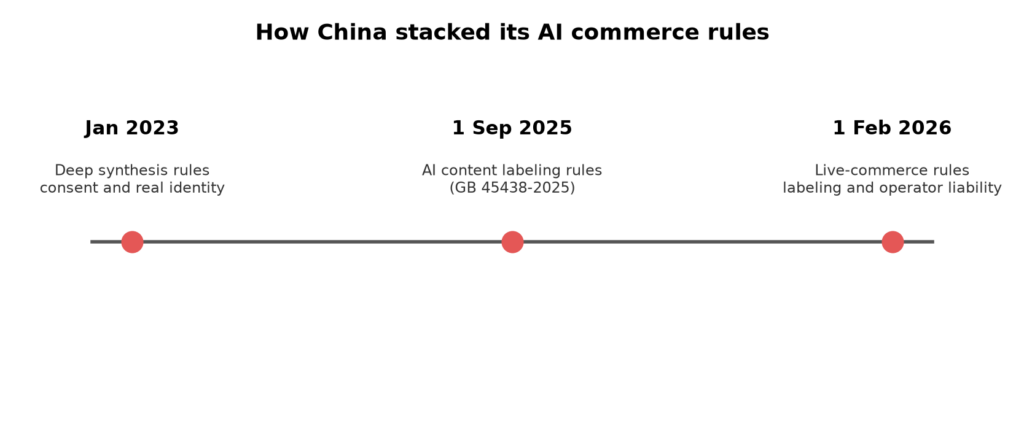
- Since 1 September 2025, AI-generated content in China must carry a label. Since 1 February 2026, a digital human selling on camera must carry one continuously, and the operator carries the legal liability.
What AI livestream commerce actually means
The phrase covers three different products that vendors sell together, and it helps to separate them.
The on-camera layer. A digital human, or virtual anchor, is a photoreal or stylized avatar driven by text-to-speech and lip-sync. It reads a script, answers a limited set of questions, and can be cloned from a real person’s likeness and voice with consent. This is the part audiences see.
The operations layer. Behind the avatar sits software that rotates scripts, restocks the product carousel, pushes coupons at set intervals, greets new arrivals by name, and filters abusive comments. In Chinese studios this role is normally filled by a human operator called the 中控 (zhōngkòng), whose job the software now absorbs in part.
The orchestration layer. The scheduling, the traffic buying, the fallback to a human when something breaks, and the compliance review of what the avatar is allowed to claim. This is where most deployments quietly live or die, and where vendors show the least.
| Layer | What it replaces | Where it breaks |
|---|---|---|
| On-camera avatar | Host hours, basic Q&A | Unscripted objection handling, charisma, negotiation |
| Operations software | Script rotation, coupons, comment triage | Novel viewer situations, sarcasm, complaint escalation |
| Orchestration | Scheduling, staffing plan, compliance review | Still needs a human owner and a supervision roster |
Strip the marketing language and the system does about three things well: it talks continuously, it matches a narrow band of viewer questions to pre-written replies, and it never needs a break. Anything beyond that is usually a rule, a template, or a person watching off-camera. Knowing which is which is the difference between a sensible deployment and an expensive demo.
The scale you are actually operating inside
There is no small version of this market. China’s online retail reached ¥15.97 trillion in 2025, up 8.6 percent, and livestream transactions grew 11.3 percent over the same period, according to the Ministry of Commerce. A research group under the ministry’s academy puts 2025 livestream GMV above ¥5 trillion and estimates 664 million participants, and calculates that livestreaming supplied about 80 percent of the increment in e-commerce last year.
Two derived figures are worth carrying into a boardroom. First, 664 million livestream shoppers against 1.125 billion internet users means roughly 59 percent of the country’s online population bought something through a livestream in the past year. Second, ¥5 trillion spread across that base works out to around ¥7,500, or roughly US$1,060, of livestream GMV per participating user annually.
Treat both with care. GMV counts orders placed, not orders kept, and returns in apparel and beauty run high. Commercial trackers publish figures well above ¥5 trillion for 2025, in one widely circulated case near ¥6.9 trillion, largely because they count order value without netting out cancellations. When you compare China with your home market, compare the definition of the number before comparing the number.
The point of the scale is not bragging rights. It is that in a market this large, a one-point improvement in off-peak conversion is a real amount of money, and a one-point deterioration in return rate is a real amount of money too. That is precisely why the operating question, not the technology question, decides outcomes.
Why it happened in China first
Three conditions had to line up, and only one of them is about technology.
The buying habit was already mass-market. Livestream shopping is a default behavior in China, not a novelty channel. When half the online population has already bought something from a live room, an automated host does not need to teach anyone a new behavior. It slots into a habit that exists.
AI usage went from early adoption to infrastructure. China reported 602 million generative AI users as of December 2025, 42.8 percent penetration, up 141.7 percent year on year and 25.2 percentage points in twelve months, per the China Internet Network Information Center. Its follow-up report on generative AI applications, published in late September 2026, put the base above 700 million with penetration past 50 percent by mid-2026. Alongside that, 36.1 percent of internet users said they used the AI assistant built into their phone, and 35.5 percent used standalone mobile AI apps.
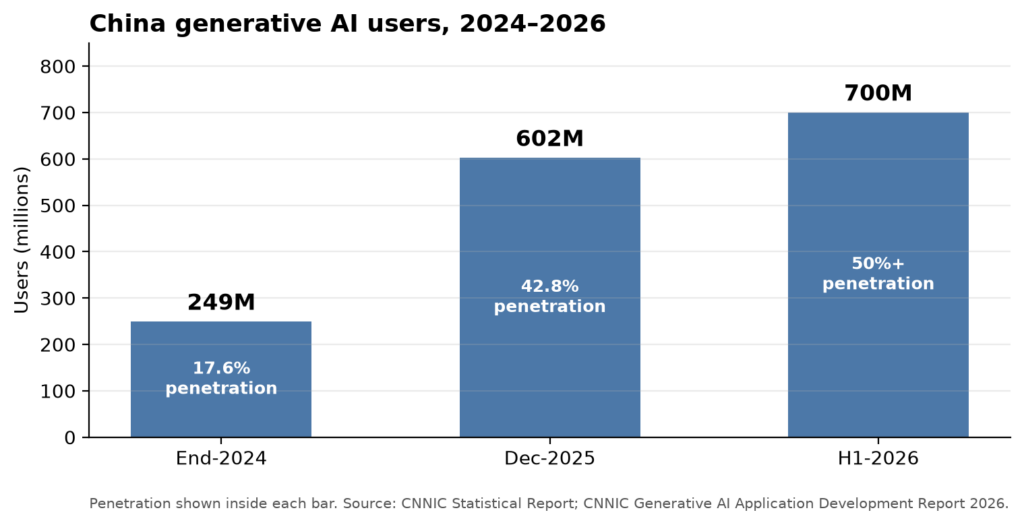
That matters for a reason vendors rarely state plainly. A consumer who already asks an AI assistant for product advice is not offended by an AI host reading a spec sheet. Acceptance was pre-installed.
The supply side had already industrialized. China’s digital human market is no longer a collection of experiments. iiMedia’s research sizes the core market at ¥33.92 billion in 2024 and forecasts ¥93.56 billion by 2030, describing a sector moving from concept validation into volume. Falling unit costs follow from that, not the other way round.
Add one more condition that is easy to overlook: the rules arrived early enough to be designed into products rather than bolted on afterwards. More on that below.
Where digital hosts actually earn their keep
The test is not “can it sell”. The test is a comparison between two numbers: the cost of having a person present, and the value of that presence.
The night band. A human host costs the same at 3 a.m. as at 8 p.m. Audience size does not. Between midnight and early morning, a digital host converts a slot with near-zero marginal labor into a slot with some revenue attached. In most Chinese deployments this is the single largest source of measurable return, and also the least glamorous.
The pitch that never changes. Sunscreen, phone cases, cables, pet litter, basic kitchen tools. The explanation is fixed, the objections are predictable, and repetition is the product. Here a digital host scales explanation without scaling payroll, and the loss in warmth is small because there was little warmth in the category to begin with.
The long tail. A merchant with thousands of SKUs cannot staff a room for each one. An avatar can keep a niche product page open all day and answer the six questions that product receives, freeing humans for the items that actually move volume.
The FAQ loop. Pre-purchase questions about size, compatibility, shipping, warranty and returns are largely structured. Answering them continuously lowers the cost of a customer who is nearly ready to buy.
The second-language and second-city audience. Avatars can be cloned into dialects and languages at marginal cost, which matters for exporters selling into China and for Chinese sellers going abroad. This is the one place where the technology creates reach that did not exist before, rather than substituting for labor that did.
Where they still fail
Failures cluster, and they cluster around the moments where a sale depends on trust, taste, or a live decision.
Objection handling. The moment a viewer doubt arrives slightly off-script, reply engines thin out. Real objections are messy, emotional and half-grammatical. Vendors show curated transcripts. Operators see the residue in the comments.
Charisma. Enthusiasm, humor, the sense that someone is on your side, and the willingness to talk a hesitant buyer out of a bad choice do not survive synthesis at scale. Audiences are forgiving of an avatar until they are not, and the switch is abrupt.
Negotiation and accountability. In China, haggling over a bundle, promising a replacement, or vouching for a product personally are trust acts performed by a person who can be held to their word. Liability for an avatar’s claims now sits with the operator, which means the commercial risk has not been removed. It has been moved.
High-consideration categories. Anything where the buyer wants a human to take responsibility, or where a wrong recommendation is expensive, is the wrong place to automate. The category list later in this article is built on this principle.
Which is why the headline claim, that digital hosts are replacing top streamers, does not hold. A top streamer sells trust. A digital host sells availability. Those are different products with different price points, and confusing them is how budgets get spent on the wrong one.
The cost math that decides the question
The number that matters is not the subscription price. It is displaced labor hours multiplied by loaded hourly cost, set against whatever conversion the shift gives up.
A workable four-line version, which you can run before you sign anything:
- Displaced labor = hours covered × loaded hourly cost of the host, the operator, the studio and the shift allowance.
- New cost = platform or per-stream fee + compute + supervision hours × supervisor cost + compliance review time.
- Conversion effect = (AI conversion rate − human baseline) × average order value × gross margin × expected order volume.
- Decision = go only if displaced labor exceeds the conversion effect plus the new cost.
The anchor everyone quotes is a ratio, not a price. One of China’s largest e-commerce platforms disclosed in March 2026 that hosted cost had fallen to about one tenth of a human presenter, that more than 70,000 merchants were using its digital hosts, and that the tool had been free to merchants since December 2025. Those are company-disclosed figures from an earnings-adjacent briefing, reported by a credible business outlet, and they should be read as a vendor claim about cost with a merchant count attached. They are useful for orientation. They are not a benchmark you can put in a business case.
Two things do not get cheaper, and budgets built on automation usually forget them.
Traffic. In Chinese livestreaming, paid traffic is frequently the largest single cost, and an avatar does not reduce it. A digital host with no paid reach is a person talking to an empty room, efficiently.
Supervision and compliance. The cheap version of this technology assumes nobody watches. The legal and operational version assumes somebody does. Reviewing scripts, claims, promotional pricing and labeling takes hours, and those hours are the hidden second line of the invoice.
There is also a cost that never appears in the model: brand equity. A room that is visibly automated, badly voiced and thinly monitored lowers perceived quality faster than it lowers cost. That damage does not show up as a line item until next year’s pricing power.
The metrics that tell the truth
Chinese livestream teams run a compact scoreboard, and four of those measures translate directly to any market.
| Measure | What it captures | Why it matters for AI deployment |
|---|---|---|
| GPM (千次观看成交额) | GMV per 1,000 views | Normalizes revenue against traffic, so you compare formats not budgets |
| Average dwell time | How long viewers stay | First place automation shows up as a loss |
| Interaction rate | Comments, likes, questions per 1,000 views | Distinguishes an avatar that is engaging from one that is merely on |
| Return and refund rate | Share of orders reversed | Where cheap conversion goes to die |
Add two internal ones: cost per streamed hour, and share of streams that required a human intervention. The second is the honest measure of how automated your operation actually is, and it is usually far lower than the vendor’s demo implies.
The design point is the control. Compare an AI shift against a human shift on the same SKU cluster, same traffic budget, same hour band, same promotional calendar. Anything else measures the calendar, not the technology.
The regulatory floor is now concrete
This is the part of the story that changed most since 2025, and it is the part most foreign coverage still gets wrong by describing it vaguely. China did not ban synthetic sellers. It licensed them, labeled them, and assigned liability.
| Instrument | Status | What it requires of a brand |
|---|---|---|
| Measures for the Labeling of AI-Generated Synthetic Content, issued by four ministries | In force 1 September 2025 | Explicit labels visible to users, plus implicit metadata in the file; accompanied by mandatory national standard GB 45438-2025 |
| Deep Synthesis Provisions | In force since January 2023 | Consent for biometric-style cloning, real-identity obligations, platform duties |
| Measures for the Supervision of Livestream E-Commerce, SAMR and CAC joint order No. 117 | In force 1 February 2026 | Continuous on-screen notice that the person is AI-generated, operator liability for what the avatar says |
Article 37 of the livestream rules is the clause worth memorizing. Any live room operator using AI-generated person images or video to sell must comply with the labeling rules and must continuously remind consumers that the person on camera is synthetic. If that content breaks the law, the operator that manages or uses it bears the legal responsibility. Article 34 separately forbids using AI to fabricate or spread false or misleading commercial information, or to impersonate others in commercial promotion. Article 17 obliges platforms to prevent it.
The enforcement teeth are specific. Failing the labeling duty under Article 37 exposes a live room operator to an order to correct, and where correction is refused or the case is serious, a fine of ¥10,000 to ¥100,000. Not existential for a large merchant. Entirely sufficient to make a compliance officer say no to a sloppy deployment.
Two structural details matter for planning. The rules define four responsible parties, not one: platform operators, live room operators, the on-camera marketers themselves, and the agencies that supply and manage them. And transaction records, including video replays and interaction logs, must be kept for at least three years, which means your AI deployment inherits a data-retention obligation the moment it goes live.
None of this is hypothetical. It is the operating environment, and it is the reason the Chinese market’s AI livestream practices look more disciplined than the global conversation about them.
A compliance checklist you can run before launch
- Labeling is continuous, not a splash screen at open. The notice stays visible for the whole session.
- Labeling is legible. No transparency tricks, no corner occlusion, no flicker.
- The avatar’s script has an approved claims list, with every efficacy, price, and comparison claim traced to evidence.
- A named human supervisor is on duty for every streamed hour, with authority to take the stream down.
- Consent and likeness rights for any cloned person are documented, with scope and duration stated.
- Promotional pricing and reference prices are logged before the stream, not after a complaint.
- Interaction logs, replays, and records are retained on the three-year schedule.
- Any AI-generated marketing asset outside the live room, including clipped video, carries its own label.
If a vendor cannot support all eight, the product is not ready for a regulated market, whatever its demo looks like.
What the hype gets wrong
The narrative is tidy: humans out, machines in, cost to zero. Three gaps make it expensive.
Adoption is being read as revenue. The most cited number in this space is China’s generative AI user base, at 602 million and then 700 million plus. That measures a population’s comfort with AI, not a merchant’s margin. Fertile soil is not a harvest.
Conversion decay is invisible in vendor decks. Nobody selling an avatar leads with the categories where it underperforms, and the operators who know are not publishing.
The denominator is missing. There is no authoritative public figure for the share of Chinese livestream GMV that AI hosts actually generate. Platform disclosures give merchant counts and cost ratios. Research firms give market sizes for digital humans as a product category. Neither gives you the number a CFO wants: what fraction of sales ran through a synthetic presenter, and at what return rate. Anyone who quotes that figure confidently is estimating, and should say so.
There is a fourth gap that is less discussed and more consequential. The technology is being sold as a way to escape labor cost, in a market where the labor being escaped is often the only thing converting. That is a strategic error dressed as an efficiency gain, and it will be discovered at the margin, quarter by quarter.
A use-case map
Sort your livestream plan into four boxes before you buy anything.
| Box | What belongs there | Action |
|---|---|---|
| Real and worth scaling | Night coverage, standardized explanation, long-tail SKU pages, FAQ loops | Build it, measure it monthly |
| Real, watch the numbers | Mid-funnel product education with a human on standby | Pilot with a control group |
| Hype dressed as reality | Fully automated flagship launches, avatars replacing trusted sellers | Do not fund |
| Not worth attempting | High-consideration goods where trust is the product | Leave to humans |
Most teams should live in the first box, test the second, and decline the third. The fourth box is where the largest single source of wasted budget sits, because it is the box that looks most impressive in a pitch.
Which categories to test now, and which to leave alone
Test now, in rough order of confidence: fast-moving replenishables and household consumables; accessories and standardized electronics; pet supplies; basic kitchen and hardware tools; auto parts and maintenance consumables where fitment is the only real variable; and B2B catalog reordering, where the buyer already knows the spec and just needs to place the order.
Wait, or do not automate the camera at all: luxury and anything where scarcity and service are the product; high-ticket durables such as furniture, appliances and vehicles; beauty and personal care with efficacy or safety claims at stake; medical devices and supplements in markets with strict advertising rules; infant formula; fine jewelry; and categories where the transaction involves negotiation, customization or a personal guarantee.
Two refinements worth adding. Regulated claim categories are dangerous for a reason that has nothing to do with audience trust: an avatar repeating an unapproved claim is a compliance event, and it repeats it hundreds of times before anyone notices. And for genuine B2B, the AI host is often the wrong unit of automation entirely. The better target is the account workflow, not the camera.
What marketers outside China should copy, and what they should not
Copy four things.
The division of labor, not the org chart. Automate the marginal hours, keep humans at the trust moment. This is the single most transferable finding, and it is transferable because it is a principle about where value sits, not a claim about a specific vendor.
Disclosure first. China’s labeling obligation preceded mass deployment, and Europe’s transparency duties for AI-generated content reach full application in 2026. Building the label into the launch plan is now cheaper than retrofitting it. It also has a commercial benefit that compliance teams rarely make: audiences tolerate synthetic sellers far better when the seller admits it.
A control-group habit. The Chinese operators who do this well are unromantic about measurement. Same SKU, same traffic, same hour band, one variable changed. That discipline is worth importing even if you import nothing else.
Retention and traceability. Three years of replays and interaction logs sounds bureaucratic until a claim is disputed. It is the cheapest insurance in the plan.
Do not copy three things.
The labor arbitrage premise. The ratio of one tenth is a Chinese ratio. It reflects the cost of a skilled host in a market where livestream talent is scarce relative to demand, plus platform-subsidized tooling. In markets where host labor is cheaper relative to paid traffic, or where livestream commerce is a small share of retail, the same software produces the same output with a worse return. Run your own ratio before you run someone else’s.
One-click 24/7 coverage as a goal. Uptime is not a KPI. Chinese rules assume a live room operator is managing audience interaction in real time, and in practice long unattended streams also lose distribution. Continuous presence without oversight is not a feature. It is a liability with a bandwidth bill.
The assumption that audiences cannot tell. They can, they increasingly do, and the reputational cost lands on the brand, not the vendor.
One difference deserves honesty. China’s advantage here is not superior AI. It is an existing buying habit, a supply base that industrialized early, and rules that arrived before the market scaled. Those are structural conditions. Where they are absent, the same technology will produce a smaller, slower return.
A 30-day pilot that costs a week of labor, not a budget
Pick one SKU cluster with a stable pitch and modest margin risk. Run the avatar in the lowest-traffic four-hour band only, with a human supervisor present. Hold traffic spend, promotional calendar and creative constant against a human-hosted baseline from the previous fortnight.
Measure five things: GPM, dwell time, interaction rate, return rate, and human interventions per hour. Set a stop rule before you start, for example a return-rate increase of more than two percentage points or a single unresolved compliance incident. Review at day thirty against costs, then expand one box at a time, in the order the use-case map suggests.
If the pilot fails, you have spent a week of supervision and a small tooling fee. If it succeeds, you have a defensible number rather than a vendor’s number, which is the only version that survives a budget review.
The bottom line
AI livestream commerce in China is not a novelty, and it is not a revolution in selling. It is the industrialization of the least valuable hours of the retail day, executed at a scale that makes the savings visible and the risks regulated.
The operators winning with it treat it as an operating decision: they measure displaced labor, they watch conversion and returns, they keep a human at the trust moment, and they label what the law requires before they scale. The operators losing money on it bought the headline, skipped the control group, and discovered the gap between availability and trust after the invoice arrived.
Digital hosts are here to stay. The question was never whether they work. It is whether you put them where they do.
Summary
Chinese livestream commerce passed ¥5 trillion in GMV in 2025, close to a third of online retail, with roughly 664 million buyers. Inside that market, digital hosts have become the cheapest way to cover off-peak hours, repeated product explanations and long-tail SKU pages, and the cost of putting one on camera has fallen toward a tenth of a human presenter on company-disclosed figures. The technology is not replacing top streamers, because a trusted seller and an always-available presenter are different products. China’s rules now make the boundary explicit: AI-generated content has required labeling since September 2025, and since February 2026 a digital human selling on camera must be labeled continuously, with the live room operator carrying liability and fines reaching ¥100,000 for label failures. The transferable lesson for marketers outside China is a division of labor, a disclosure-first launch sequence, and the discipline of a control group. The non-transferable part is the labor ratio, which is a market condition, not a technology feature.
FAQ
Is AI livestreaming actually profitable for merchants in China?
For some, clearly. The returns concentrate in off-peak coverage, standardized product explanation and long-tail pages, where the displaced labor cost is high relative to the conversion given up. For flagship launches and high-consideration goods the arithmetic usually inverts, because the conversion loss outweighs the labor saved. Profitability is a category result, not a technology result, and any vendor claiming a general answer is selling.
Do Chinese platforms allow fully automated livestreams?
National rules do not prohibit AI hosts, and no rule bans automation as such. They require labeling and place responsibility on the operator. Platforms add their own distribution and supervision requirements, and long unattended streams are frequently treated as low-quality content, which costs reach. The practical line is not human versus machine. It is supervised versus unsupervised.
What exactly does the law require when a digital human sells on camera?
Two things that are easy to state and easy to miss. The AI-generated person must be labeled in line with the national labeling measures and the GB 45438-2025 standard, and the live room must continuously remind viewers that the person is synthetic. The operator using or managing that content bears liability for what it says. Failing the labeling duty carries an order to correct and, in serious or repeated cases, a fine of ¥10,000 to ¥100,000.
How much cheaper is a digital host than a human host?
The most cited figure is roughly one tenth, disclosed in March 2026 by one of China’s largest e-commerce platforms alongside a merchant count above 70,000. That is a company figure about hosting cost, not a full cost of ownership. It excludes paid traffic, supervision, compliance review and any conversion gap, and those four items are where the real comparison is usually decided.
Can AI hosts replace top livestreamers?
No, and the market has already answered this. Top presenters sell trust, judgment and accountability, and those are the qualities synthesis does not reproduce. What AI hosts replace is availability, which used to be expensive and no longer is. The commercial consequence is a squeeze on the middle of the talent market rather than the disappearance of its top.