How a Chinese Industrial Belt Is Going Global With AI
AI Cross-Border Selection Center to Land in Foshan’s Zumiao
Foshan’s childrenswear trade once made a third of China’s kids’ clothing. Now the cluster is building a front door that machines can read.
On the evening of October 30, Zumiao subdistrict in Foshan’s Chancheng district used an industry-upgrade conference to confirm that an AI cross-border product-selection center will be built inside the City-Core Creative Center — the anchor of a newly published “one core, five poles” industrial layout. The center is slated to land in the coming phase; it is not yet operating.
What Foshan announced
The occasion paired two events: the subdistrict’s release of its childrenswear upgrade plan for Chancheng, and a leadership change at the Foshan Children’s Products Industry Association, which elected Zou Huanxi as its new president. Alongside the spatial plan came an industry alliance, a package of support measures billed as “ten points,” and a mascot IP named Yangbao.
Money sits behind the rhetoric. Companies coached into applying as outbound-trade demonstration projects can seek a one-off reward of up to 500,000 yuan. Four international ambassadors, whose combined TikTok following across platforms exceeds five million, were accredited at the event, and a live cross-border broadcast ran from the venue while the plan was being read out.
Why a childrenswear cluster needs a selection center
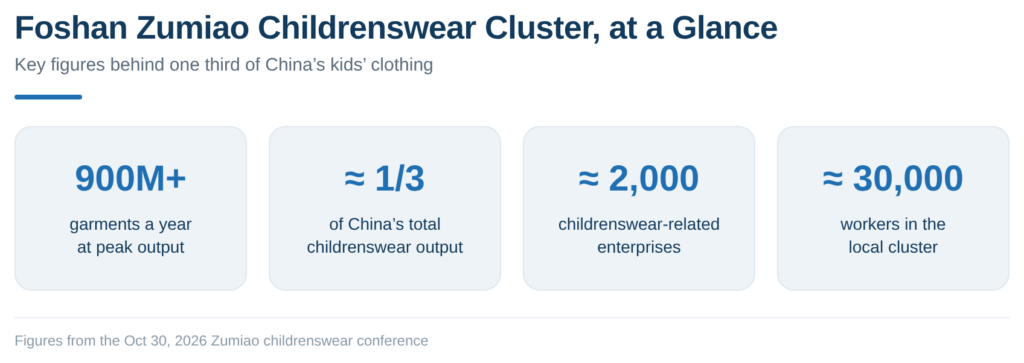
Zumiao is the origin point of Foshan’s childrenswear industry and remains its core carrier. At its peak the subdistrict produced more than 900 million garments a year — roughly one third of national output. It stays dense: about 2,000 childrenswear-related enterprises and close to 30,000 workers.
Density has not translated into pricing power. Li Rui, deputy party secretary and director of the Zumiao subdistrict office, described an industry moving through a deep restructuring from price competition to quality competition, and named the constraints directly: firms that are small and scattered, few anchor brands, weak original design, and tight industrial space.
The map: one core, five poles
The core is the City-Core Creative Center, which will carry brand headquarters, original design, and cross-border trade. The five poles divide labour by village: Dongsheng for standardised, intelligent manufacturing; Jiancun for wholesale trade and brand showcase; Chaodong for a complete baby-and-infant apparel supply chain; Zhen’an for standardised toddler ready-to-wear; and Yongxin for original design and IP incubation.
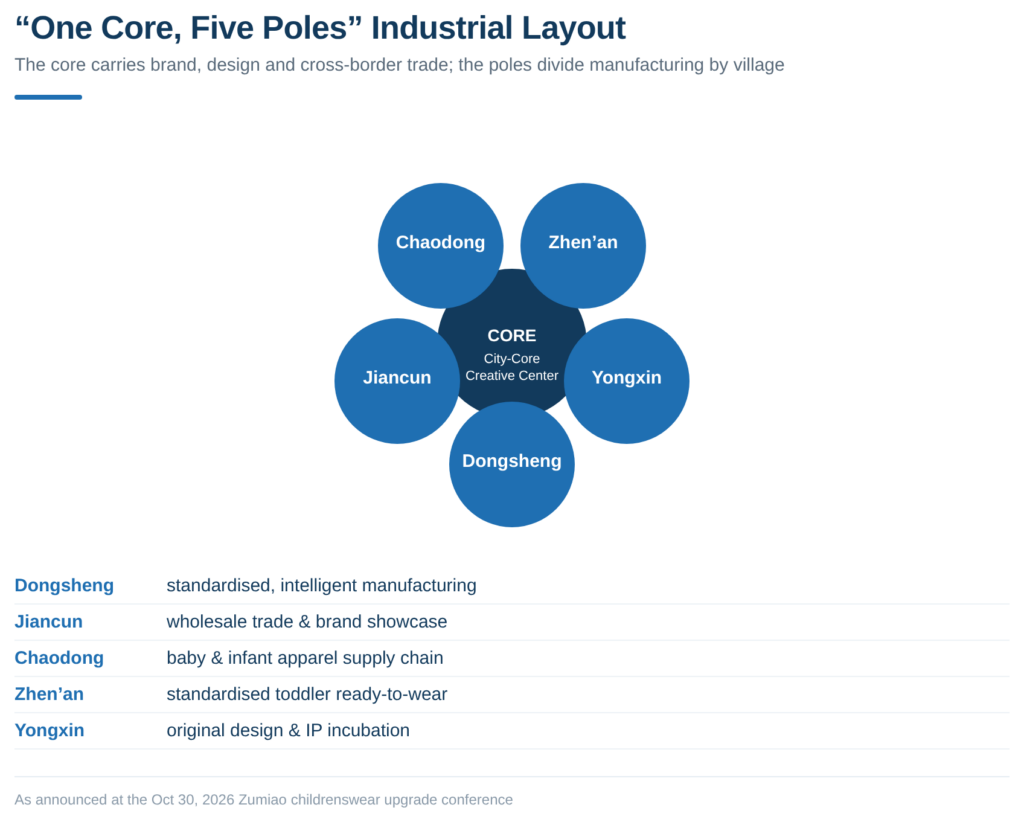
Read the layout as a production line laid over a map. Selection sits at the centre, because that is where the money is decided.
How the center intends to sell
The operator is Guangdong Dingyu Congju Technology, and its general manager, Zeng Shan, describes the model as building trust offline while adding volume online.
Offline means a 1,200-square-metre showroom that keeps tenant samples on permanent display, plus a calendar of overseas buyer delegations arranged through government and association channels, so buyers can inspect workmanship and negotiate face to face. Livestream rooms sit inside the same building, with overseas hosts selling from the samples on the floor — see it, stream it, ship it, without the goods leaving Foshan.
Online means three parallel surfaces: a B2B wholesale site, direct-to-consumer brand sites, and an overseas social matrix. Tenants gain access to a pool of more than 40,000 overseas wholesale buyers and a creator distribution network, with channels spanning bulk purchasing, small wholesalers, creator resale, and retail.
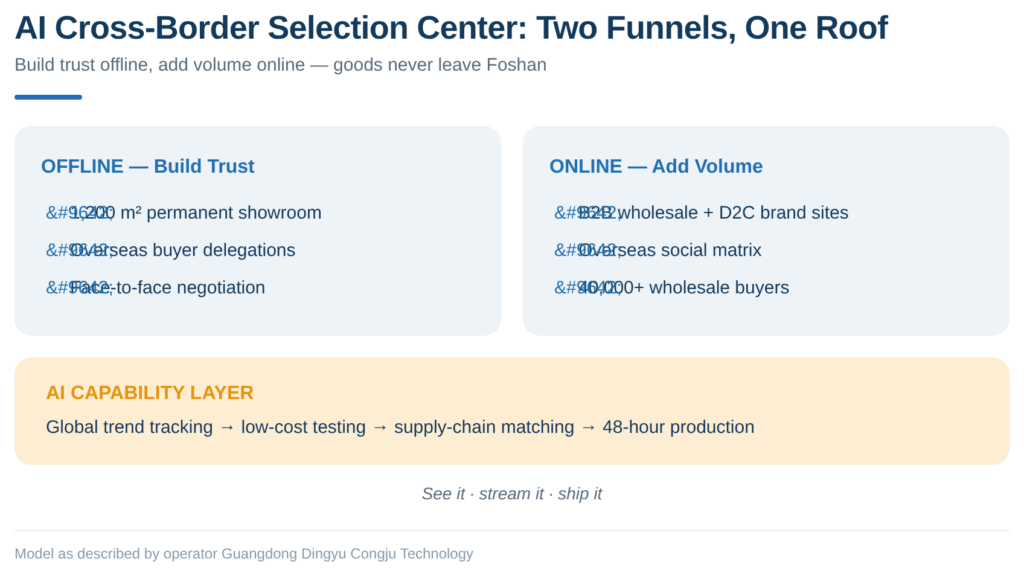
Four capabilities are meant to hold it together. AI tracks global market trends and feeds design development and low-cost testing, which cuts the cost of a wrong bet. Once a style is confirmed, the platform’s supply-chain system matches it to local factory capacity, and production can complete in as fast as 48 hours — orders first, inventory second.
The demand shift underneath
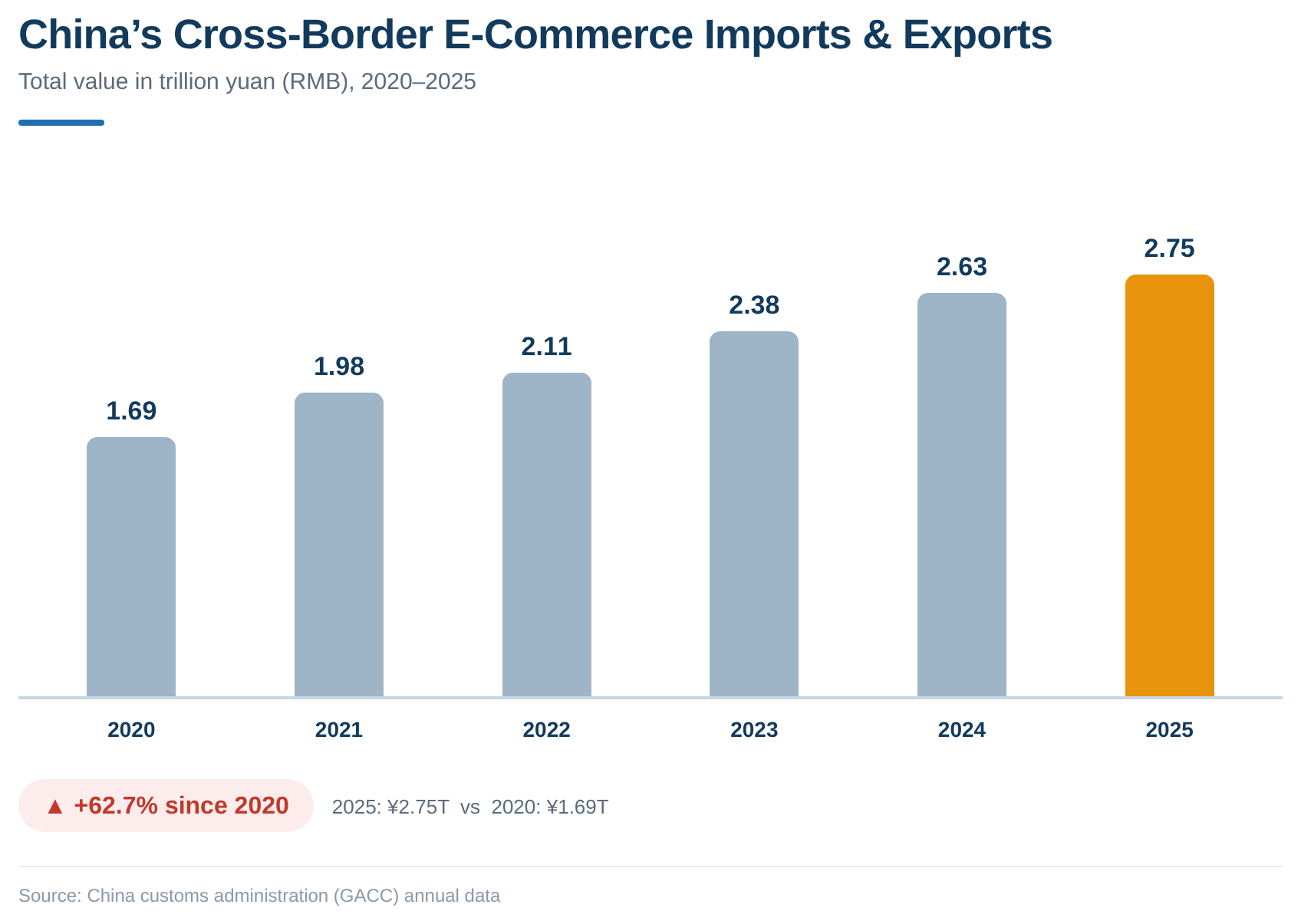
China’s cross-border e-commerce imports and exports reached 2.75 trillion yuan in 2025, up 62.7% from the roughly 1.69 trillion yuan recorded in 2020, according to China’s customs administration. Policy has moved in parallel: the State Council’s Opinions on Deepening the Implementation of the “AI+” Initiative, issued in August 2025, pushes AI deployment across priority economic areas rather than treating it as a standalone technology vertical.
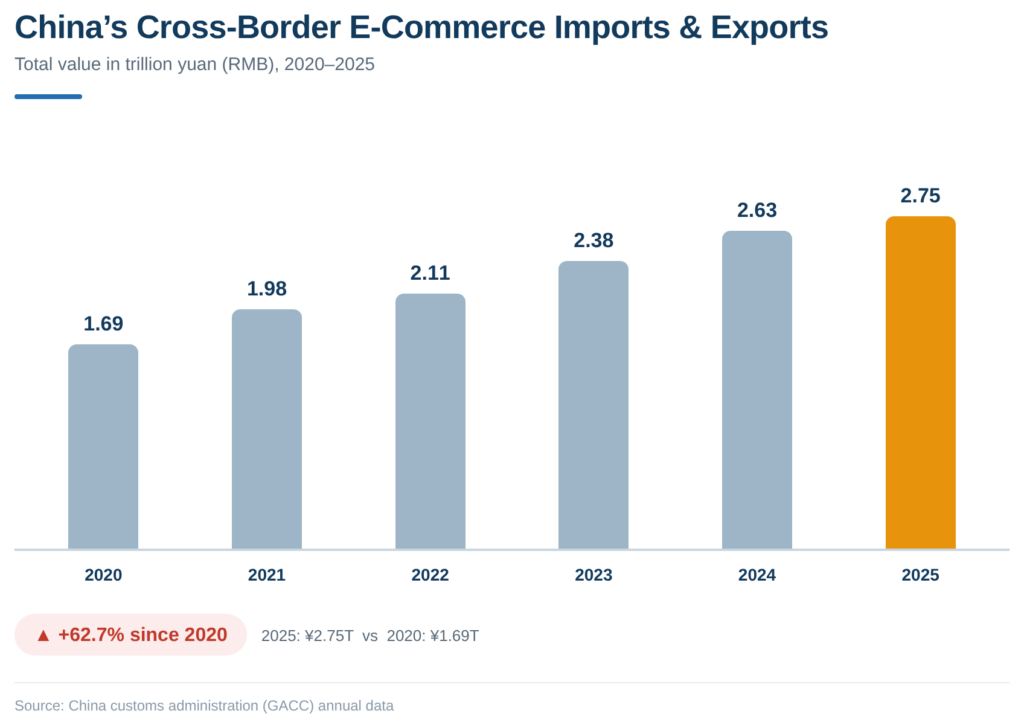
That combination changes what a “selection center” is for. In a catalogue business, selection is an internal judgment about what a factory can sell. In a demand-signal business, selection is a market-research function running continuously, and the output is a specification — size curve, fabric, price band, channel — that factories build against.
What this means for marketers
Selection is now a media function. The center sells through livestreams, creators, and social distribution, which means the product decision and the content decision are the same decision — made earlier, and with data attached.
Two funnels share one roof. Wholesale runs on samples, minimum order quantities, and relationships; direct-to-consumer runs on content, creators, and conversion. Brands moving between them need separate creative and separate measurement, not one blended dashboard.
Product data has to be machine-readable. Overseas buyers increasingly research suppliers through AI assistants, so specifications, MOQs, lead times, and certifications need to exist as structured English data — not just as a showroom impression. This is what it means to be “discoverable before the deal,” and it is fast becoming the default gate for cross-border sourcing.
Localisation is not translation. Sizing conventions, seasonal calendars, safety standards, and cultural references differ by market, and a 48-hour production promise is only credible if those variables are locked before the order.
Capacity claims invite scrutiny. Orders-first production reduces inventory risk for the seller and shifts it toward responsive capacity. Whether factories can hold that promise across peak seasons is the operational question the model has to answer.
What to watch
Three things decide whether this becomes a template. The timeline and tenant mix — a selection center is only as good as the factories displayed in it. Whether the AI trend data flows back to individual factories, and on what exclusivity terms — because design intelligence is the asset being pooled. And the cost side of cross-border selling — freight, tariffs, and compliance in major markets — none of which a showroom can solve.
If the model works in a cluster with 30,000 workers and 2,000 firms, other Chinese industrial belts will copy it. That is the part worth watching.