The Humanoid Hype Reckoning: Why China’s VCs Stopped Talking About Physical AI
China’s Physical AI Boom Goes Quiet as Primary-Market Investors Stop Talking
After 503 deals and more than RMB 96 billion in a single 12-month window, Chinese venture funds are declining interviews, fielding questions from their own backers, and re-pricing the sector in real time.
HONG KONG / SHANGHAI, Nov 1 — The loudest theme in Chinese technology has developed a strange silence at its centre.
In a survey of investors published today by STAR Market Daily, the Shanghai-based financial title run by Cailian Press, most funds that had previously backed robotics and embodied intelligence declined to be interviewed about physical AI. Several gave the same reason in different words: internal guidance says not to talk about this sector publicly. Not one of these firms was an outsider to the theme. Some had already committed capital; others were still meeting founders raising for it.
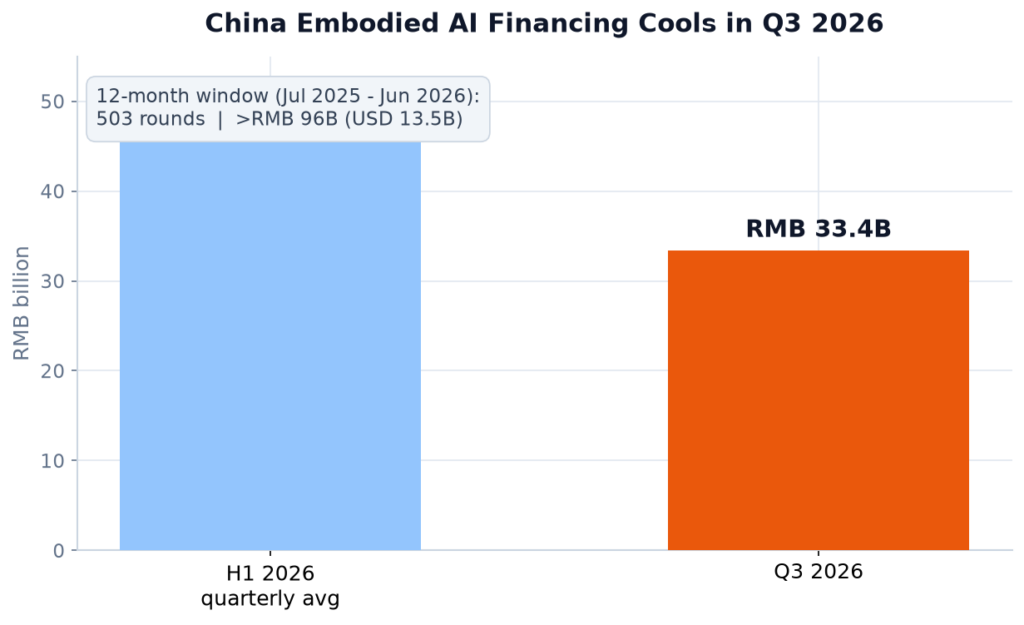
That avoidance arrived after an unusually crowded year. Between July 2025 and June 2026, China’s embodied intelligence sector recorded 503 financing rounds worth more than RMB 96 billion, or roughly USD 13.5 billion, excluding IPOs and M&A, according to STAR Market Daily’s own tally. That is more than one deal per day for twelve months straight.
The pace then changed. In the third quarter of 2026, at least 185 rounds closed for about RMB 33.35 billion, roughly USD 4.7 billion, against a first-half quarterly average above RMB 46 billion. Money is still arriving. It is arriving on different terms and at a visibly slower tempo.
What changed is who is asking the questions
Fund managers describe a shift in their own investor base. One firm that had spoken at industry events and shared technical projections on physical AI later received enquiries from its limited partners. Those backers were no longer only asking how large the opportunity could become. They were asking what the fund’s exposure to it looked like.
The reference point that keeps surfacing in these conversations is public pricing. Unitree Robotics — the first humanoid-robot maker to list on mainland China’s A-share market, debuting on Shanghai’s STAR Market on 19 August — opened at a market value of about RMB 444.9 billion. (UBTech, which listed in Hong Kong in 2023, technically preceded it on the exchanges.) By mid-October the value had fallen to roughly RMB 163.5 billion, after the shares hit a post-listing low of RMB 404.03 on 15 October. On 28 October it stood near RMB 281.5 billion, closing at RMB 695.90. Two and a half months, one company, and a spread wide enough to make any pension fund or family office ask for a written answer.
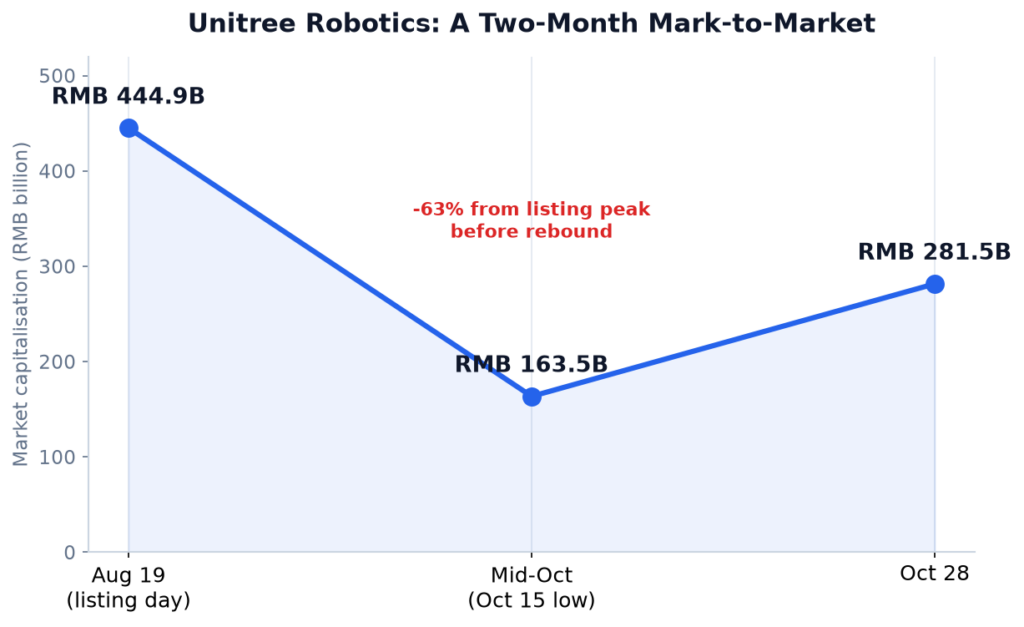
Private valuations had been set by the highest bid in the room. Public markets set them by continuous trading. Once a comparable exists, a primary-market mark has to be defended rather than assumed.
Conviction and communication have come apart
Investors who remain positive on the underlying technology are careful to separate two decisions. The first is whether physical AI, which in China mostly means embodied intelligence, has a long runway. The second is what to do about it right now, and how to describe that choice in public. Several said both things can be true: a ten-year view stays intact while the near-term posture becomes quieter.
Deal flow reflects it. People who advise founders on fundraising say the hottest window has closed. Investment teams still exist inside these funds. They simply no longer rush.
Diligence moved from demos to delivery
The questions asked of founders have changed. Model capability and research output still matter, but a video of a robot performing is no longer the decision material. Investors now press on how many real sites a machine operates in, what those deployments earn, and how far the commercial process has actually gone. Physical AI has reached the stage where a slide cannot substitute for a purchase order.
The numbers behind that shift are not all reassuring. Unitree, the sector’s most visible listed name, shipped more than 5,500 humanoid robots to end customers in 2025, but its first-half 2026 revenue rose 48.5 per cent year on year while net profit excluding non-recurring items fell 19.3 per cent to RMB 244 million. In its first reported quarter as a listed company — Q3 2026 — revenue reached RMB 665 million, up 69.9 per cent, while research-and-development spending jumped 249.6 per cent. Growth and margin are moving in opposite directions. That is precisely why investors have stopped taking a demo as proof of a business.
The giants are circling
There is a second, less comfortable question. Large artificial intelligence companies are circling the field. ByteDance’s Seed team has been recruiting robotics talent — roughly a dozen roles spanning hardware and software, including a “mass production hardware product manager” tasked with moving machines from demos to stable delivery. DeepSeek has already placed capital: in August it took a RMB 141 million strategic stake in Unitree with a 36-month lock-up and a mutual priority-procurement agreement. Speculation has separately attached to DeepSeek’s founder, Liang Wenfeng, about scouting embodied-AI startups.
If foundation-model developers push into the embodied “brain” layer, startups built specifically around that layer lose part of their claim to permanence. For an investor, that argues against paying a scarcity premium for capability that a better-funded lab could compress.
The forecast and the tape are telling different stories
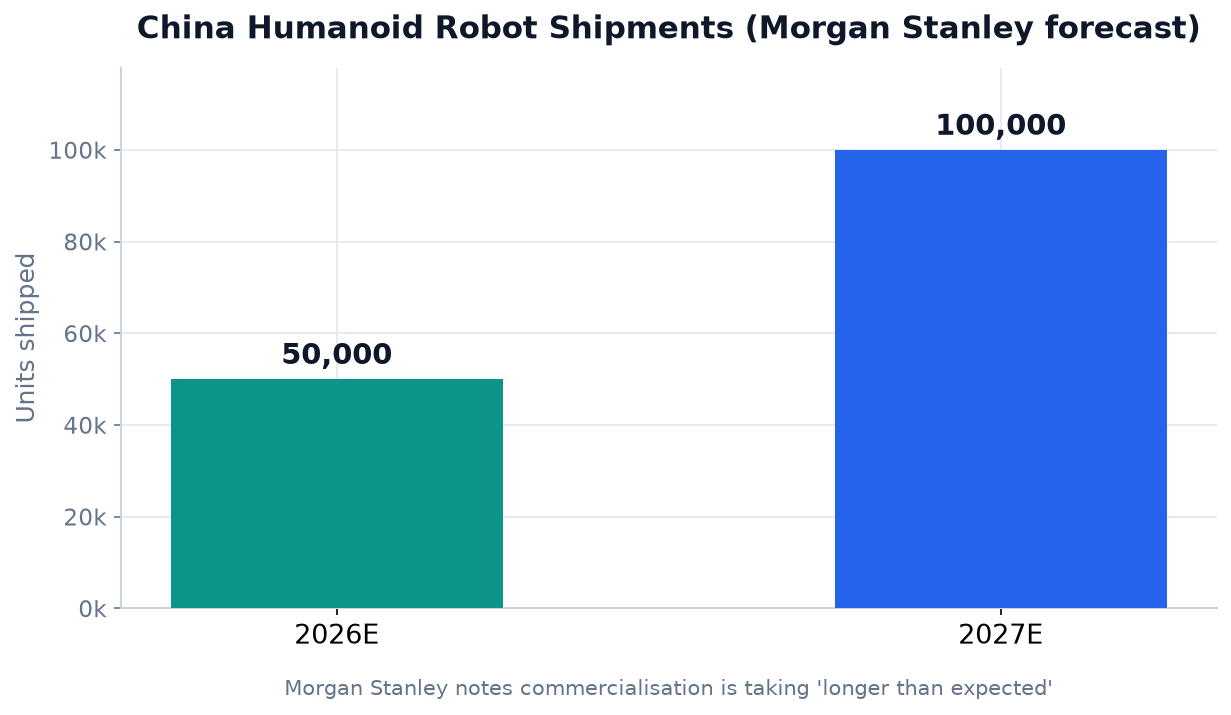
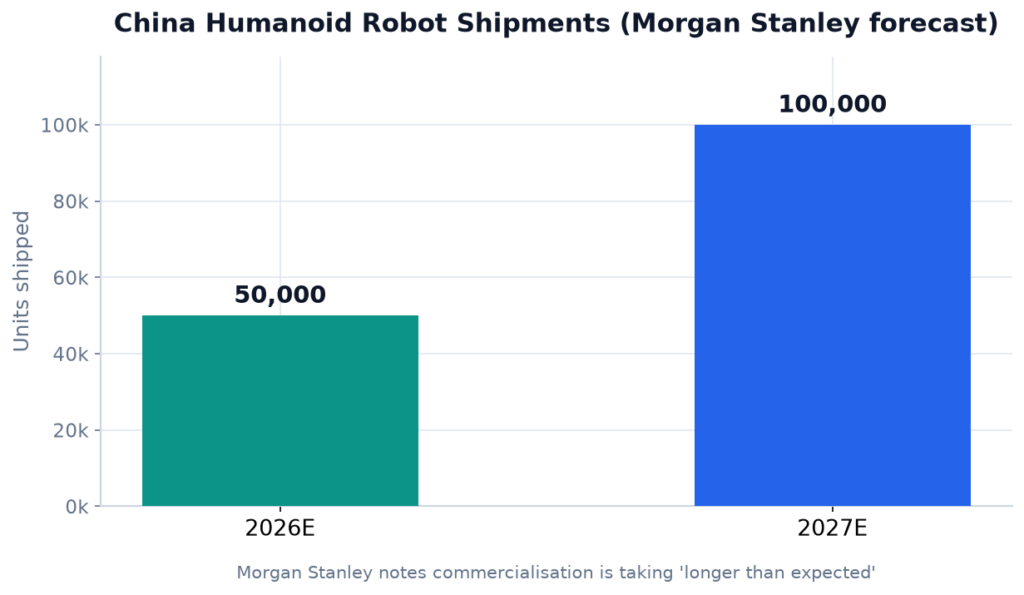
The long-term story remains expansive. Morgan Stanley projects China’s humanoid robot shipments at 50,000 units in 2026, doubling to 100,000 in 2027 — while cautioning that the move from demos to full commercialisation is taking “longer than expected”, constrained by data bottlenecks, hardware reliability and limited generalisation.
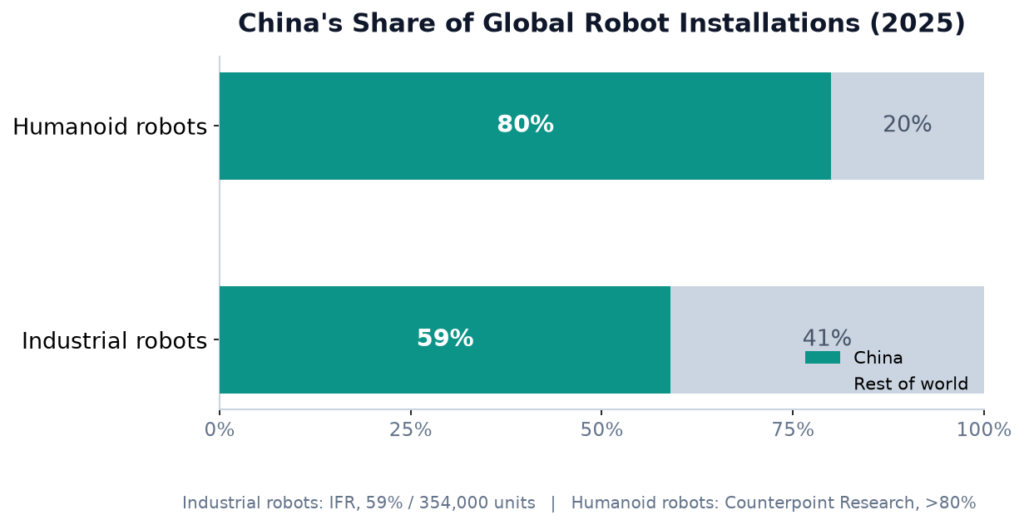
China’s manufacturing base supplies the argument that the forecast is reachable. The International Federation of Robotics reports that China accounted for 59 per cent of new industrial robot installations worldwide in 2025, around 354,000 units, up 20 per cent year on year. Counterpoint Research puts China’s share of humanoid robot installations even higher, at more than four out of five globally.
None of that resolves the pricing question. A decade-long demand curve and a two-month mark-to-market are simply different instruments, and the second one is currently louder.
Figures at a glance
- China embodied AI financing, Jul 2025–Jun 2026: 503 rounds, more than RMB 96 billion (about USD 13.5 billion), IPOs and M&A excluded — STAR Market Daily tally
- Q3 2026: at least 185 rounds, about RMB 33.35 billion (roughly USD 4.7 billion), versus a first-half quarterly average above RMB 46 billion
- Unitree Robotics market capitalisation: RMB 444.9 billion (19 Aug) → RMB 163.5 billion (mid-Oct) → RMB 281.5 billion (28 Oct)
- China share of global industrial robot installations, 2025: 59 per cent, about 354,000 units — IFR
- China share of global humanoid robot installations, 2025: more than 80 per cent — Counterpoint Research
- China humanoid robot shipments: 50,000 (2026E) rising to 100,000 (2027E) — Morgan Stanley
Why it matters
Physical AI has moved from a storytelling contest to an evidence contest. Capital is not leaving; it is being repriced against deployment data and listed comparables. The sector’s next phase will be decided by installations and revenue, not by keynote frequency.
What to watch
Fourth-quarter deal counts and average round sizes in China; whether more humanoid makers follow Unitree to the STAR Market; and any formal announcement from a foundation-model lab entering embodied intelligence.