The Honest Market vs the Cheap One: What AI Product Photography Means for Trust in 2026
The AI Model Has Three Legs, and the Fitting Room Is Fake
Deck: Chinese online shops are now filling apparel listings with AI-generated models that cost roughly RMB 30 a set — about a twentieth of a conventional shoot — and some are telling buyers the pictures are real photography.
BEIJING, Nov 1 — China’s largest online shopping event is in full swing, and a growing share of the people wearing the clothes on sale do not exist.
Reporting from this year’s Double 11 festival shows that AI-generated model imagery has become common across apparel listings, with some sellers running what amounts to a synthetic version of the customer photo review. The problems are visible. Generated hands bend where hands do not bend. At least one image shows a model with three legs. When buyers asked, some shop staff said the pictures were real photo shoots.
The economics explain the rush
The numbers make the adoption easy to understand. A conventional shoot used to cost RMB 600 to 800 per set, roughly USD 85 to 110. A generated image costs RMB 30 to 40, about USD 4 to 6. That is a gap of roughly twenty times, and a service layer has grown around it, offering ready-made AI models and prompt packages to merchants who have no studio at all.
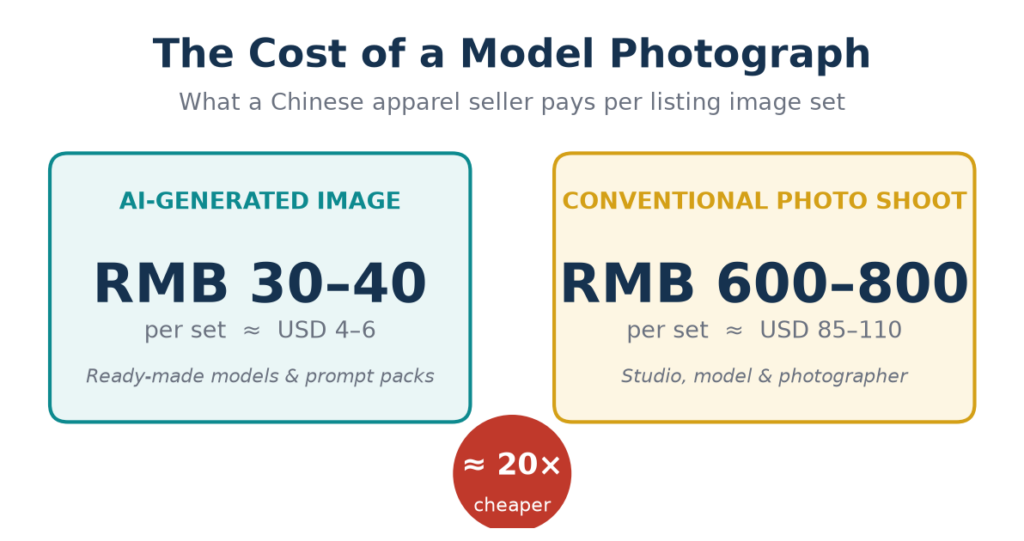
These figures come from individual merchants interviewed in trade reporting, not from an official market survey, so they describe what a seller can pay rather than a guaranteed industry average. The direction of the gap, though, is not in dispute.
A distorted picture breaks the only job the picture had
Buyers read a listing photo for fit, for drape, for how a wrinkle behaves near the seam, for how the fabric sits when someone is seated. That is the entire informational purpose of the image. Resolution and gloss do not compensate for a body that cannot stand up.
The stakes are not theoretical. Poor fit is the single largest driver of online returns. Industry research cited by Grand View Research puts the figure at 46 per cent in a Harris Poll of US consumers, ahead of damage and quality complaints. A catalogue image that misrepresents the garment does not merely waste a click; it manufactures the very returns problem that retailers spend heavily to avoid.
This is a new cause, not a new complaint
Over-retouched product photography drew the same criticism for years, precisely because a flattering lie destroys the reference point. Generated imagery simply made the lie cheaper and faster to produce at volume. The offence is not the technology but the decision to present a synthetic rendering as documentary evidence of how a garment fits a human body.
Beijing Evening News, in a commentary published today, drew the line in the right place. Using AI to photograph clothing is not the offence. Shipping an anatomically broken figure is simply the tool used badly. Insisting it is a live shoot when it is not is something else, and it strips the consumer of the ability to know what they are looking at.
The legal exposure is not hypothetical
Under Chinese law, a seller who claims real photography while the AI image’s silhouette, cut or material differs materially from the delivered garment is exposed on two fronts. The claim itself can constitute false advertising, and where it is strong enough to drive a purchase decision, it can be treated as consumer fraud.
Labelling is already mandatory in China
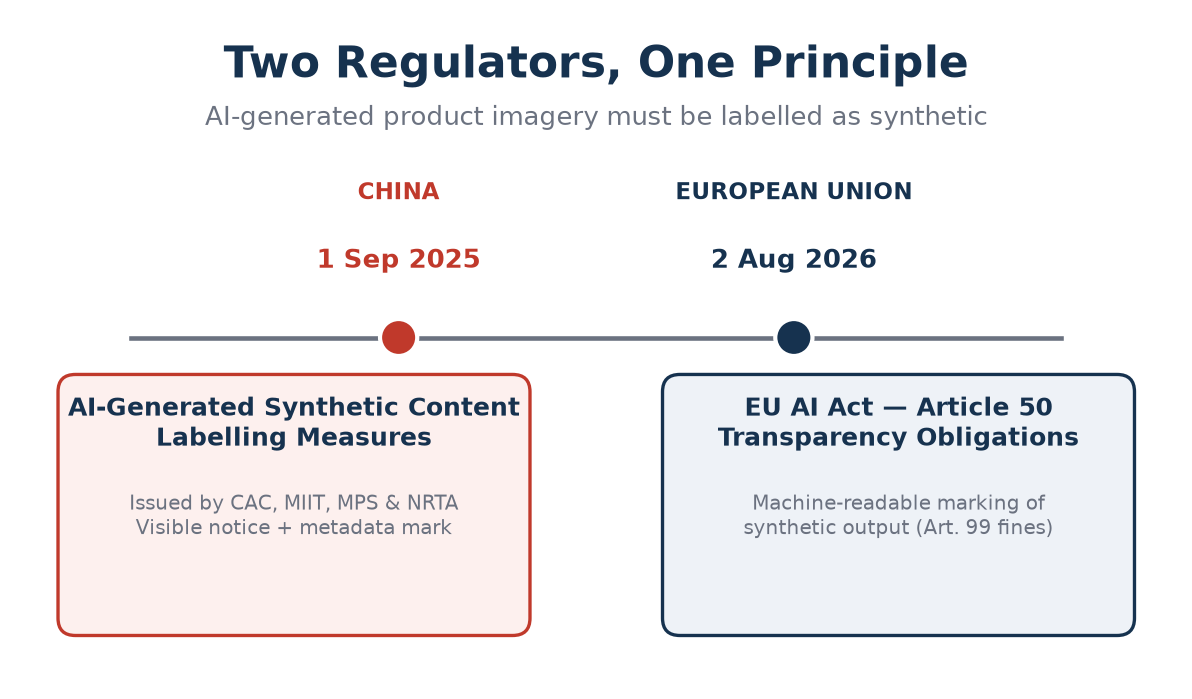
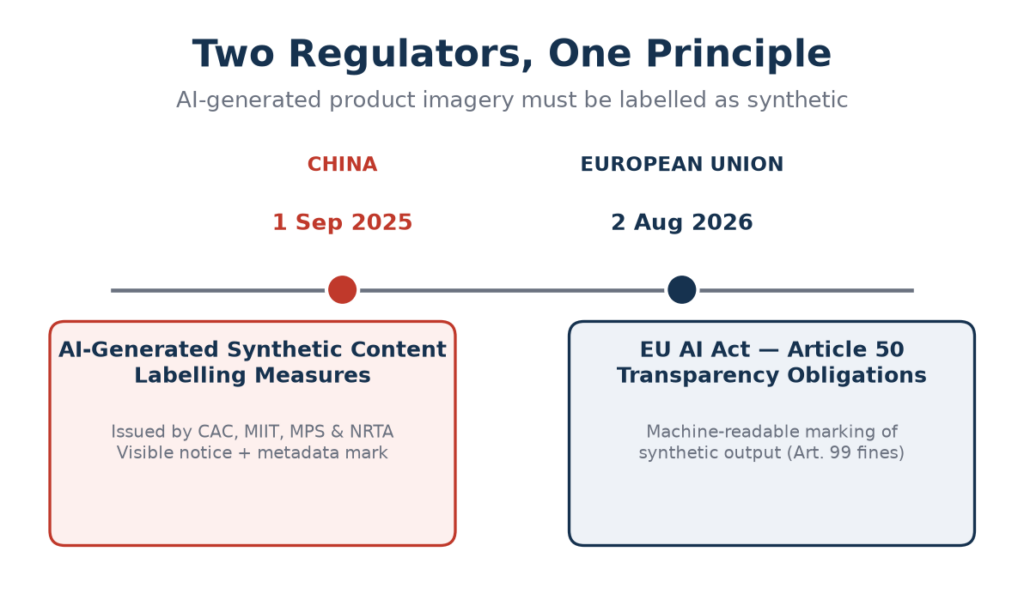
Separately, labelling is already mandatory. The Measures for Labelling AI-Generated Synthetic Content, issued by the Cyberspace Administration of China together with the Ministry of Industry and Information Technology, the Ministry of Public Security and the National Radio and Television Administration, took effect on 1 September 2025. They require both visible notices and metadata-level marks. Stripping the mark and asserting the image is a photograph is a direct conflict with that framework.
Europe is writing the same rule with a bigger penalty
The transparency provisions of the EU Artificial Intelligence Act apply from 2 August 2026. Article 50 requires providers of systems that generate synthetic image, audio, video or text to mark outputs in a machine-readable format so they can be detected as artificially generated or manipulated. Deployers that generate or manipulate imagery resembling real people, objects or events must disclose that the content has been altered.
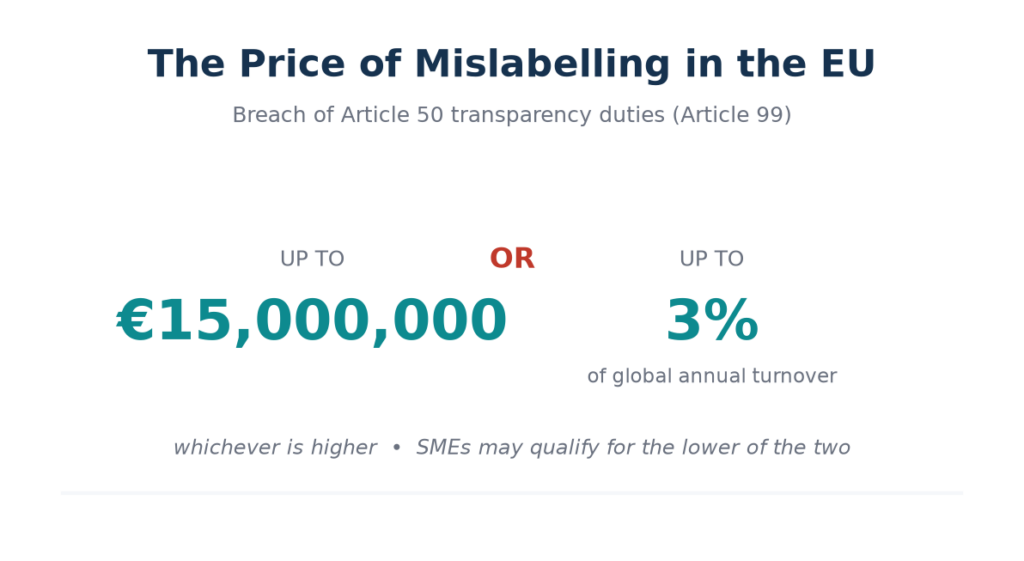
Breaches of those transparency duties sit inside Article 99, where fines reach up to EUR 15 million or 3 per cent of worldwide annual turnover, whichever is higher. The ceiling applies to the largest operators; small and medium-sized enterprises may face the lower of the percentage and the fixed amount. For a cross-border apparel seller, the sharper point stands: the same product image can be compliant in one market and penalised in another, on labelling grounds alone.
The market being built around the honest version
Virtual try-on — the technology that actually shows how a garment behaves on a body — is the honest mirror of this story. Grand View Research sizes the global virtual try-on market at USD 6.9 billion in 2025, and projects it to grow from USD 8.5 billion in 2026 to USD 38.3 billion by 2033, a 24.0 per cent compound annual rate. North America held the largest revenue share at 38.2 per cent in 2025, while Asia Pacific is the fastest-growing region at a projected 27.9 per cent annual rate. Apparel is the largest application, accounting for 37.2 per cent of 2025 revenue.
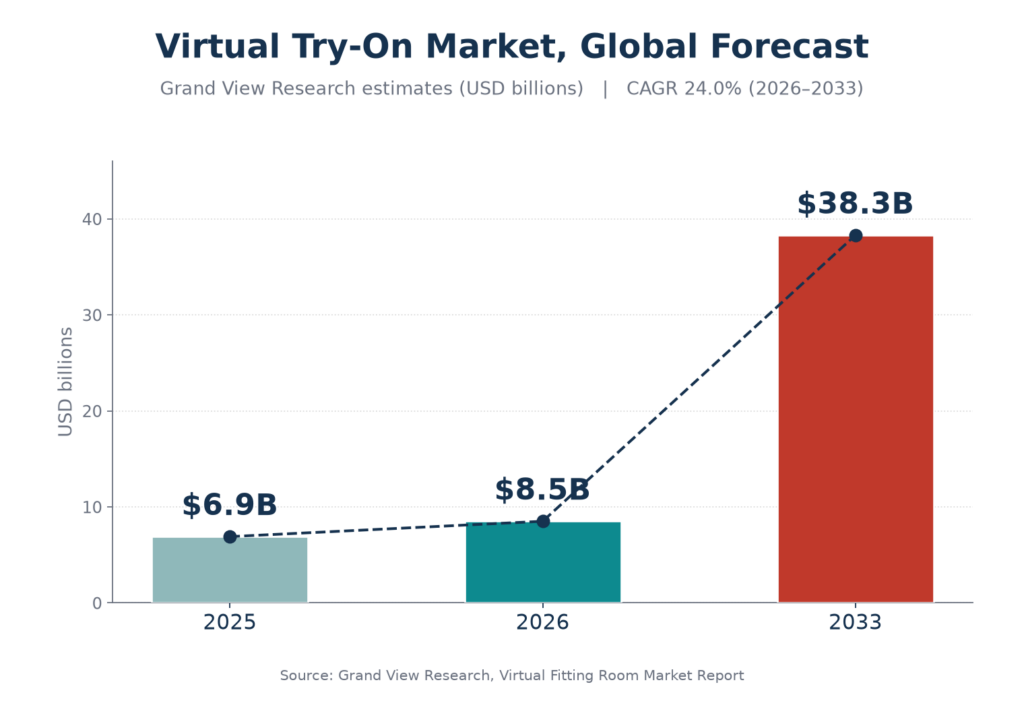
A caveat is worth stating plainly. These are commercial research estimates and forecasts, not official statistics — and, more importantly, virtual try-on and AI model photography are not the same market. Note what the try-on market is selling: accuracy. Generative model imagery is selling cost. They are adjacent products with different promises, and merchants are currently buying the cheap one while presenting it as the accurate one. The remedy for a broken AI photo is therefore not merely better AI; it is either honest labelling or a tool built to answer the fit question truthfully.
What a cross-border seller should do now
For merchants selling the same catalogue into China and Europe, the practical checklist is short. Label synthetic imagery with a visible notice and keep the metadata mark, as the 2025 Chinese measures require. Do not claim a generated image is a photograph, in listing copy or in customer replies. Before the EU transparency duties bind in August 2026, audit how product images are produced and described across every market. The cheapest insurance is honesty: a labelled AI image may lose some polish, but an unlabelled one buys legal risk and returns in one package.
Quick answers
How much does an AI model image cost in China? About RMB 30 to 40 per set, against RMB 600 to 800 for a conventional shoot, according to reporting on this year’s Double 11 sales period. These are merchant figures, not a surveyed industry average.
Is it illegal to use one? Generating the image is permitted. Failing to label it, or describing it as a real photograph, is where labelling rules and advertising law begin to apply.
Why it matters
The trust that product photography carries is a shared asset. Every unlabelled three-legged model spends a little of it, and the cost lands on the merchants who photograph honestly. Regulation in China and Europe has already supplied the tool to stop that; enforcement at platform level is the part still missing.
What to watch
Whether listing images start carrying visible AI labels during the 11.11 peak, and whether platforms treat mislabelled synthetic photography as a listing violation rather than a creative choice.