ByteDance’s PineDrama Hit 100 Million Downloads in Nine Months. Now It Has to Earn Them.
ByteDance’s PineDrama Passed 100 Million Downloads in Nine Months. Free Was the Easy Part
ByteDance has carried its free-to-watch short-drama model out of China, and the export is moving faster than the incumbents it is aimed at.
PineDrama went live in January 2026, after tests in the US and Brazil in December. Nine months later, cumulative downloads passed 100 million and daily active users settled near 7 million, according to Sensor Tower. The app ranked seventh among Chinese non-gaming apps by overseas downloads in the second quarter of 2026, and it is the only title in the group of seven short-drama apps to cross 100 million global downloads while launching within the past twelve months. It sits in the top ten iPhone free-app charts in the US, Brazil and Thailand, and it has already overtaken ReelShort in Brazil — where it led the country’s download chart in July with roughly 5.5 million installs, more than double ReelShort’s total for the same month.
That is a distribution result. The harder question starts where distribution stops being free.
Two models, one price gap
PineDrama gives episodes away and unlocks the rest through ads. ReelShort and DramaBox, the paid leaders, do the reverse: a few free episodes, then coins at roughly $0.30 to $0.50 per installment, or a pass. ReelShort’s annual pass runs $199.99 — close to a Netflix standard plan in several markets, and a steep ask for material that costs a few thousand dollars per episode to produce.
The gap shows up in customer acquisition. Rivals buy installs on Meta and TikTok. PineDrama draws from TikTok’s own feed, so its marginal cost of reaching a new viewer is close to nothing. For ReelShort, marketing and user acquisition consumed about 55% of revenue in 2025, with Facebook taking roughly 25% of that spend, TikTok 19%, Snapchat 16% and Instagram 8%, per MPA and eMarketer data on microdrama ad spending.
ByteDance also kept the operation at arm’s length: PineDrama is run by a team inside TikTok’s business division, not by the Hongguo team.
The paywall was already leaking
PineDrama did not walk into a healthy paid market. It walked into one that was spending more and collecting less.
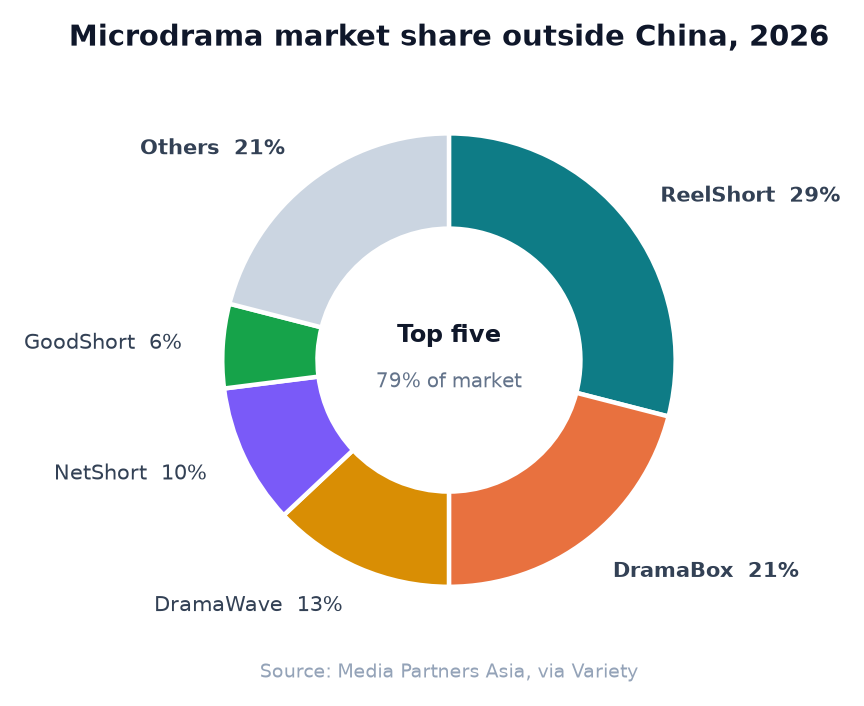
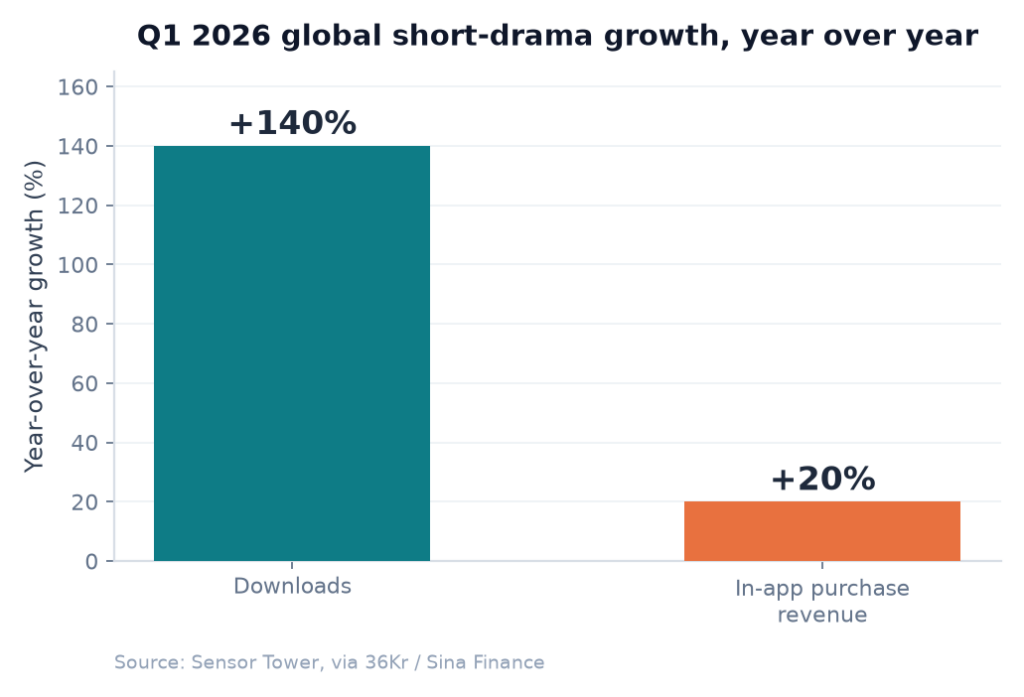
In the first quarter of 2026, global short-drama downloads rose 140% year over year — exceeding 850 million — while in-app purchase revenue grew just 20%, per Sensor Tower. Only about 2% of installs at the two largest paid platforms are still active 30 days later. Around 300 overseas short-drama apps are chasing the same viewers, and the top five — ReelShort, DramaBox, DramaWave, NetShort and GoodShort — hold 29%, 21%, 13%, 10% and 6% of the market respectively, according to Media Partners Asia.
The DramaBox–GoodShort merger this month removes one bidding war over ad inventory. It does not fix the underlying math: after spending cuts, the best-performing platforms earn net margins of about 3%.
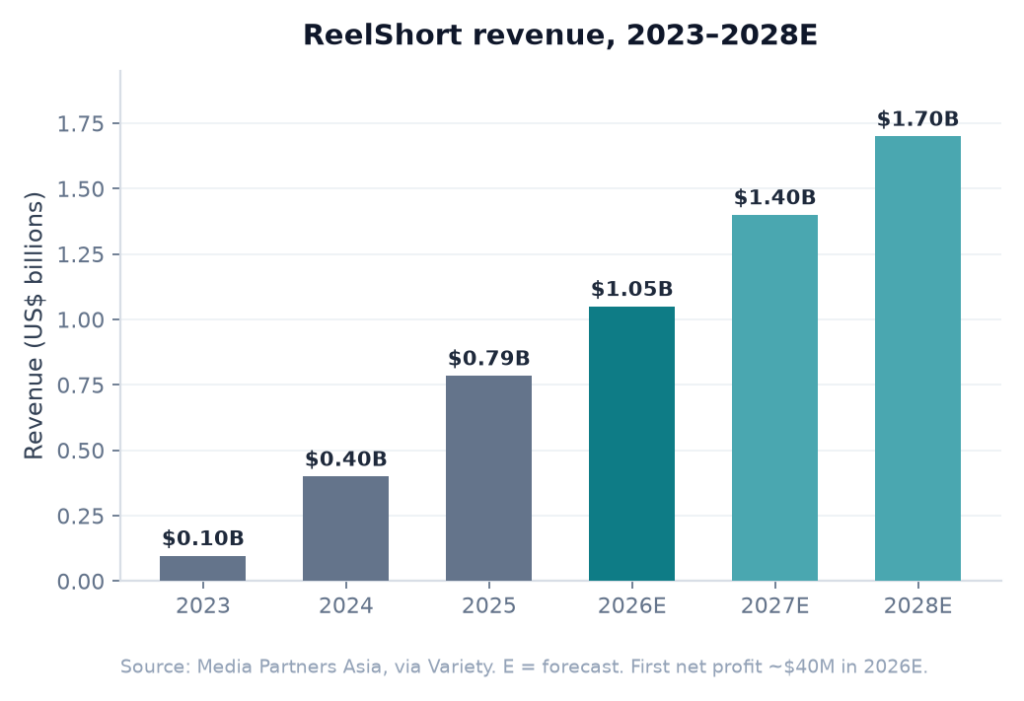
Media Partners Asia still expects ReelShort to book $1.05 billion in revenue in 2026, up from $785 million in 2025, and to post its first net profit of roughly $40 million. Most of that improvement comes from moving billing off app stores and cutting acquisition costs, not from better shows — MPA models marketing spend falling from 55% of revenue to around 44% by 2028.
What ByteDance actually exported
PineDrama is not a clone of Hongguo Short Drama. It inherits the mechanics.
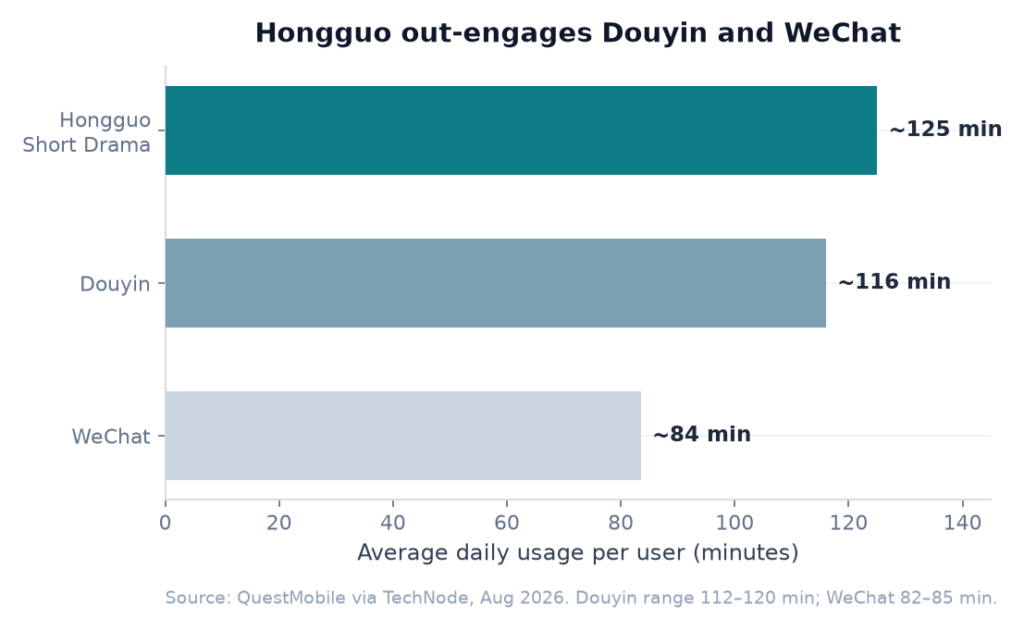
Hongguo, launched in August 2023, reached roughly 368 million monthly and 168 million daily users by July 2026, per QuestMobile data cited by Chinese brokers and media, and users spend about 125 minutes a day inside it — more than on Douyin. The formula: free episodes, ad monetization, plus a coin-incentive layer that paid viewers to keep watching.
On October 21, Hongguo announced it will retire the coin feature. New activations stop receiving coins from November 1; the feature goes dark for every user by December 31. Content stays free, the company said. The subsidy did its job — it bought scale — and now the platform has to convert attention into advertising yield.
That timeline matters outside China. The version of the model going overseas is not the subsidized one. It is the one under pressure to show a return. And there is a structural reason to watch closely: by the second quarter of 2026, free short-drama apps accounted for roughly 83% of user time in the category, up from about 15% a year earlier. The free model is not a curiosity anymore; it is the default.
Content is a supply chain, and it is localizing
Most producers supplying PineDrama today are Chinese teams with experience on Hongguo, Douyin or TikTok. The platform also licenses IP from the group’s fiction library — producers report that 70% to 80% of the IP behind AI-generated dramas comes from Tomato Novel — and it is recruiting local producers.
Read the US top-100 on a single day in mid-October and the formula is plain: 50 titles tagged high society, 31 family bonds, 15 werewolf. Same story beats, new passports. Production is stretching beyond China too. In Nigeria, a locally produced title, The Billion Naira Bride, cleared 40 million views in its first week. Teams there and elsewhere are shooting contract-marriage and inheritance plots with local casts and local currencies, and some of those teams are already developing AI-generated microdramas for the same platform.
AI has compressed the whole supply chain. ReelShort’s chief executive has said production costs fell roughly 90% over the past year thanks to pre-visualization, set generation and compositing. That is a double-edged sword: it lowers the cost of entering the market, but it means everyone now has the same cheap production stack — which is why the advantage keeps shifting to whoever controls distribution.
The market is big enough to fight over
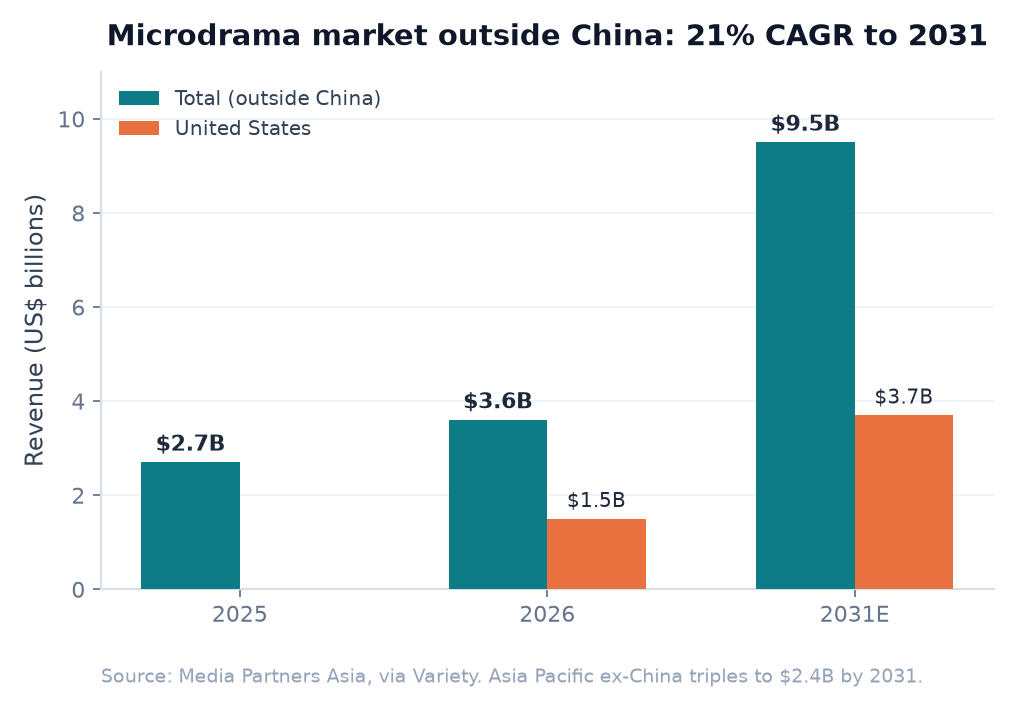
Media Partners Asia sizes the microdrama market outside China at $3.6 billion in 2026 and projects $9.5 billion by 2031, a 21% compound annual growth rate. The US alone is expected to double from $1.5 billion to $3.7 billion, while Asia Pacific ex-China triples to $2.4 billion.
Advertising is the piece ByteDance is betting on. At ReelShort, ads were a minor line before 2024 and are projected to reach about 15% of revenue by 2028 — a far smaller share than in China, where free-to-watch platforms carry the category.
What to watch
Three numbers decide whether this holds.
Ad yield per daily user. Seven million DAU is a start, not a business. CPMs outside a handful of markets run well below Chinese levels, and washed-out short-drama inventory is not premium inventory. The geography of PineDrama’s early growth makes this acute: Indonesia and Brazil together account for roughly 82% of its cumulative downloads, and per-user monthly revenue in Latin America runs around $0.68, versus $1.29 in North America. If revenue per user lands under the cost of content, licensing and bandwidth, the free model becomes a subsidy with a different name.
Hit rate. PineDrama’s library leans on licensed IP and proven genres, which lowers the cost of failure and caps differentiation. The paid platforms learned the hard way that audiences follow a title, not an app — which is why NetShort’s AI hit One Move God Mode reportedly returned over $8 million and forced the entire field to pivot. A title that travels is worth more than a feed that happens to be free.
Regulatory drag. A Chinese-owned app distributing video at scale in the US and Brazil sits inside the scrutiny that already reshaped how TikTok operates. PineDrama’s exposure is smaller — no social graph, less user-generated content — but not zero.