The $215 Billion Answer: Why the AI Dividend Landed at the Bottom of the Stack
Who Ate the AI Dividend?
Four years into the build-out, the answer is almost embarrassingly simple. It went to whoever owned a bottleneck.
One number ends the argument
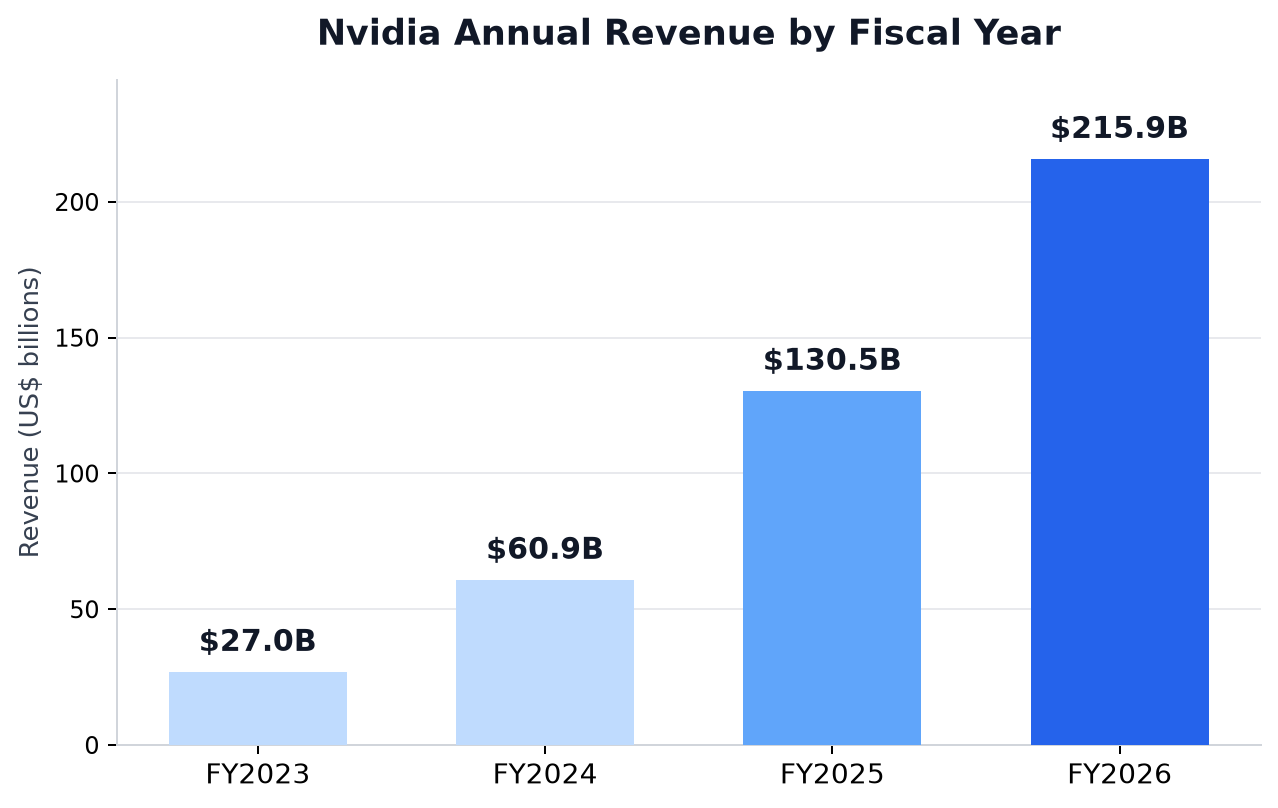
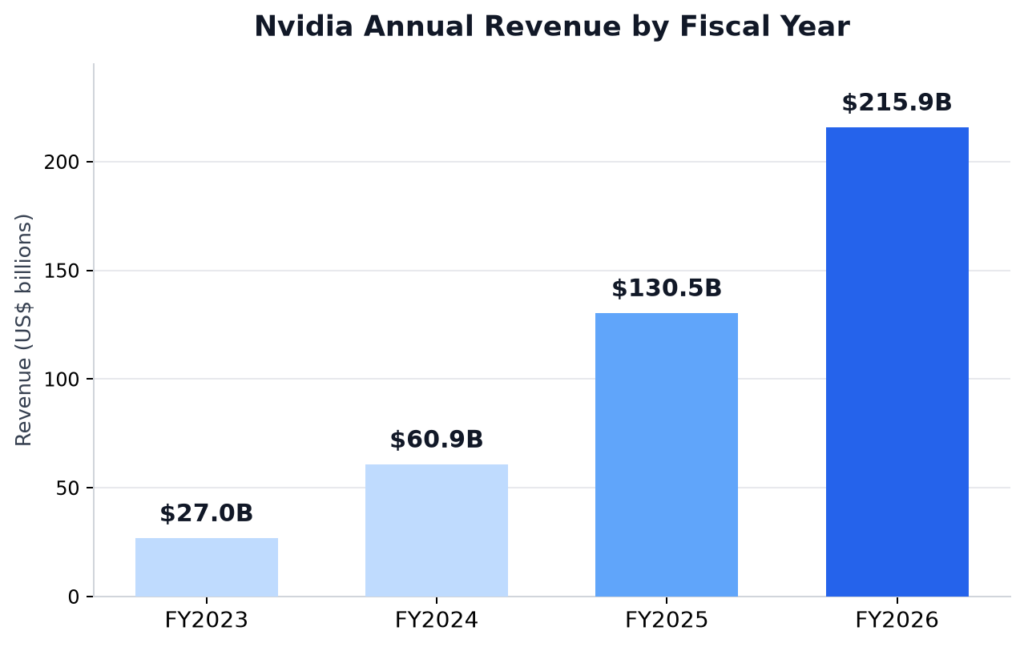
Nvidia reported $215.9 billion in revenue for its fiscal year ending January 2026, according to its annual filing with the SEC. Three years earlier, that figure was $27.0 billion. In the quarter ending July 2026, the company booked $96.2 billion — more than double the same quarter a year before.
To put that quarter in perspective: it is roughly seven times the annual size of China’s entire micro-drama market, which already topped ¥100 billion in 2025.
If you are looking for where the AI dividend landed first, stop looking at apps. Look at the balance sheet that supplies them.
The spending side is just as extreme
The build-out is being funded faster than the business it serves is growing. One analysis in August 2026 put hyperscaler capital expenditure at roughly 102% of their cloud revenue — for the largest providers, spending on infrastructure now exceeds the revenue of the very cloud business it is meant to power. Amazon alone has committed to around $220 billion of capital spending in 2026.
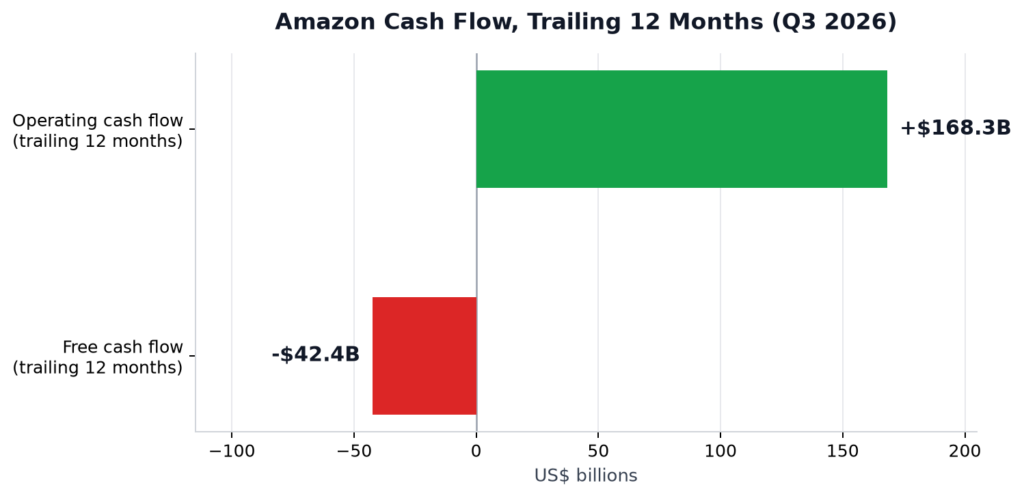
Amazon illustrated the trade-off plainly in late October 2026. Even as it reported a healthy positive operating cash flow of $168.3 billion over the trailing twelve months, its trailing free cash flow was negative $42.4 billion — and it held 2026 capital spending unchanged. That is a company choosing infrastructure over short-term cash, at a scale with little precedent outside wartime industrial policy.
The application layer’s report card
The application layer, meanwhile, handed in something less flattering. MIT Media Lab’s The GenAI Divide study concluded in 2025 that 95% of organizations reported no measurable return from their generative AI investment — a statistic that has echoed through the industry ever since.
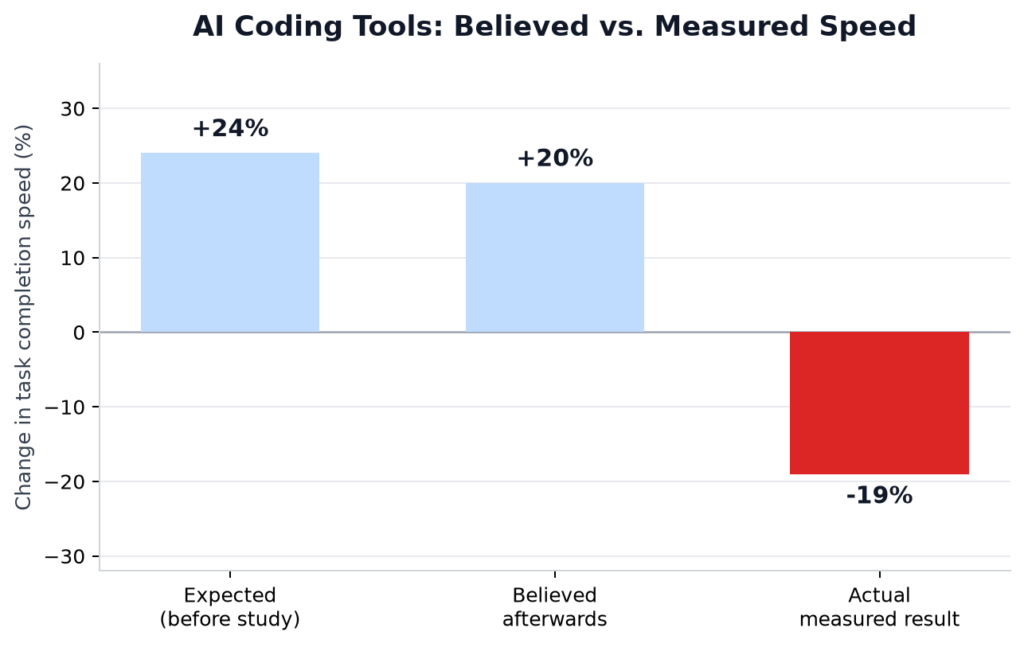
METR ran a randomized controlled trial with 16 experienced open-source developers working on 246 real tasks in their own repositories. The tools made them 19% slower, even though the developers believed they were faster.
Adoption is still rising, but it remains concentrated in large firms and in narrow, well-bounded use cases — useful, real, and nowhere near a transformation.
Perception ran ahead of reality
The METR result deserves a second look, because it captures the quiet mistake the whole market is making. Developers expected the tools to make them 24% faster, and even after the study they believed they were 20% faster. The measured outcome was the opposite. When the input is cheap, the temptation is to confuse using it with benefiting from it.
Why the middle of the stack loses
The middle of the stack sells applications built on a commodity input, to customers with no switching cost, against thousands of competitors with the same model access and the same playbook.
That is a recipe for prices falling to marginal cost. The layer above the model owns the customer relationship or the workflow. The layer below owns the scarce physical inputs. The layer in between owns a slide deck.
The labour story is real, but narrower than the headlines
Stanford’s Digital Economy Lab found no evidence of economy-wide displacement. What it did find is sharper: employment for workers aged 22 to 25 in AI-exposed occupations now sits about 19% below the trajectory of their less-exposed peers — an early, descriptive finding the researchers themselves caution is not yet a causal estimate. Experienced workers show no comparable gap.
Read that carefully. The adjustment is happening at the entry point, where tasks are most codified and least defended by relationships. The dividend is being redistributed away from junior white-collar labour and toward capital — a quieter and more consequential shift than the “robots take all the jobs” narrative.
China is running the same experiment, with different owners
China’s AI market looks structurally different and behaves structurally the same. Model access is cheap and increasingly open, which pushes value away from the model layer even faster than in the United States. But distribution is concentrated in a handful of super-apps, so the advertising and transaction pools that AI content feeds are captured at the platform layer.
The evidence is in plain sight. More than 90% of the roughly 430,000 micro-dramas released in China in the first eight months of 2026 were AI-generated, according to official data reported by Xinhua. A fully AI-generated feature film, Sanxingdui: Future Past, opened in late October 2026 with roughly 10,000 screenings and grossed about $180,000 in its first four days.
Cheap production, concentrated monetisation
One short-drama app, Hongguo, reached 168 million daily active users as of July 2026. Cheap production everywhere, concentrated monetisation at the top, and a long tail earning close to nothing.
Who ate it, in order
| Layer | Capture mechanism | Evidence |
|---|---|---|
| Compute, memory, power | Physical scarcity and pricing power | One supplier booked $215.9B in a fiscal year |
| Distribution platforms | Own the feed, the auction, the payment | 168M daily users on a single short-drama app |
| Model providers with API lock-in | Switching costs in tooling and evaluation | Enterprise contracts and agent frameworks |
| Enterprises with proprietary data | Workflow integration and process ownership | Where pilots actually reach production |
| Everyone else | Labour sold at commodity rates | 95% of organizations report no measurable return |
The tell for the next eighteen months
In August 2026, Nvidia’s finance chief said roughly half of its data centre business now comes from customers beyond the largest hyperscalers. That is a meaningful shift. It means the build-out is being financed by more balance sheets than the four obvious ones — sovereign programmes, neoclouds, and AI-native labs among them.
Broader demand is healthy for the supply chain. It also means more of the spending is leveraged. When the next correction comes, it will not start with a model release. It will start with a financing structure.
What to do about it
If you run an enterprise, buy outcomes and stop buying seats. Tie every deployment to one line on the P&L, and kill the ones that cannot name it.
If you allocate capital, track capex-to-revenue conversion across the supply chain rather than model benchmarks. The gap between those two numbers is where the risk lives.
If you make content or run marketing, accept the new arithmetic. Supply is free; distribution is not. Buy the audience relationship, the placement, and the memory — because those are the only items on the invoice that still hold value.
The uncomfortable question
If AI makes output cheap everywhere, then durable margin can only exist where output is not the product. That is the entire lesson, and almost nobody wants to hear it.