How the Biggest AI Buildout in History Became a Credit Story
On October 29, Microsoft filed to raise at least $25 billion in a U.S. investment-grade bond offering — its first domestic dollar debt sale since 2017. The deal spans ten tranches with maturities from two to forty years and drew more than $115 billion in orders. Microsoft holds one of the largest cash piles on earth and still printed positive free cash flow last quarter. It borrowed anyway. That single fact captures the state of the AI economy better than a year of keynote decks.
The Numbers Behind the Shift
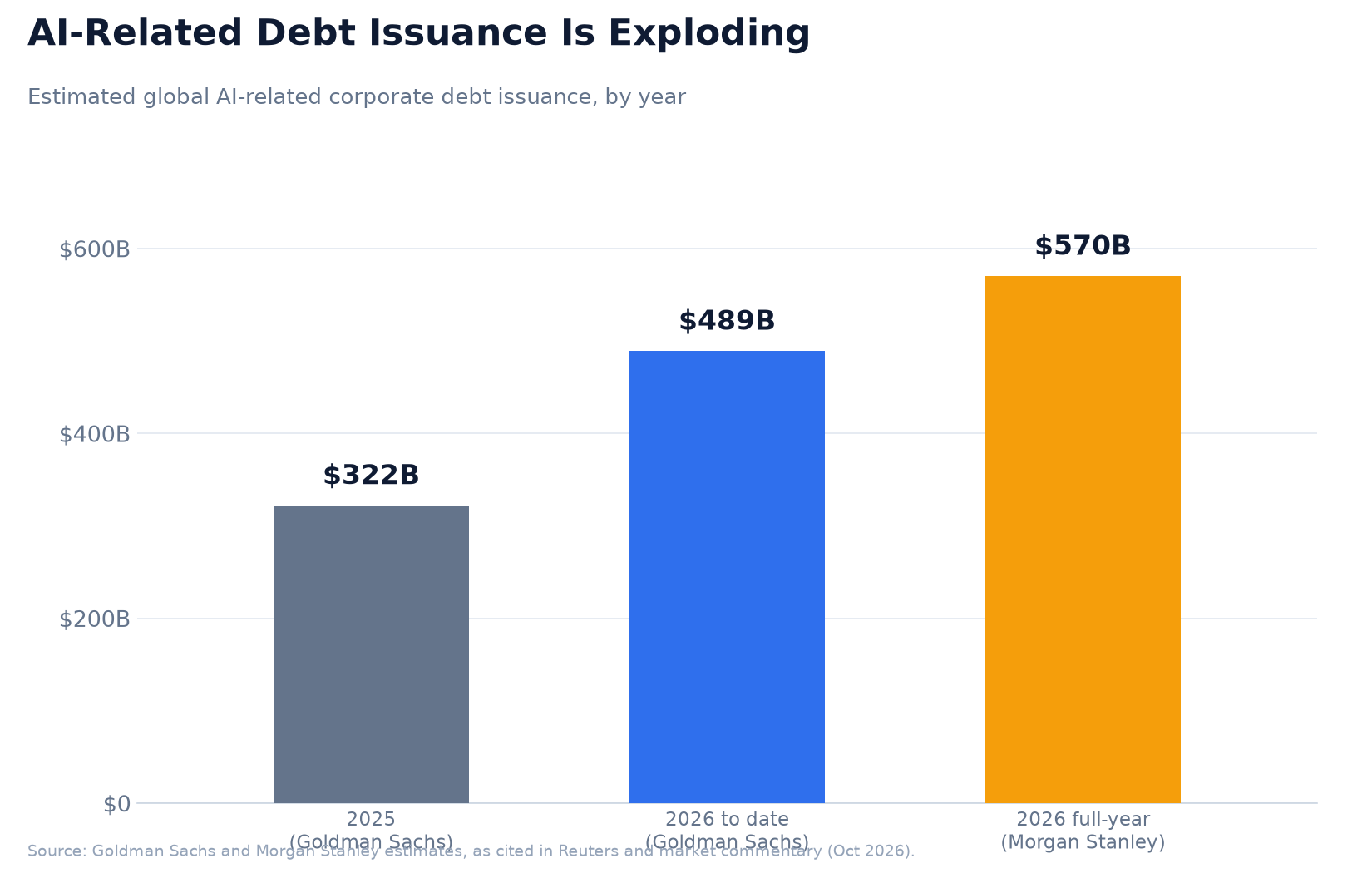
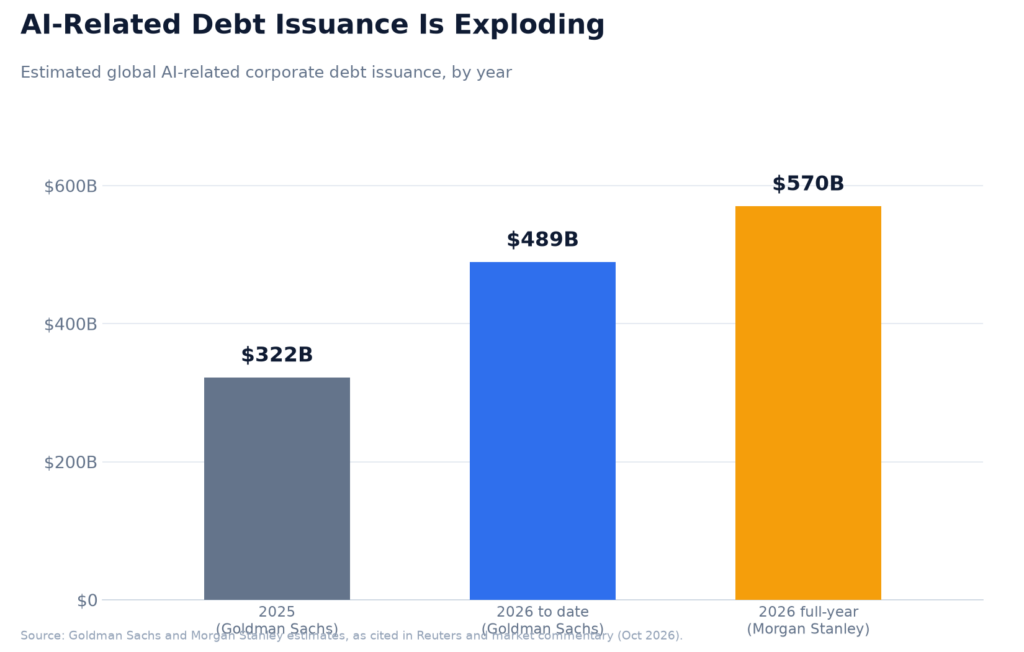
Start with the aggregate. According to Goldman Sachs research, roughly $489 billion of AI-related debt has been issued through 2026, against a comparable figure near $322 billion for 2025. Morgan Stanley sees the full-year tally approaching $570 billion and expects hyperscaler capital-expenditure needs to exceed $1 trillion in 2027.
Now look beneath that borrowing at the cash flow statements, and the picture turns uncomfortable quickly.
Amazon posted trailing-twelve-month free cash flow of negative $42.4 billion and is guiding toward roughly $220 billion of capital spending this year, even as AWS grew at its fastest pace in nearly five years.
Alphabet reported negative free cash flow of roughly $9.1 billion for the quarter and held its full-year capital-expenditure range near $195 billion to $205 billion.
Meta logged negative free cash flow around $2.1 billion — a rarity for the company — then raised its 2026 capex guidance to between $135 billion and $145 billion. Two days later, S&P Global Ratings revised Meta’s credit outlook to negative from stable, citing uncertainty around spending and cash flow into 2027.
Microsoft remains the outlier: roughly $18.6 billion of positive free cash flow even after $45.2 billion in capital spending and finance leases. But that too is a delaying action — free cash flow fell about 27% year over year, and around 75% of its capex now flows into short-lived assets such as GPUs and memory, up from about half a year earlier.
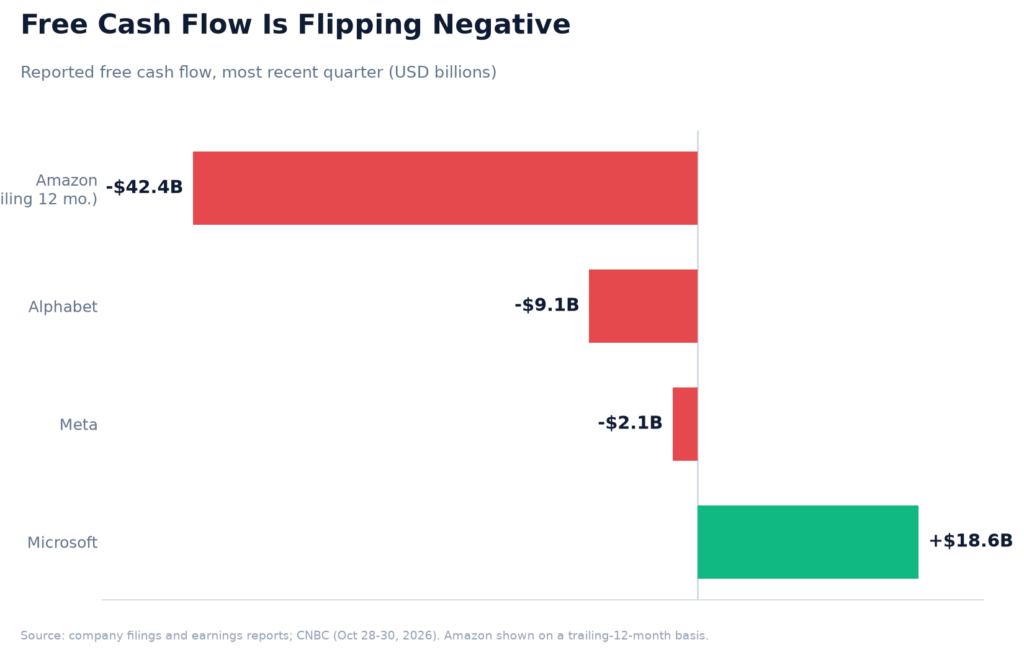
Across the biggest cloud and software names, capital spending has begun to outrun the operating cash flow the businesses themselves generate. Reuters reports the five largest tech spenders returned the smallest share of cash to shareholders in at least 15 years — dividends and buybacks now equal roughly 9.3% of operating cash flow. Share buybacks have nearly vanished as the cash gets redirected into data centers.
Why the Funding Mix Changes Everything
Here is the part most coverage skips. When capex is funded from operating cash, the constraint on how many models you train and how many racks you build is revenue — and revenue is a management problem. Ship better products, sell more of them.
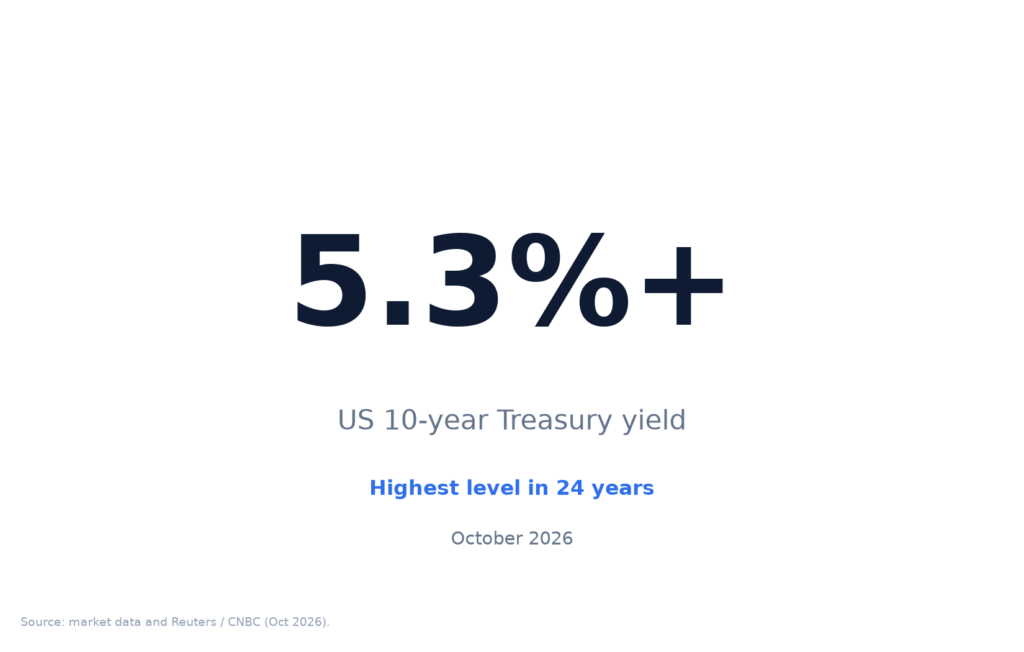
When capex is funded from the balance sheet, the constraint becomes the cost of capital. And the cost of capital is not a management decision. It is set by bond markets, central banks, and one variable no hyperscaler CEO controls: the 10-year Treasury yield, which pushed to a 24-year high around 5.3% in October 2026.
Interest rates and credit spreads have now entered the model roadmap. For an industry that spent three years behaving as if capital were free, that is a genuinely new variable. Every extra month of GPU depreciation life, every basis point of spread widening, changes the lifetime cost of a training cluster. Lenders can already see the tiering: a top-rated hyperscaler soaks up $25 billion with blocked-out demand, while a lower-rated neocloud scrambles to place a few billion at any price.
The Divergence Worth Watching
Equity markets are pricing capability — Azure up 48%, AWS at its fastest growth in five years, Google Cloud expanding. Credit markets are pricing default risk. Where those two signals disagree, credit has historically been right about the timing, even when equity was right about the destination.
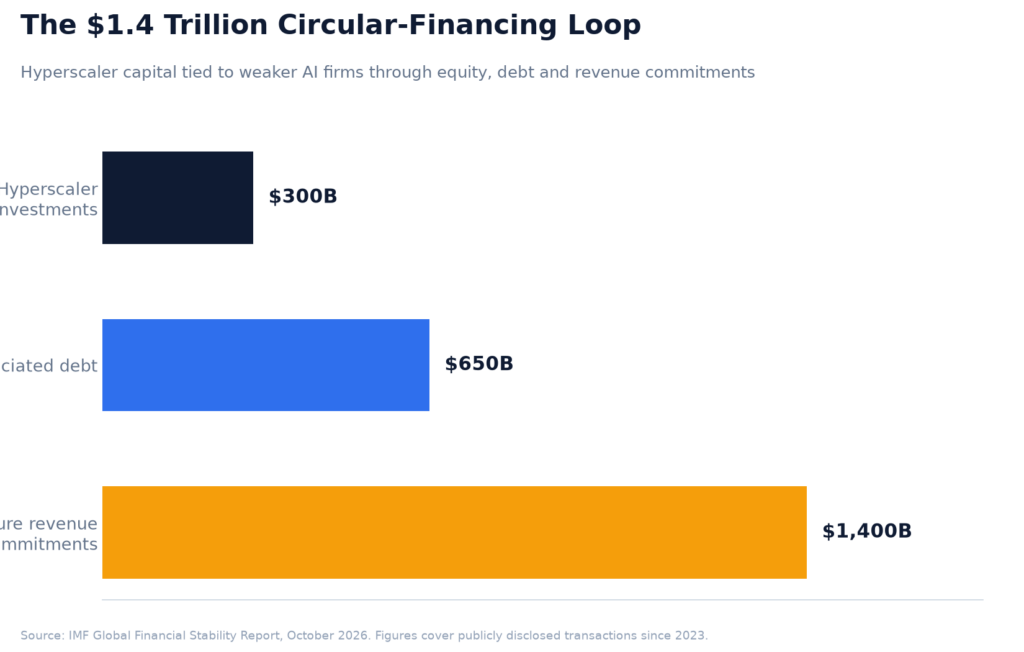
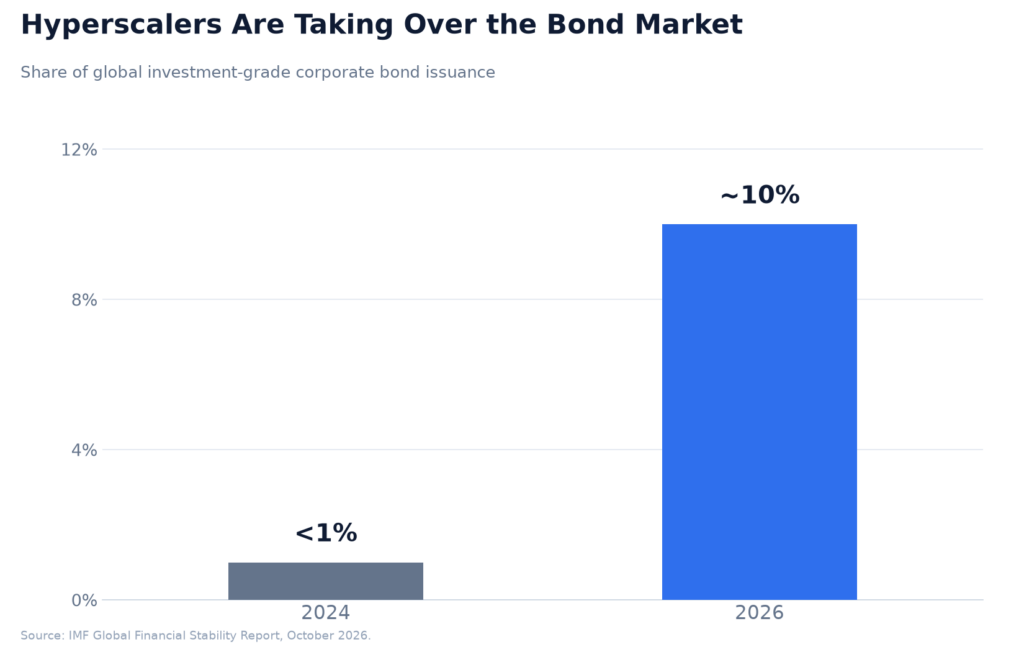
The IMF made this argument in its October Global Financial Stability Report. Since 2024, hyperscalers have grown from under 1% of global investment-grade bond issuance to roughly 10%. The fund also mapped a circular financing loop of about $1.4 trillion: some $300 billion of hyperscaler equity invested in financially weaker AI firms, layered on roughly $650 billion of associated debt, in exchange for future revenue commitments. Its term for the danger is wrong-way risk — the equity, the debt, and the revenue stream that services both can deteriorate at the same moment because they depend on the same counterparties.
None of this means the buildout stops. Every hyperscaler reports demand exceeding supply, and Microsoft’s CFO says she sees capex accelerating. The question for 2027 is not whether the spending continues, but who is funding it, at what price, and against what collateral.
What to Ignore, and What to Watch Instead
Ignore the daily swings in AI-adjacent equities — they measure sentiment, not solvency. Watch three signals:
- Capex guidance revisions. Microsoft and Alphabet both held off raising near-term forecasts this quarter — the first hesitation after two years of ratcheting higher.
- Free cash flow inflection points. Meta just crossed into negative territory; Amazon and Alphabet were already there. Watch whether any name guides back to positive.
- Investment-grade issuance as a share of capex. When the marginal AI dollar is borrowed rather than earned, the credit cycle becomes the AI cycle. The IMF’s stress scenario — an unwinding of AI investment trimming global GDP by roughly 0.4% by 2028 — now belongs in any serious road map.
The buildout is not a purely Western credit story. China is racing to expand AI infrastructure across its energy-rich western provinces, and Alibaba has been accelerating investment in AI chips, models and data-center capacity. Chinese giants face the same arithmetic — expanding compute against finite cash flow — only with a different domestic capital market behind them. The global AI capex bill is one shared constraint spread across every balance sheet that touches it.
The era of easy-money AI ends the day lenders start asking new questions about old collateral.