When AI Answers Become Ad Slots: What China’s GEO Crackdown Really Changed
A product that never existed, recommended in two hours
On the evening of 15 March 2026, China’s state broadcaster ran its annual consumer rights program. CCTV’s 3.15 Gala is a strange institution: part investigation unit, part public shaming ceremony, watched by hundreds of millions of people who have learned to treat it as a preview of which industries are about to have a very bad year.
This year one of the segments was about a category most viewers had never heard of. Generative engine optimization, which in one sentence means shaping content so that an AI assistant can find it, trust it and cite it. The industry calls it GEO.
What the program showed was not subtle. Software that churns out articles by the thousand. Selling points invented from nothing. Industry rankings and customer reviews for products that had no customers. Accounts registered in advance to publish all of it, on cue. Then the crawlers arrive, the content slides into the models, and a device that does not exist starts turning up in the recommended-answer slots of mainstream AI assistants. The reported timeline was about two hours.
Two hours is the number worth sitting with. Not because it is fast, though it is. Because it tells you what kind of market this is. Nobody spent two years building brand equity. Nobody ran a clinical trial. Somebody paid a vendor, uploaded a batch of files, and bought a shelf position inside a system that millions of people now consult before they spend money.
If you run marketing outside China, the temptation is to file this under regional peculiarities and move on. That would be a mistake. The crackdown did not happen because China regulates technology differently. It happened because AI answers became a commercial surface faster than anyone built the rules for selling space on it, and one country happened to notice first.
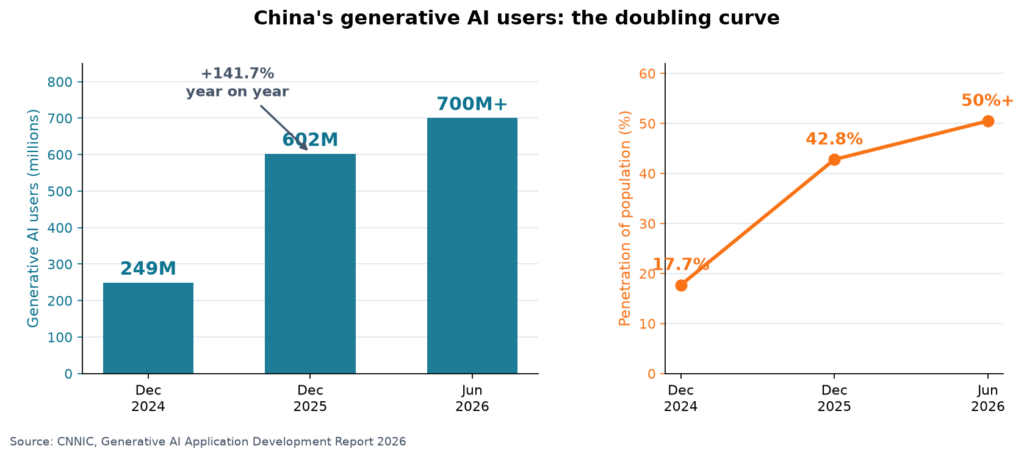
China did not just notice early. It was enormous. By the middle of 2026 the country counted more than 700 million generative AI users — penetration past 50 percent — and roughly three out of four of them turn to the technology to answer questions. When the answer box is where a fifth of the population starts a search, what happens inside it stops being a technology story and becomes a consumer story.
What the Gala actually alleged
Strip out the television production and the allegation is narrow and technical.
A set of service providers were selling a promise: pay us, and your product will appear frequently in AI-generated answers. Some of them went further and promised that outright false advertising could be delivered in the form of a “standard answer” — the flat, confident, apparently neutral phrasing that assistants use when they are summarizing what they believe to be consensus.
The method was unglamorous. Manufacture material at volume, seed it across sites that models crawl, and wait. The Chinese press gave the practice a name that stuck: AI poisoning, 投毒. Four behaviors were cited in coverage: generating false information, contaminating AI data, manipulating rankings, and using the resulting visibility against competitors.
Notice what is absent from that list. Nobody is accused of hacking a model. Nobody is accused of stealing weights. Every action taken was, on its own, something a legitimate content team does every day: write pages, publish them, try to rank. The violation lives entirely in the relationship between the claim and the truth.
That is the part regulators find hard to police with technical rules, and the part every marketer should be thinking about.
Why “poisoning” is technically the right word
There are two ways to bend an AI system’s beliefs, and they have very different economics.
The expensive way is to corrupt what the model learns during training. You would need enormous volume, and you would be competing against filtering, deduplication, and whatever data governance the lab bothered to implement. It is slow, capital-intensive, and mostly reversible at the next training run.
The cheap way is to corrupt what the model reads at the moment it answers. Modern assistants increasingly retrieve documents first and generate second. That retrieval layer is the soft spot, because it accepts new material continuously and weights recency and apparent consensus heavily.
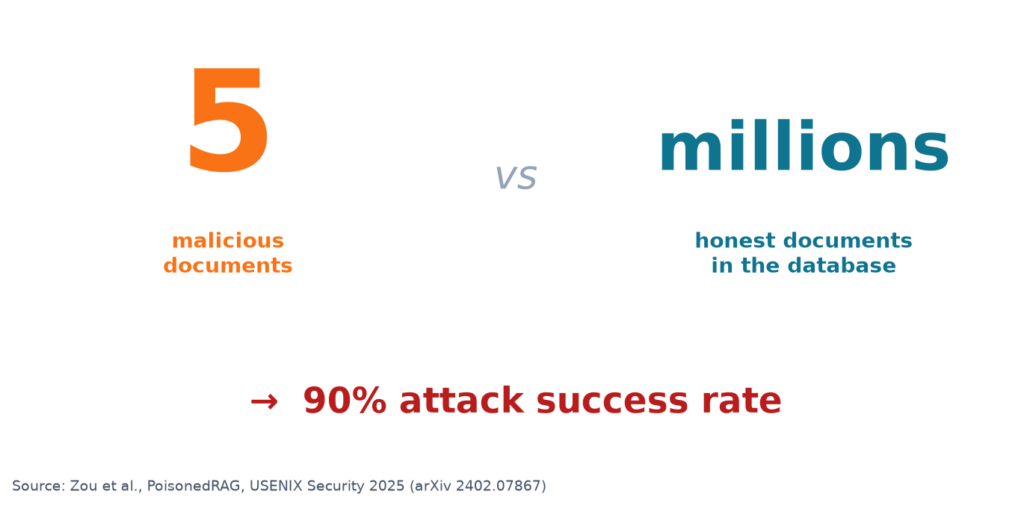
The security literature has been clear about how soft. A 2025 USENIX Security paper introduced an attack called PoisonedRAG, in which an adversary injects a handful of malicious texts into a retrieval database that holds millions of documents. Five documents. Ninety percent attack success rate at getting the model to produce an attacker-chosen answer to an attacker-chosen question. The authors also tested defenses and concluded the existing ones were not sufficient.
Read that ratio again. Five against millions. Every honest publisher in that database is outvoted by a rounding error.
That asymmetry is the entire business case for black-hat GEO. It is also why the regulatory response arrived quickly. A manipulation technique that costs almost nothing and works almost always is not a marketing tactic. It is a market failure with a login page.
The uncomfortable part: the research said this would work
Here is where the story stops being about villains.
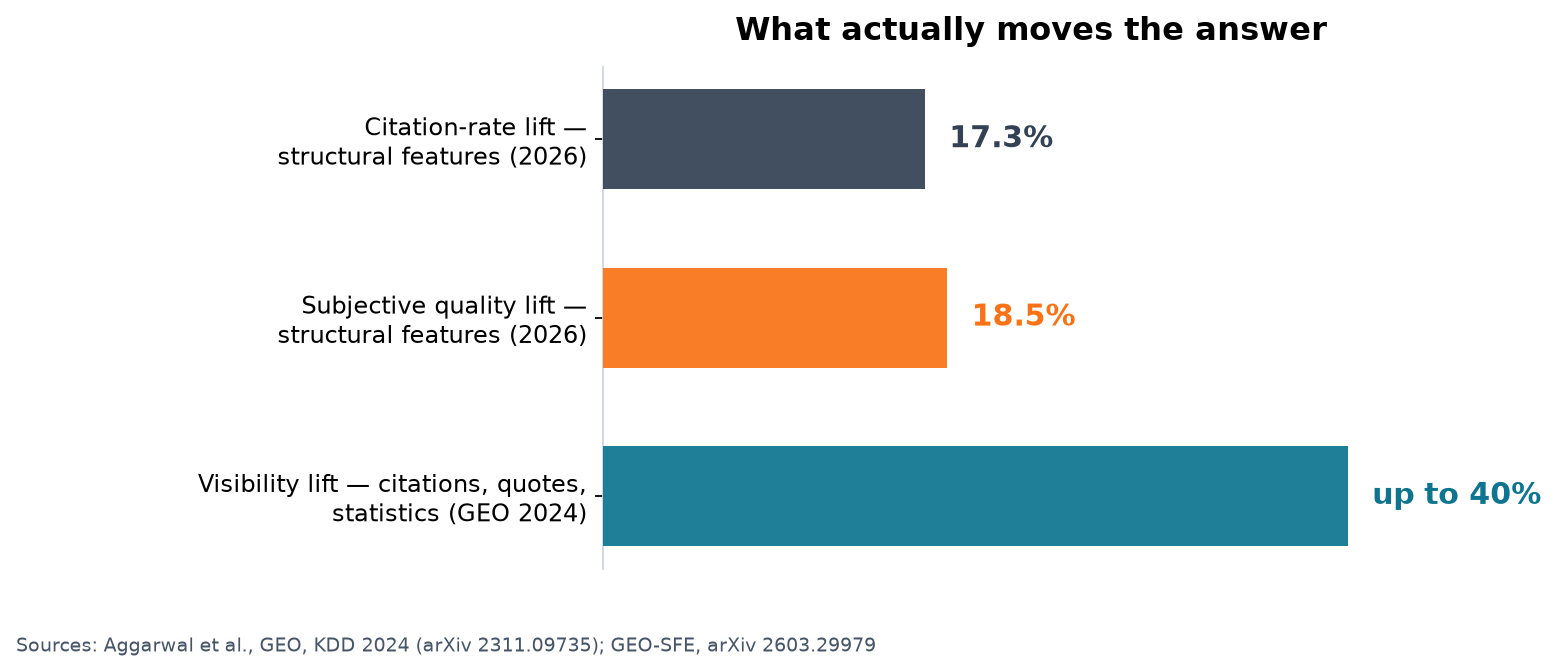
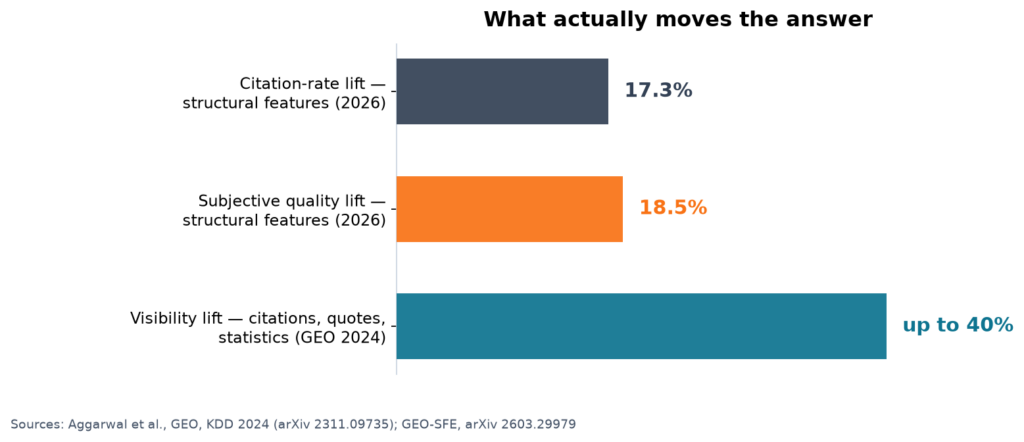
In 2024, a group of researchers from Princeton, Georgia Tech, the Allen Institute for AI and IIT Delhi published a paper at KDD that gave the field its name. They showed that content creators could raise their visibility inside generative answers by up to 40 percent, using moves that would embarrass nobody: adding citations, quoting sources, including statistics, and writing in a style the engine could lift cleanly.
That paper was written to help the creator economy avoid being disintermediated. It reads, in hindsight, like a manual with the safety warnings printed in a smaller font.
Because if citation and quotation reliably move an answer, then fabrication moves it harder. The legitimate lever and the illegitimate one are the same lever. One pulls with the truth attached, the other cuts it loose.
The 2026 follow-up work made the mechanism more explicit still. A framework published this spring decomposed content structure into three layers — document architecture, information chunking, visual emphasis — and measured what structure alone does to citation behavior across six mainstream generative engines. The result was a 17.3 percent improvement in citation rate and 18.5 percent in subjective quality, with no change to the underlying claims.
Seventeen percent from formatting. No invented facts required. This is the most important number in the whole debate, because it tells you that the gap between manipulation and optimization is not a technical threshold. It is a decision about whether the substance is real.
Where China actually drew the line
The lazy reading of March 2026 is that Beijing came down on AI marketing. It didn’t. No rule bans optimization. What the framework does, and has done since 2023, is make three specific things expensive: lying about a product, hiding that you paid for attention, and buying your way past competitors by degrading the information everyone else relies on.
The 2023 floor: accuracy, not omniscience
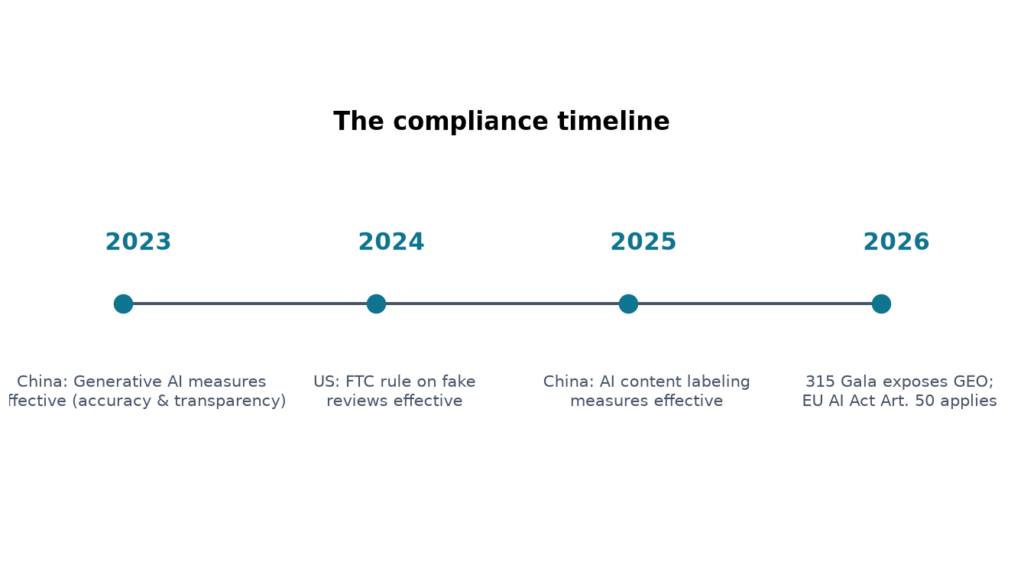
The baseline is the Interim Measures for the Management of Generative AI Services, in force since 15 August 2023. Article 4 requires providers to follow laws and public morality, to avoid generating prohibited content including false and harmful information, to respect intellectual property, and — the clause that matters commercially — to take measures appropriate to the service type to improve transparency and to raise the accuracy and reliability of generated content.
Note the verb. Improve. The obligation is a duty of care over the pipeline, not a warranty that every sentence is true. That distinction is deliberate, and it is roughly where every serious jurisdiction has landed: you are responsible for the process you operate, not for the epistemic state of the universe.
For a marketer, the practical translation is uncomfortable but simple. If your content operation is designed to make answers more accurate and more traceable, you are inside the rule. If it is designed to make answers more favorable regardless of accuracy, you are the thing the rule was written about.
The 2025 labeling regime, and why the metadata is the point
Then came the harder instrument. On 14 March 2025, four regulators — the cyberspace administration, the industry ministry, the public security ministry and the broadcasting regulator — published measures for labeling AI-generated synthetic content. They took effect on 1 September 2025.
The measures create two labels, and the second one is the interesting one.
An explicit label is what a person perceives: text, sound or a graphic mark on the content or in the interface, telling you this was machine-made.
An implicit label is what the file carries: metadata recording that the content is AI-generated, who provided the service, a provider code, and a content identifier. Invisible to you. Perfectly legible to a machine.
Now think about what that does to a volume strategy. The black-hat model depends on anonymity at scale — publish ten thousand pieces, and nobody can tell where they came from or that they were produced by one operator on one afternoon. An embedded, machine-readable passport removes exactly that advantage. The content is still there. It is just no longer unattributed.
Advertising that doesn’t look like advertising
The third thread is older and less exotic. China’s advertising rules have long required paid promotion to be identifiable as promotion. An AI answer that recommends a product because a vendor paid for the recommendation, while presenting itself as neutral synthesis, fails that test on its face.
Economists quoted in Chinese state media made precisely this argument in March: disguising commercial promotion as objective AI-generated knowledge undermines a consumer’s right to informed choice, may breach the requirement that advertising be identifiable, and where facts are fabricated may amount to false advertising or unfair competition.
The enforcement weather also shifted. In January 2026, the State Administration for Market Regulation identified AI-generated advertising as a priority problem for internet advertising supervision in the year ahead. Two months later, the Gala supplied the visuals.
The counterintuitive aftermath
Here is the detail that surprised everyone, including the people running GEO agencies.
Demand went up.
Within a week of the broadcast, agencies that had spent months insisting black-hat and white-hat practice were different things reported being booked solid. Negotiations that had stalled since January closed in days. A self-discipline convention drafted by the trade eight days before the broadcast started circulating afterwards as though it had been written for the occasion.
Why would a crackdown expand a market?
Because the crackdown did the one thing the industry could not do for itself: it created a category. Before March, “GEO” was a phrase that meant whatever the seller wanted it to mean, which is a terrible condition for a procurement decision. After March, there was a public line between two kinds of vendor, and buyers could ask a question they could not previously ask — which side of it are you on?
Regulation is frequently described as a cost. It is also, sometimes, a labeling system for an unlabeled market. That is what happened here.
The rest of the world is walking toward the same line
If you sell into the US or the EU, you are not exempt from this argument. You are just earlier in the queue.
America got there through reviews
In August 2024 the Federal Trade Commission finalized its rule on consumer reviews and testimonials, which took effect on 21 October 2024. The rule targets reviews and testimonials that misrepresent whether the reviewer exists, whether they used the product, or what their experience was.
The Commission was explicit that this covers AI-generated fake reviews. Not “AI assistance in drafting a real customer’s review.” Reviews attributed to people who are not people.
Which means: if your GEO program includes manufacturing a persona who is said to have tried the product, you are not in a gray area of marketing ethics. You are inside a rule with civil penalty exposure, and the only remaining question is whether anyone notices.
Europe put a date on it
Article 50 of the EU AI Act came into force on 2 August 2026. Providers of systems that generate synthetic audio, image, video or text must mark outputs in a machine-readable format so they can be detected as artificially generated. Deployers publishing deepfakes must disclose them. Deployers publishing AI-generated text on matters of public interest must disclose that too — unless the content has gone through human review and a natural or legal person holds editorial responsibility for it.
That carve-out deserves more attention than it gets. Europe is not asking whether a machine helped you write. It is asking whether a named human is answerable for what was published. Which is, in effect, a legal endorsement of the oldest signal of credibility there is: somebody put their name on it.
Platforms run their own courts
Statutes are slow. Search engines are not. Google’s spam policies have long treated scaled content abuse and site reputation abuse as violations, and enforcement does not require a regulator, a hearing or a statute of limitations. It requires an algorithm and a bad afternoon.
This is the enforcement channel most marketers underestimate. You do not need to be prosecuted to be punished. You need to be classified.
Four questions that separate optimization from manipulation
Most compliance frameworks are useless because they describe states of mind. Here are four tests you can actually run on a piece of content or a vendor proposal.
| Test | The question | What failure looks like |
|---|---|---|
| Truth | Is the claim true of the product as shipped, independent of the answer box? | The claim only exists in the AI answer, nowhere in the product |
| Provenance | Can the model’s statement be traced to a source with a name and an address? | The supporting material is unattributable, syndicated, or self-published at scale |
| Durability | Would this survive a model update and a fresh crawl? | The position collapses when the crawler re-reads the web |
| Disclosure | Would a regulator describe this as advertising? | Yes, and there is no label anywhere near it |
Run the tests in order. Most black-hat proposals fail the first one and never reach the fourth.
There is also a commercial tell that requires no legal training. Any vendor offering guaranteed placement in AI answers is either lying about the guarantee or lying about the mechanism. Generative answers are non-deterministic by design: same question, different day, different answer. A guarantee is not a service level. It is a description of how the content was made.
What compliant GEO actually looks like
Once you remove the folklore, the work is unglamorous and mostly pre-existing.
Fix the entity layer first. Models resolve brands through consistent, corroborated facts: legal name, category, product identifiers, dates, locations, the people who work there. Inconsistency across your own properties is not a branding problem, it is a retrieval problem.
Then build first-party evidence that can be quoted. Specifications, test results, pricing logic, warranty terms, methodology notes. The material an assistant can lift without hedging. This is the single highest-leverage investment available, and almost nobody does it, because it produces no dashboard.
Then earn third-party corroboration you do not control. Reviews, trade press, regulatory filings, academic citation, forum discussion. The point is not volume. It is independence, which is precisely what a fabricated corpus cannot simulate credibly for long.
Then structure for extraction. The structural engineering research is blunt about this: architecture, chunking and emphasis change citation probability by double digits with zero change to the claims. Headings that answer a question. Definitions that stand alone. Tables where a table is the honest format. Numbers with units and dates attached.
Then measure with a frozen prompt set. You are not tracking rankings, because there are no rankings. You are tracking share of answer, sentiment, which sources get cited, and whether your own domain is among them. Four metrics, reviewed monthly.
The measurement fight you will lose
Somebody in your organization will ask for return on investment per answer. You should refuse to invent it.
The attribution plumbing is partial by design. Some engines pass referrer parameters; others strip them. Clicks exit the answer surface through paths that analytics tools read inconsistently. The commerce integrations that would close the loop are being built, but they are not finished, and no vendor has access to data the platforms have not exposed.
What is measurable today: whether you appear, how often, in what company, with what sentiment, and whether branded search moves when you do. What is not: the revenue of a specific answer.
Say that out loud in the planning meeting. The alternative is a number that flatters the agency, misleads the CFO, and gets discovered in year two.
What happens when the answer slot becomes inventory
The next chapter is already visible, and it resolves this whole argument in an uncomfortable way.
If AI answers become the primary place people decide what to buy, the answer slot becomes ad inventory. Once it is inventory, it gets sold openly, priced, and labeled — because that is what happens to every ad format eventually. The Chinese industry has already coined a term for the phase after GEO: generative engine marketing, GEM, meaning paid placement inside generated answers.
When that arrives, the manipulation problem does not disappear. It changes shape. The question stops being “did you trick the model” and becomes “did you disclose the placement,” which is a question regulators already know how to answer.
The strategic implication is not subtle. Brands whose value rests on verifiable facts and durable entities will carry over into that world intact. Brands whose visibility was rented from a content farm will not, because when the shelf is for sale, the shelf owner decides who is on it.
The short version
- In March 2026, China’s consumer rights gala exposed GEO vendors selling fabricated content that reached AI recommendation slots within hours. The mechanism, not the medium, was the violation.
- The technical case for manipulation is brutally simple: five documents can outvote millions. That asymmetry is why rules arrived.
- China’s response was not a ban on optimization. It was accuracy obligations from 2023, a dual explicit-and-implicit labeling regime from September 2025, and existing advertising-identifiability rules.
- The implicit label is the underrated instrument. A machine-readable passport strips scale of its main advantage, which is anonymity.
- The crackdown grew the legitimate market, because it gave buyers a line to sort vendors by.
- The US reached the same place through its fake-review rule in 2024. The EU reached it through Article 50 in August 2026. Platforms reached it years ago through spam policy.
- Legitimate optimization and manipulation pull the same lever. The difference is whether the claim survives contact with the product.
FAQ
Is generative engine optimization legal in China?
Yes, as a practice. There is no prohibition on structuring content so that models can find, understand and cite it. What is prohibited is generating false information, presenting paid promotion as neutral synthesis, and degrading a competitor’s standing through fabricated material. The line sits at the claim, not the technique.
Does China’s labeling rule apply to content I wrote with AI assistance?
The measures target AI-generated synthetic content and the services that produce it, with obligations split between providers and platforms. The practical exposure for a marketing team is narrower than the headlines suggest and depends on how the content is produced and distributed. What is not ambiguous is the direction of travel: provenance metadata is becoming standard infrastructure, and content strategies that assume invisibility are pricing in a risk that is already materializing.
If nobody can guarantee placement, what am I actually buying?
Three things that are real. Coverage of the questions your buyers ask, in the phrasing they use. The structural and evidentiary work that makes your material quotable. And measurement of share, sentiment and citation quality over time. Anything beyond that — guaranteed mentions, one-week ranking, “standard answer” positioning — is a description of how the content was manufactured, not a service.
Does a Chinese consumer rights program matter to my US or EU brand?
Not as a legal precedent. As a leading indicator, yes. China has the largest measured consumer AI population on earth: more than 700 million generative AI users by mid-2026, penetration above 50 percent, and roughly three in four of them using the technology to answer questions. When a market that large starts treating answer manipulation as a consumer protection issue, the regulatory logic travels. It usually arrives elsewhere two to four years later, wearing local clothes.
What should I audit first?
Your own properties. Pick the twenty questions your buyers actually ask, run them through four or five assistants, and record what comes back: whether you appear, which sources are cited, what the answer says about you, and whether any of it is wrong. Most teams discover two things in the first afternoon. They are less visible than they assumed, and some of what the models believe about them is out of date. Both are fixable, and neither requires a vendor.