DeepSeek’s Router-and-Worker Blueprint Shows What Comes After the Chatbot
DeepSeek’s New Agent Architecture Lets AI Direct Other AI
The Chinese lab’s Super-agent design replaces chat sessions with a router–worker hierarchy. Its own tests show tail latency cut by nearly half — and token consumption up 37%.
On October 31, DeepSeek’s Harness team published a technical paper titled Super-agent Design Exploration: Towards a More Autonomous Agent System. It is not a product launch. Alongside the paper, the team released an open prototype, dsh-superagent-prototype, on GitHub, and described it plainly as a validation of a technical direction rather than a shipping product.
The argument inside the paper deserves more attention than the release mechanics. DeepSeek is saying the binding constraint on agentic AI has moved. It is no longer how much a model can do in one turn. It is how many things a human can supervise at once.
The bottleneck moved from the model to the person
Most agent systems today are built around sessions. One conversation, one context, one task in flight. When a person wants to run five things in parallel, they end up maintaining five windows, five context stacks, and five mental models of progress.
DeepSeek puts a number on the ceiling: a person can keep track of roughly three to five active sessions at a time. Beyond that, the tooling gets in the way — single-session blocking during a long tool call, contexts that drift apart, and tasks that stall the moment a laptop goes offline.
The company’s framing is blunt. Agent systems need to move from reactive single-task tools to collaborators that stay online, run several complex jobs in parallel, and act when the environment changes.
One coordinator, many executors
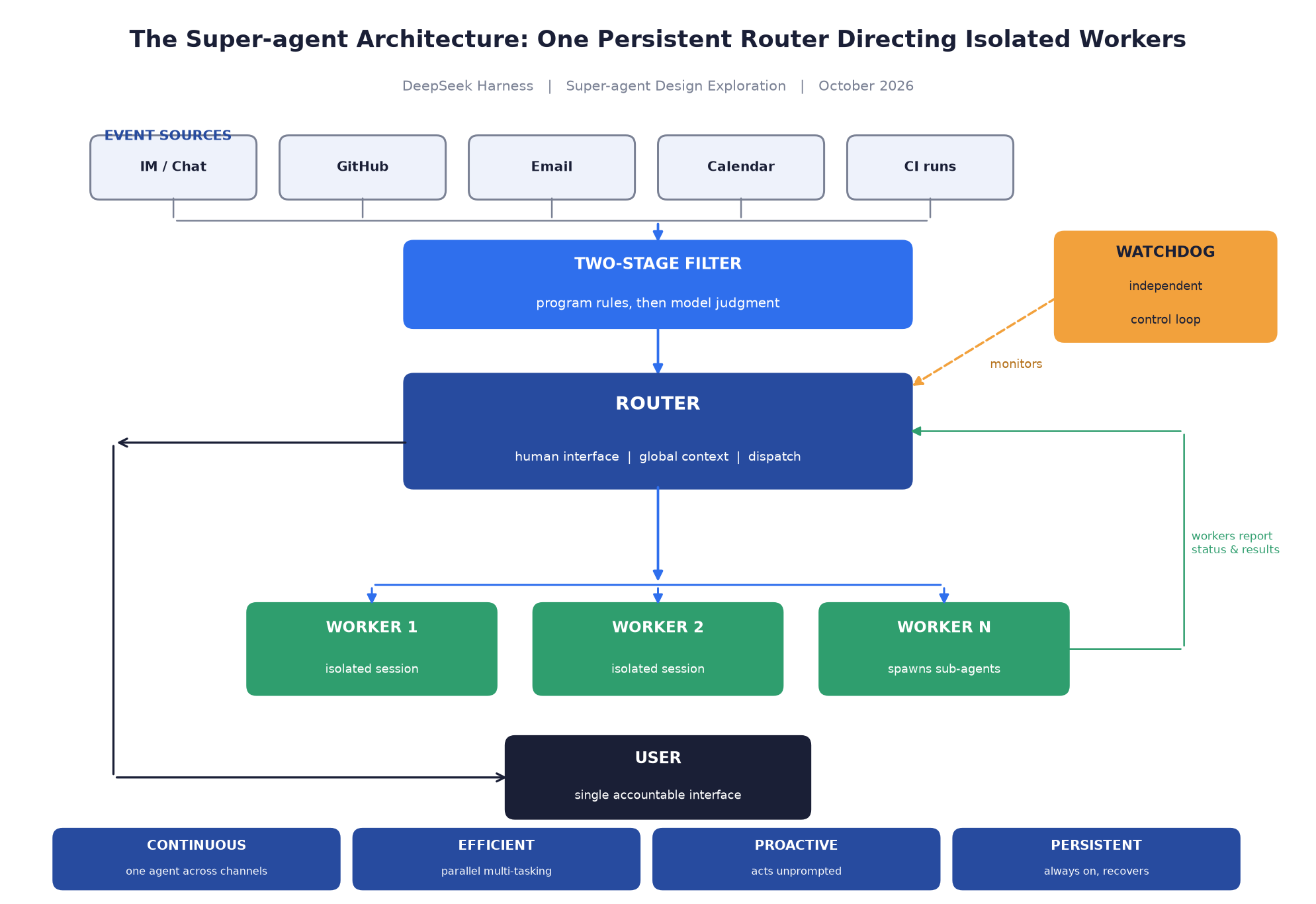
The heart of the design is a two-tier split. A Router layer handles human interaction, holds the global context, and decides what gets dispatched. Worker layers run specific jobs in isolated sessions, each with its own context and tool access, and each able to call further sub-agents when a task needs it.
Workers do not talk to the user. They report status and results back to the Router, which owns the single conversation the human sees. The user experiences one assistant. The system may be running a dozen processes behind it.
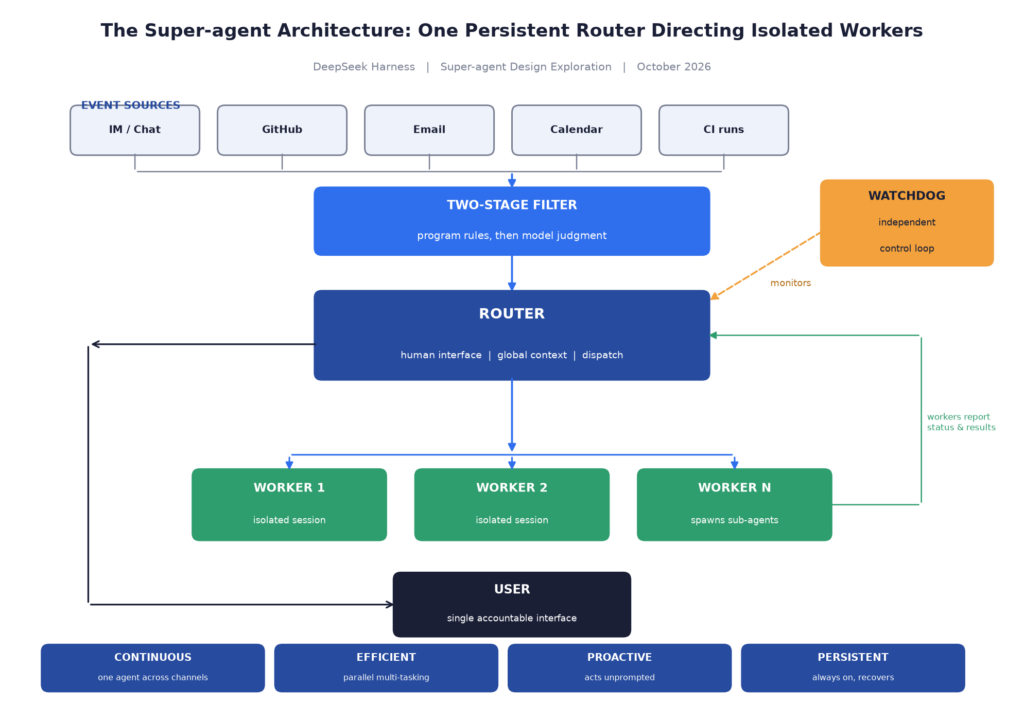
To cut coordination overhead, DeepSeek added a subscription mechanism. Once a Worker takes ownership of a thread — a pull request, a chat topic — subsequent events tied to that thread route straight to the Worker instead of passing through the Router again.
DeepSeek also argues the Router does not need a frontier model. Routing is comprehension plus dispatch, so a lighter model can handle it while stronger models are reserved for execution. Session management, in this view, should become an internal detail rather than something users administer by hand.
Four properties, five moving parts
DeepSeek defines a Super-agent by four properties: continuous (one agent across channels), efficient (true parallelism), proactive (watches for events and advances work nobody requested), and persistent (always on, able to recover from failures over long runs).
The architecture rests on five components: the two-tier hierarchy, event-driven triggering, a human-facing interaction model, the separation of compute, state and execution environment, and an independent watchdog.
Events are the input layer. Chat messages, email and calendar alerts, code review comments, CI results — all treated as triggers. Because most of that stream is noise, DeepSeek filters in two stages: deterministic program rules first, then a model judgment on whether the survivors justify action.
The measurements
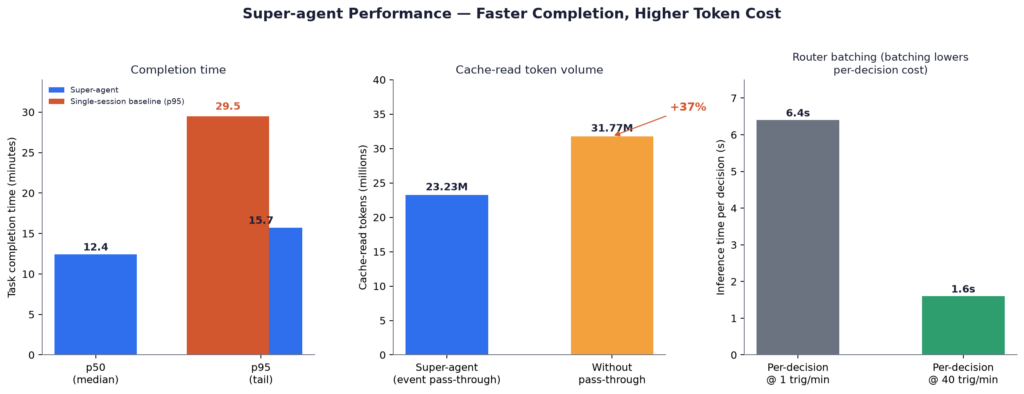
DeepSeek ran a preliminary comparison of its Super-agent against two single-session-plus-subagent configurations under different prompting. Each run carried about 300 messages, roughly 20 of them real work requests, repeated five times per configuration.
The Super-agent completed work requests with a median of 12.4 minutes and a p95 of 15.7 minutes. The single-session baseline under neutral prompting reached a p95 of 29.5 minutes.
The gap came from scheduling, not raw model speed. Under neutral prompts, the baseline model never called its sub-agents across five runs — everything queued through the main session and absorbed interference from incoming messages. DeepSeek’s two-tier design removes that discretion by making dispatch structural.
The cost side is reported without spin. Cache-read volume rises because multiple isolated contexts must be maintained. Removing the event pass-through mechanism increased Router decisions by about 30% and pushed total cache reads from 23.23 million to 31.77 million tokens, a 37% rise.
Router throughput held up under load. As trigger arrival rose from about one per minute to roughly 40, average batch size climbed from 1.0 to 2.8 and per-request latency went from 2.5 to 3.9 seconds — but inference time per decision fell from 6.4 seconds to 1.6 seconds, because batching amortized the work.
DeepSeek is careful about what these numbers mean. The test used synthetic load and simulated tool durations. It measures scheduling and coordination, not code quality or task correctness.
The market this lands in
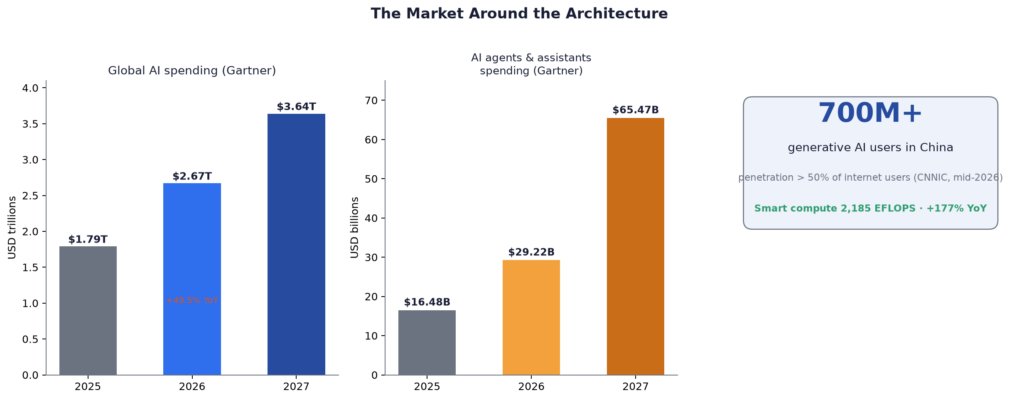
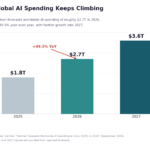
Gartner expects worldwide AI spending to reach USD 2.67 trillion in 2026, up 49.5% from USD 1.79 trillion in 2025, then climb to USD 3.64 trillion in 2027. Within that, agents and assistants remain a small but fast-moving slice: USD 16.48 billion in 2025, USD 29.22 billion in 2026, and USD 65.47 billion projected for 2027.
Two Gartner findings sharpen the context. The firm places generative AI in the Trough of Disillusionment for 2026 even as spending keeps rising, and it expects more than 40% of agentic AI projects to be canceled by 2027. Separately, Gartner forecasts that through 2027, enterprises running IT operations agents on uncapped token-based pricing will exceed initial cost expectations by more than 50%.
The China backdrop adds a second lens. According to the China Internet Network Information Center, more than 700 million people in the country were using generative AI as of mid-2026, a penetration above half of internet users, while access to AI assistants and productivity tools grew more than 100% year over year. Smart compute capacity reached 2,185 exaflops, up 177% year over year, and 32.5% of users already apply the technology to work tasks. On both sides of the market — global spending and Chinese adoption — the question has shifted from whether agents work to how they scale.
What it means for marketing and digital operations
For teams running content, campaign, and lifecycle operations, the practical shift is about supervision ratios. Today, an AI-assisted marketing workflow usually looks like one operator driving one tool at a time, switching contexts between research, drafting, QA, and reporting. The routing model implies something different: a single accountable interface that dispatches parallel workstreams and reports back consolidated, with humans setting objectives and approving outputs rather than issuing each next instruction.
That has two consequences worth planning for. First, throughput stops scaling with headcount and starts scaling with how well work is specified and how clean the upstream event stream is — garbage triggers produce garbage dispatch. Second, cost becomes a function of coordination, not just generation, which is consistent with Gartner’s warning that agentic systems consume far more tokens than conversational AI because they run multistep loops.
There is also a distribution question. If assistants consolidate multi-step tasks behind a single interface, brand exposure narrows to whatever the agent selects. Content that cannot be parsed, verified, and cited by a machine has less room to compete.
The unresolved list
DeepSeek names its own gaps: how the Router scales as task volume grows, long-horizon memory across weeks or months, how humans collaborate once sessions stop being the unit of work, agent-to-agent communication across instances, and security. The security section is the least comfortable — once a cloud agent reaches into a local machine, prompt injection, credential leakage on the endpoint, and cross-device permission scope become live risks. The team also concedes the paper proposes no new theory; it applies classic systems thinking — scheduling, cache hierarchy, event-driven design, compute-storage separation — to agent architecture.
The takeaway
DeepSeek has not shipped a Super-agent product, and the prototype is a testbed. What the paper establishes is a credible answer to a question the market has been circling: if models can already finish tasks unsupervised, the next unit of design is not the prompt or the session. It is the org chart around the model.
That is a smaller claim than the headlines suggest and a more durable one. The companies that win the next phase of agentic AI may not have the best single model. They may have the best routing layer, the cheapest coordination cost, and the clearest rules for when a human must sign off.