Your Team Isn’t Gaming the Metric. They’re Believing It.
Every KPI playbook arrives at the same advice: keep the diagnostic metric separate from the compensated one. Pay on outcomes, track proxies privately, gaming stops.
Good advice. Incomplete advice. The reason why is more interesting than the advice itself.
A management-accounting research programme has spent a decade documenting what happens when a measure stands in for a strategy. They call it surrogation: managers lose sight of the construct a measure was meant to represent, then act as though the measure is the construct. The satisfaction score stops being evidence of satisfaction and becomes satisfaction.
That sounds like ordinary incentive gaming. Then the experiments got uncomfortable.
The substitution happens before anyone decides anything
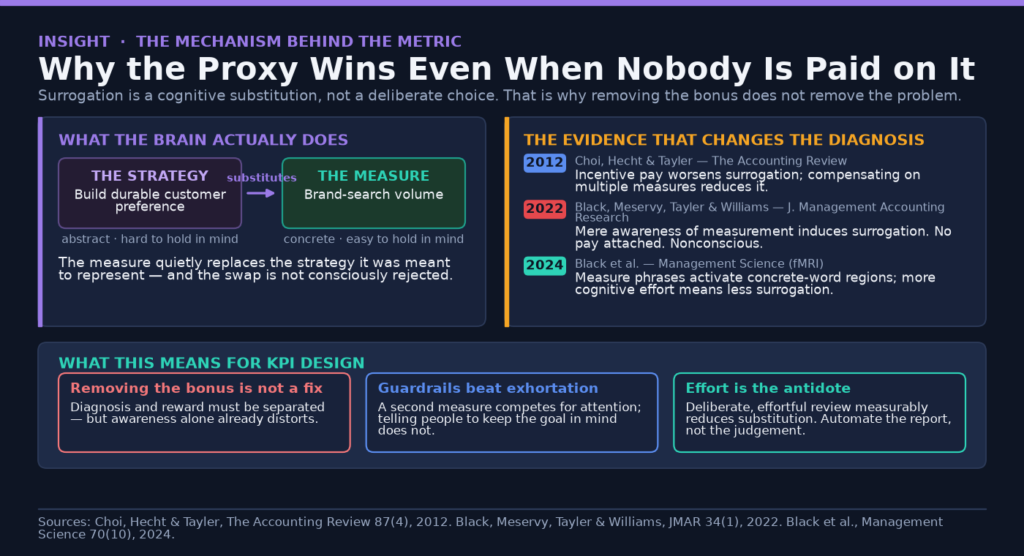
Willie Choi, Gary Hecht and Bill Tayler, writing in The Accounting Review in 2012, found incentive compensation makes surrogation worse — and that compensating managers on multiple measures of a strategy reduces it compared with a single measure.
Predictable. Pay on one number, get one number.
But the effect kept appearing where it should not have. Surrogation persisted after incentives were removed. It persisted when participants faced an opportunity cost for maximising the surrogate — when surrogating actively cost them money.
That is not someone choosing to game a bonus. That is something else.
Why concrete beats abstract in a fair fight
The mechanism is attribute substitution: when a target attribute is hard to access mentally and a related heuristic is easy, the easy one stands in — unless the swap is consciously rejected.
Measures are concrete. Strategies are abstract. Brand-search volume you can hold in your head. Durable customer preference you cannot. The measure wins the competition for attention because it is cheaper to think about, not because anyone prefers it.
In 2024, Paul Black and colleagues took this into an fMRI scanner and published in Management Science. Measure phrases triggered greater activation in brain regions favouring concrete over abstract words; strategy phrases showed the reverse. Greater brain activity and longer response times were associated with less surrogation.
Effort is protective. The error lives in the fast, cheap path.
The finding that should change your dashboard policy
The decisive result came in 2022. Black, Thomas Meservy, Tayler and Jeffrey Williams, in the Journal of Management Accounting Research, told participants that one attribute had been randomly selected to be measured — explicitly no more or less important than any other.
No compensation attached. Measure outcomes were not even visible.
They surrogated anyway. Surrogation also rose under cognitive load, exactly what you would expect of a nonconscious process rather than a calculated one. Busy people substitute more.
So if mere awareness of measurement is enough to distort judgement, separating the report from the reward cannot be the whole fix. It removes the amplifier, not the mechanism.
What actually follows
Choose what you announce, not just what you pay on. Publishing a metric is an intervention. On the wall, it competes with your strategy for working memory — bonus or no bonus.
Prefer two measures to one. The 2012 result is the practical one: multiple measures reduce substitution because no single number stands unopposed. It is the strongest empirical backing guardrails have.
Protect the effortful review. Automate the reporting. Do not automate the judgement about whether the number still means what you think it means.
The uncomfortable part
We like the incentive story: it gives us a villain and a lever. Someone chased a bonus; remove it; solved.
The cognitive story is harder. The distortion is a default of how minds handle abstractions. It runs in honest people doing good work, and worsens precisely when everyone is busiest.
The question is not only what do we reward? It is what have we made easiest to think about? That, more often than we admit, is what the team pursues.