The Budget Stops Being Last Year’s Number Plus 5%
Your marketing budget probably has a secret: a meaningful slice of it is spending money on things nobody would approve today. That is not a scandal — it is just how incremental budgeting works. Last year’s number rolls forward, gets a small adjustment, and the past quietly owns the future. Meanwhile, Gartner’s 2026 CMO Spend Survey shows budgets stuck at 7.8% of company revenue — barely above 2025’s 7.7%, and far below the roughly 11% average of the four years before the pandemic. Fifty-six percent of CMOs say that is not enough to execute their strategy. Zero-based budgeting (ZBB) attacks the problem at the root: start every cycle from zero, and make every dollar re-apply for its job against a current outcome. It is heavy, and it is easy to wield badly — Kraft Heinz is the cautionary tale — but done right, ZBB turns a flat budget from a museum of past priorities into a portfolio of current bets.
1. The flat-budget era is not a phase — it is the regime
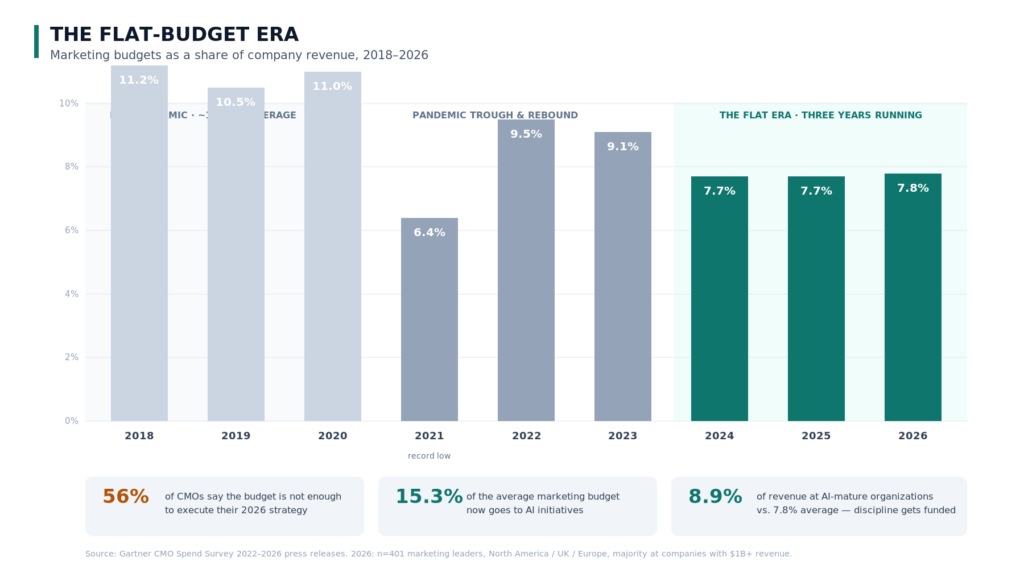
Let’s start with the uncomfortable arithmetic. In Gartner’s annual CMO Spend Survey, marketing budgets hit a record low of 6.4% of company revenue in 2021, rebounded to 9.5% in 2022, then slid again: 9.1% in 2023, 7.7% in 2024, and 7.7% again in 2025. The 2026 edition — 401 marketing leaders across North America, the UK and Europe, most at companies with over $1 billion in revenue — puts the figure at 7.8%. That is not a recovery. That is a plateau, and Gartner’s analysts describe single-digit budget shares as the new normal.
The squeeze is felt everywhere. Fifty-six percent of CMOs say their budget is insufficient to deliver their 2026 strategy; 54% report insufficient resources. The share complaining has actually improved — 64% in 2024, 59% in 2025 — but a majority still cannot fund the plan they were hired to execute. And the money is being reshuffled, not added: AI initiatives now absorb 15.3% of the average marketing budget, and 70% of CMOs call AI leadership a critical goal while only 30% report mature readiness. Somebody has to pay for that. In a flat budget, the only somebody available is the past.
2. Why incremental budgeting fails: waste acquires tenure
The default method in most marketing departments is incremental budgeting: take last year’s grid, adjust a few percentages, debate the deltas. It feels efficient. It is actually amnesia with a spreadsheet attached.
Here is the failure mechanism, step by step. First, waste acquires tenure. The martech subscription nobody logs into, the agency retainer that stopped producing, the sponsorship renewed because the contract auto-renews — all of it rolls forward by default, because the burden of proof sits on whoever wants to cut, not on whoever wants to keep. Second, the flat-budget squeeze turns that inertia into starvation: when every dollar is already committed to history, new priorities — AI tooling, a new channel, a brand refresh — can only be funded with scraps. Third, the evidence gap: incremental budgets justify variances from last year, not value. The question becomes “what changed?” instead of “what is worth it?”
McKinsey’s research on resource allocation puts numbers on the inertia. A third of companies reallocate only about 1% of their capital from year to year; the average is 8%. Executives know better — 83% call reallocation the top management lever for growth, ahead of operational excellence or M&A — yet the budget keeps behaving as if last year were a verdict instead of a data point. Incremental budgeting does not merely tolerate waste. It gives waste a permanent contract.
3. What zero-based budgeting actually is
Zero-based budgeting flips the burden of proof. Each cycle starts from a blank page — zero — and every line item, retainer and subscription must justify itself against current priorities, not against a prior-year baseline. If a spend cannot state its mission, the outcome it serves, and the evidence that it earns its keep, it does not survive.
McKinsey’s formulation is the cleanest: zero-basing shifts the budgetary burden of proof “from the finance function or cost-reduction team to justify cuts, to the business to justify spend by proving the ROI that the spend will achieve.” Read that twice. Under incremental budgeting, cutting requires a case. Under ZBB, keeping requires one. That single inversion is the entire method.
Two clarifications matter. First, the justification format is a business case, not a variance note: mission, outcome, evidence — not “last year plus 3%.” Second, ZBB is not a cost-cutting exercise. It is an evidence discipline. The cutting is a side effect; the clarity is the point. Teams that run ZBB purely to shrink the number usually destroy value — more on that in the Kraft Heinz section. Teams that run it to rank their priorities usually find money they did not know they had.
4. The payoff, part one: the efficiency prize
How much money is actually hiding in a typical marketing budget? McKinsey’s estimates give you a defensible range, category by category.
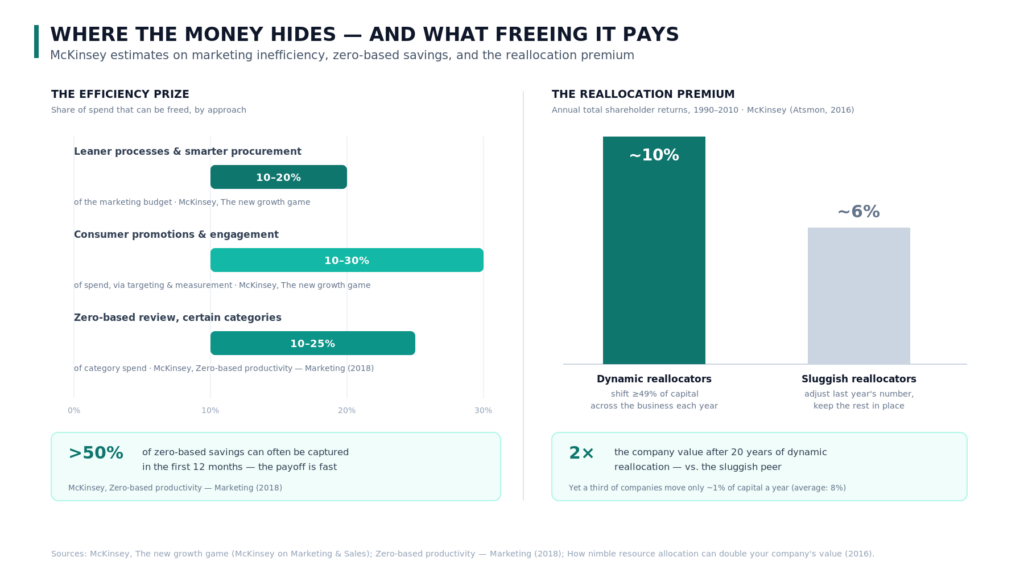
In “The new growth game,” McKinsey reports that many companies can save 10 to 20 percent of their marketing budgets simply by making processes leaner, paying the right price for services — and paying only for what they actually need — and figuring out who should do the work. Optimizing consumer promotions and engagement through better targeting, simpler programs and better measurement can free another 10 to 30 percent of that spend. And in its dedicated zero-based productivity work, McKinsey finds that zero-based marketing can uncover savings worth 10 to 25 percent of spending in certain categories.
Two honest caveats. These are category-level potentials, not a guaranteed haircut on your total budget — your mix determines what is actually recoverable. And the payoff arrives fast: McKinsey notes that often more than 50 percent of zero-based savings can be captured in the first 12 months. Under a flat budget, that is the strongest argument there is. You do not need the CFO to give you more money. You need a method to find the money you already have.
5. The payoff, part two: the reallocation premium
Finding the money is half the story. What you do with it decides whether ZBB compounds.
McKinsey’s long-running reallocation research (Yuval Atsmon’s 2016 analysis, tracking companies from 1990 to 2010) splits the corporate world into cohorts. Dynamic reallocators — companies that shift at least 49% of their capital across the business — delivered roughly 10% annual total shareholder returns. Sluggish reallocators delivered about 6%. Compounded over 20 years, the dynamic reallocator ends up worth roughly twice its less agile peer. And in its zero-based productivity research, McKinsey found that businesses methodical about reinvesting unlocked funds into growth — proven winners or future products — outperform the market.
The implication for a flat marketing budget is direct. ZBB is not just a way to survive 7.8% — it is a way to behave like the companies that turn budget discipline into a compounding advantage. The budget becomes a ranking of priorities instead of a sediment of history, and every freed dollar gets a job with a higher return than the one it replaced.
6. The payoff, part three: credibility with finance
There is a quieter benefit that CMOs underestimate: ZBB speaks the CFO’s language. A budget built from justification, not inheritance, arrives at the finance review already carrying the evidence that finance would otherwise demand. Mission, outcome, expected return — that is a business case, and business cases get defended in bad years.
Gartner’s 2026 data hints at exactly this dynamic. Organizations with mature AI readiness do not just spend differently; they get funded differently — averaging 8.9% of revenue on marketing versus the 7.8% survey average, and allocating 21.3% of their budgets to AI versus 15.3%. Gartner’s chief of research, Ewan McIntyre, reads this as a signal that the most advanced CMOs pair investment with “budget agility, innovation capacity and operating discipline” — and are rewarded with larger budgets. Correlation is not causation, of course. But the pattern is hard to ignore: discipline is visible to the people who sign the checks, and visible discipline gets funded. The evidence that survives a zero-based review is the same evidence that wins next year’s budget.
7. How to run ZBB without killing the brand: four guardrails
Now the hard part. ZBB has a failure mode, and it is not subtle: it leans toward whatever is measurable, short-term and defensible in a spreadsheet. Brand building — the compounding engine with no clean last-click ROI — loses those arguments by design. So you build guardrails before you start, not after the damage.
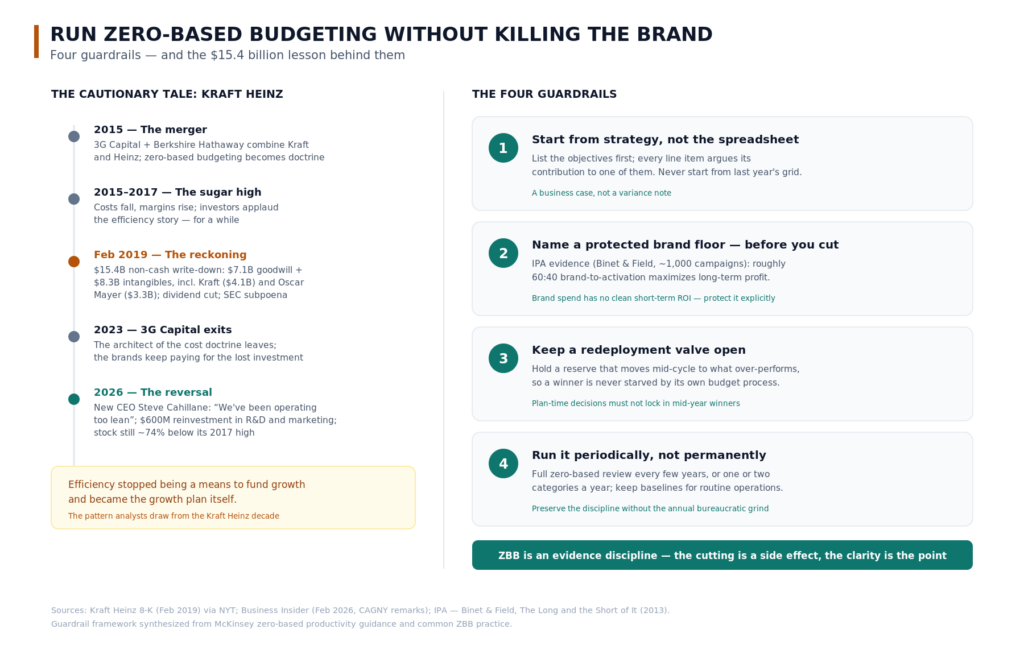
Guardrail one: start from the strategy, not the spreadsheet. List the top objectives first, then make every line item argue its contribution to one of them. Never start from last year’s grid — that smuggles the museum back in through the service entrance.
Guardrail two: name a protected brand floor before you cut. The IPA’s evidence base — Les Binet and Peter Field’s analysis of roughly 1,000 effectiveness cases in “The Long and the Short of It” — puts the optimum split between brand building and sales activation at about 60:40 on average (updated to 62:38 in “Effectiveness in Context”). Treat that as a category-sensitive starting point, not a law of physics, and write your brand floor into the exercise before the zero-based reviews begin. Otherwise the process will eat it.
Guardrail three: keep a redeployment valve open. ZBB’s structural weakness is rigidity: decisions made at plan-time can starve a campaign that proves itself in month five. Hold a reserve that can move mid-cycle to whatever is over-performing, so a winner is never underfunded by its own budget process.
Guardrail four: run it periodically, not permanently. Full ZBB every year is a bureaucratic grind that exhausts teams and breeds gaming. The pragmatic pattern: a full zero-based review every few years, or one or two categories annually, with historical baselines kept for routine day-to-day operations. You preserve the discipline without paying its overhead every single cycle.
8. The Kraft Heinz lesson: when efficiency becomes the strategy
The canonical warning is a decade old and still getting sharper. When 3G Capital and Berkshire Hathaway merged Kraft and Heinz in 2015, zero-based budgeting became the doctrine: every cost re-justified, every year. At first, the machine delivered exactly what it promised — costs fell, margins firmed, investors applauded.
Then the bill arrived. In February 2019, Kraft Heinz disclosed a $15.4 billion non-cash impairment: $7.1 billion of goodwill and $8.3 billion of indefinite-lived intangibles, including $4.1 billion against the Kraft brand and $3.3 billion against Oscar Mayer. The dividend was cut; an SEC subpoena over accounting policies followed. The write-down was not really about ketchup. It was the balance sheet admitting that the cash-generating assumptions attached to those brands were no longer defensible after years of underinvestment.
The epilogue is the part most ZBB articles miss. 3G Capital exited in 2023. In January 2026, Steve Cahillane took over as CEO, and at the CAGNY conference in February he said the quiet part out loud: “We’ve been operating too lean, and we acknowledge that, and we’re going to fix it.” The company announced a $600 million reinvestment plan spanning R&D and marketing. The stock, at the time of his remarks, sat roughly 74% below its 2017 high.
The lesson is not “ZBB bad.” The lesson is that efficiency stopped being a means to fund growth and became the growth plan itself. ZBB wielded as a permanent austerity machine starves the very assets — brand, innovation, capability — that the savings were supposed to fund. Wielded as a periodic evidence discipline with a protected brand floor, it is the opposite: it funds them deliberately.
9. Risks and honest caveats
Let’s keep the scorecard honest. Four risks deserve a line in your own business case for ZBB.
The brand-evisceration risk is the big one — covered above, but worth repeating: anything without a clean short-term ROI will lose a zero-based argument unless you change the rules of the argument in advance. The time cost is real: justifying every line is expensive in analyst-hours, and on intangible marketing outputs it is genuinely hard. Budget the overhead explicitly; do not absorb it quietly and then resent the method. The rigidity trap bites teams that skip the redeployment valve — plan-time decisions should not lock in mid-year winners. And the gaming risk grows with repetition: teams learn to dress activity up as outcomes to survive the review. The discipline only works while the evidence standard stays honest, which is one more reason to run ZBB periodically and rotate the categories you zero-base.
Conclusion: close the museum
A flat budget is a visibility problem. When the money is stuck at 7.8% of revenue and 56% of your peers say it is not enough, the only way to fund the new is to free the old — and incremental budgeting makes that nearly impossible, because the old rolls forward by default. Zero-based budgeting is the fix: start from zero, and make every dollar re-apply for its job against a current outcome. The prize is real — McKinsey’s 10–25% category-level savings, more than half of it capturable in year one, feeding a reallocation discipline that historically doubled company value over two decades. But wield it with guardrails: protect the brand floor before you cut, keep a redeployment valve open, run it periodically rather than constantly, and keep the evidence standard honest. Then the budget stops being a museum of past priorities and becomes what it should be in a flat-budget era — a portfolio of current bets.