The Question Before the Purchase: What Decision Does This Tool Serve?
Somewhere in your company right now, a dashboard nobody opens is renewing itself. It has a login page, a quarterly business review, and an invoice that arrives like clockwork. What it doesn’t have is a user.
That’s not a joke about one bad purchase. It’s the industry’s default setting. Gartner’s 2025 Marketing Technology Survey — 413 martech leaders, surveyed between June and August 2025 — found that teams actively use only 49% of their martech capability. Just 15% of organizations qualify as high performers, meaning they hit strategic goals and can show positive ROI. Everyone else is paying full price for a half-empty stack.
And the bill keeps growing. Martech now absorbs nearly 22% of total marketing spend, the largest single line in the budget, per the same Gartner research. Meanwhile Zylo’s 2026 SaaS Management Index, built on more than 40 million licenses and $75 billion in spend under management, puts the average organization’s annual license waste at $19.8 million.
So here’s the uncomfortable question: if the tools are good — and most of them are — why is the outcome so bad?
Because procurement runs backwards. Someone sees a shiny product, gets excited, signs, and constructs the rationale afterwards. Buying without regrets means reversing that sequence: name the decision first, audit what you own, verify the data plumbing before the feature list, and put a human’s name on the contract before the ink dries. The antidote to shelfware isn’t another tool. It’s governance.
The Shelfware Scandal: Half the Capability, All of the Bill
Let’s sit with the utilization number for a second, because it deserves more than a headline.
Gartner has tracked this for years: 58% of capability in use in 2020, 42% in 2022, a low of 33% in 2023, and a partial recovery to 49% in 2025. One honest caveat before you chart that: the survey’s definitions shift slightly between editions — some years measure breadth of capabilities, some phrase it as tools actively used — so treat it as a trend line, not a lab measurement. The trend is damning either way. Survey after survey, the average team has left roughly half of what it pays for sitting idle.
The license-level view, from the SaaS side of the house, rhymes with it. Zylo reports that organizations leave an average of 36% of licenses unused when measured against industry-recommended utilization levels. Absolute usage tells a blunter story: average license utilization was 54% in 2025 — up from 47% in 2024, which means 46% of licenses went unused in a typical 30-day window.
Two yardsticks, one verdict. Whether you measure the gap against best practice or count the logins, a huge share of paid capability does nothing.
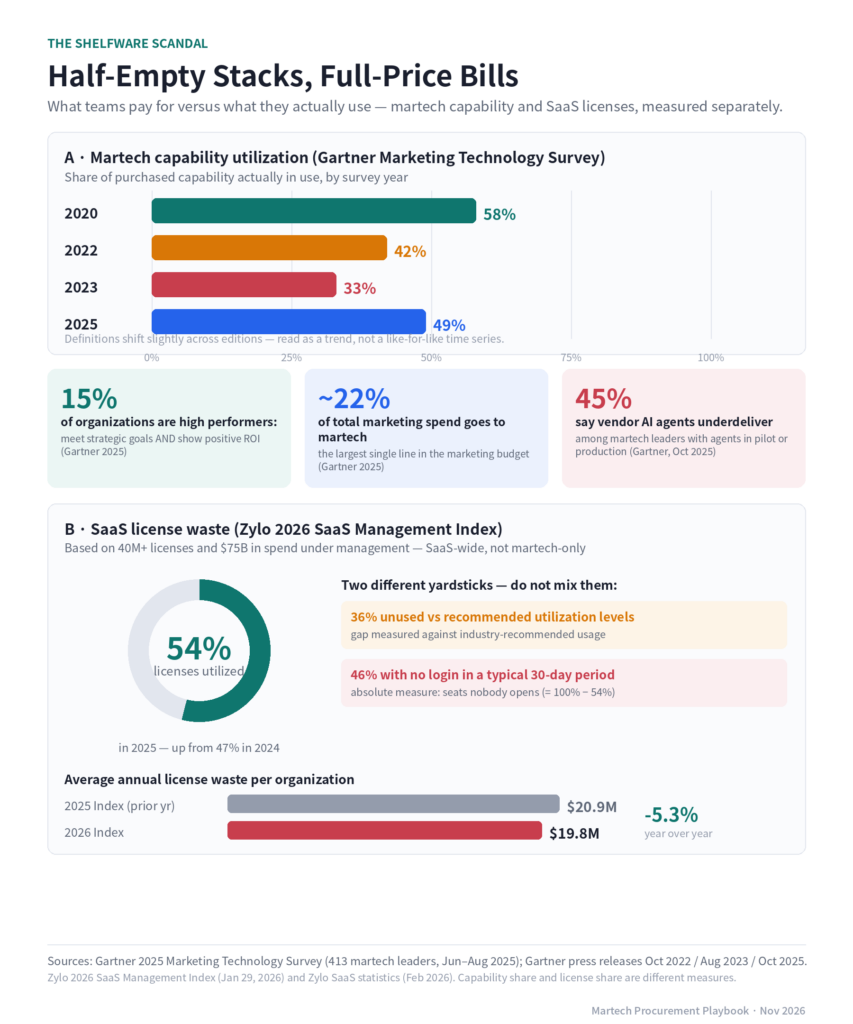
And no, the waste isn’t shrinking fast enough to celebrate. That $19.8 million average is down 5.3% from $20.9 million the year before — real progress, on a number that still dwarfs most marketing teams’ entire discretionary budget. Zylo’s dataset skews toward large enterprises, so scale the figure to your own headcount before quoting it in a board meeting. The direction, though, holds at every size: the bigger the estate, the bigger the leak.
The Market Quit Growing. Your Vendor Risk Didn’t.
For fifteen years, Scott Brinker’s martech landscape had one plot: more. This year, for the first time, the story changed.
The 2026 Marketing Technology Landscape Supergraphic, published by Brinker and Frans Riemersma in May 2026, counts 15,505 products — up from 15,384, a net gain of 121. That’s 0.79% growth. Effectively flat. Peak martech, maybe.
But flat is not calm. Under that placid headline, 1,488 products were added and 1,367 were removed. New entrants fell 40% year over year; exits rose 13%. For every product that appears, roughly one disappears. Brinker’s own metaphor is the right one: martech is a river, not a lake.
Who’s drowning? The exit profile is instructive. Of the removed products, 51.7% came from the 2010–2019 SaaS wave — the first great martech generation is being cycled out, not just the recent crop of AI wrappers. Another 45.5% sat in the $1M–$10M revenue band, and roughly 80% had fifty or fewer employees. These were real businesses. They found traction; they never became inevitable. Squeezed from above by incumbents bundling AI features and from below by AI-native startups, the middle is where products go to die.
Why should a buyer care? Because a three-year contract with a vendor in that squeeze zone is a risk position, not just a purchase. Today’s demo darling can be an acqui-hire, a pivot, or a 404 page before your second renewal. Vendor viability now belongs in the evaluation scorecard, next to features and price.
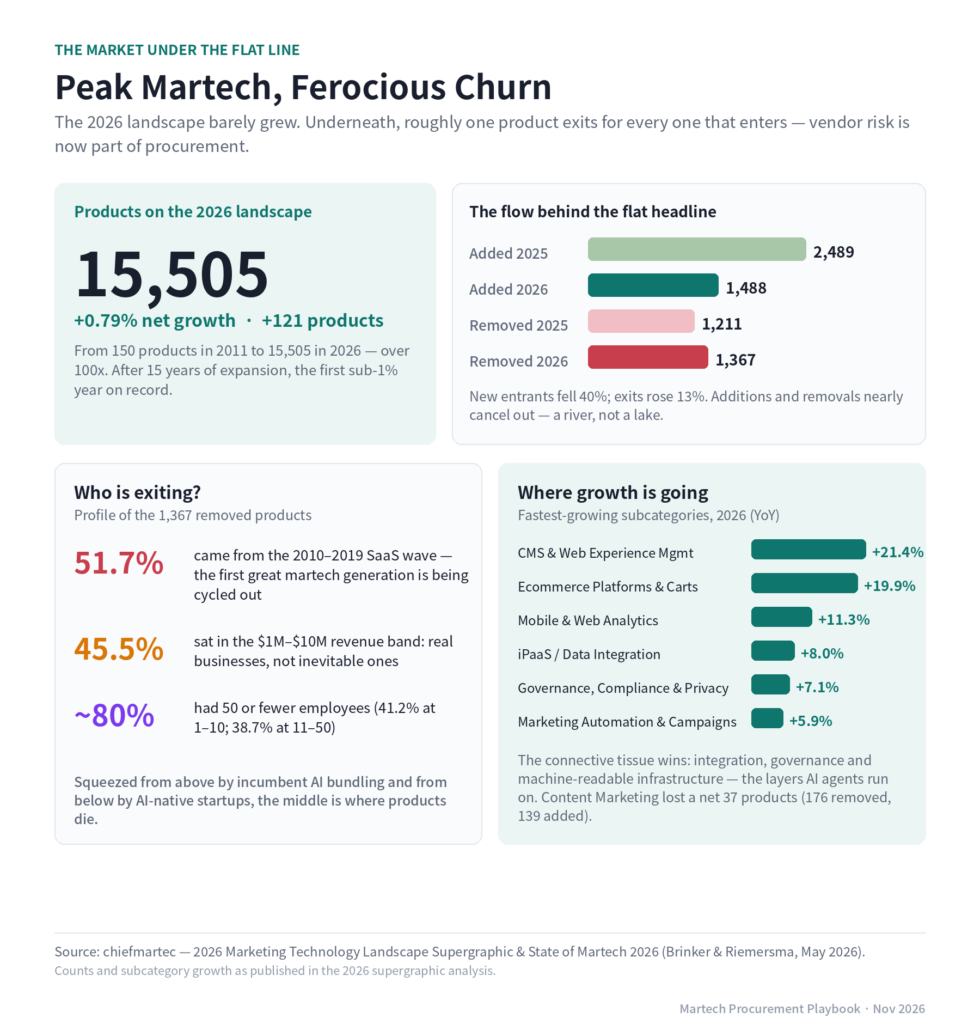
There’s a shopping signal buried in the churn, too. The fastest-growing categories in 2026 aren’t shiny new ones — they’re the connective tissue. CMS and web experience management grew 21.4%, ecommerce platforms 19.9%, mobile and web analytics 11.3%, iPaaS and data integration 8.0%, governance and privacy 7.1%, even marketing automation 5.9%. Meanwhile content marketing — the category that doubled during the generative-AI gold rush — lost a net 37 products, with 176 removed against 139 added. The market is repricing wrappers downward and plumbing upward. Your procurement criteria should do the same.
Why Procurement Runs Backwards
Here’s the sequence that built most stacks: someone sees a new tool, gets excited, and constructs a rationale in retrospect. The business case is written after the signature, like a confession. Three months later the stack is heavier, the integrations are messier, and nobody can explain what actually drives results.
It’s not stupidity. It’s incentives. Every purchase is locally rational — this tool solves this team’s this-week problem — while the collective cost lands on nobody’s desk.
The feature-list trap
Most evaluations compare feature checklists, because features demo well. But the question that predicts whether a tool becomes an asset or a silo is duller: can it exchange data cleanly with your warehouse and your identity layer?
The industry keeps learning this the expensive way. In MarTech’s 2025 State of Your Stack survey, run with chiefmartec and MarketingOps.com, 65.7% of respondents named data integration as their single biggest stack-management challenge. Not features. Not price. Plumbing. And 62.1% said they were using more tools than two years earlier — the sprawl and the integration pain grow together, because they’re the same phenomenon viewed from two angles.
A tool that can’t join your data is not a capability. It’s a second version of the truth, and your analysts will pay the reconciliation tax in evenings and weekends.
The owner vacuum
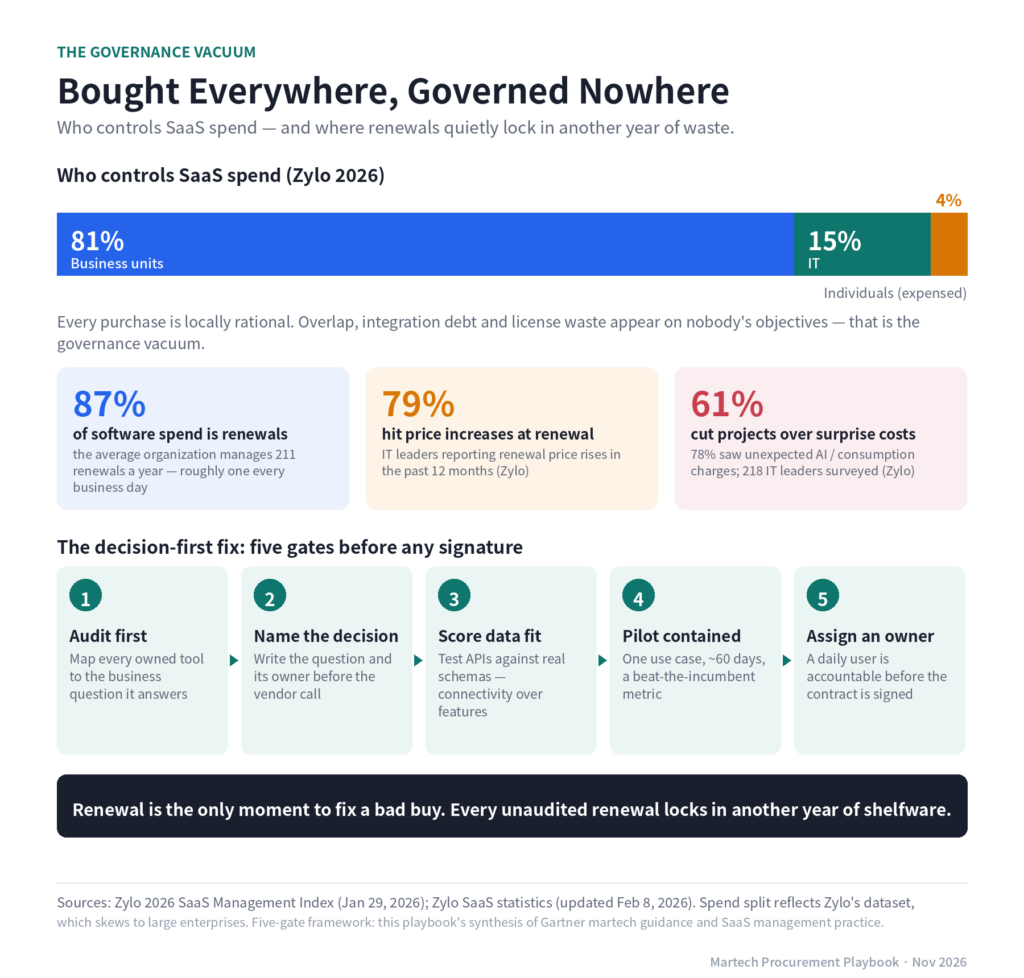
Now follow the money. Zylo’s 2026 index found that business units control 81% of SaaS spend while IT directly manages just 15%; the remainder trickles in through individual expense reports. And expense-based purchasing grew 267% year over year, with ChatGPT now the most-expensed application in the dataset.
Read that as an organizational chart, not a scandal. Software is bought everywhere and governed nowhere. Marketing buys engagement tools, sales buys sequencing tools, service buys deflection tools, and someone’s corporate card buys an AI assistant that ends up holding customer data. Each line item made sense to its buyer. The overlap, the integration debt, and the renewal calendar belong to no one.
That’s the reframe this whole playbook rests on: procurement is an architecture decision wearing a shopping decision’s clothes. Every tool either extends your stack’s data spine or fragments it. There is no neutral purchase.
The Decision-First Framework: Five Gates Before Any Signature
The fix is not a purchasing freeze. Freezes just push buying onto expense cards, where you can’t see it. The fix is a sequence — five gates that run before any vendor call, in order. Skip one and the shelfware comes back through the side door.
Gate 1: Audit what you own before you shop
Map every existing tool to the business question it answers. Not the category it belongs to — the question. “Which channels produce pipeline we can defend to finance?” is a question. “Marketing automation” is a logo.
Any tool you can’t map to a question with a named decision-maker gets flagged for elimination, not replacement. And the audit often surfaces capability you’re about to buy already sitting, unactivated, inside something you pay for. Gartner’s own martech guidance starts here: document vendors, engage stakeholders, compare cost against utilization, and feed the audit into strategy — not into a drawer.
Gate 2: Write the decision before the demo
Before evaluating anything, write down the specific business questions the tool must answer and who owns each answer. This kills speculation before it drives purchases. If the strongest argument for a platform is “we might want this someday,” that’s a hypothesis, not a requirement — park it.
Gartner’s high performers evaluate use cases on four tests: supportive of business outcomes, selective in dependencies, simple enough to land in one to three months, and specific about users, data and tech. Steal that filter. It fits on an index card.
Gate 3: Score data connectivity over features
Test the vendor’s APIs against your real schemas — your customer IDs, your event names, your consent flags — not against a sandbox built to impress. Prioritize clean exchange with the warehouse and identity layer before any demo polish. Require vendors to demonstrate value, not describe it, and ask for integration references, not just customer logos.
If a vendor can’t show your data flowing both directions in a proof of concept, you’ve learned everything the feature matrix was hiding.
Gate 4: Pilot on one contained use case
Run a bounded proof of concept — say sixty days, one use case, one team — with a success metric defined before kickoff. The metric should be comparative: does this beat the incumbent per analyst-hour, per campaign, per dollar? “The team likes it” is not a metric; it’s a mood.
A contained pilot also caps the downside. You can fail a sixty-day experiment cheaply. You cannot fail a three-year enterprise agreement cheaply.
Gate 5: Buy for active use, not QBR theater
Choose tools that surface decision-ready outputs for the people running campaigns — not dashboards designed to impress in quarterly business reviews. The QBR is the vendor’s ritual, not your workflow. If the product’s proudest artifact is a slide you’d never act on, you’re buying theater tickets.
One more filter before signing: the survival check. Given what the 2026 churn data shows, ask every shortlisted vendor about runway, customer concentration, and where they sit in the squeeze between incumbent bundling and AI-native attack. It feels rude. It’s cheaper than a migration.
The Governance Layer: What Makes the Framework Stick
A framework without governance is a poster. Four habits turn it into an operating system.
One tool, one named owner
Every tool gets one accountable owner — chosen by who actually uses it daily, not who signed the contract. The signer optimizes for the deal; the daily user optimizes for the work. When utilization drops, you now know exactly whose calendar the review goes on. This single habit fixes more underutilization than any training program, because underutilization is usually an ownership problem cosplaying as a skills problem.
Set an active-use threshold
Decide in advance what “used” means. A workable default: a tool is underutilized if fewer than half its licensed seats logged in within thirty days. Binary used/unused labels hide the truth — a platform can be “in use” by three people while ninety paid seats gather dust. Zylo’s own optimization guidance starts with the sub-50% cohort for exactly this reason, then works upward toward the 90%-plus utilization its best customers reach.
Reclassify by function, not by buyer
The sales team’s sequencing and cold-outreach tools sitting on marketing’s P&L are a category error, and category errors hide waste. Re-sort the inventory by the function each tool performs, not by whose budget it landed in. You’ll find duplications that were invisible when the list was organized by department — two teams paying for the same job under different line items.
Buy the data spine, rent the edge
The rationalized stack owns its shared data layer and a few core platforms, and bolts on specialized point tools only where they earn their keep. Notice that the market agrees: integration, governance and analytics categories are growing fastest in the 2026 landscape, while point-solution categories shed products. Fewer destinations, one source of truth, replaceable edges. That’s not austerity — it’s the only architecture where adding a tool doesn’t subtract coherence.
Renewals are where the money is
Here’s the stat that should reorganize your calendar: renewals account for 87% of total software spend, and the average organization manages 211 of them a year — roughly one every business day, per Zylo. Meanwhile 79% of IT leaders hit price increases at renewal in the past twelve months, 78% saw unexpected charges tied to AI or consumption pricing, and 61% had to cut projects because of unplanned SaaS cost increases.
You usually can’t fix a bad contract mid-term. Renewal is the moment the leverage returns — and every renewal that passes without a utilization audit locks in another year of waste. Put the audit thirty to sixty days before each renewal date, not thirty days after.
Risks and Honest Caveats
Any playbook that promises only upside is selling something. Four ways this one can go wrong:
Consolidation overreach. Cutting tools without tracing their data flows first can sever a join between two systems you didn’t know were connected. A “redundant” platform may be quietly load-bearing — the only place a consent flag lives, the only bridge to a legacy CRM. Trace the data before you cancel the contract. The spreadsheet of features lies; the schema diagram doesn’t.
The build-vs-buy seduction. Agentic coding tools make custom pipelines genuinely viable now, and some teams respond by deciding to build everything. Resist the symmetry of that temptation. Build where volume and ownership compound — your data spine, your scoring logic, the workflows that are your edge. Rent everything else. A custom integration you maintain alone is shelfware with a git repository.
Governance that eats experimentation. Heavy procurement process can strangle the very experimentation the stack exists to enable. The gates should be proportional: gate redundant, high-cost, data-touching buys hard; let small, reversible experiments run fast with logging instead of approval. Visibility for everything, friction where the risk is. The 267% growth in expensed software is what happens when you get this ratio wrong — people route around gatekeepers.
Metrics that flatter or mislead. Two traps here. First, the Gartner utilization series shifts definitions across years, so don’t sell 58-to-49 as a precise decline; sell the bottom line — over half the paid potential sits idle. Second, the AI halo: in Gartner’s October 2025 announcement from the same survey, 45% of martech leaders with AI agents in pilot or production said vendor capabilities fell short of promised business performance — even though 89% still expect significant benefit. Hope is not utilization. Pilot agent features on the same contained-use-case discipline as anything else, and beware vendors repricing your existing contract around AI tiers you never activated.
Conclusion: Govern the Stack, Not the Vendor
The martech stack’s problem was never a shortage of tools. There are 15,505 of them, and the average team uses less than half of what it already pays for. Another purchase cannot fix that arithmetic; it can only extend it.
Buying without regrets means reversing the backwards sequence. Audit what you own. Name the decision before the tool. Score data connectivity over features. Pilot before you commit. Assign a named owner before you sign. And treat every renewal as what it is — the recurring referendum on whether each tool still earns its place.
The shelfware scandal is not a budget problem. It’s a governance vacuum. Fill the vacuum with a decision-first, owner-anchored discipline, and the same budget buys you a stack that actually works — while your competitors keep paying full price for half-empty ones.