The Incentive Gap: Why Marketing Knowledge Stays Unwritten
Here is a discovery that reframes the whole SOP conversation: the reason marketing teams don’t write things down is not that they don’t know they should. It’s that the incentive structure makes documentation a losing trade for the individual — even when it’s a winning trade for the team.
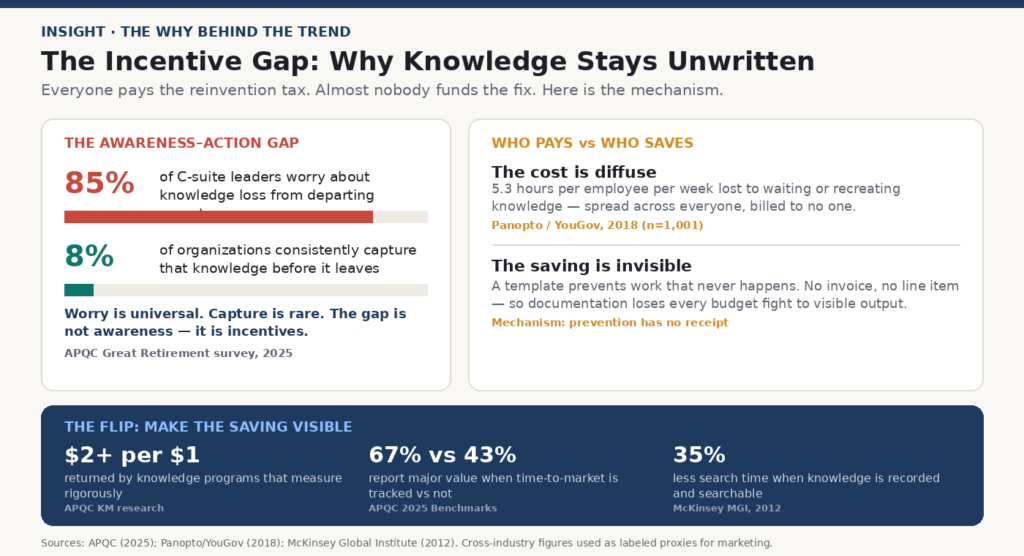
Start with the gap itself. APQC’s 2025 research on the “great retirement” found that 85% of C-suite leaders worry about knowledge walking out the door with departing experts. Yet only 8% of organizations consistently capture that knowledge before it leaves. That is not an awareness problem. Everyone knows. Almost nobody acts. When a behavior is universally endorsed and rarely practiced, the explanation is never ignorance — it’s incentives.
The Mechanism: Diffuse Costs, Invisible Savings
Look at who pays the reinvention tax. Panopto’s 2018 study with YouGov found employees lose 5.3 hours a week waiting on colleagues or recreating undocumented knowledge. But notice the shape of that cost: it’s spread across everyone, a few minutes at a time, and billed to no one. No manager sees a line item called “rebuilt the launch checklist again.” The pain is real but diffuse — and diffuse pain never makes it onto a priority list.
Now look at who saves. Writing the template takes an afternoon from one person, and the payoff is work that never happens: the campaign that doesn’t get rebuilt, the new hire who doesn’t spin for a quarter. Prevention has no receipt. You can point to a shipped campaign; you cannot point to the campaign you didn’t have to redo. So in every budget fight, visible output beats invisible prevention — not because leaders are foolish, but because the accounting is rigged against the template.
There’s a second twist: the person who writes the SOP often isn’t the person who benefits most. The hero who documents her process is handing away the very scarcity that made her indispensable. Hero culture quietly taxes its own cure.
The Flip: Give the Saving a Receipt
The way out is not more exhortation — it’s measurement. APQC found that knowledge programs which measure rigorously can return $2 or more for every $1 spent per participating employee, and programs that track outcomes like time-to-market report major business value at 67% versus 43% for those that don’t. The moment you count hours saved, ramp time compressed, and rework avoided, prevention gets a receipt — and the budget fight changes sides. McKinsey Global Institute’s 2012 research points the same direction: a searchable record of knowledge cuts search time by up to 35%.
So the insight is this: an SOP library doesn’t fail for lack of templates. It fails because nobody made the savings visible. Write the genius down — then put a number on what it saves. That number, not the document, is what keeps the library alive.