The Incentive Asymmetry Behind the Content Speed Trap
Everyone can see what AI did to content production: it made the belt faster. Almost nobody can see why that made consistency harder. The answer isn’t in the tools. It’s in who feels the speed.
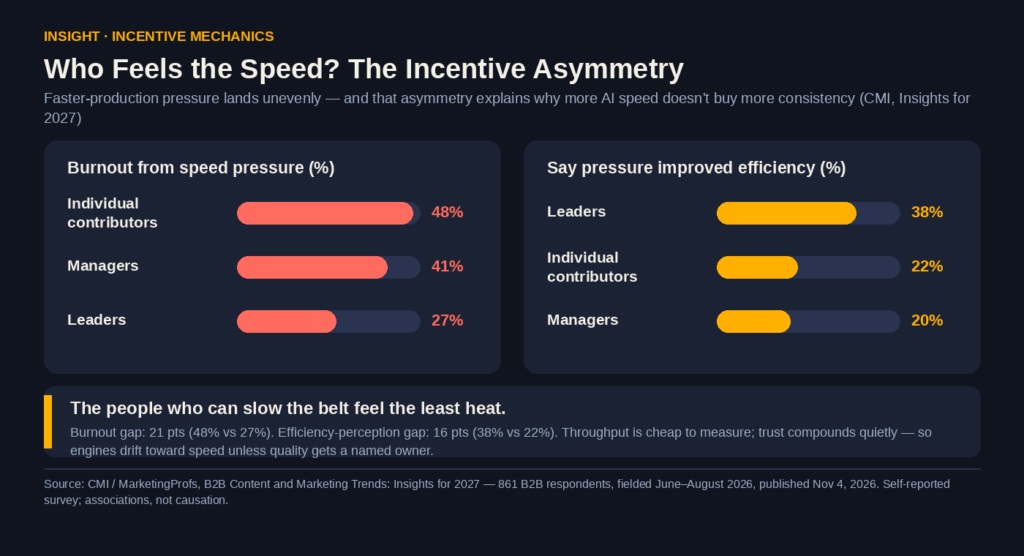
CMI’s newest B2B survey — 861 respondents, published November 4, 2026 — contains one of the most revealing splits in years of benchmark data. Asked about the effects of rising pressure to produce faster, 48% of individual contributors report burnout or creative fatigue. Among leaders, it’s 27%. Flip the question to benefits, and the gap reverses: 38% of leaders say the pressure improved efficiency, versus 22% of the people actually writing.
Sit with that for a second. The group experiencing the least pain is the group most convinced the pain is productive.
Why the asymmetry exists
It’s not hypocrisy; it’s physics. Leaders experience speed as a dashboard: output per week, cost per asset, pipeline velocity — all clean, countable, immediate. Practitioners experience speed as context-switching, shortened thinking time, and the third revision of a generic draft. The cost of speed is real but diffuse; the benefit of speed is real but concentrated in whoever reads the report.
So when a team decides how fast the belt should run, the decision is made by people holding the cheap-to-measure number, while the expensive-to-measure cost — original thinking, brand voice, trust — sits on someone else’s desk. Every content engine inherits this bias by default. Throughput gets an owner. Quality gets a hope.
What it predicts
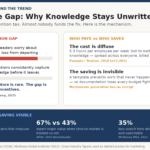
This mechanism explains two things the headline numbers can’t. First, why AI adoption keeps climbing (88% of teams now use it) while quality remains its weakest reported contribution (17%): the tools optimize the metric leaders can see. Second, why the same survey shows burnout (35%), less original thinking (32%), and generic content (29%) outranking efficiency gains (28%) as effects of speed pressure — the belt accelerates exactly what’s measured and erodes exactly what isn’t.
It also explains why the fix in the main playbook is structural, not motivational. Naming an owner and a time-box for quality gates does what pep talks can’t: it puts the diffuse cost on the dashboard, next to the throughput number. And it’s why refresh loops matter — maintenance is the one activity where speed and trust point the same direction, which is why HubSpot’s updated posts doubled their organic views while everyone else chased new volume.
The takeaway for anyone running an engine: don’t ask whether your team can produce faster. Ask who in the room feels it when they do — and make sure that person owns a metric.