Why Voice Commerce Stalled: The Economics Behind the Utterance That Couldn’t Close
Amazon has spent twelve years and, by its own internal accounting, more than $25 billion trying to prove that a voice assistant could be a business. The interesting part is not that it failed. It is where the money finally showed up.
Because it showed up on a device with a screen.
The Razor, and the Missing Blade
When Amazon launched Echo in 2014, it ran Gillette’s playbook. Sell the razor cheap, make the margin on the blades. The razor was the speaker — sold at or below cost, sometimes for forty dollars. The blades were supposed to be purchases: you talk to Alexa, Alexa orders the coffee pods, Amazon collects the margin it already earns on everything.
That is the entire theory of voice commerce in one sentence, and it is worth noticing how much it assumed. It assumed the utterance is the transaction. It assumed that a person saying “order the usual” and a person tapping “buy now” are economically the same event.
They are not, and the gap between them cost Amazon a decade.
Between 2017 and 2021, its devices division — Echo, Kindle, Fire TV, Ring, the whole portfolio — booked more than $25 billion in losses, according to internal documents reported by The Wall Street Journal. A former senior employee put the problem in one line that has since become the category’s epitaph: “We worried we’ve hired 10,000 people and we’ve built a smart timer.”
People used the speakers for alarms, weather and music. All free. None of it billable.
Three Attempts, One Missing Ingredient
The instructive part is that Amazon did not stop. It cycled through every monetization model available to a screenless device, and each attempt failed for the same structural reason.
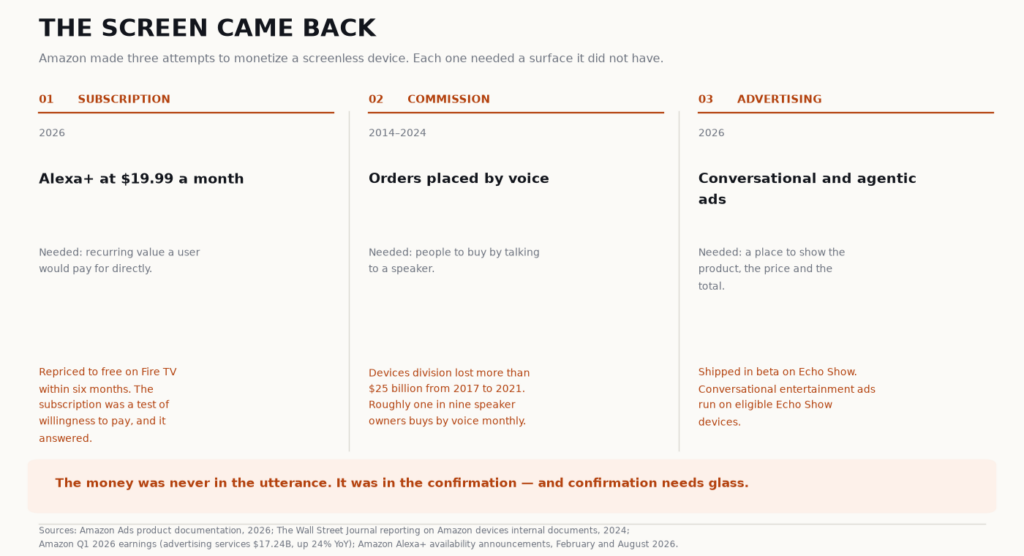
Attempt one was the subscription. In February 2026, Alexa+ went generally available to US customers at $19.99 a month, free to Prime members. It was the first serious attempt to charge for the assistant itself rather than for what the assistant might sell. By August 2026, Alexa+ was being pushed free to every compatible Fire TV device in the US, with no Prime requirement and no action from the user.
Six months from price tag to giveaway. That is not a pricing tweak. That is a verdict on willingness to pay for a voice interface on its own.
Attempt two was the commission. This was the original dream: voice orders, Amazon takes the margin. And voice ordering does happen — roughly one in nine smart speaker owners buys by voice monthly, and voice carts are abandoned at a far lower rate than web carts. But the order values are small, concentrated in replenishables, and the volume never justified the hardware subsidy. Voice turned out to be excellent at reordering what you already know and poor at everything that requires wanting something new.
Attempt three is advertising, and it is the one that worked. Amazon’s ad business posted $17.24 billion in the first quarter of 2026, up 24 percent year over year, crossing $70 billion on a trailing twelve-month basis. Within that machine, the conversational formats — Conversational Ads, Agentic Ads, Prime Video Sponsored Tiles — are the fastest-moving surface. Alexa+ Agentic Ads, unveiled at Cannes Lions in June 2026, lets a customer go from hearing a pitch to completing a purchase inside the same conversation. No app, no site, no checkout page.
And here is the detail that reorganizes the whole story. Those formats shipped in beta on Echo Show. Amazon’s own documentation describes conversational entertainment ads as running on “eligible Echo Show devices,” where customers interact with advertising “through voice and touch.”
Voice and touch. On a screen.
Why the Utterance Was Never the Asset
Strip the Amazon case down and you get a general mechanism, one that applies to every ambient surface.
An advertisement has to do three things: show the thing, state the price, and close the loop. Voice is genuinely good at the first, serviceable at the second, and structurally incapable of the third — because closing requires confirmation, and confirmation is a visual act. You want to see the size, the brand, the total, the delivery date, the return policy. You want to check it before money leaves your account.
This is why the trust data looks the way it does. Roughly 46 percent of consumers say they do not trust a voice assistant to correctly interpret and process an order, and about 45 percent will not send payment through one. It is not that they doubt the microphone. It is that they cannot see what they are agreeing to.
So ambient commerce keeps resolving to the same shape: voice for discovery and intent, glass for commitment. The screenless interface did not replace the screen. It became the top of a funnel that still ends on one.
The Uncomfortable Implication for Brands
If you have been treating “screenless” as a synonym for “post-visual,” this is the correction. The ambient layer is real, and it is growing — 8.4 billion voice-enabled devices is not a rounding error. But its economics do not reward brands that abandon visual craft. They reward brands that can survive compression.
The winning asset is no longer the landing page. It is the three seconds of product truth that survives being read aloud, plus the visual confirmation that closes the sale. Voice decides whether you are in the conversation. The screen decides whether you are paid.
Amazon learned this the expensive way, and the lesson arrived as hardware: after a decade of arguing that the interface would disappear, the company’s most successful ambient ad format requires you to look at it.
The screen was never going to die. It was going to get smaller, closer, and much harder to skip.