The Last Percent Is the Only Percent
The economics behind the exception queue — and why the last percent of accuracy is the only percent that matters
The number nobody budgets for
Amazon’s Just Walk Out was, by any measure, a genuine technical achievement. Cameras overhead, weight sensors on the shelf, computer vision that let you walk out with a sandwich and get billed later. Every retail conference had the video. Every chain had a working group.
By 2022, according to reporting in The Information, roughly 700 of every 1,000 sales required a human to look at them. The internal target was about 50. In April 2024, Amazon pulled the system from its Fresh grocery stores and replaced it with smart carts that scan as you shop.
Amazon disputes the framing: the team was mostly training models, it says, and only a small minority of visits were validated after the fact. Nobody disputes that people were involved, or that there were a great many of them.
The interesting question is not whether the technology worked. It is why a system that worked impressively well still could not be run as a business. And the answer is not a hardware problem. It is a slope problem.
99% sounds like success and behaves like a cost centre
Here is the arithmetic that gets skipped in the deck.
A store doing 100,000 transactions a day at 99% accuracy generates 1,000 exceptions. At 99.9%, it generates 100. At 99.99%, ten. Those sound like small differences. They are not, because each exception is not a number — it is a person opening a video, scrubbing to the right four seconds, making a judgment, and logging it.
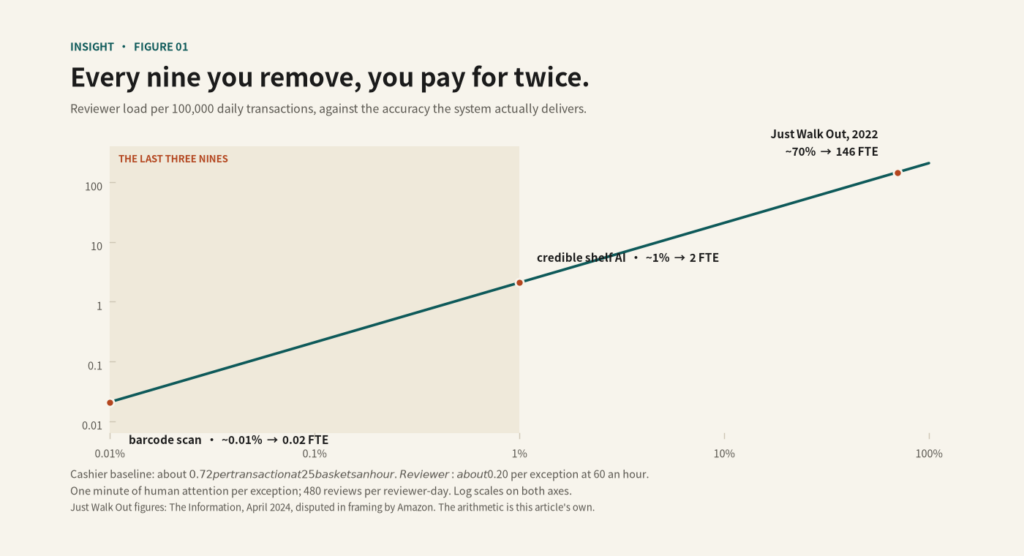
One minute per exception, 480 reviews per reviewer-day, and the curve does the rest. At 1% exceptions you need two full-time reviewers per 100,000 transactions. At 10%, you need twenty. At 70% — the Just Walk Out number — you need about 146.
Now price it against the thing you were trying to replace. A cashier at 25 baskets an hour costs roughly $0.72 a transaction. A reviewer at 60 exceptions an hour costs about $0.20 each. So an exception rate above roughly 28% costs more than the cashier you removed. Below it, you are genuinely saving money. The system in the demo sat at 70.
That is the mechanism. Automation does not eliminate labour; it converts a linear labour cost into a step function, and hides the step in a queue nobody owns.
Why this is worse than it looks
Two properties make the exception queue uniquely dangerous as a line item.
It is invisible in the place where decisions get made. A cashier appears in the store labour budget. A reviewer appears in a shared services cost centre, or an outsourced contract, or an operations overhead line three levels away from the person who signed off on the cameras.
And it scales with volume, not with headcount. Open three hundred more stores and the queue grows proportionally, silently, in a spreadsheet maintained by someone who has never seen the aisle.
The reframe that actually helps
The useful lesson is not “avoid edge AI.” It is that the accuracy number on a vendor slide is a cost input, not a capability milestone. Ask what exception rate the system runs at in your store, on your busiest Saturday, and then multiply.
That single question kills more bad pilots than any pilot itself — and it is the one almost nobody asks.