Inside China’s Ninefold MaaS Boom: Revenue, Vendors and the Pivot to Token Efficiency
Market brief — October 31, 2026
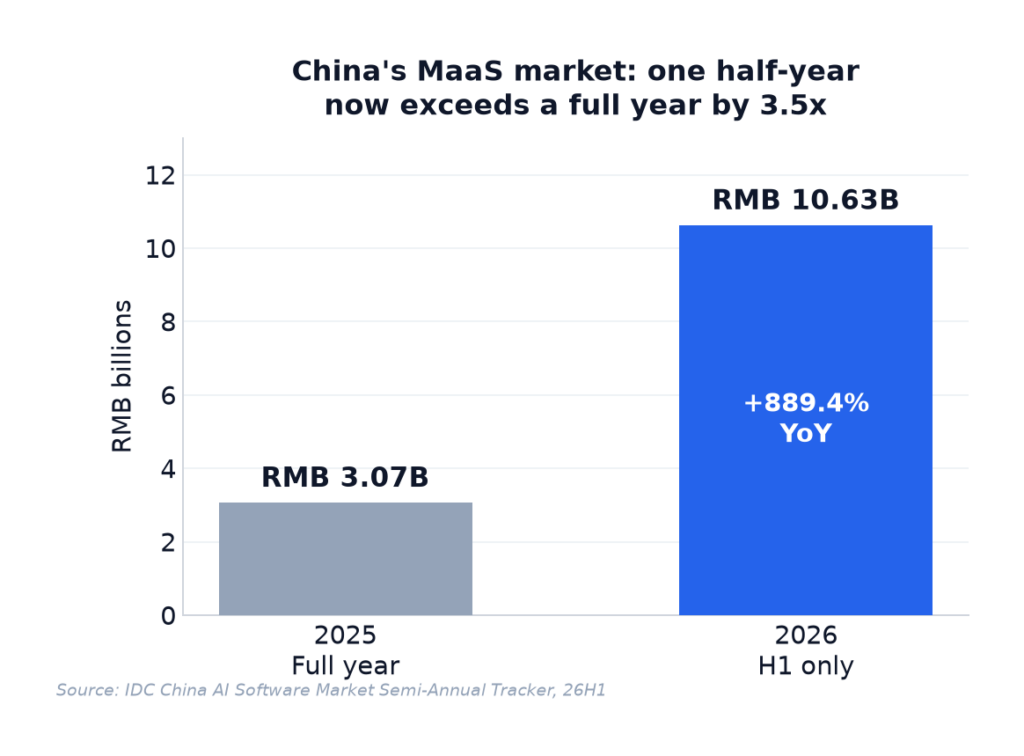
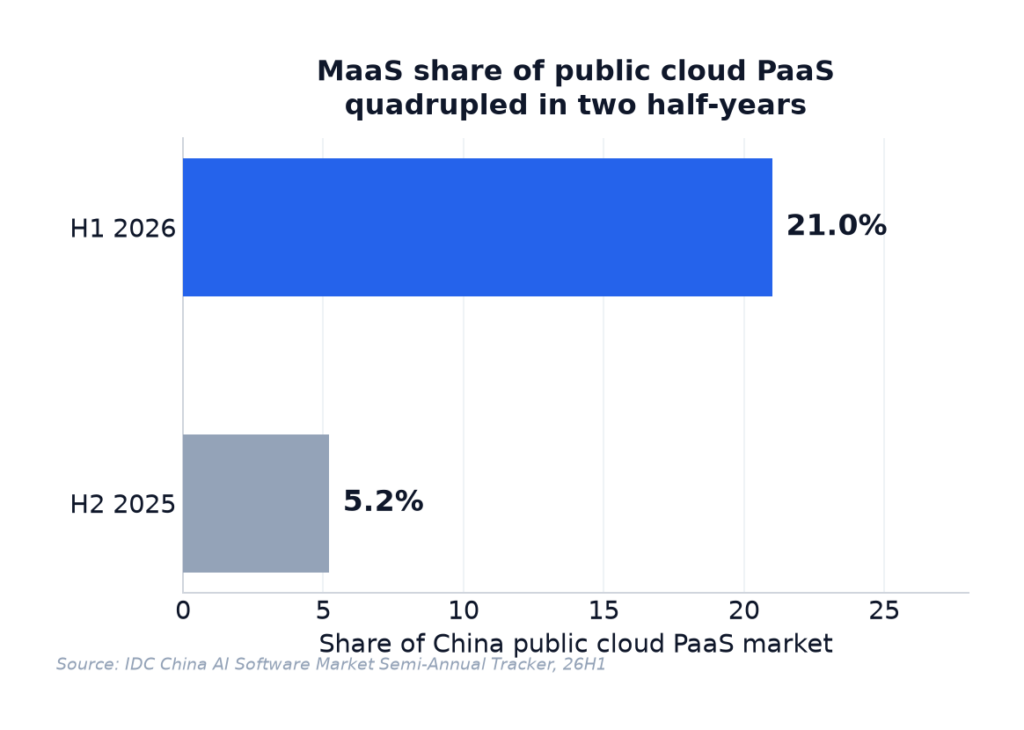
China’s model-as-a-service (MaaS) market reached RMB 10.63 billion in revenue in the first half of 2026, up 889.4% year on year, according to IDC’s semi-annual China AI Software Market Tracker. The hosted-model market now accounts for 21.0% of China’s public cloud PaaS revenue, up from 5.2% just two half-years earlier.
The scale is clearest in a single comparison. The RMB 10.63 billion booked in six months of 2026 is more than triple the RMB 3.07 billion the market generated across all of 2025. Growth is compounding fast enough that one half-year now swallows an entire prior year.
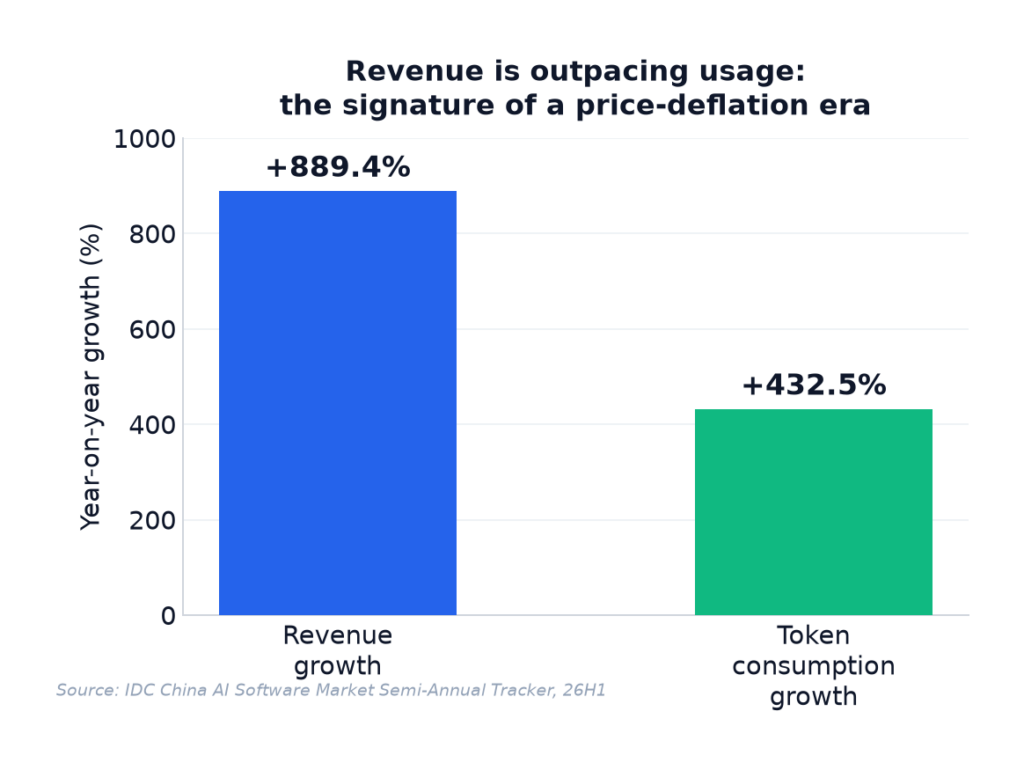
Revenue is outpacing usage. Full-market token consumption hit 2,857.9 trillion in H1, up roughly 432.5% — strong, but well short of the 889.4% revenue gain. When billing grows twice as fast as the tokens behind it, the read is that average prices kept falling even as workloads got heavier. Longer agent runs and richer multimodal tasks push up per-task token demand, offsetting price cuts and keeping revenue climbing faster than raw volume.
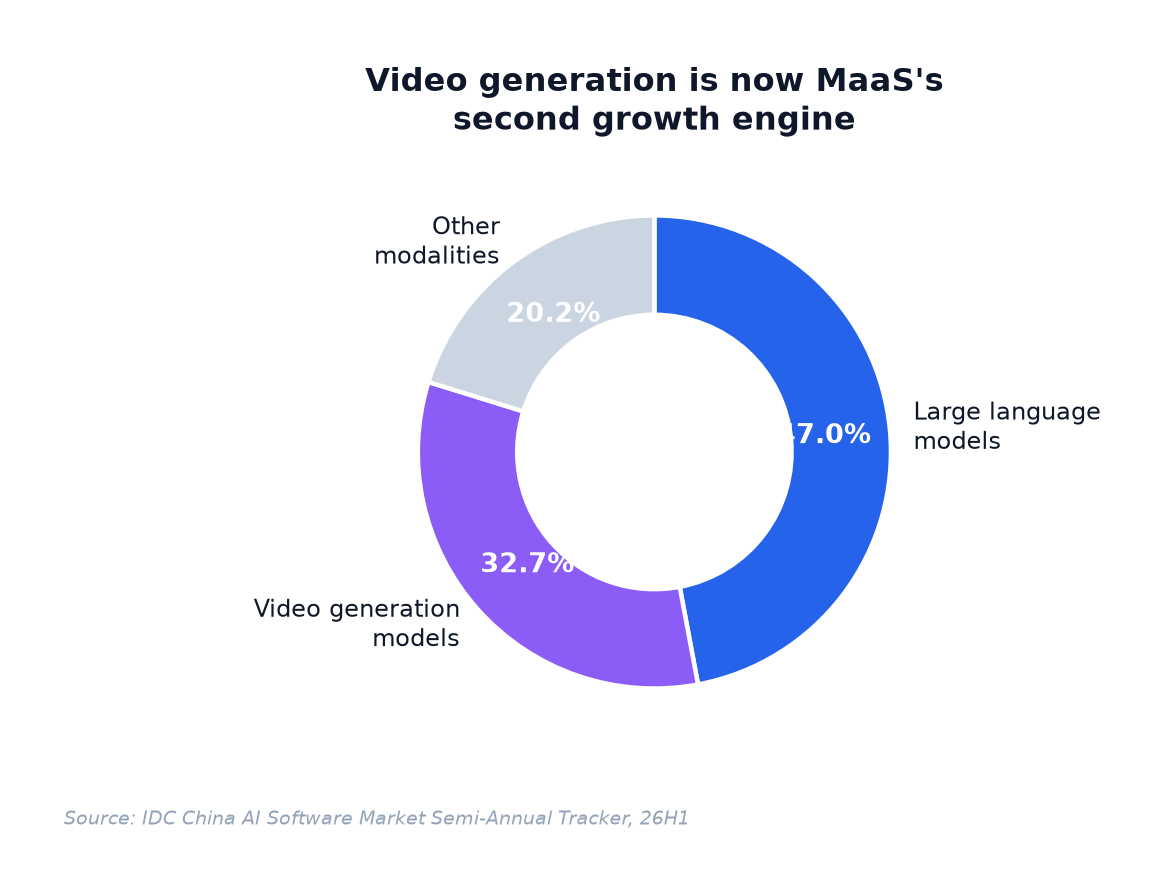
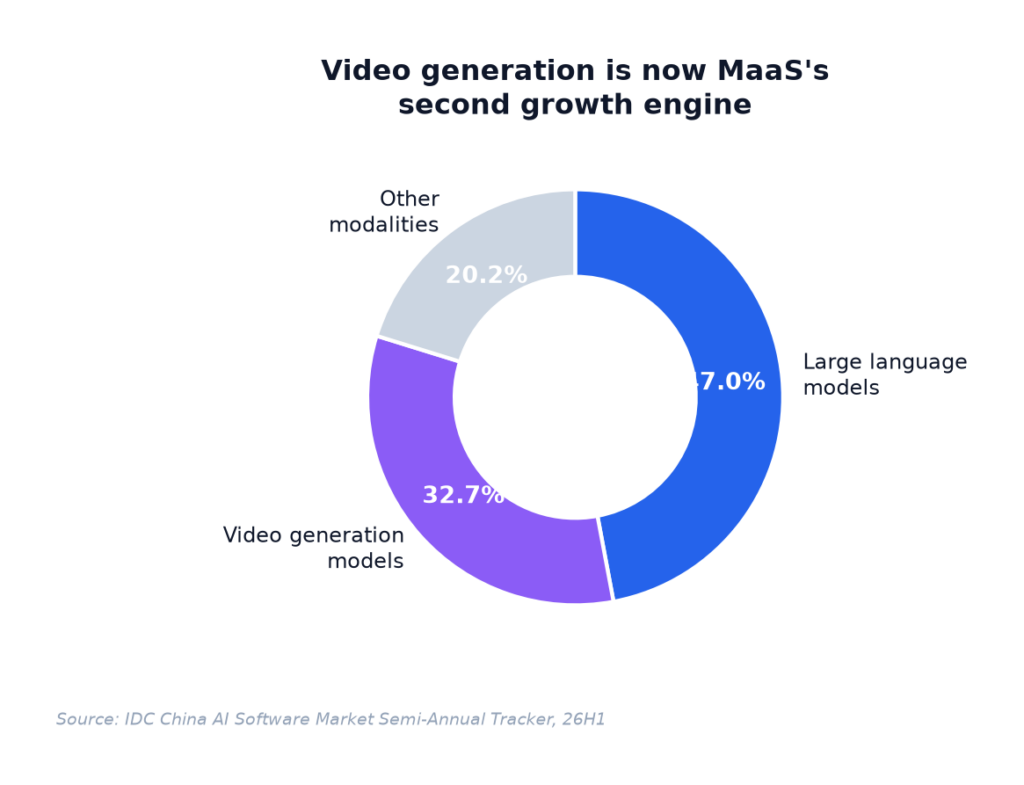
Video is now the second engine. IDC’s modality split shows large language models at 47.0% of MaaS revenue, video generation at 32.7%, and other modalities at 20.2%. Video crossed its commercialization threshold in the first half, with short drama, advertising and e-commerce production moving to batch adoption. It is the single most important structural change in the market: MaaS is no longer a text-only business.
A parallel private-deployment market is growing, but far slower. IDC sized China’s large-model private deployment market at RMB 2.88 billion for H1, up 108.4%. Demand is concentrated in government, manufacturing, energy and finance, where buyers are moving from IT infrastructure builds toward production deployments. Hosted services are growing roughly eight times faster, which shows where volume is consolidating.
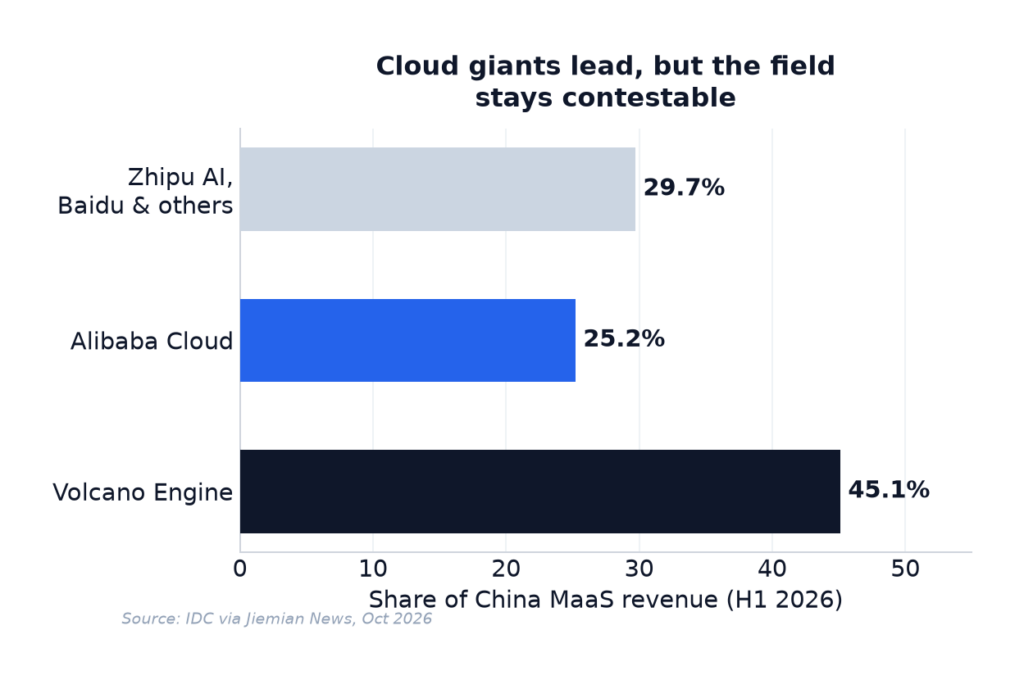
Four groups compete, and the top of the table remains cloud-led. Cloud hyperscalers bundle model services with compute and toolchains. Model labs run fast release cadence and aggressive pricing. Inference specialists and aggregators sell multi-model neutrality and cost efficiency. Telecom operators arrive with national compute footprints and government channels. In H1 revenue terms, Volcano Engine led with 45.1% share, followed by Alibaba Cloud at 25.2%, with Zhipu AI overtaking Baidu for third place.
The selection criteria have changed. IDC’s read is that competition has moved from token price deflation to token efficiency — usable output per unit of compute, won through inference-framework optimization and large-cluster scheduling — with compute access as the durable long-term moat. Buyers, meanwhile, no longer choose on benchmark scores. In China, data security, customization, self-controllability and domestic-stack compatibility are baseline requirements, and engineering delivery plus long-term operations decide whether a project survives.
The structural risk is margin. Revenue is scaling faster than profitability. API providers are still in a phase where top-line growth is bought with price cuts, and private deployment carries heavy services cost. Monetization is diversifying — usage-based billing still dominates, but subscriptions, committed-capacity deals and outcome-linked revenue sharing are ramping, an attempt to turn a resource trade into a value-sharing one.
A useful global contrast. Gartner puts worldwide AI spending at $2.67 trillion in 2026, but only $28.3 billion of that goes to generative AI models themselves, with AI infrastructure absorbing roughly $1.5 trillion. The same logic shows up in China’s numbers: the model layer is where the attention goes, but compute and efficiency are where the economics actually live.
Watch next: whether independent aggregators hold share as model churn accelerates, whether overseas expansion lifts blended margins, and how fast value-sharing billing moves from experiment to mainstream.