Inside China’s 700-Million-Strong Generative AI Boom: Who’s Using It and For What
China’s Generative AI User Base Crosses 700 Million as Compute Buildout Hits 2,185 EFLOPS
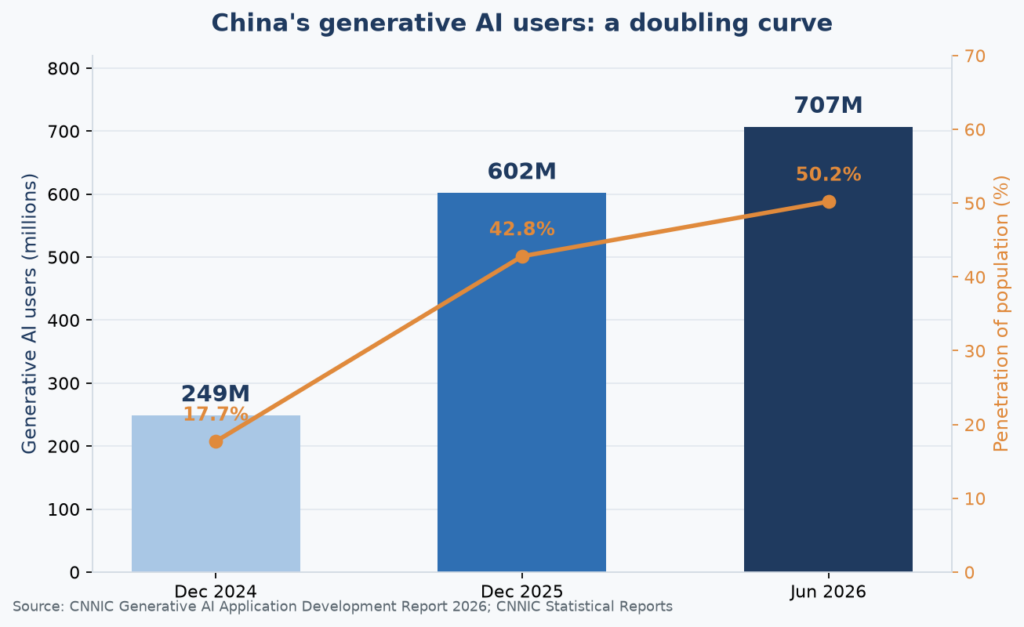
More than 700 million people in China were using generative artificial intelligence by the middle of 2026, pushing penetration past the 50 percent mark, according to the Generative AI Application Development Report 2026 released by the China Internet Network Information Center on 29 September. The milestone cements China as the largest measured consumer AI market on earth, and it arrived faster than most forecasters expected.
The trajectory is the story. China counted 602 million generative AI users at the close of 2025, a 141.7 percent jump year on year, at 42.8 percent penetration, a 25.2-percentage-point gain in twelve months alone. The move past 700 million marks a second consecutive year of near-doubling, a curve that has outrun the adoption pace seen in most Western markets.
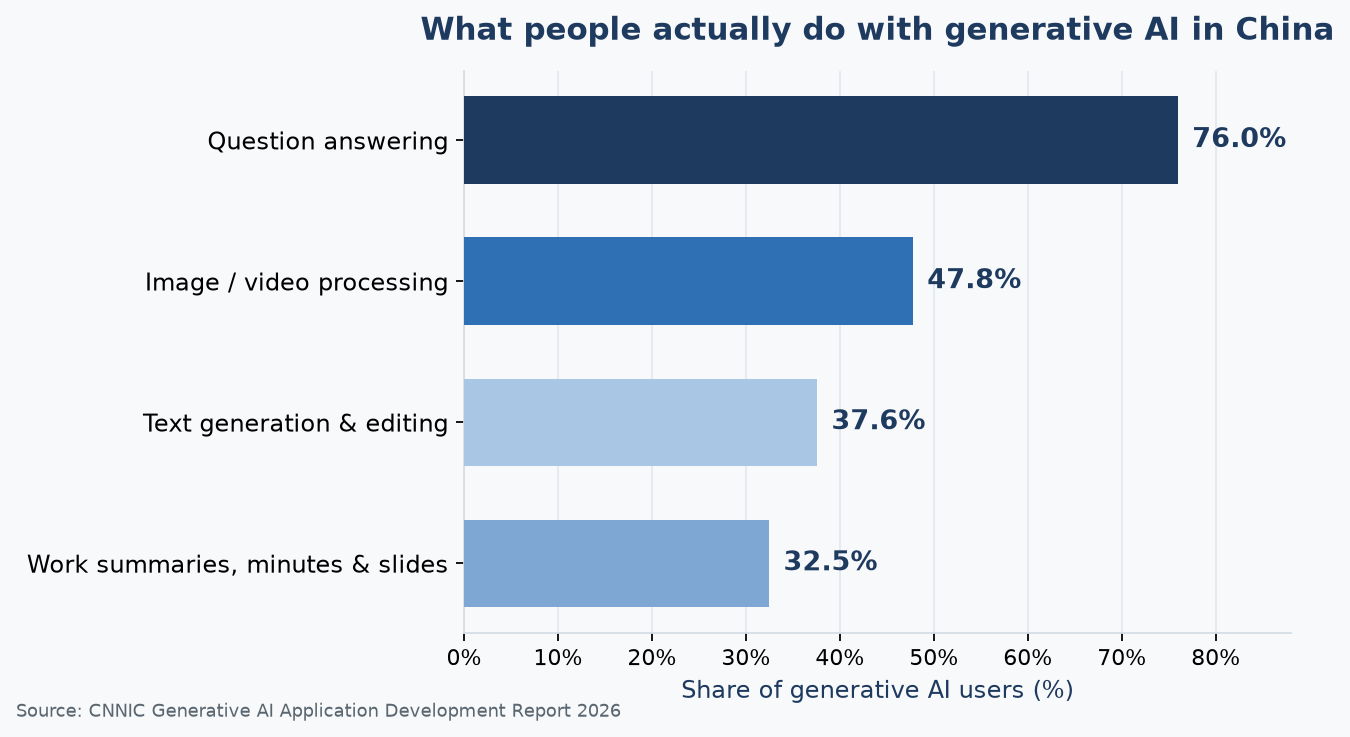
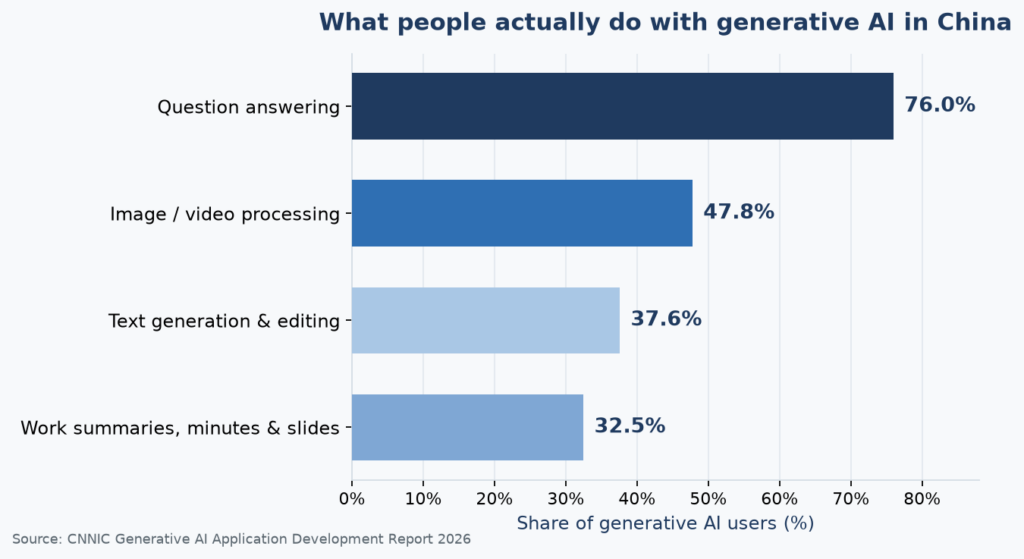
What people actually do with the technology is narrower than the hype implies. Roughly 76 percent of users turn to generative AI to answer questions. Another 47.8 percent use it to process images or video, 37.6 percent for text-related tasks, and 32.5 percent to produce work summaries, meeting minutes and slide decks. Usage counts for general-purpose AI assistants and AI productivity tools each more than doubled year on year, a sign the behaviour is hardening into routine rather than settling as novelty.
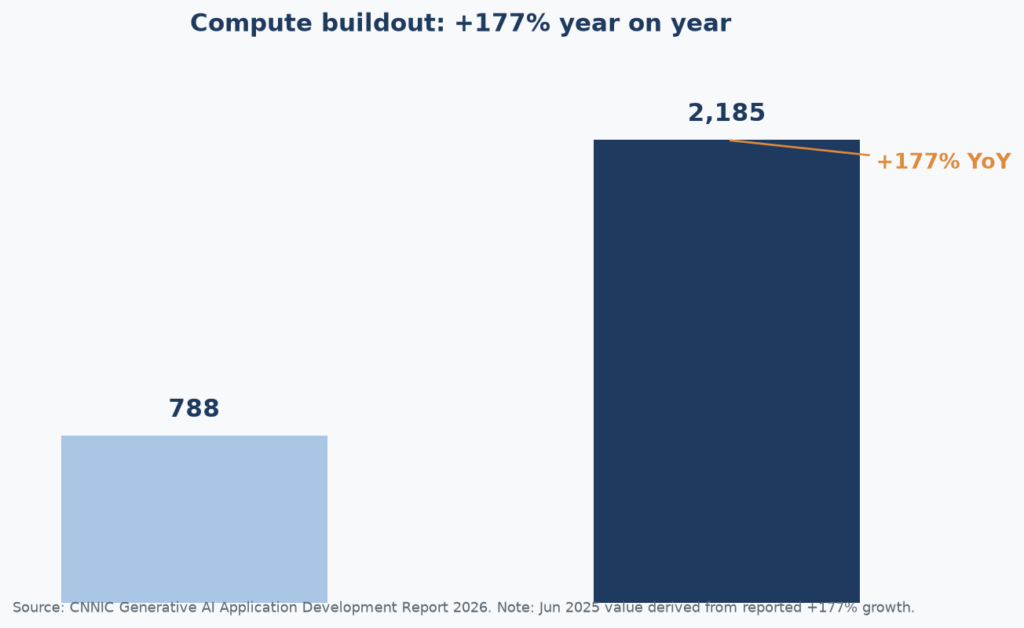
Underneath sits a buildout on an industrial scale. Intelligent computing capacity reached 2,185 EFLOPS by the end of June, up 177 percent from a year earlier. China also brought its first fully domestic 100,000-card AI supercluster into service, with chips, compute, storage, networking and cooling all sourced at home, alongside more than 120,000 high-quality datasets. Domestic model developers, including DeepSeek and Moonshot AI, have meanwhile released open-source models with trillion-level parameters, and the top six models on a major global usage ranking all came from Chinese teams.
Capital is following the hardware. China logged 1,255 AI-related investment and financing deals in the first half of 2026, equivalent to 78 percent of the entire 2025 count, worth about 250.1 billion yuan, already 182 percent of last year’s full-year total. Commercially, 38.7 percent of internet users bought smart hardware in the prior six months, led by wearables at 20.2 percent and 3C devices at 18.2 percent, while more than 30 percent of manufacturing enterprises above designated size now report AI adoption. Humanoid robotics is emerging as the fastest-moving frontier, with more than 400 robot products on the market in the first half and full-year output expected to top 100,000 units.
The strategic read for overseas platforms and advertisers is blunt. Penetration growth has run well ahead of paid conversion. The relevant question is no longer reach, it is whether a 700-million-user base can sustain subscription or ad-funded monetization at Western average-revenue-per-user levels. Watch the fourth-quarter disclosures from Chinese model providers, and whether the 2027 penetration curve begins to flatten near 60 percent.