Why Your AI Marketing Isn’t Working (And What Actually Does)
AI Marketing Is Not a Magic Button: Separating Signal From Noise
Meta description: AI in marketing is infrastructure, not a miracle. A practical field guide to what is signal, what is noise, and how to tell them apart before you buy.
If someone promises you a button that doubles your growth, ask them one question first: who is thinking through the strategy behind that button? Because that button does not exist. What does exist is a quieter, far more useful truth — AI in marketing is infrastructure, not magic. It systematically lowers the cost of drafting, matching, and measuring, but it does not, and cannot, replace strategy, trust, or the human relationships that actually close a deal.
The Button That Doesn’t Exist
We have all seen the pitch. Plug our model into your funnel, it says, and watch revenue climb while you sleep. The implication is that the technology itself does the marketing — that the hard part, the judgment, was somehow automated away.
It was not. What got automated was the easy part: the first draft, the first pass at an audience segment, the first cut of a report. The hard part — deciding what is worth saying, to whom, and why they should care — still sits with a human. Pretend otherwise and you have not adopted AI. You have handed your thinking to a tool that was never built to do it for you.
Why Hype Sells Faster Than Proof
Hype beats evidence for one simple reason: a promise is easier to buy than a pilot. A vendor can sell you a “fully autonomous growth engine” in a single sentence. Proof that it works takes a quarter, a control group, and a willingness to measure failure. Most buyers skip the last three.
This is not a new pattern. It happened with social media, with programmatic advertising, and with every “revolutionary” martech wave before this one. The difference now is the scale of the noise. We even have a word for it — AI washing — and it is a big enough problem that regulators have started acting. The US Securities and Exchange Commission fined two investment advisers in 2024 for making false and misleading statements about their use of AI, and the Federal Trade Commission launched a crackdown on deceptive AI claims the same year. When a sales deck leans on adjectives instead of numbers, you are not looking at a capability. You are looking at marketing for marketing.
Signal One: Cost, Not Miracle
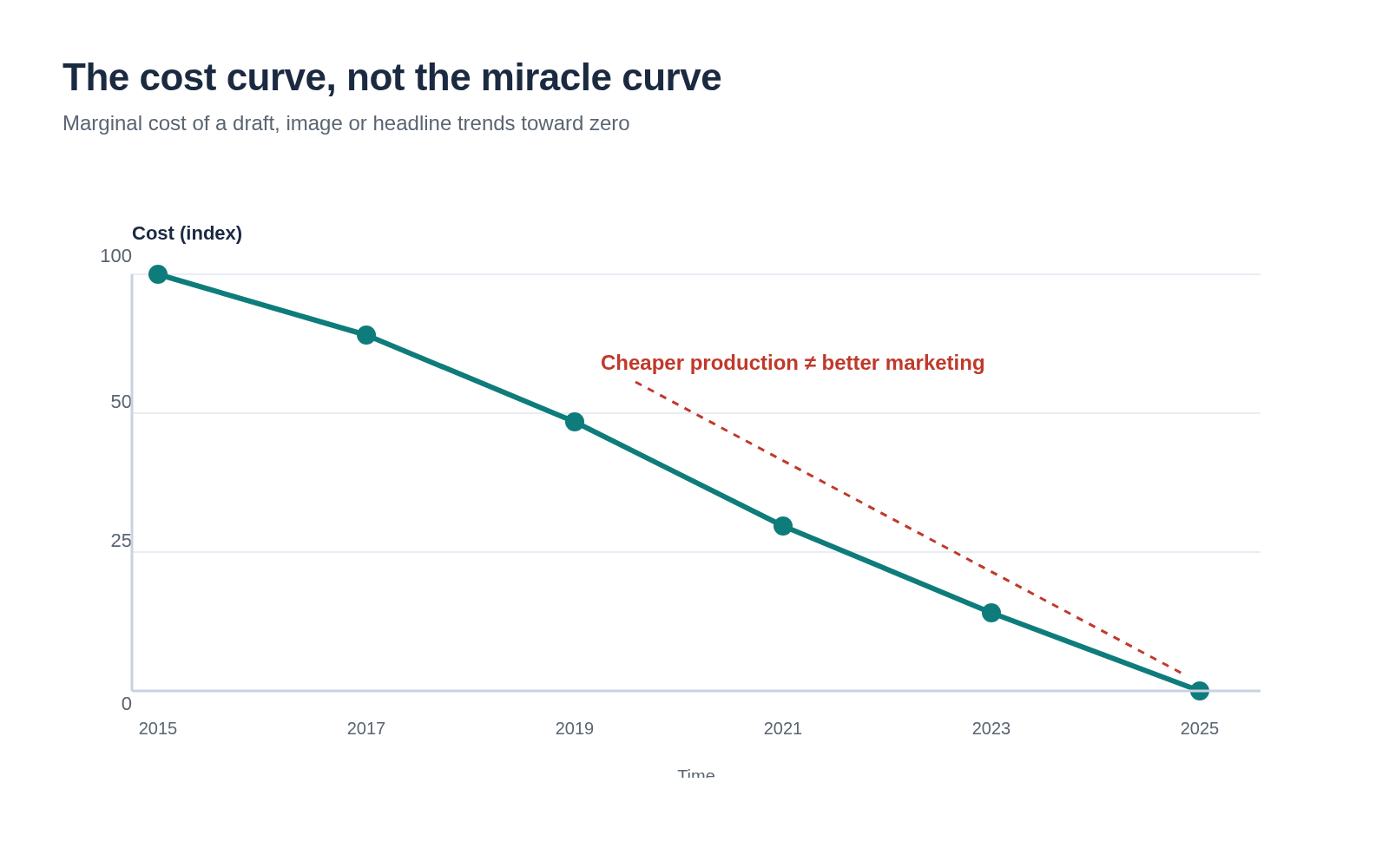
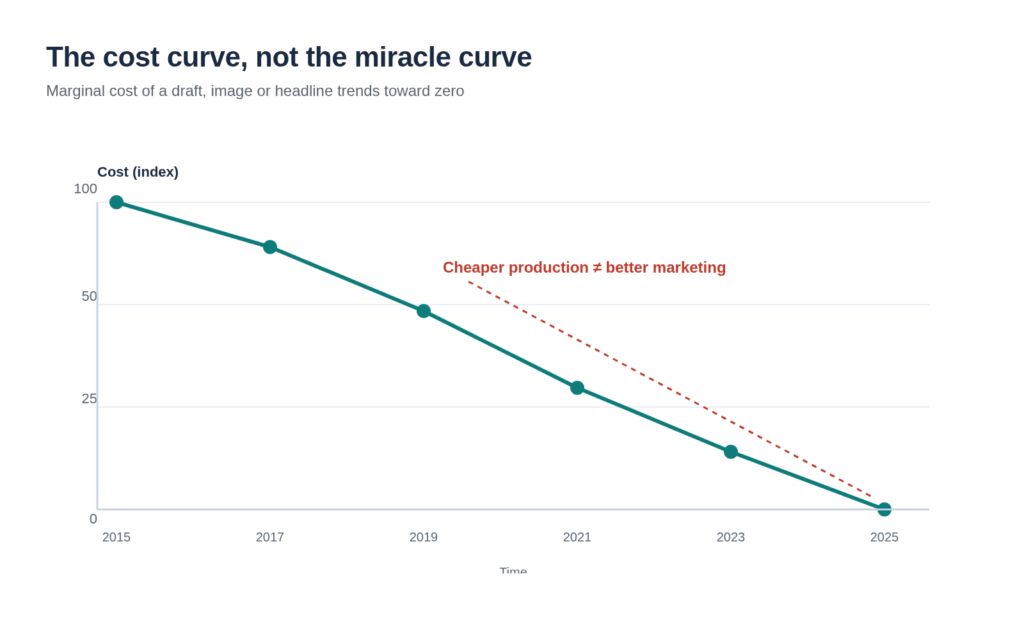
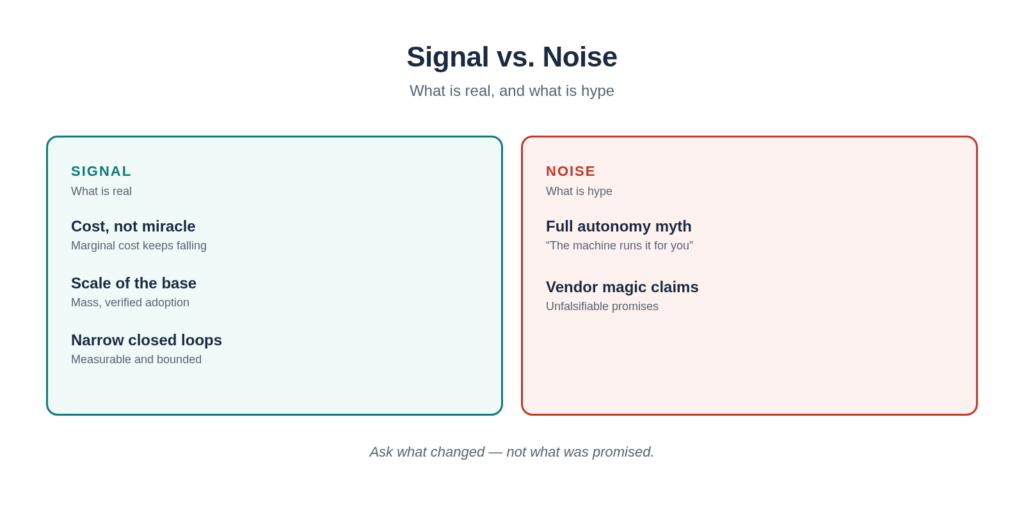
Strip away the rhetoric and the first genuine signal is cost. Generative AI does not invent growth out of thin air. It makes the marginal cost of producing a decent draft, a decent image, or a decent headline trend toward zero.
That is a real and meaningful change. It means a small team can produce the volume that once required an agency. It means experimentation gets cheap enough that you can afford to test ten angles instead of one. But cheaper production is not the same as better marketing. A thousand cheap drafts that say nothing useful are still a thousand drafts that say nothing useful. The win is real — but it is a cost win, and cost wins only compound when the thinking stacked on top of them is sound.
Signal Two: Scale of the Base
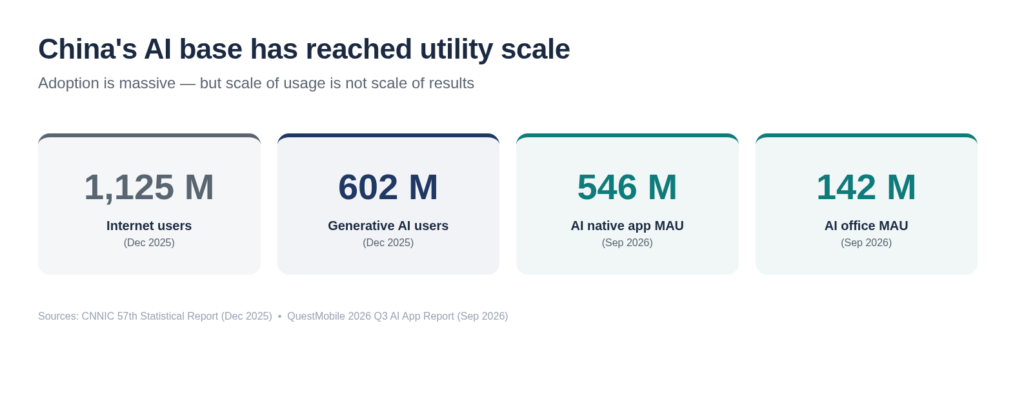
The second signal is scale, and here the numbers are worth sitting with. China offers the clearest picture. CNNIC’s 57th Statistical Report counted 1.125 billion internet users at the end of 2025 — an 80.1% penetration rate — alongside 602 million generative AI users, a 42.8% penetration by CNNIC’s measure. On the mobile side, QuestMobile’s third-quarter 2026 report puts AI native app monthly active users at 546 million, AI office tools at 142 million, and total monthly touches across AI assistants at 1.157 billion.
Globally, the curve looks similar. Stanford’s 2025 AI Index found that 78% of organizations reported using AI in 2024, up from 55% the year before, while the share using generative AI in at least one business function jumped from 33% to 71%. McKinsey’s 2024 survey found 65% of organizations regularly using generative AI, roughly double the prior year.
Here is the point that is easy to miss inside all those big numbers: scale of usage is not scale of results. Hundreds of millions of people use these tools. That tells us the infrastructure has arrived. It tells us nothing about whether any given brand is using it well. A utility reaches everyone; that does not make it a strategy.
Signal Three: Narrow Closed Loops
The third signal is where the rubber meets the road. AI marketing works — demonstrably — in narrow, closed loops. Draft, review, revise. Generate a variation, measure which one converts, feed the winner back. Segment a list, score it, learn from the response. These loops are tight enough to measure, which means they are tight enough to improve.
This is why Gartner’s well-known 2022 prediction that 30% of outbound marketing messages from large organizations would be synthetically generated by 2025 was never really a claim that machines would win. It was a claim that the drafting loop gets automated. That is exactly where the value concentrates: repetitive, measurable, bounded tasks with a clear feedback signal. The moment the loop opens up — the moment judgment, taste, or trust enters — the value of the tool drops sharply.
Noise One: Full Autonomy Myths
Now the other side of the ledger. The loudest noise in the market is the full autonomy myth: the idea that an AI agent can run your marketing end to end, set its own strategy, and optimize itself into growth.
It cannot, and the reason has nothing to do with how clever the model is. Marketing is not a closed system. It depends on signals that live outside any dataset a model can see — a founder’s conviction, a customer’s unspoken objection, a competitor’s move that has not happened yet, a reputation built over years. An autonomous agent can optimize the loop you hand it. It cannot decide which loop matters. That decision is the job.
Noise Two: Vendor Magic Claims
The second form of noise is the vendor magic claim, and it is the one you will actually encounter most. “Our AI writes content that ranks.” “Our AI finds buyers you cannot reach.” “Our AI replaces your copywriter.”
Notice what these claims share: they are unfalsifiable. There is no number attached, no baseline, no control. When a claim cannot be falsified, treat it as a slogan, not a feature. The correct response is not to argue; it is to ask for the one thing a real capability always has — a benchmark, a lift number, a before and after. If the answer is a whitepaper full of adjectives, you have your answer.
A Filter for Any AI Claim
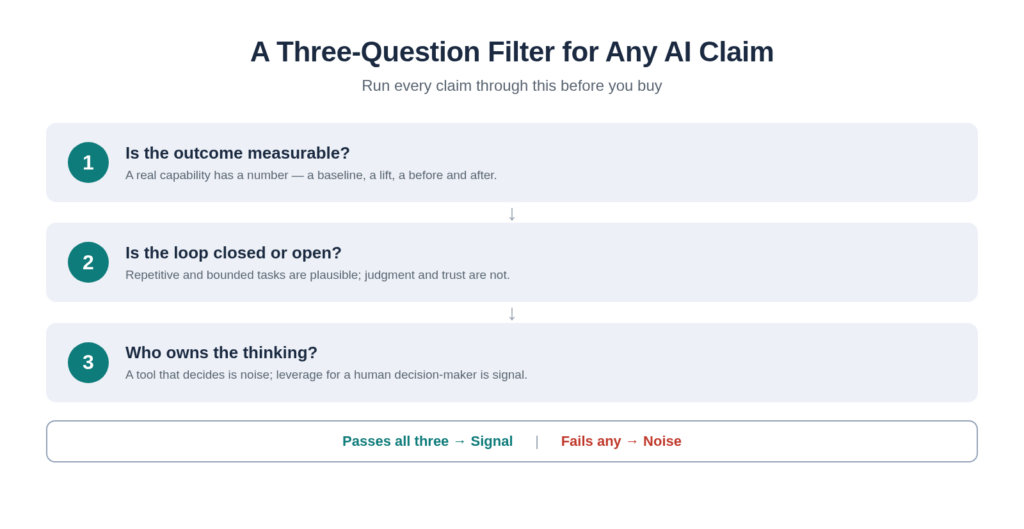
So how do you tell signal from noise without becoming a cynic? Run every claim through a three-question filter.
First, is the outcome measurable? If the promised result has no number and no way to verify it, it is noise. Second, is the loop closed or open? If the task is repetitive and bounded, the claim is plausible. If it requires judgment or trust, be suspicious. Third, who owns the thinking? If the tool is positioned as a decision-maker, walk away. If it is positioned as leverage for a human decision-maker, keep listening.
This filter is not anti-AI. It is the opposite. It is what lets you adopt AI for the reasons that are true instead of the reasons that are comfortable.
Building a Pragmatic AI Stack
A pragmatic stack starts small and earns its expansion. Begin with the cheapest, most measurable loop you have — usually drafting and personalization — and instrument it before you scale it. Set a baseline. Run a control. Watch the lift, not the demo.
Then extend to the loops you can actually close: audience segmentation and scoring, content variation and testing, reporting and insight generation. At each step, keep the human in the loop for the decision and the machine in the loop for the repetition. That division of labor is the whole game.
The Human Skills That Appreciate
Here is the part most vendors will not tell you: as the machines get better, the human skills get more valuable, not less. Strategy appreciates, because someone still has to choose the loop. Taste appreciates, because volume alone is worthless without the ability to recognize the one good version in a hundred. Trust appreciates, because AI can draft an email but it cannot build a relationship. And measurement appreciates, because a tool is only as good as the person who knows what to count.
The marketers who thrive are not the ones who outsource their thinking the fastest. They are the ones who use the machine to multiply their thinking the fastest.
A 2026 Reality Checklist
If you want a one-page test of whether you are using AI or being used by its hype, check these boxes. Are your AI outcomes attached to a measured baseline and a lift number? Is every AI task a closed loop with a clear feedback signal? Is there a human decision-maker owning every loop the machine runs? Can you point to a specific cost you removed or a task you made faster — in numbers, not adjectives? If you answered no to any of these, the gap is not your AI stack. It is your measurement.
The Quiet Professional Stance
The people actually making money with AI in marketing are quiet about it. They do not tweet about “autonomous growth engines.” They show you a dashboard with a lift number and a control group. They describe AI the way you would describe electricity: not because it is magic, but because it is always there, powering the work, and nobody talks about it at dinner.
That is the stance worth adopting. Stop looking for the button. Build the wiring.
Summary
AI in marketing is real, but it is infrastructure, not a miracle. The genuine signals are three: it collapses the marginal cost of production, it has reached utility-scale adoption, and it works reliably inside narrow, measurable, closed loops. The noise is equally clear: the myth of full autonomy and the vendor’s unfalsifiable magic claim. The professionals who win separate the two with a simple filter — measurable outcome, closed loop, human ownership of the thinking — and treat AI as leverage for judgment rather than a replacement for it.
FAQ
Is AI marketing just hype?
No, but the hype is real. What is overhyped is the promise of autonomous, one-click growth. What is underhyped is the quiet, measurable work of using AI to make drafting, matching, and measuring dramatically cheaper. The technology is genuine; the sales pitch around it often is not.
What is real versus fake AI?
Real AI shows up as a measurable capability: a lift number, a faster cycle, a removed cost, all against a baseline. Fake AI — often called AI washing — shows up as adjectives without numbers. If a claim cannot be falsified or verified, treat it as a slogan rather than a feature.
How do I avoid AI washing?
Apply a three-question filter to every claim: Is the outcome measurable? Is the loop closed, or does it require human judgment? Who owns the thinking? If a vendor fails any of these, the “AI” is likely a rebranded feature. The same filter applies to your own reporting — do not describe your work as AI-driven unless you can show the lift.
What actually works today?
Narrow, closed loops with clear feedback: drafting and revision, audience segmentation and scoring, content variation and A/B testing, and reporting. These are repetitive, measurable, and bounded, which is exactly where the value concentrates. Anything requiring strategy, taste, or trust still needs a human in charge.
Where should I invest first?
Start with the cheapest, most measurable loop you already run — usually drafting or personalization — and instrument it before scaling. Set a baseline, run a control, and measure the lift. Expand only to other loops you can actually close. The goal is leverage for your judgment, not a replacement for it.