ChatGPT Ads Is in 89 Countries — Here’s Who Wins the Early Race
ChatGPT Ads Reaches 89 Countries in Eight Months — Where the First-Mover Edge Actually Lives
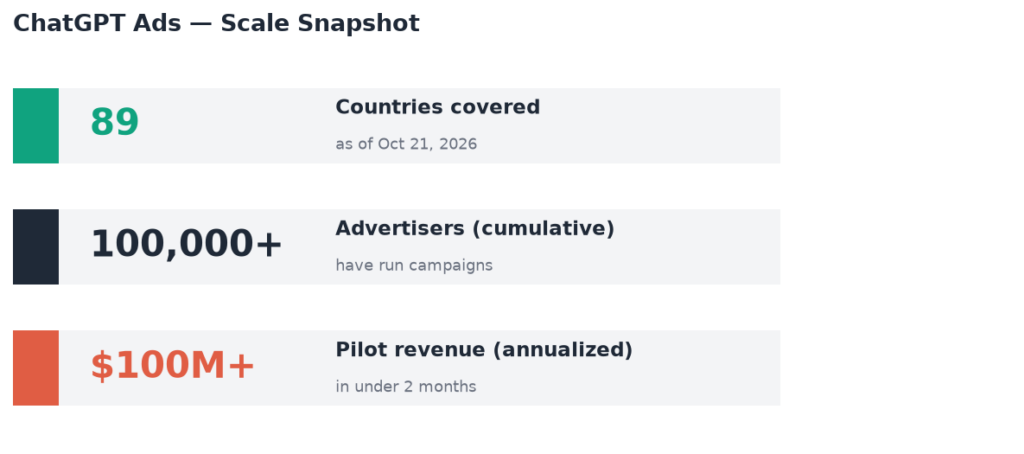
Eight months after OpenAI first switched on ads inside its chatbot, ChatGPT Ads has crossed a threshold that would have sounded like science fiction two years ago. The product now runs across 89 countries, and OpenAI says more than 100,000 advertisers have run campaigns on the platform. The milestone is real. The harder question it raises is who actually wins the early window — and who mistakes being first for being safe.
The milestone, and what “ads inside answers” means
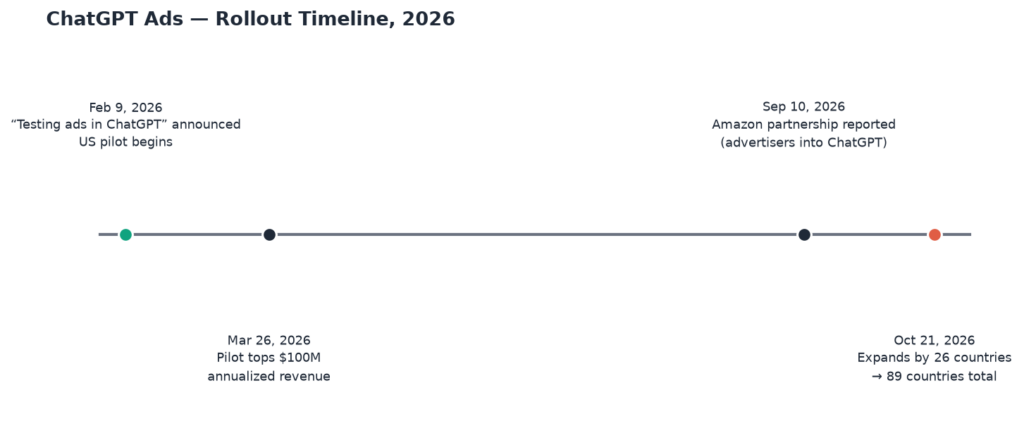
The rollout has been unusually fast, even by AI standards. OpenAI announced it was testing ads in ChatGPT on February 9, 2026, starting with a small United States pilot. Within roughly two months, the pilot had reached $100 million in annualized revenue, a pace that caught the attention of advertisers who had spent a decade dismissing the format as speculative. By late October, a single expansion added 26 countries in one move, taking the footprint to 89 markets — a step change rather than a gradual climb.
The more consequential shift, though, is mechanical rather than geographical. ChatGPT Ads is not a sidebar. It is not a banner stitched beside an answer. The ad sits inside the answer itself. OpenAI frames the environment as one built on conversation, context, and real-time decisions — which is a polite way of saying the sponsored message and the assistant’s reply now share the same surface, the same voice, and the same moment of intent. In practice, placement is decided by an auction that weighs relevance, bid, and the assistant’s memory of what the user has already asked.
That is a different placement model from search or social. A search ad sits above organic results and can be visually skipped. A feed ad competes for attention in an endless scroll. An answer-native ad is folded into the content the user came to get. Its relevance is judged not by keywords alone but by the whole thread. For advertisers, this changes what a conversion even is — the interaction is often a recommendation, a comparison, or a follow-up action that happens inside the conversation, not a visit to a landing page. The brand does not interrupt the answer. In many cases, the brand becomes part of it.
Why early presence may lock category association
The strongest argument for moving now is not about cost per impression. It is about memory. In a new ad surface, the first brands to appear begin to define the category itself — the company that comes to mind when a user asks an AI for a recommendation in a given vertical. That is a category entry point, and category entry points, once formed, are expensive for later entrants to dislodge.
Three compounding reasons make early presence matter.
First, the auction is thinner today than it will ever be again. With supply still growing and demand still forming, early bidders pay less for attention that will cost more once the platform matures and competition crowds in. The same placement bought cheaply this quarter is not coming back at that price.
Second, learning compounds. Advertisers who enter now are building the conversation-aware creative formats and the measurement frameworks before best practices harden. That operational knowledge is itself a moat. By the time the format standardizes, the early cohort already knows what works and what quietly fails.
Third, and most quietly, the data layer is being built right now. Every early campaign feeds the model’s understanding of which brands belong to which intents. An assistant’s recommendations are not neutral; they are shaped by what advertisers have already taught it.
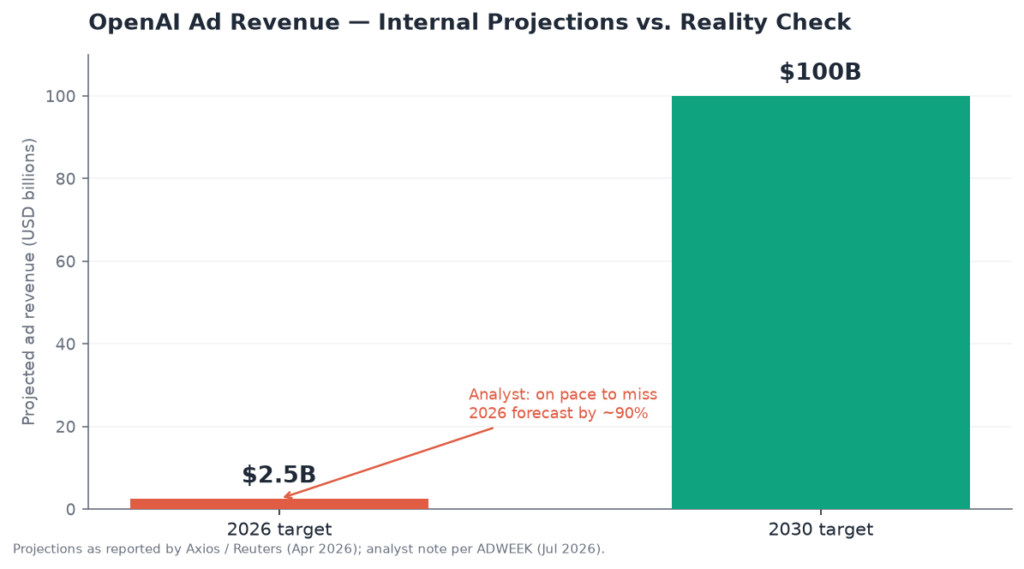
The caveat matters as much as the opportunity. Being first is not the same as being ready. The early revenue numbers look strong, but they are pilot-scale. Analysts have already cautioned that the platform’s promise is running ahead of its execution — one estimate, reported by ADWEEK, suggested the ad business could miss its own internal forecast by a wide margin. The first-mover edge exists, but it is conditional. It accrues to advertisers who arrive with a trust strategy, not to anyone who simply buys inventory.
The trust risk advertisers must manage
This is the part of the conversation most brands skip, and it is the part that will decide who actually wins.
The core risk is adjacency. An ad that lives inside a generative answer is only as credible as the answer around it. If the model errs — a hallucinated statistic, a misattributed claim, a tone that drifts — the brand pays for the model’s mistake by association. On a search results page, a brand can distance itself from everything else on the page. Inside an AI response, there is nowhere to hide.
Measurement is the second risk, and it is structural. Marketers have spent two decades perfecting last-click attribution. ChatGPT Ads does not map cleanly onto that framework, because the conversion often happens as a recommendation or an in-thread action rather than a click to a site. Industry observers have flagged measurement and brand safety as the two open questions the format has not yet answered.
Legal exposure is the third. Advertising inside an AI assistant raises disclosure questions, data-use questions, and liability questions that are still being worked out. Advertisers entering early are, in effect, helping to write the rules while also operating under them.
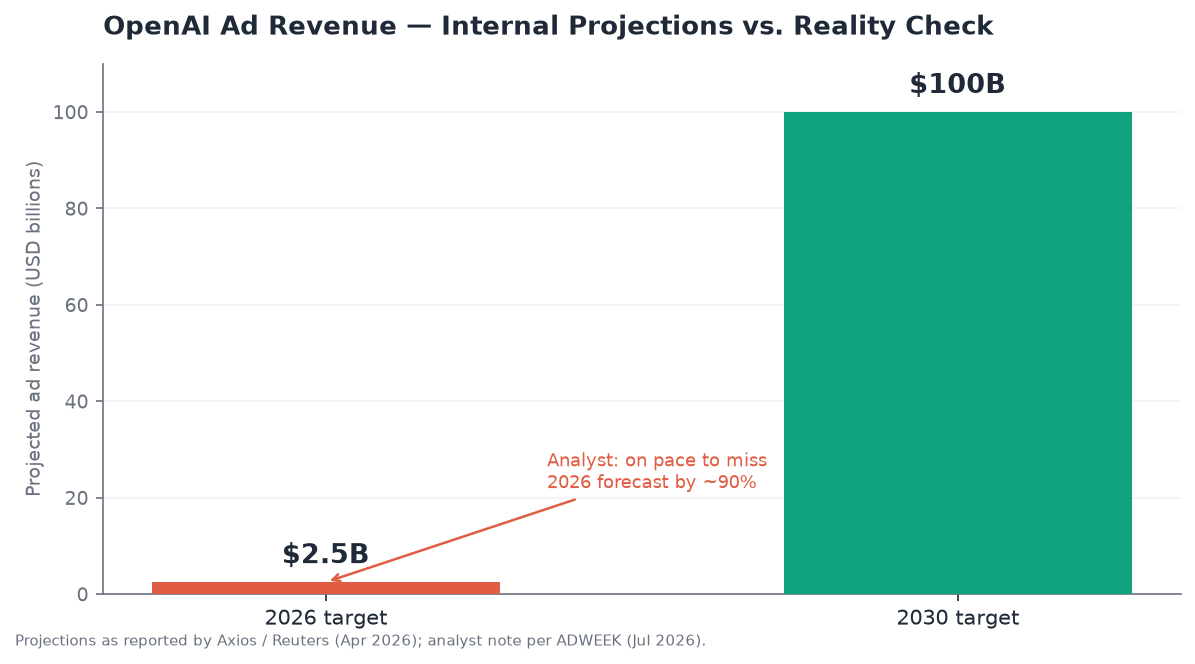
There is a broader signal worth watching. Axios reported internal projections of $2.5 billion in ad revenue this year and $100 billion by 2030 — a steep ambition curve. Against that, the analyst view is far cooler. The gap matters to advertisers, because a platform under revenue pressure is a platform that may test the boundaries of what advertiser-friendly means.
Where the map stops
For a global read on this story, the most telling detail is not the 89 countries OpenAI added. It is the ones it did not — and cannot. Mainland China is absent from the list, because ChatGPT itself is not officially available there, and Chinese authorities have publicly named services offering unauthorized access. That is not a market gap. It is a hard border.
On the other side of that border, a parallel AI advertising economy is being built to a different rulebook — search and short-video platforms running their own large models, their own recommendation engines, and their own conversational ad formats. The strategically interesting fact is that both worlds are converging on the same conclusion at roughly the same time: advertising is moving from the feed into the answer. China is not behind this trend. It is running a separate instance of it.
For global advertisers, that split produces two playbooks rather than one. In the OpenAI-aligned world, the race is for category association before the auction matures. In China’s walled AI ecosystem, the race is governed by domestic platforms and domestic compliance, and first-mover dynamics play out on entirely different rails.
The bottom line
The first-mover edge in ChatGPT Ads is real, but it is not a coupon. It is a bet that early category association, accumulated learning, and a thin auction will compound into durable advantage — and it only pays off if the brand can hold the trust bar the format demands. Advertisers who treat ChatGPT Ads as a scale channel first will find the adjacency risk eats their returns. Advertisers who treat it as a trust-building surface, and who measure it on its own terms rather than forcing it into last-click frameworks, are the ones positioned to win the early window.
Being early gets a brand into the conversation. Being credible is what keeps it there.