How to Get Cited by ChatGPT, Perplexity, and Every AI Answer Engine
When someone asks an AI a question, does your brand show up in the answer? Traditional SEO was never designed to answer that. Rankings tell you where you sit in a list of links. GEO tells you whether an AI bothers to mention you at all.
That single difference is why generative engine optimization confuses so many people. It borrows the SEO name, so we assume it works the same way. It doesn’t. Let’s untangle what it actually is, what AI engines actually reward, and how to measure something you cannot see on a results page.
The Name Everyone Misuses
GEO stands for generative engine optimization, and the term arrived with a specific meaning. A research team at Princeton formalized it in a 2023 paper, defining generative engines as the new class of search tools that don’t return a list of links but instead generate a direct answer by pulling from multiple sources and summarizing them.
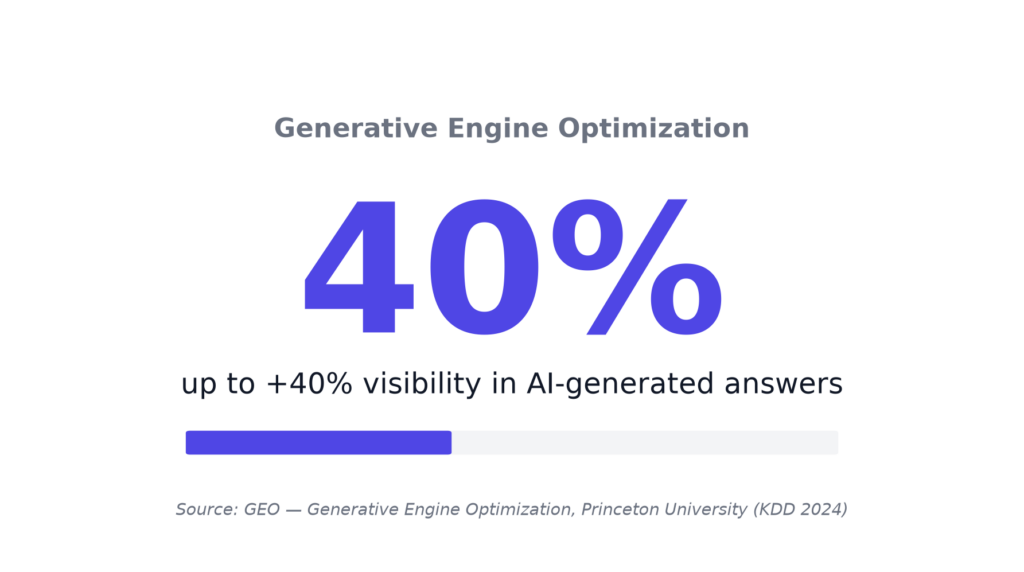
That paper matters for two reasons. First, it gave the discipline a name and a benchmark. Second, it produced the number everyone now quotes: well-structured content can gain up to 40% more visibility inside generative engine answers. Not clicks. Not rankings. Visibility — how often and how prominently an AI surfaces your content.
Here is the misuse. People use GEO as a fancy synonym for AI SEO, then apply old SEO playbooks to it. That produces busywork, not results. GEO is not SEO with a new label. It is a different objective operating on a different mechanism, and until you accept that, everything downstream gets blurry.
GEO vs SEO: Same Goal, Different Mechanism
Both disciplines want the same thing — your content gets found. The mechanism is where they split.
SEO optimizes for a ranking algorithm. You want position one on a results page. The output is a link a human clicks. The currency is the click-through.
GEO optimizes for a generation model. You want to be one of the sources an AI draws from when it writes an answer. The output is a mention, a citation, a synthesized sentence. The currency is being referenced.
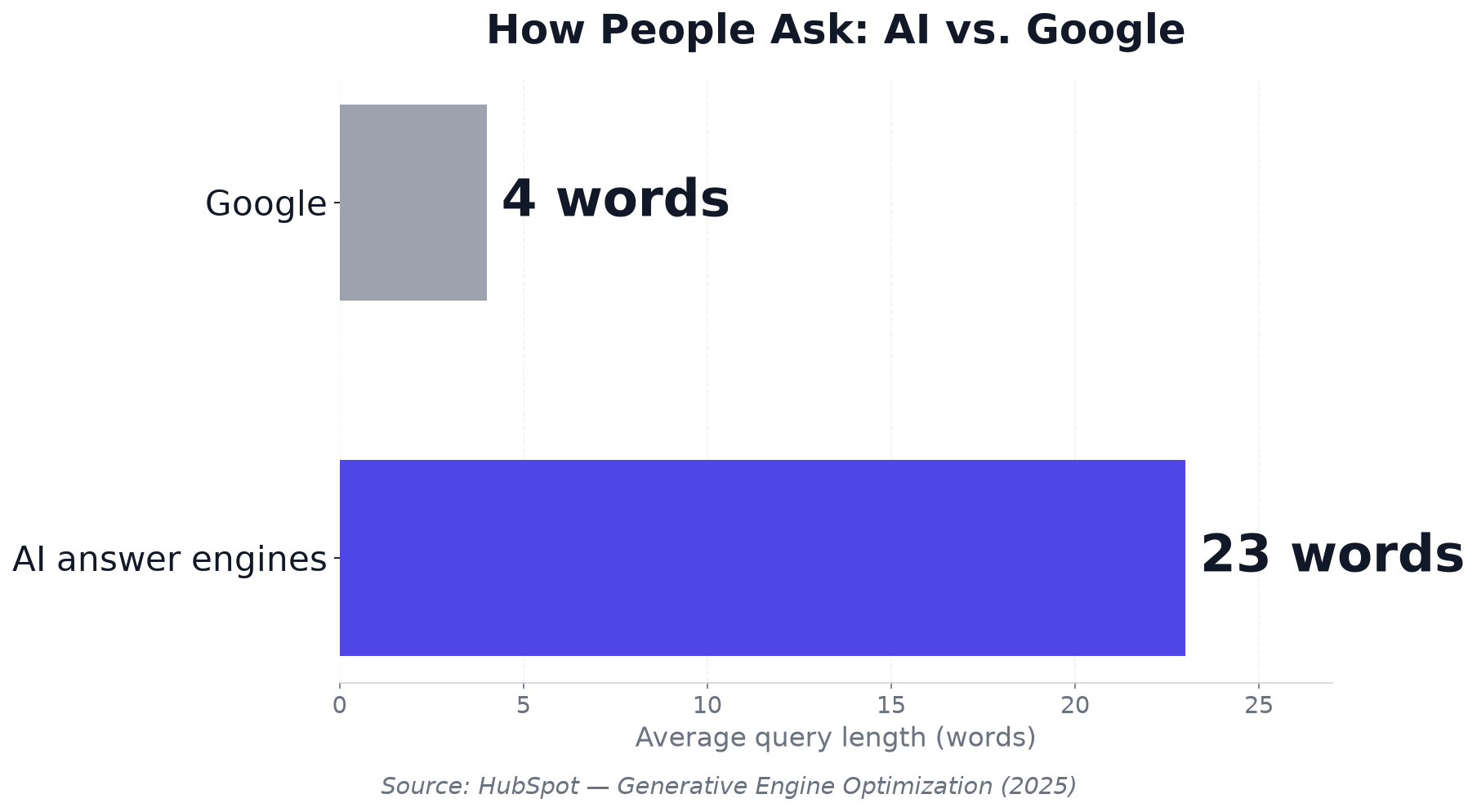
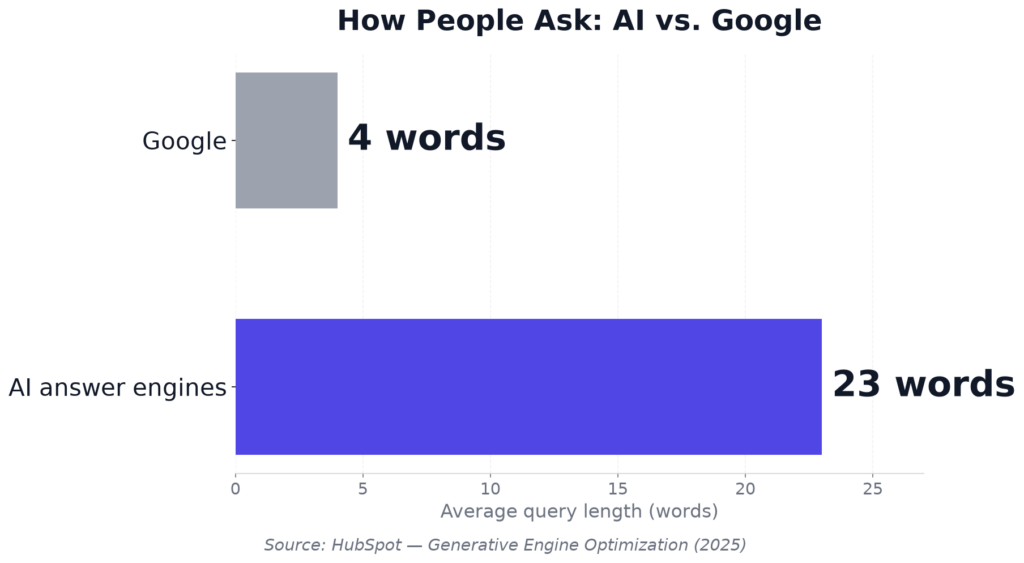
Look at the inputs and the difference sharpens. SEO leans on keywords, backlinks, domain authority, and page speed. GEO leans on structure, clarity, entity definition, and citation-worthiness. HubSpot’s research on the shift notes that AI queries average around 23 words against Google’s typical 4-word search — conversational, context-heavy questions instead of keyword fragments. A model trained to answer those questions reads your page differently than a crawler scoring your links does.
One more distinction worth naming: SEO is a ranking game with visible feedback. You can see position four. GEO is a citation game with mostly invisible feedback. You often can’t see whether an AI used you. That invisibility is exactly why measurement matters so much — we’ll get to it.
What AI Engines Actually Cite
If the goal is being cited, the practical question is simple: what makes an AI decide to cite one source over another?
The Princeton team tested this directly. Across a large benchmark of queries and sources, they found that adding statistics, adding quotations, and adding explicit citations consistently lifted visibility — up to that headline 40% ceiling. The flip side was just as instructive: keyword stuffing and filler content actively hurt. A model that is trying to write a clean answer punishes the same tactics that old search engines tolerated.
The pattern underneath those findings is coherence. Generative engines favor content a model can trust, extract, and repeat without breaking the answer. Three qualities keep showing up across studies and practitioner testing.
First, quotability. If a sentence is tight, factual, and self-contained, a model can lift it almost verbatim. If it’s buried in marketing prose, it can’t. Second, verifiability. Content that cites its own sources, or points to data a model can check, reads as safe to reuse. Third, authority. Engines lean toward established, consistently referenced sources — the same E-E-A-T signals that matter in classic search, but applied to a different outcome.
Structure Signals That Travel Into Answers
The single most underrated GEO lever is structure. It’s boring, and it works.
A generative engine has to parse your page, decide what’s important, and extract it. When your content is a wall of undifferentiated paragraphs, the model has to guess. When it’s broken into clear sections with descriptive headings, short paragraphs, and scannable lists, the model can lift exactly what it needs.
Think of headings as labels a model reads before it reads you. A heading like “How much does it cost” tells an engine exactly which block answers a pricing question. A heading like “Additional Considerations” tells it nothing. The same logic applies to tables, definitions, and numbered steps — anything that packages an answer in a way that survives extraction.
Here’s the part most people skip: the signal has to survive the journey. A model may compress, paraphrase, or reorder your content. Write sentences that stay true even when cut from their context. Lead with the answer, then explain. Put the number in the sentence, not just in a chart the model can’t read.
Entity Clarity and Why It Wins
Generative engines don’t just match keywords; they build a picture of entities — who, what, where, and how things relate. When your content names things clearly and consistently, you make it easy for the model to slot you into the right picture.
Entity clarity means defining your product, your category, and your relationships in plain, unambiguous language. Say what the thing is in the first sentence. Use one consistent name. Explain how it connects to the things around it.
Why does this win? Because a model answering a question about a category has to decide which sources represent that category well. If your page states, plainly, what your company does and where it fits, you’ve done the model’s reasoning for it. Vague positioning forces the model to guess, and models that are guessing don’t cite you.
The Role of First-Party Data
There is a type of content AI engines can’t get anywhere else: your own numbers. Survey results, internal benchmarks, original measurements — none of this exists on a competitor’s page.
When an AI needs a statistic to answer a question, it has two options: repeat something widely cited, or use a distinctive first-party figure. The distinctive figure is yours to own. That’s why original research is the closest thing GEO has to a moat. A model answering a market-size question will reach for whoever actually measured it.
You don’t need a research department. A simple, well-documented survey of your own customers, or a cleaned-up dataset you already own, is enough to become the source the answer quotes.
Freshness and Verification
Generative engines prefer sources they can verify, and freshness is a proxy for verifiability. A page updated recently, with a visible date and cited sources, signals that its claims are current and checkable. A dateless page from three years ago signals the opposite.
This is why GEO demands a discipline SEO often let slide: actually cite your sources. When your content points to the data behind its claims, a model can trace it. When it doesn’t, the model has to take your word — and it usually won’t. The Princeton findings echo this: explicit citations were among the strongest visibility boosters they measured.
Measurement: Citation, Not Rank
Here is where GEO gets uncomfortable. Rank is easy to see. Citation is not.
You can’t fully observe every time an AI pulls your content, but you can approximate it. The practical method is manual and direct: ask the engines the questions your audience asks, and record whether you appear, how often, and where in the answer. Do this on a schedule — weekly or monthly — with a fixed list of queries and engines. That gives you a baseline and a trend, which is more than most teams have.
There are also emerging tools that attempt to track brand mentions inside AI answers at scale. Treat their numbers as directional, not gospel; the space is young and the measurement is genuinely hard. The honest truth is that GEO measurement today is part process, part patience. Citation rate — mentions per query — is the metric that matters, even when you have to collect it by hand.
Common GEO Mistakes
The fastest way to waste a GEO budget is to import SEO habits wholesale. The most common mistakes are easy to spot once you name them.
Keyword stuffing still shows up, and it backfires harder in generative engines than it ever did in search. A model trying to write a fluent answer will not quote a sentence crammed with awkward phrases. Writing for the algorithm instead of the answer is a close cousin — publishing thin, repetitive content that ranks for nothing and cites for less.
Then there’s the invisibility problem ignored. Teams ship content and never check whether any AI references it, because there’s no ranking to glance at. If you aren’t measuring mentions, you’re flying blind in a discipline whose whole point is being mentioned.
Finally, treating GEO as a replacement for SEO. It isn’t. It’s a second channel on top of the first, and abandoning proven search traffic for an emerging one is a bet most businesses can’t afford.
A Starter GEO Checklist
If you’re starting from zero, here’s the order that works.
First, define what you want to be cited for. Pick the questions your customers actually ask, and match each to a page. Second, answer those questions plainly — lead with the answer, use a heading that mirrors the question, and keep the language a model can extract. Third, add the substance models reward: a real statistic, a quotable sentence, and a cited source wherever you make a claim. Fourth, clarify your entities — name what you are and how you relate to the category, in language a stranger would understand. Fifth, add first-party data where you can, even a small original survey. Sixth, keep the page fresh and dated. And seventh — the one everyone forgets — set up a recurring check of whether you’re actually being cited, so you can see what’s moving.
China and the West: Different Engines, Same Logic
GEO gets treated as a Western story, but the underlying shift is global, and China is its own distinct battlefield.
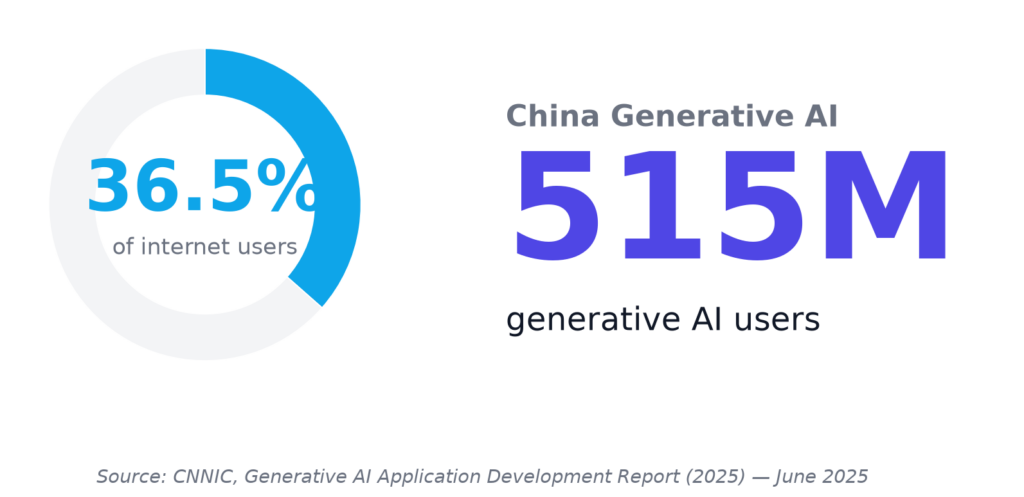
The scale in China is hard to overstate. According to the China Internet Network Information Center, 515 million people — more than a third of the country’s internet users — were using generative AI by mid-2025. The momentum hasn’t slowed since: CNNIC’s follow-up report put the figure past 700 million users, with penetration crossing half of the population, by the first half of 2026. When half a billion people are getting answers from models, being cited by those models is no longer optional.
The mechanics differ, and that’s the part people miss. The dominant engines in China aren’t ChatGPT and Perplexity; they’re domestic platforms with their own retrieval behavior, their own content ecosystems, and their own rules about what gets referenced. Optimizing for them means understanding those platforms the way you once learned Google’s quirks.
But the logic underneath is identical. Both ecosystems have moved from returning links to generating answers. Both reward clear structure, verifiable claims, and quotable content. In both, the metric that matters has shifted from where you rank to whether you’re mentioned. The engines change. The physics doesn’t.
Where GEO Is Heading Next
GEO is young enough that its rules are still being written, but a few directions are already visible.
The researchers who named the discipline were blunt about where it’s going: generative engines are rapidly replacing traditional search engines like Google and Bing. That shift is why an SEO industry worth something in the order of $80 billion is being reshaped rather than merely nudged — and why the distribution question is flipping. When assistants become the front door, being the source the assistant trusts matters more than owning the results page.
Measurement will mature, and with it, accountability. Right now most teams can’t see their AI visibility clearly. The tools that close that gap — and the teams that learn to read citation data the way they once read rankings — will gain an early and compounding edge.
The durable lesson is the simplest one. Generative engines reward the same fundamentals that always made content good: say something true, say it clearly, and make it easy to verify. GEO didn’t invent that. It just changed who’s listening.
Summary
GEO is the practice of earning citation inside AI-generated answers rather than ranking in a link list. The term came from Princeton research showing well-structured content can gain up to 40% more visibility in generative engine responses. It complements SEO rather than replacing it, and it demands a different focus: clear structure, entity clarity, verifiable and quotable claims, first-party data, and freshness. Measurement is the hard part — you track citation rate, not rank — and it’s often collected by asking the engines directly. China is running the same shift at enormous scale, with 515 million generative AI users by mid-2025 and more than 700 million by early 2026, proving the logic travels across engines and borders even when the platforms differ.
Structured FAQ
Q: Is GEO replacing SEO?
A: No. SEO still drives the clicks that make up the bulk of most businesses’ organic traffic. GEO is an additional channel that optimizes for AI citations, and the two overlap heavily — good structure, authority, and clarity serve both. The teams that treat them as one stack rather than a choice tend to do best.
Q: How do I actually get cited by an AI?
A: Lead with a direct answer, mirror the question in your heading, and add what models reward: a concrete statistic, a quotable sentence, and a cited source. Keep claims verifiable and your entities clearly defined. There’s no guaranteed trick, but these inputs consistently lift visibility in the research done so far.
Q: Does schema markup help GEO?
A: Schema helps machines parse your page, which is useful, but it’s not a magic switch. Generative engines lean more on readable structure, clear entities, and quotable content than on hidden markup. Use schema where it clarifies your entities; don’t expect it to substitute for substance.
Q: How is GEO measured?
A: By citation rate — how often your content appears in AI answers for a fixed set of queries across engines. Most teams measure it manually on a schedule, asking ChatGPT, Perplexity, and other engines the same questions and logging mentions. Tools are emerging, but the field is young and the numbers are still best treated as directional.
Q: Is GEO different in China?
A: The mechanics differ — the dominant engines are domestic platforms with their own retrieval behavior and rules — but the core logic is identical. China’s scale makes it urgent: 515 million people were using generative AI by mid-2025, growing past 700 million by early 2026. In both markets, the goal has shifted from ranking to being mentioned, and the same fundamentals win.