Field Notes on a Shakeout: Watching China’s Livestream Economy Reprice Its Top Tier
Every industry eventually discovers that its most expensive intermediary is the one standing between it and its customer. Chinese livestream commerce found that out in about thirty months.
The number that broke the story
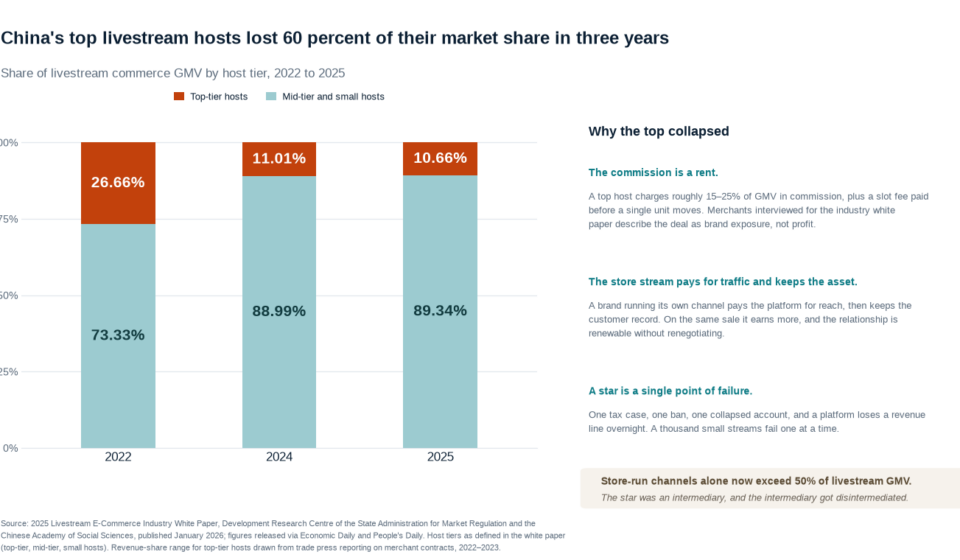
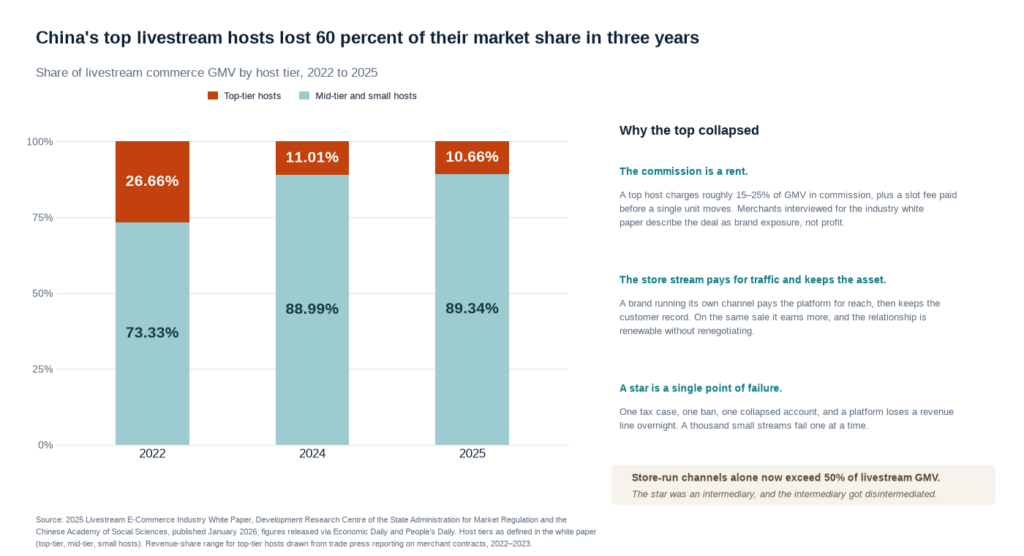
In 2022, top-tier hosts moved 26.66 percent of China’s livestream commerce GMV. By 2024 that was 11.01 percent. In 2025 it settled at 10.66 percent, with mid-tier and small hosts taking 89.34 percent, according to the industry white paper published in January 2026 by the Development Research Centre of the State Administration for Market Regulation and the Chinese Academy of Social Sciences.
Read that as a fall of roughly 60 percent in share over three years, in a market that was itself growing 16.48 percent a year to RMB 5.26 trillion. The stars did not shrink because the market cooled. They shrank while the market grew.
For Western brands, this is the more useful story than the usual one about Chinese livestream being enormous. The interesting question is not how big it got. It is why the most-followed participants in it were quietly demoted.
The commission is a rent, not a channel
Start with the unit economics, because they are unforgiving.
A top-tier host’s commercial terms typically run to a commission of roughly 15 to 25 percent of GMV, plus a slot fee payable before a single unit ships. Industry interviews cited in the white paper are blunt about what that buys: brand exposure and market entry, not profit. A merchant that keeps returning to the top of the market is paying for discovery it could eventually buy more cheaply elsewhere.
This is not a distribution channel. It is a toll booth on demand. And a toll booth is only worth its price while it is the only road.
The alternative arrived, and it kept the asset
The road turned out to be the brand’s own channel.
Store-run livestreams, where a brand’s own staff sell on its own account, now contribute more than half of livestream GMV. On the same sale, a brand pays the platform for reach rather than paying a host for access, and it keeps the customer record, the repeat purchase, and the audience relationship. The marginal economics improve on every cycle. A star host’s economics do not: the fee resets each time.
That is the mechanism behind the shift, and it is unglamorous. Nobody was disrupted. The intermediary was simply disintermediated by arithmetic.
Concentration was also a risk position
The second driver is structural rather than financial.
A platform whose revenue depends on a handful of hosts is holding a concentrated position in people who are, legally and reputationally, single points of failure. China spent 2021 and 2022 learning this at speed: a tax investigation, a suspension, a product scandal, and a platform’s flagship revenue line disappears in a week.
A market made of 3.88 million professional hosts and small store channels fails one stream at a time. That is a better portfolio, and platforms have been deliberately rebalancing toward it since 2022, with merchant support programs, commission waivers, and traffic allocation tilted toward store-run channels.
What this means outside China
The lesson travels better than the format does.
Western social commerce is currently in the phase China left in 2022: a small number of creator accounts carry a disproportionate share of the revenue, and brands treat those accounts as the channel. The Chinese evidence suggests what happens next. The creators do not vanish. They get repriced, and the brands that build their own audience infrastructure keep the margin the intermediary used to take.
The question worth asking about your own creator programme is not how many followers the account has. It is who owns the customer when the stream ends.
A closing caution
None of this makes top-tier hosts irrelevant. Their approval ratings remain the highest in the industry, and they still do the one job small channels cannot: launching a brand into a market it has never entered. The shift is in what they are for, not whether they matter.
They stopped being the market. They became the opening act.