The Audit Filter: Why Localization Stalls at Layer Two
Every failed China localization story gets told the same way. The market was difficult. Local competitors were irrationally cheap. Consumers there are different. And every time, the diagnosis is a description of the symptom wearing the costume of a cause.
Here is a mechanism that explains the stall better, and it has nothing to do with the market.
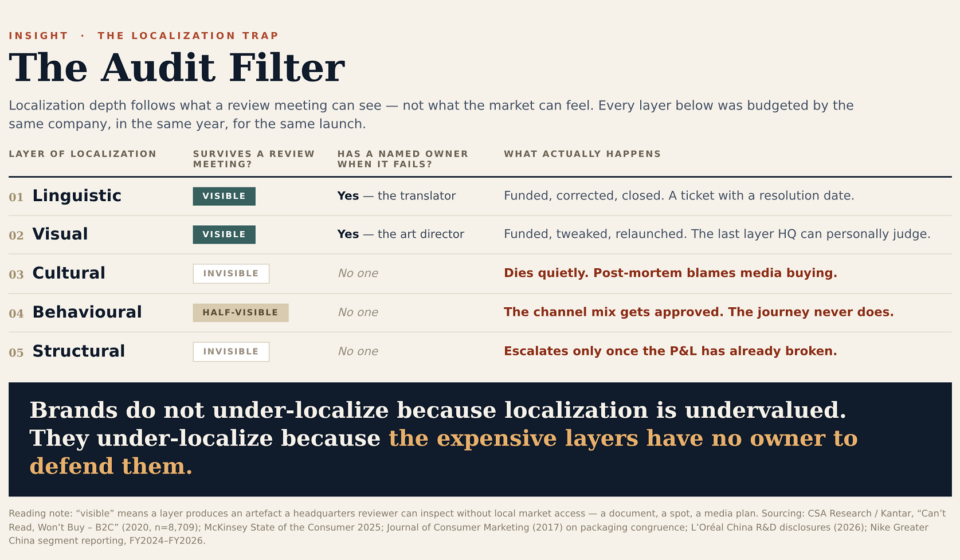
Localization depth tracks reviewability, not importance.
Think about what a headquarters meeting can actually inspect. It can open a translated page and see whether the Chinese is grammatical. It can watch a localized spot and judge whether the imagery looks current. It can read a media plan and check whether the budget split is defensible. Everything in that meeting is an artefact — a thing with edges, that someone produced, that can be approved or sent back.
Now think about what that same meeting cannot inspect. Whether a joke about a mother-in-law lands as warmth or as insult. Whether the decision to buy happens in a search bar, a group chat, or a livestream at eleven at night. Whether a subscription model makes sense in a market where membership is free and the relationship lives in an app. None of that produces an artefact. It produces an outcome, months later, with no signature on it.
So the organisation funds the layers that generate artefacts and defers the layers that generate outcomes. Not out of laziness — out of ordinary governance. A budget without an owner is a budget that loses every argument it enters.
The tell is not the budget. It’s the post-mortem.
The clearest evidence for this mechanism isn’t in any spending breakdown. It’s in what gets blamed when a launch underperforms.
Language problems get caught before launch, because someone is accountable for the review. Creative problems get caught in testing, because someone is accountable for the spot. But when a campaign simply doesn’t move anyone, the review has no artefact to point at — so it reaches for the nearest measurable thing and blames media buying. The channel mix was wrong. The agency over-delivered frequency to the wrong audience. Buy more reach.
That reflex is diagnostic. An organisation that blames media for a cultural failure is telling you exactly where its visibility ends. Media is the last layer with an artefact, so it absorbs the blame from every layer above it.
Why the expensive layers need an owner, not a budget line
This is where the two patterns in the data converge.
When L’Oréal wanted Layer Five, it didn’t add a localization budget to a global function. It built a Shanghai research centre with roughly 400 scientists, a reconstructed Chinese skin model, and the authority to ship formulas globally — a peptide serum developed for this market now sells in Western department stores. When Nike finally moved, it didn’t produce a better campaign. It appointed a vice-president of local product creation and rebuilt distribution around Tmall, JD and Douyin. In both cases the structural layer got a person, a headcount and a P&L, and only then did it get built.
Meanwhile the consumer evidence says the deeper layers are where the money is. McKinsey found 47% of global consumers weigh local ownership in purchase decisions, and that fit — not price — is the main reason. A panel study across 2001 to 2024 found localization strengthens brand identity mainly through presence and repetition: offline promotion and ad investment. Both are outcomes, not artefacts. Both are invisible in the meeting that approves them.
What this means if you’re the one approving
Three practical consequences, none of them comfortable.
Audit authority, not output. Ask which layer your China team can change without asking permission. If the honest answer is copy and creative, you have localized the reviewable part of the business and left the rest to the market.
Look for the missing owner. Every layer without a named accountable person will underperform, and the failure will be attributed to the layer beneath it. When cultural localization fails, media gets blamed — because media is the last thing with a receipt.
Treat congruence as the test, not depth. Localization isn’t a ladder you climb for its own sake. A Journal of Consumer Marketing study found Western packaging outperformed locally styled packaging with Chinese consumers for hedonic products, with no difference for utilitarian ones. The question isn’t “are we local enough.” It’s “where does the claim stop matching the experience” — and then building that specific thing.
The trap isn’t that brands don’t care about localization. It’s that they staff the layers they can see. The expensive insight is that the layers they can see are the cheap ones.