Amazon Just Put a Restaurant Delivery Button Inside Its Shopping App
You’re browsing Amazon for a charger cable, and suddenly you can also order dinner — same app, same Prime account, zero delivery fee.
That’s the new reality Amazon and Uber announced on November 5. Prime members can now order Uber Eats through Amazon’s shopping app, no separate Uber account required.
It’s a small product change with big strategic implications: Amazon just made Prime stickier without building a single delivery kitchen.
What Was Announced
Let’s start with the specifics.
On November 5, Amazon and Uber announced a partnership: US Prime members can order Uber Eats restaurant delivery directly through Amazon.com or the Amazon Shopping app — no separate Uber Eats app or new Uber account required.
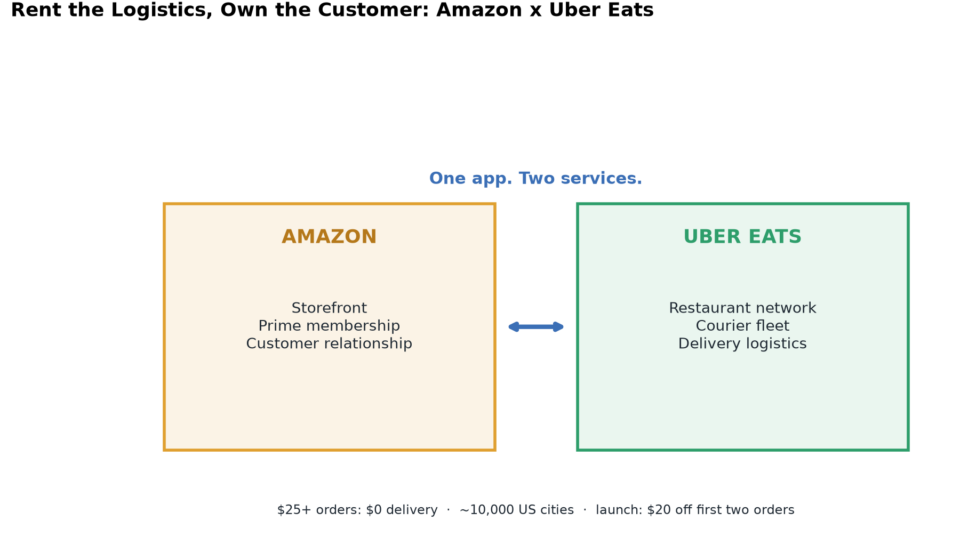
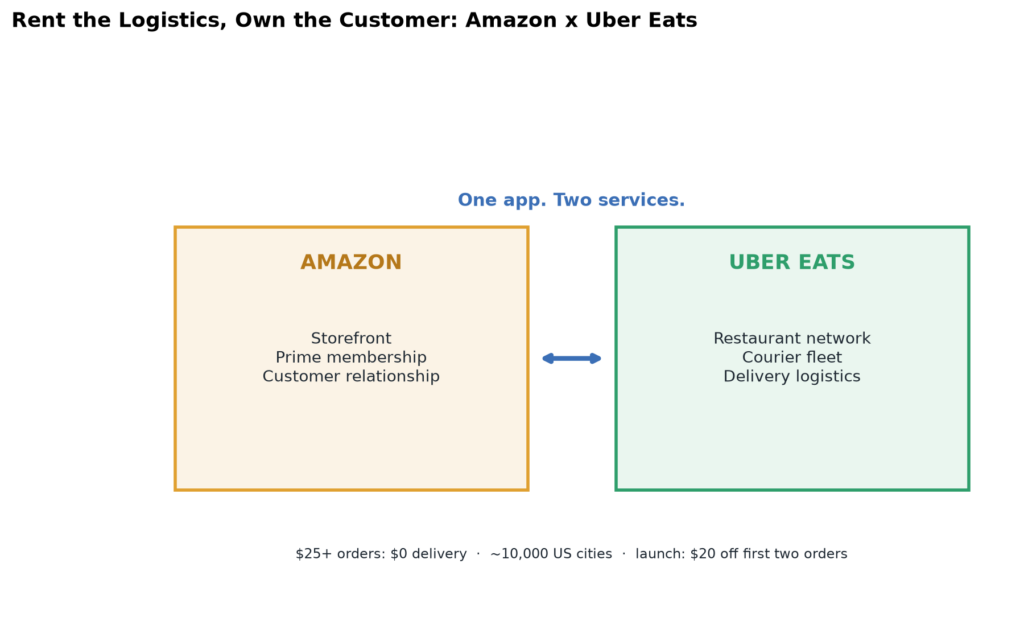
Qualifying restaurant orders of $25 or more get $0 delivery fee. There’s a launch promotion offering $20 off each of the first two qualifying orders. The partnership covers nearly 10,000 US cities and towns.
It’s a meaningful integration: third-party restaurant delivery is now embedded inside Amazon’s shopping experience.
The “Rent, Don’t Build” Logistics Logic
Here’s the strategic insight.
Amazon isn’t building its own restaurant delivery network. It’s renting Uber Eats’ infrastructure — the restaurant relationships, the courier network, the delivery logistics. Amazon provides the storefront and the customer relationship; Uber provides the operational heavy lifting.
That’s a deliberate choice. Amazon already has its own grocery delivery (Whole Foods, Amazon Fresh), but building a restaurant delivery network from scratch would be expensive and slow. Partnering with Uber Eats gets Amazon into the category immediately, without the capital outlay.
It mirrors a broader Amazon pattern: own the customer relationship, rent the operations where they’re already commoditized.
The Prime Moat Deepening
Why does Amazon want restaurant delivery inside its app?
The answer is Prime. Every new benefit increases switching costs and retention. Restaurant delivery is a high-frequency use case — people order food more often than they buy electronics — which means more daily touchpoints with the Amazon app.
More touchpoints mean more opportunities to sell, more data, and more reasons for customers to stay in the Amazon ecosystem. The integration also exposes non-Prime users to Prime’s value proposition, potentially converting them.
The Retail Media Implications
Here’s the part that matters for marketers.
More daily active users in the Amazon app means more ad impressions and more retail media inventory. Amazon’s retail media business is already a dominant force in digital advertising; anything that increases app engagement expands that surface.
For CPG and restaurant brands, this is another channel to reach Prime households. For Amazon, it’s another way to monetize the customer relationship.
The “super-app” framing — Amazon becoming a one-stop app for everything from shopping to dining — is industry analysis, not an official Amazon strategy. But the direction is consistent with a broader trend of major platforms expanding into adjacent services.
The Caveats and Boundaries
It’s important to be precise about what this is and isn’t.
This is US-only, and not all orders qualify for $0 delivery. Minimums and terms apply. Service fees, taxes, and tips still apply per checkout terms.
Crucially, Amazon is not operating the delivery — Uber Eats is. Amazon is the storefront; Uber Eats is the logistics provider. So this isn’t Amazon “taking over” food delivery; it’s Amazon integrating a partner’s service into its app.
What This Means for the Delivery Wars
Step back, and this partnership fits a larger competition.
Food delivery is a brutal business with thin margins. Uber Eats, DoorDash, and Grubhub have fought for years over market share. Amazon entering as a storefront partner — rather than a direct competitor — is a smart way to participate without absorbing the operational costs.
For Uber, the deal provides access to Amazon’s enormous Prime customer base — a distribution channel that’s hard to replicate. For Amazon, it’s a new Prime benefit without the delivery network buildout.
Both sides gain. That’s why it makes sense.
What to Watch Next
Three signals will show how this develops.
Watch the uptake. If Prime members adopt restaurant delivery through Amazon at scale, the partnership becomes a core Prime benefit rather than a novelty.
Watch whether DoorDash or other competitors respond with similar integrations. If they do, the “storefront + logistics partner” model becomes a trend.
And watch the retail media implications. If Amazon starts integrating restaurant ads into its retail media offerings, the partnership’s advertising value becomes clear.
The Bottom Line
Amazon’s partnership with Uber Eats is a small feature with a big strategic purpose: make Prime stickier and expand the retail media surface without building a delivery network.
It’s a textbook “rent, don’t build” move — and it shows how major platforms are increasingly competing by integrating adjacent services rather than owning every piece of the value chain.
For consumers, it means one more reason to stay in the Amazon app. For competitors, it means one more front in the platform wars.