Kimi Just Started Selling the Runtime, Not Just the Model
Everyone is selling AI models. Moonshot AI just started selling something more valuable: the place where those models run.
On November 5, Kimi launched “Hosted Agents,” turning its Harness agent-runtime framework into a cloud service where enterprises can run round-the-clock agents with long-running tasks and multi-agent collaboration — without building or maintaining any of the underlying infrastructure.
It’s the difference between selling someone a car and selling them a road.
What Was Launched
Let’s start with the facts.
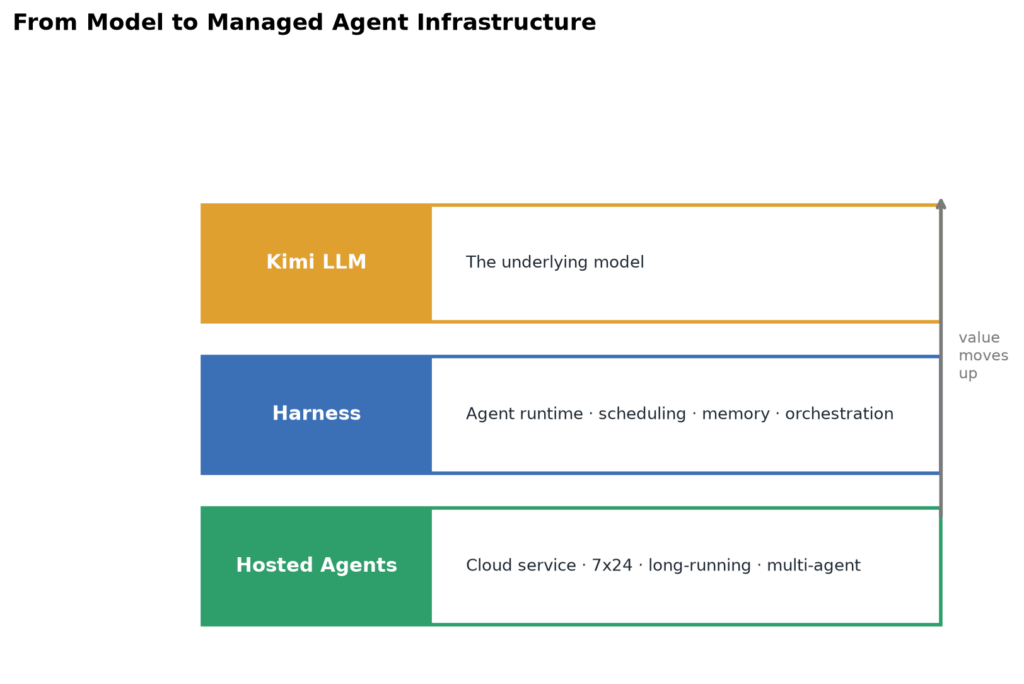
On November 5, Moonshot AI announced “Kimi Hosted Agents” . The idea is straightforward: take the Harness framework — the agent-runtime infrastructure that supports running AI agents — and offer it as a cloud service to enterprises and developers.
The service provides a 7×24 hosted environment. Companies don’t need to build and maintain their own execution framework; they get a managed environment that supports long-running task execution and multi-agent collaboration.
In plain terms: if you want to deploy AI agents that run continuously, coordinate with each other, and handle complex multi-step workflows, Kimi will host the infrastructure for you.
The Business Model Shift
Here’s why this matters more than it might first appear.
Most AI companies sell model inference — you send a request, you get a response, you pay per token. That’s a component business. The model is a part of your application, and the AI company is a supplier.
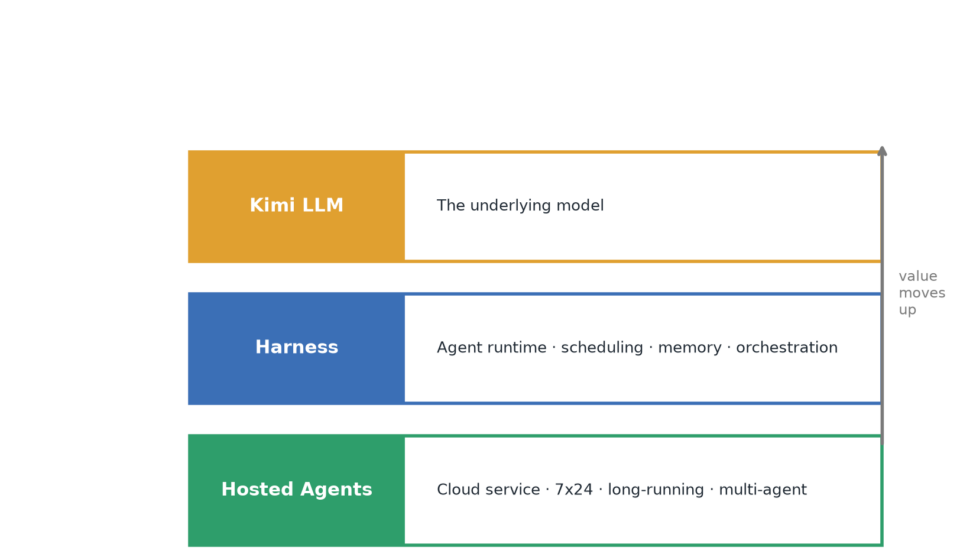
Hosted Agents is a different model. Moonshot is selling the runtime — the environment where agents live, plan, remember, and coordinate. That’s much closer to a platform business. Once an enterprise builds its agents on Kimi’s Harness, switching costs rise dramatically.
The analogy to cloud computing is apt. AWS sells EC2 (raw compute, a component) and Lambda (managed serverless runtime, a platform). Lambda is stickier, higher-margin, and harder to replace. Kimi’s Hosted Agents is Moonshot’s attempt to be the Lambda of AI agents.
The “Agent Runtime as a Service” Trend
Moonshot isn’t alone in this insight.
The same week, DeepSeek disclosed that its Harness platform had reached 154 million daily users and 92 trillion tokens per day (see our A5 coverage). Both companies have converged on the same realization: agents need infrastructure, and infrastructure is where the durable value sits.
The “agent economy” isn’t just about models. It’s about scheduling, memory, tool orchestration, and multi-agent coordination — the plumbing that lets agents actually do things. Whoever provides the best plumbing captures the most value.
This is where the next AI platform war will be fought. Not in benchmark scores, but in runtime reliability, tooling, and ecosystem lock-in.
China’s Agent Infrastructure Race
Zoom out, and Moonshot’s launch fits a broader pattern.
China is building the infrastructure for an agent-driven economy. DeepSeek (154M users, 92T tokens/day), Tencent (10x inference expansion after Hy4’s launch — see our A6 coverage), and Moonshot (Hosted Agents) are all investing heavily in the layer beneath the model.
The throughline: while the US debates model-level regulation (ASI Prohibition Act), China is building the plumbing to deploy agents at scale. That’s a different kind of competition — and one that may prove more consequential in the long run.
What It Means for Developers and Enterprises
If you’re building with AI, here’s the practical read.
First, the barrier to deploying agents drops significantly. You no longer need to build and maintain complex runtime infrastructure — you can focus on the agent logic and the business problem.
Second, time-to-value improves. Multi-agent workflows that once required months of infrastructure work can now be deployed faster.
Third, vendor lock-in risk rises. Building agents on a proprietary runtime creates switching costs. For enterprises, that’s a trade-off between speed and flexibility.
Fourth, pricing models matter. Watch for per-agent, per-token, and per-task pricing — the way these are structured will define the economics of the agent economy.
The Bigger Picture: Moving Up the Value Chain
Step back, and Moonshot’s move is a classic value-chain play.
In any technology market, value migrates from components toward platforms and ecosystems. The companies that capture the platform layer — the place where applications are built and run — tend to capture the most durable value.
By selling the runtime, Moonshot is moving from “supplier of a model” to “platform where agents live.” That’s a higher-value, stickier position — and it’s where the company believes the future of AI business models lies.
What to Watch Next
Three signals will show how this develops.
Watch the pricing structure. How Moonshot charges for Hosted Agents will reveal whether it’s competing on cost or on value-added platform features.
Watch adoption by enterprises. If large companies build production agents on Kimi’s Harness, the platform model is validated.
And watch whether competitors (DeepSeek, Tencent, Alibaba) launch comparable managed-agent services. If they do, the “agent runtime as a service” category becomes real — and the competition shifts to reliability, tools, and ecosystem.
The Bottom Line
Kimi’s Hosted Agents isn’t just a new product. It’s a statement that Moonshot wants to sell the road, not just the car.
In the agent economy, the model is becoming a commodity. The runtime — the environment where agents live, collaborate, and do work — is where the durable value is moving. Moonshot is betting on that shift before most of its competitors have even named it.
Whether that bet pays off depends on execution. But the strategic logic is sound: sell the model, and you’re a supplier; sell the runtime, and you’re a platform.