DJI’s Matrice 5T: The Drone That Can See a Power Line in the Dark
A lineman inspecting a high-voltage power line in bad weather is doing one of the most dangerous jobs in the industrial world. DJI’s Matrice 5T, launched November 5 at 57,488 RMB, is built to do it from the air.
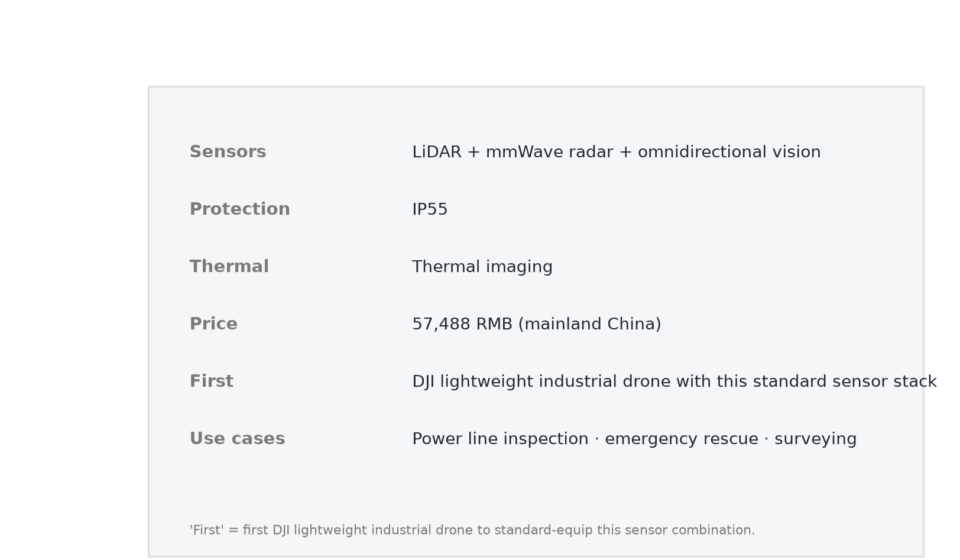
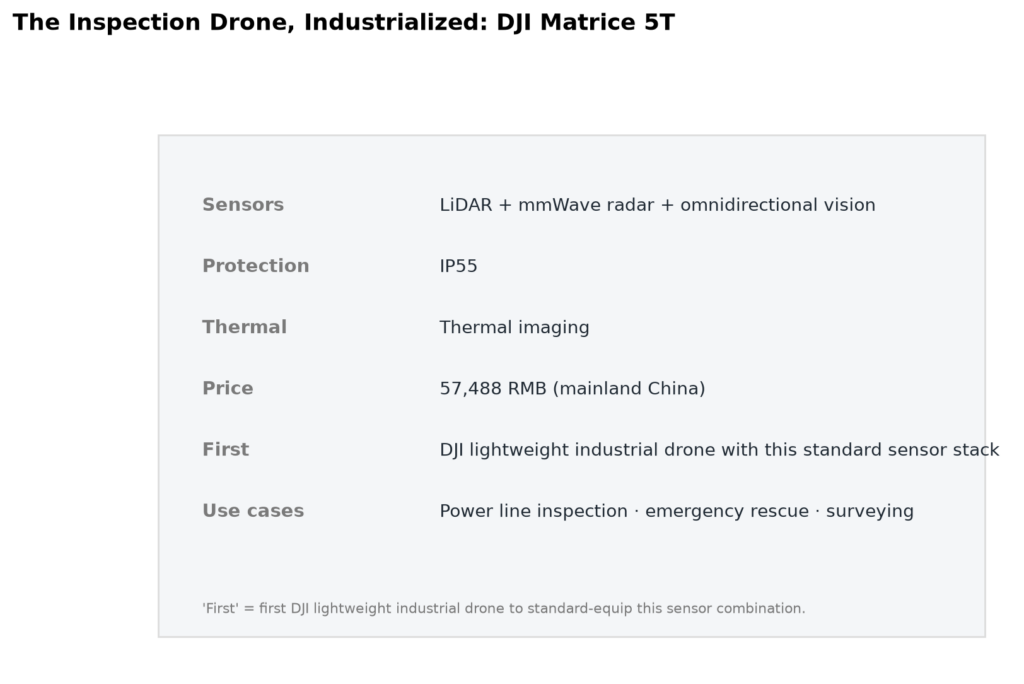
With LiDAR, millimeter-wave radar, and full-color omnidirectional vision sensing — a combination DJI has never standard-equipped on a lightweight industrial drone — it can detect thin power conductors and other small obstacles that cameras alone can’t reliably see.
This isn’t a flying camera. It’s a tool. And it marks the moment the low-altitude economy starts shifting from “drones that fly” to “drones that do a specific job better and safer than a person.”
The Hardware: A First for DJI
Let’s be precise about the “first,” because DJI’s marketing and the accurate claim differ slightly.
The Matrice 5T is the first DJI lightweight industrial drone to standard-equip a combined sensor stack: LiDAR, millimeter-wave radar, and full-color omnidirectional vision sensing. That’s a meaningful escalation. DJI has done LiDAR before, but not as a standard package on a lightweight industrial platform.
The machine also carries IP55 protection, thermal imaging, and inspection and surveying capabilities. It’s built for the field, not the showroom.
Why LiDAR Matters for Inspection
The headline sensor is LiDAR, and it’s worth explaining why.
LiDAR fires laser pulses and measures their return, building a precise 3D map of the environment. For power line inspection, that matters enormously: thin conductors are exactly the kind of object that camera vision struggles to see reliably, especially against a bright sky or in poor light. LiDAR can detect them.
Millimeter-wave radar adds all-weather sensing — fog, dust, low light. It’s the kind of redundancy that keeps a drone operating when conditions would ground a camera-only aircraft.
Together, the sensor stack enables automated, precise industrial inspection at scale. That’s the difference between a drone that takes pictures and a drone that does a job.
The Price and the Positioning
The mainland China price is 57,488 RMB. That’s the reported figure; actual pricing varies by configuration, region, and channel, so treat it as a reference point, not a universal price tag.
More important than the number is the positioning. This is not a consumer drone. It’s aimed at power line inspection, emergency rescue, and surveying — jobs where the value is measured in safety and efficiency, not in camera specs.
For a utility company, replacing a risky lineman inspection with an automated drone flight isn’t about saving money on hardware. It’s about reducing the chance that a person falls. That’s a fundamentally different value proposition.
The Tool-ification of the Low-Altitude Economy
DJI’s launch sits inside a broader shift in China’s low-altitude economy.
The policy direction is clear: safety first, cargo before passengers, isolated operations before integration (see our A7 coverage). That sequencing creates the runway for industrial drones like the Matrice 5T — tools that prove utility in specific, high-value jobs before the market moves to more ambitious applications.
The Matrice 5T is exactly the kind of product that phase rewards. It’s not trying to be a flying taxi. It’s trying to be the best possible inspection tool. And in a market where regulation is cautious and incremental, “proven tool” beats “flashy promise.”
What This Means for Industrial Operations
If you run infrastructure — power lines, pipelines, bridges, cell towers — the significance is practical.
Automated inspection with LiDAR and radar redundancy reduces the need to send people into dangerous situations. It also generates precise 3D data that’s useful for maintenance planning. The economics improve as the drone gets better, because the alternative — human inspection — is expensive and risky.
That’s why industrial drone adoption is accelerating even as consumer drone growth matures. The value is in the job, not the gadget.
The Caveats Worth Naming
Two things deserve caution.
First, “adapted for power line inspection” is not the same as “deployed at scale by utilities.” DJI has demonstrated capability; there’s no confirmed evidence yet of specific grid customers or scaled deployments. The product can do the job; whether it’s actually doing it widely is a separate question.
Second, the “first” claim needs precision. It’s DJI’s first lightweight industrial drone with this combined sensor stack as standard — not the first DJI drone to have LiDAR, and not necessarily an industry first. Framing matters.
What to Watch Next
Three signals will show whether this matters.
Watch for utility deployment announcements. If major grid operators adopt the Matrice 5T at scale, the tool-ification thesis is validated.
Watch the competitive response. Autel, Skydio, and Chinese industrial drone makers will respond with their own sensor-stacked platforms.
And watch the low-altitude economy policy rollout. If cargo and inspection applications expand as the “safety-first” framework suggests, industrial drones like this one are the first wave.
The Bottom Line
DJI’s Matrice 5T isn’t a consumer gadget. It’s a tool designed to replace humans in dangerous, precision inspection work — and it signals that the low-altitude economy has entered its “tool-ification” phase.
The value isn’t in how high it flies. It’s in the job it does better and safer than a person. And in a market where regulation rewards proven utility over flashy ambition, that’s exactly the kind of product that wins.