Microsoft Walks Away: The Neocloud Model Just Got Repriced
Microsoft didn’t cancel its AI ambitions this week. It canceled Nscale’s Texas expansion option — a deal that would have more than doubled an existing computing-capacity lease and could have been worth tens of billions of dollars.
It was the second pullback. Weeks earlier, Microsoft had walked away from a $3 billion deal to anchor Nscale’s flagship UK data center in Essex, after power connection delays pushed the expected supply date into the 2030s.
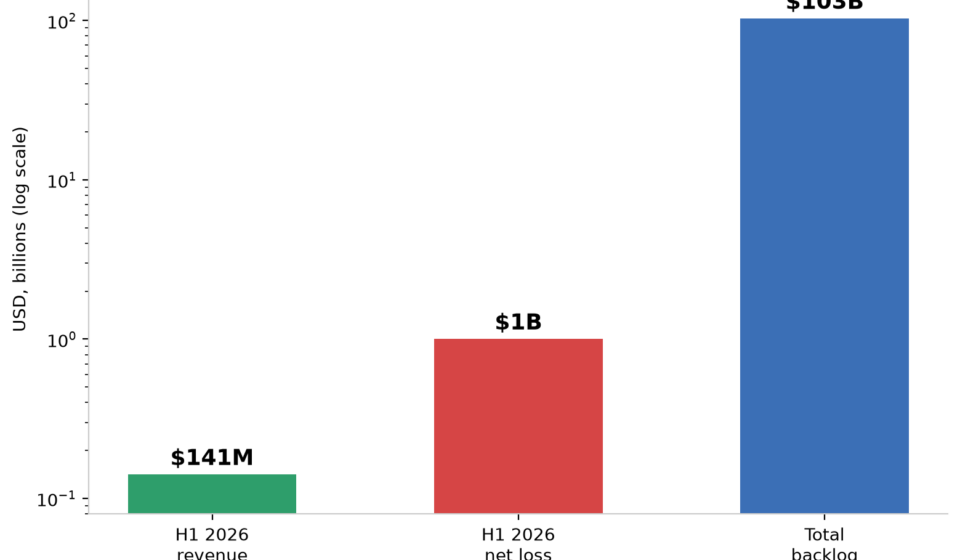
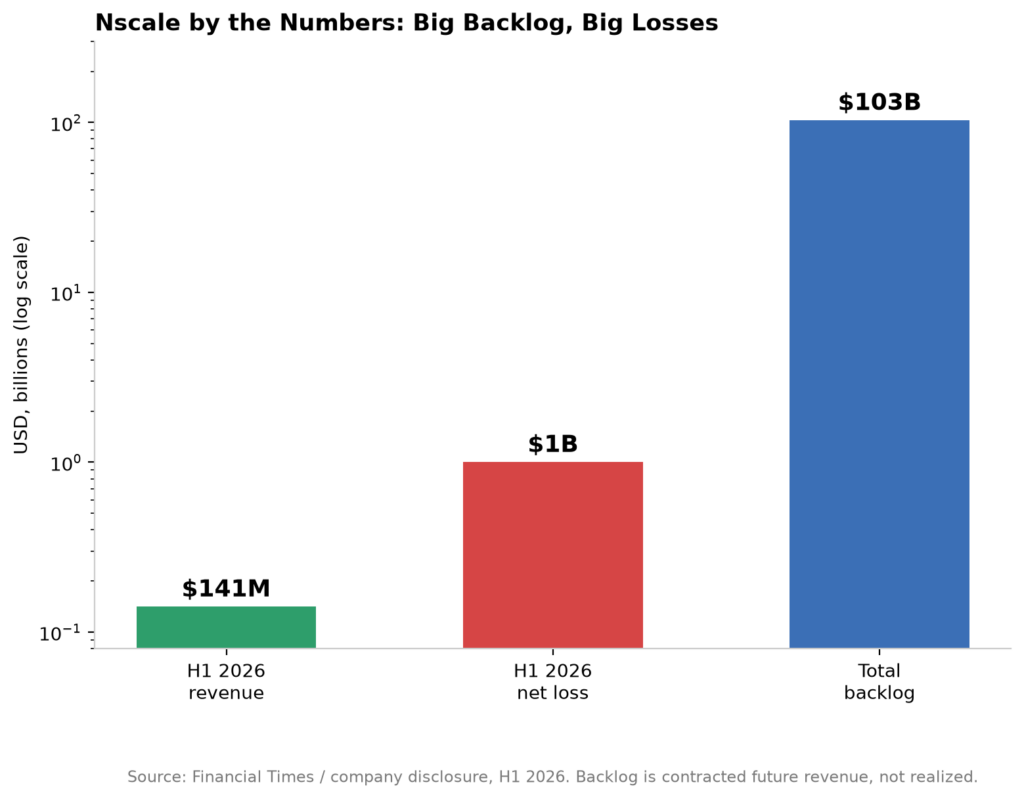
Nscale, a British AI infrastructure firm backed by Nvidia and preparing a roughly $35 billion IPO, posted a $1 billion net loss on just $141 million in revenue in the first half of 2026. Its $103 billion contracted backlog is, on paper, enormous. But a backlog is a promise. And promises are only worth what the counterparties think they are.
What happened on November 5 wasn’t a story about Microsoft abandoning AI. It was the moment the “neocloud” business model got repriced — in public.
What Microsoft Actually Walked Away From
The details matter here, because the headlines blurred two separate deals.
In Texas, Microsoft held an option to expand an existing lease of about 240 megawatts at Nscale’s Ward County development, roughly doubling its commitment with an additional ~500 megawatts. The potential value was in the tens of billions of dollars. Microsoft declined to exercise it.
In the UK, Microsoft withdrew as anchor tenant for Nscale’s Essex project — a £2 billion development — after grid connection delays meant power might not be available until the early-to-mid 2030s. That timeline was too late for Microsoft’s needs.
What remains intact: existing Microsoft contracts in Texas, Norway, and Portugal. Microsoft has stressed that its broader relationship with Nscale is unaffected. And Nscale says its $103 billion backlog doesn’t change.
So this isn’t a divorce. It’s a refusal to expand. But in the neocloud model, “refusing to expand” is exactly the thing that matters.
Nscale by the Numbers: The Debt-Fueled Growth Story
To understand why the market reacted, you have to understand Nscale’s economics.
In the first half of 2026, the company posted a $1 billion net loss on $141 million in revenue. That’s a company spending heavily to build capacity before it has the revenue to pay for it — the standard neocloud playbook, and the reason these firms lean so hard on long-term contracts from anchor customers.
Those contracts are what let neoclouds borrow. A hyperscaler’s signature on a multi-year lease is the collateral that turns an ambitious construction plan into a bankable project. Nscale’s $103 billion backlog is impressive precisely because it represents future revenue that lenders can underwrite against.
But when the anchor tenant declines to expand, the signal isn’t “the contract is gone.” The signal is “the next contract is less certain.” For a company burning a billion dollars a half to build, “less certain” is a very expensive word.
Why Microsoft Pulled Back
Microsoft hasn’t given a detailed public explanation, but the pattern is legible.
Nscale’s UK project ran into grid connection delays that pushed power availability into the 2030s. That’s a fundamental problem for any customer that needs computing capacity this decade. The Texas expansion, meanwhile, was an option — not a commitment — and Microsoft chose not to exercise it.
The broader read: Microsoft is getting more selective about where it rents capacity versus where it builds its own. It continues to invest massively in its own data center footprint. The Nscale pullbacks suggest a shift from “rent anything available” to “rent only what’s bankable, on a timeline that works.”
That’s not a retreat from AI. It’s a reallocation of control.
The Neocloud Problem: High Debt, Long Leases, Uncertain Demand
Step back, and the neocloud model’s fragility becomes clear.
CoreWeave, Nscale, Nebius, and their peers built businesses on a simple loop: borrow, build, pre-lease to hyperscalers, repeat. The model works as long as the hyperscalers keep signing and the power keeps flowing.
But both assumptions are now under pressure. On the demand side, hyperscalers are getting pickier — the midterm election results and the data center backlash (see our S1 coverage) have injected political risk into every new project. On the supply side, grid connection delays and permitting fights are stretching timelines. Goldman Sachs estimated that roughly 45% of planned US data center capacity additions could be affected by the political shift.
When the anchor customers get pickier and the infrastructure gets harder to build, the neocloud model’s risk premium rises. That’s what got repriced this week.
The IPO Math Just Changed
Nscale filed for a US IPO in September, targeting a valuation in the neighborhood of $35 billion — though reports suggest it may face investor pushback on that figure.
The Microsoft news complicates the pitch. An IPO story built on “hyperscalers will rent our capacity” is harder to tell when one of the biggest hyperscalers just declined to expand. The company still has its $103 billion backlog and is reportedly in talks with Anthropic over a deal worth up to $45 billion. But public-market investors will ask a sharper question than private ones: what happens if the backlog doesn’t convert to revenue on schedule?
That’s the question every neocloud faces now.
What Microsoft Is Actually Doing
It’s worth being precise about Microsoft’s strategy, because “Microsoft is cutting AI spending” would be wrong.
Microsoft remains one of the largest buyers of AI computing infrastructure in the world, and its partnership with OpenAI and its own data center buildout are enormous. What’s changing is the mix: more owned or directly controlled capacity, fewer speculative options on third-party sites with uncertain power timelines.
That’s a rational response to the new environment. If you’re Microsoft, why commit to an expansion option at a site with grid uncertainty when you can build where you control the power? The Nscale pullbacks aren’t a lack of appetite. They’re a preference for control.
What This Means for AI Infrastructure Investment
Three implications stand out.
First, neocloud equity and debt will be repriced for political, power, and counterparty risk. The days of “any hyperscaler contract equals bankable project” are over.
Second, companies with owned generation, dedicated transmission, and community buy-in gain relative advantage — the Google-in-Wyoming and Amazon-in-Texas playbook (see our S6 and A8 coverage). The neoclouds that survive will need to look more like their customers.
Third, the AI buildout continues, but with a sharper filter. The projects that get built will be the ones with firm offtake, reliable power, and political cover. The rest will wait.
What to Watch Next
Three signals will tell you how this plays out.
Watch Nscale’s IPO pricing. If public markets accept the $35 billion valuation despite the Microsoft news, the neocloud model survives. If they don’t, the whole cohort gets marked down.
Watch the Anthropic talks. Nscale’s potential $45 billion deal with Anthropic is now a critical proof point. If it closes, the backlog story holds. If it stalls, the pressure intensifies.
And watch CoreWeave and Nebius credit spreads. If the debt markets start pricing neocloud risk higher, the model’s funding engine slows — and a lot of planned capacity never gets built.
The Bottom Line
Microsoft’s decision to walk away from Nscale’s Texas expansion wasn’t a verdict on AI. It was a verdict on a financing model that depended on anchor tenants signing whatever was put in front of them.
For two years, the neocloud trade worked because the hyperscalers were insatiable. On November 5, one of them showed it could say no. That single word repriced an entire category — and reminded everyone that in the AI buildout, the counterparty on the other side of the contract is just as important as the chips inside the box.