The Day AI Infrastructure Got Repriced
On the morning of November 6, 2026, two headlines sat side by side on the financial wires, and together they told you everything you needed to know about where the AI trade now stands.
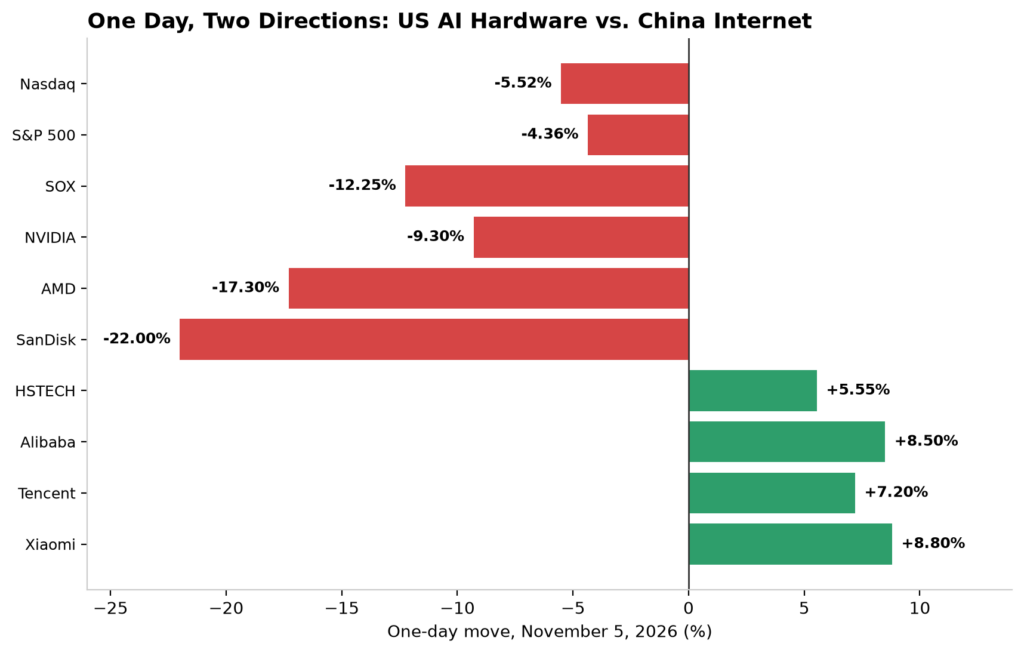
The first: the Nasdaq Composite had just fallen 5.52% — its worst single day since President Trump’s “Liberation Day” tariffs in April 2025. The Philadelphia Semiconductor Index cratered 12.25%, its steepest one-day drop since March 2020. Roughly $2.5 trillion in market value vanished from the tech-heavy index in a single session.
The second: Google announced a $17 billion data center in Wyoming.
Same day. Same panic. Opposite bets. And that contradiction is the real story — not the crash itself, but what the crash revealed about how AI infrastructure now gets built, who pays for it, and whether the people living next to it will let it happen at all.
Nobody Was Selling AI. They Were Selling Permission.
The temptation is to call this an election selloff. Democrats swept both chambers of Congress, and the market threw a tantrum. Case closed? Not quite.
Look at what actually fell. NVIDIA dropped 9.3% — about $447 billion in market value, enough to erase its entire 2026 gain. AMD fell 17.3%. Micron and Western Digital each dropped about 17%. SanDisk plunged 22%. Broadcom shed 10%. The VIX, Wall Street’s fear gauge, spiked 69.48% to 28.15.
Now look at what rose the same day, half a world away. Hong Kong’s Hang Seng Tech Index jumped 5.55% — its best day since the DeepSeek rally of February 2025. Alibaba climbed 8.5%. Tencent added 7.2%. Xiaomi gained nearly 9%.
If this were simply “AI is dead,” the Hong Kong reaction makes no sense. What fell wasn’t AI. It was a specific kind of AI bet — the hardware-and-datacenter trade, priced for endless expansion and frictionless permitting. What rose was the opposite: cheap, cash-generating internet platforms that don’t need to pour 30% of revenue into concrete and copper.
The market wasn’t rejecting artificial intelligence. It was repricing the social and political permission required to build it.
The Trigger Was Local, Not Abstract
Here’s the detail most coverage missed. On the same ballot as the midterm elections, voters faced 41 data-center-related measures across the country. According to Ballotpedia, all but one went against data centers.
That is not a partisan anomaly. That is a verdict.
In Texas — the spiritual home of the unregulated data center — voters elected Democrat Gina Hinojosa as governor. She campaigned on a promise to halt new data center approvals until residents are protected by law. “Texans are furious about data centers,” she said, “and all of this is to produce AI with no rules, no laws, no regulations to protect them.”
Goldman Sachs analysts estimated that roughly 45% of planned US data center capacity additions could be affected by the political shift.
And here’s the thing: this was never really about “AI safety” in the abstract. It was about electricity bills. Water. Noise. The feeling that a hyperscale facility was being dropped into a community that got the strain and none of the benefit. When your neighbor’s power bill spikes because a data center moved in, you don’t care about benchmark scores.
The Real Fear: A Twenty-Year Asset With a Four-Year Permission Slip
Data centers are among the longest-lived assets in modern industry. A single campus can take three to five years to build and operate for twenty. But the political permission to build them runs on a much shorter clock — an election cycle, a city council vote, a rate case.
That mismatch is the fault line. When the Nasdaq fell 5.52%, it wasn’t pricing in a recession. It was pricing in the possibility that some of the most expensive infrastructure projects in corporate history might get stuck at the starting line.
Meta’s president, Dina Powell McCormick, said the quiet part out loud at a Wall Street Journal tech conference: “Building new data centers in the United States is going to be very difficult going forward.” Expanding existing ones, she suggested, would be easier. Translation: the easy era is over.
Meanwhile, the Companies With a Power Plan Kept Building
While the market sold, the biggest players doubled down — but selectively.
Google committed $17 billion to its first Wyoming data center, in Laramie County, powered largely by a 702-megawatt natural gas fuel cell installation with carbon capture, air-cooled to use no water, and backed by a promise to pay 100% of its power and grid-upgrade costs. It was announced two days after voters rejected data centers in 40 of 41 local measures. Google looked at that result and said: we’ll build it anyway — but we’ll bring our own power, our own carbon solution, and our own community council.
Amazon, separately, disclosed “Project Spectrum” — a roughly $5 billion campus near Glen Rose, Texas, drawing up to 1,200 megawatts of carbon-free nuclear power from the Comanche Peak plant next door under a 20-year agreement.
And Apple? It raised $7.5 billion in the bond market the same week, drawing $31 billion in orders — more than four times oversubscribed — at a spread tighter than Microsoft’s. Why? Because Apple isn’t spending its balance sheet on AI infrastructure. In a week when the market was punishing AI capex, Apple’s decision not to build became a selling point.
Notice the pattern? The companies that thrived — or at least held their ground — were the ones that didn’t need permission from a local zoning board to make their numbers. They either brought their own power, or they didn’t spend on data centers at all.
The Neoclouds Got Repriced
The clearest casualty of the week wasn’t a stock. It was a business model.
For two years, a cohort of “neocloud” companies — CoreWeave, Nscale, Nebius — ran a simple playbook: borrow heavily, build data centers, pre-lease capacity to hyperscalers, repeat. The model worked as long as the hyperscalers kept signing.
Then Microsoft blinked. It declined an option to more than double its Texas computing lease with Nscale — a deal potentially worth tens of billions — weeks after walking away from a $3 billion UK lease because grid connections wouldn’t be ready until the 2030s. Nscale, which posted a $1 billion net loss on $141 million in revenue in the first half of 2026, is now trying to raise money in public markets at a valuation well below its earlier hopes.
When your anchor tenant starts saying no, the entire debt-fueled edifice starts to wobble. That’s what got repriced on November 5 — not “AI” itself, but the assumption that demand for computing would arrive on schedule and on budget, forever.
And Then There’s China: The Rotation Nobody Saw Coming
The most counterintuitive number of the week: on a day when US AI hardware lost hundreds of billions, China’s internet stocks had their best session in nine months.
This wasn’t a coincidence, and it wasn’t a fundamental re-rating of the Chinese economy. Bloomberg Intelligence’s Marvin Chen described three rotations happening at once: money moving out of Korea and Taiwan into China; money moving from growth into value; and money moving away from pure AI hardware plays into more diversified businesses.
The setup was almost too perfect. Hong Kong short-selling had reached 32% of turnover earlier in the week — the highest in over three years. The Hang Seng Tech traded at 13 times forward earnings, its cheapest since 2024. One strategist called the resulting squeeze “one of the biggest in recent years.”
So yes, some of it was mechanical. But the deeper signal — that global capital is now hedging its AI exposure by owning the boring, cash-rich platforms instead of the capital-hungry hardware — is real. And it’s not going away just because the dip got bought.
So What Actually Changed?
Let’s be precise, because the sloppy version of this story — “AI is over” — is wrong.
What changed is this: AI infrastructure now carries a political risk premium. For three years, the market priced data centers on chips, power, and land. Starting November 5, it started pricing in something harder: whether a community will let you build, whether a grid will connect you, and whether a governor will sign off.
Three consequences follow.
First, vertical integration becomes a moat. If you own your generation, your transmission, and your carbon solution — the way Google does in Wyoming and Amazon does in Texas — you can build when others can’t. If you’re renting everything, you’re exposed to every vote.
Second, capital discipline is being rewarded. Apple didn’t need to explain its AI spending this quarter because it barely has any. Meta, which is pouring tens of billions into infrastructure, paid 1.6 percentage points over Treasuries to borrow. The bond market is now a referendum on your AI strategy.
Third, and most important: the AI buildout isn’t stopping. It’s being re-underwritten. The projects that survive will be the ones that clear a higher bar — political, environmental, and financial.
What to Watch Next
Three signals will tell you whether this was a one-week panic or a genuine regime change.
Watch the data center ballot pipeline. If local opposition keeps winning, expect hyperscalers to shift even harder toward owned generation and “behind-the-meter” power deals — the Google/Amazon playbook.
Watch the neocloud credit spreads. If CoreWeave and Nscale can’t refinance at reasonable rates, the model contracts, and a lot of planned capacity never gets built.
And watch China. If the rotation into Chinese internet stocks holds for more than a few weeks, it means global investors have decided that “AI exposure” doesn’t have to mean “AI hardware exposure.” That would be the biggest repricing of all.
The Bottom Line
On November 5, 2026, Wall Street learned a lesson it had been avoiding for three years: you can’t build the future of computing without asking permission from the present. The $2.5 trillion that vanished wasn’t a verdict on artificial intelligence. It was a verdict on the assumption that AI infrastructure could grow forever without ever having to answer a question from a voter, a ratepayer, or a zoning board.
The companies that understood this — Google with its fuel cells, Amazon with its nuclear reactor, Apple with its restraint — didn’t panic. They adapted.
Everyone else just found out what that adaptation costs.