Your DTC Playbook Is a Liability in China
Every China entry plan I have seen opens with the same five slides. Keep the website. Scale paid social. Build the email list. Convert to subscription. Ship the global persona with a translated homepage.
Then the plan meets the market, and eighteen months later somebody in the boardroom says China is hard.
China is not hard. It is simply not built the way the plan assumes. Each of those five moves is a rational response to how commerce works in the United States or Europe. In China, each one is wrong in a different way, and the errors compound. The website gets no traffic, so the ads look expensive. The ads convert badly, so the email capture looks pointless. The list never grows, so retention has to be bought with discounts. The discounts teach the customer to wait for the next sale. By year two the brand is running a promotion machine with a Western cost structure and calling it a market problem.
The market is not the problem
Start with the demand side, because it is the part nobody can blame. China ended 2025 with 1.125 billion internet users and 80.1% penetration. Online retail reached RMB 15.97 trillion, up 8.6%, and physical goods bought online accounted for 26.1% of total retail sales. Live commerce alone moved more than RMB 5 trillion.
The market did tighten. Total retail sales of consumer goods grew just 1.3% in the first half of 2026. Service retail grew 5.3%. Spending is shifting from things to experiences, and a slower goods market is unforgiving: when the tide stops rising, every structural mistake shows up on the P&L.
Mistake
Mistake 1:“Our website is our storefront”
In the West, the DTC model is a website with a point of view. It is the shop, the data warehouse, the loyalty program and the brand voice in one place. Traffic is the whole game.
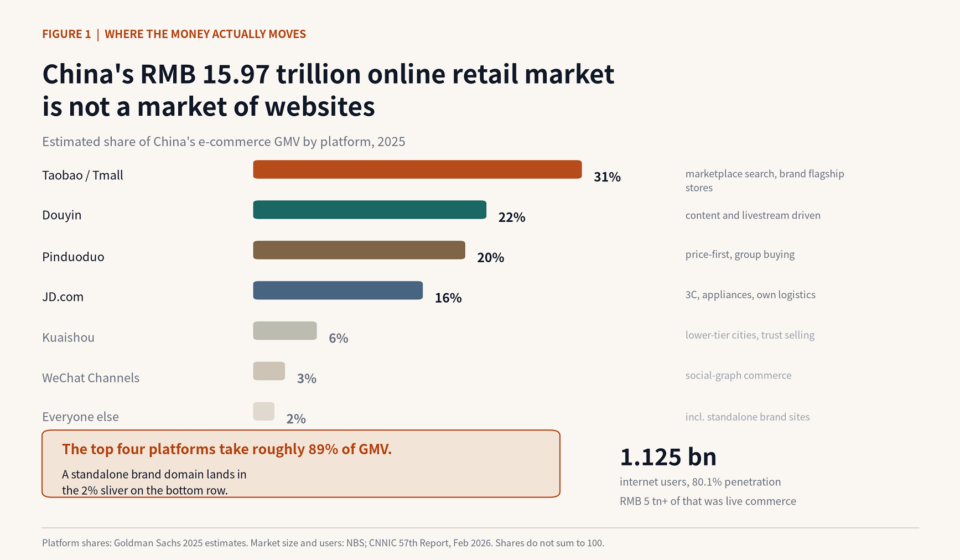
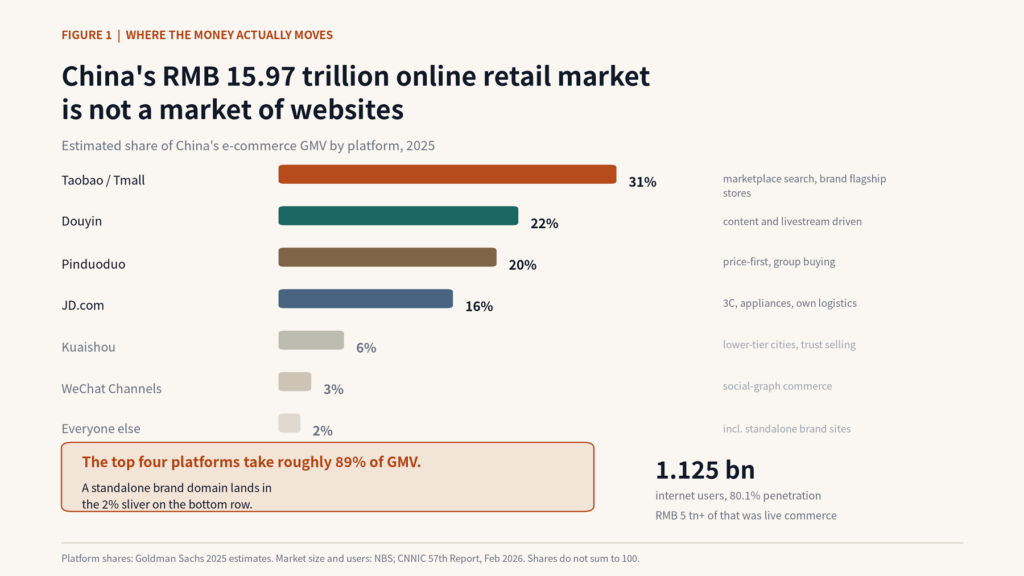
In China, the website is a brochure nobody opens. Commerce happens on four platforms that take close to 90% of GMV. Goldman Sachs estimates put 2025 shares at about 31% for Taobao and Tmall, 22% for Douyin, 20% for Pinduoduo and 16% for JD.com, with Kuaishou, WeChat Channels and a long tail behind them. There is no meaningful shelf space for a standalone brand domain.
Ask where a Chinese shopper would even find you. Not in a search engine, because she is inside an app. Not through a URL from a podcast, because she is inside an app. Not through an email link, for reasons covered below. The storefront has to exist where the buying already happens: a Tmall flagship for credibility and in-platform search, and a WeChat mini-program for the relationship you actually own.
The flagship store is a media asset, not a shop
That distinction matters when you budget. A Tmall flagship is part shop, part search placement, part trust signal and part promotions engine. Brands that treat it as a passive catalog underfund the function it performs best: being findable at the moment of intent. In practice that means a meaningful share of revenue goes back into platform advertising and content, and the first-year budget is closer to the cost of running a media business than the cost of running a website.
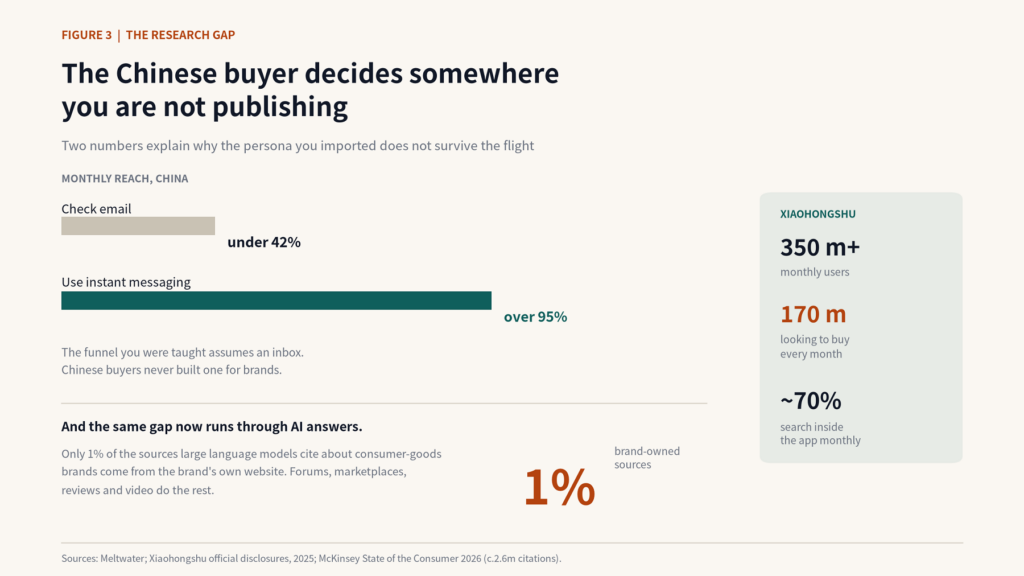
Then there is the part that stings for anyone who spent a decade on their own domain. Generative AI has made the brand website even less central. McKinsey analyzed roughly 2.6 million citations across 25 consumer-goods brands and found that large language models draw only about 1% of their brand-related sources from the brand’s own website. Forums, marketplaces, review pages, video and media do the rest. If your China plan still hinges on driving traffic to your own domain, you are optimizing the least influential asset you own.
Mistake 2: “Social ads drive our growth”
The Western growth engine assumes two things: an ad duopoly, and a pixel that can follow a person from impression to checkout.
Neither survives the flight. Meta and Google are not part of the journey. The inventory sits inside Douyin, Xiaohongshu, WeChat and Baidu, and each runs on its own logic: an interest graph, an intent graph, a social graph, a keyword index. Creative built for one does not port to the next.
There is no pixel that sees the whole journey
A Chinese purchase path can run through a short video, an in-app search, a group-chat recommendation, a livestream and a marketplace listing, in any order, across two devices. No single tag sees that. Platforms keep their data. So the Western analyst opens the dashboard, finds no clean line from click to purchase, and concludes the channel does not work.
The channel works. The measurement model does not exist. The discipline has to change accordingly: geo holdouts, platform lift studies, matched-market tests, and a tolerance for ranges instead of decimals. A brand that insists on last-click attribution in China is not being rigorous. It is being nostalgic.
Platform-native creative is not repurposed creative
A Douyin ad is not a Meta ad with Chinese subtitles. It needs a hook inside the first second and a half, a human face, a price reveal and an obvious reason to comment. Xiaohongshu rewards visual honesty and punishes polish that reads as advertising. That creative tax is real, and it is usually the first line item cut when the quarter misses.
Mistake 3: “We’ll build an email list”
Fewer than 42% of Chinese internet users aged 16 and over check email in a given month, according to Meltwater audience data. More than 95% use instant messaging. Email is not a weak channel in China; it is barely a channel. Your welcome flow is shouting into a room nobody enters.
Private domain is not an email list
The replacement is WeChat: 1.42 billion monthly users, more than four million mini-programs, and an entire operating discipline the industry calls private domain. It means the brand owns a direct, repeatable way of reaching people through Official Account followers, WeCom one-to-one contacts, group chats and mini-program order data.
Three operational notes that foreign teams tend to learn the hard way.
An Official Account is not a newsletter. A service account gets four pushes a month. That is a magazine cadence, not a drip sequence. The real rhythm comes from template messages, WeCom conversations and groups.
The audience is not portable. You cannot export a WeChat follower base. If the account is restricted, the audience is gone by lunchtime and there is no CSV to restore it from. So capture the phone number, keep order history in a system you control, and run sales through WeCom so the relationship belongs to the company rather than to a rep who might resign.
Groups are rooms, not billboards. Broadcast into a 500-person group and you are muted within a week. Answer questions in it and you get repurchase rates that email never produced.
Mistake 4: “Subscription is our retention model”
Subscription works in the West because a card on file removes friction. In China, the friction is the value proposition. The market is organized around 618, Double 11, trade-in subsidies and price comparison; auto-renewal reads as a way to lose money quietly.
What does work is the paid membership: one annual fee, a bundle of privileges. Alibaba’s 88VIP passed 59 million members in the December 2025 quarter and is still growing at a double-digit rate. JD’s Plus program is smaller still, and the company does not publish a current figure. That is a premium tier in a market of 1.1 billion internet users, not a mass retention mechanic.
So build retention in layers. A paid tier that bundles services people actually use, because a membership people forget they bought gets canceled, and one they use every week does not. A community layer where the brand shows up as a participant rather than a broadcaster. A service layer where the post-purchase experience does the marketing, which in a market this competitive is the only durable differentiator left.
Mistake 5: “We know our customer”
This is the expensive one, because it is invisible on a dashboard. The persona supposedly transfers: twenty-eight, urban, professional, values quality, shops on mobile. Same person, different city.
She is not the same person. She reads ingredient lists. She checks the reviews before the product page. She compares across three apps while standing in your store. She is less moved by your heritage and more moved by whether the thing works and whether people like her say it does.
170 million people are researching a purchase every month
Xiaohongshu has more than 350 million monthly users. According to the platform, roughly 170 million of them are actively looking to buy something in any given month, and around 70% search inside the app every month. That is where the decision gets made, inside peer content you do not control and cannot simply buy.
McKinsey’s 2026 consumer research adds a second twist. More than three-quarters of shoppers are trading down in some form, while spending shifts toward experiences and toward things that can be verified. Price sensitivity is up. Blind brand loyalty is down. Localizing a global persona by swapping the city name does not survive contact with either trend.
Start from zero. Commission category research in Chinese, on Chinese platforms, with domestic competitors in the frame. Build the persona from observation, not translation.
The fix: a China-native stack
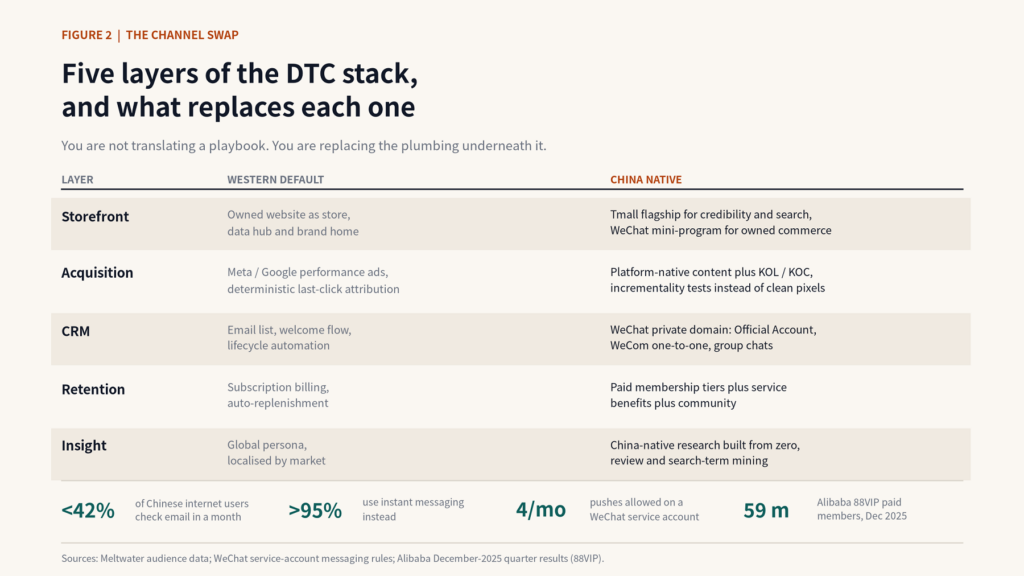
Here is the argument on one page. These are not localized versions of five Western layers. They are five different layers.
Storefront: a Tmall flagship for credibility and search, a WeChat mini-program for owned commerce. The website becomes a credibility asset and a global brand reference, not a sales channel.
Acquisition: platform-native content plus a KOL and KOC layer, with paid amplification behind the content that already performs. Budget for creative volume, not for one hero film.
CRM: WeChat private domain run through WeCom, with consent and data-localization compliance designed in from day one rather than patched in after the first audit.
Retention: paid membership tiers, service benefits and community. Recurring billing only where the category genuinely suits it.
Insight: continuous China-native research, with review mining and search-term analysis as standing inputs rather than an annual study nobody reads.
The uncomfortable part: this is an ownership question
If the fix is that structural, the reporting line has to change. Which is precisely what the last few years of deals have been about.
Gap sold its Greater China business to Baozun for about USD 40 million, in a transaction agreed in 2022 and completed in 2023, handing over design, production, stores and e-commerce for 20 years. It took years, and a rebuilt product mix, before the brand stopped leaning on discounting to move stock.
In April 2026, Starbucks completed a joint venture giving Boyu Capital a 60% stake in its China retail business, with Starbucks keeping 40% and retaining the brand. Nearly 8,000 stores, and the company that invented the third place decided it needed a local owner to run them.
Read those two deals as one sentence: if the playbook does not transfer, the control has to. You can hire your way to capability. You cannot A/B test your way out of the wrong operating model.
Where to start if you are not on the ground yet
Cross-border is the sane first move, and the data says it is still growing: retail sales on major cross-border import platforms rose 5.6% in 2025. A Tmall Global store lets you test assortment, pricing and content with a lighter legal footprint, real consumers and real reviews, before you commit to a domestic flagship and a local operating company.
Use that phase for what it is good at. Find out which three products actually sell. Find out which claims survive a Chinese review section. Find out whether your price architecture holds once a competitor’s livestream undercuts it by 30%. None of that requires a warehouse. All of it requires attention.
A 90-day diagnostic before you spend anything
Four questions you can answer with data you already have or can buy.
One. If we removed our website from the plan, what actually breaks? If the answer is attribution, that is not a storefront. That is a spreadsheet.
Two. Can we name the three searches a Chinese buyer types before she knows our brand? If not, you do not have an acquisition plan. You have a media plan.
Three. Where does first-party data live after someone buys? If it lives in a platform dashboard, you have rented your customers.
Four. Who in the building has the authority to change the product for China? If the answer is a regional brand manager working from a global template, the localization will be cosmetic, and the P&L will show it inside four quarters.
Bottom line
Western DTC brands do not fail in China because they are bad at marketing. They fail because they are excellent at a game that is not being played here. The website, the ad account, the email list, the subscription and the persona are all artifacts of one market’s plumbing. China built different plumbing, and it will not reroute it for your funnel.
The brands that win do not localize harder. They rebuild the stack, hand the keys to people who live in the market, and stop measuring China with a Western ruler.