From Traffic to Asset: Why Chinese Brands Build Flywheels, Not Campaigns
The most expensive number in Chinese marketing isn’t a media rate. It’s the price of meeting one stranger for the first time.
iResearch put that price above ¥1,000 in its Q1 2026 e-commerce traffic report. Not the cost of selling something — the cost of walking one new customer through the door, before product, before delivery, before the discount.
Now the other number in that report: what mature operators pay to speak to someone they already have. Thirty to sixty yuan.
Eighteen times cheaper. Same person. Same message. Different relationship.
That gap is the story. Not “China does social better.” Not “Western brands don’t get WeChat.” Something duller and more consequential: a lot of Chinese brands stopped treating marketing as a purchase and started treating it as the acquisition of assets. Traffic is rented. Assets are owned. Almost everything else here follows from that one sentence.
Rented Is Exactly the Right Word
When you buy media, you buy a visit. The visit ends. The platform keeps the user record, the behavioral trail, and the right to charge you again tomorrow — at whatever the auction clears.
So the budget never builds anything. It rents. Stop paying and the audience evaporates overnight. Everyone in the room knows this, and almost everyone budgets as if they don’t: the media plan gets approved every year, the asset plan never gets written.
Why the Treadmill Sped Up
Three things happened at once. None of this is cyclical.
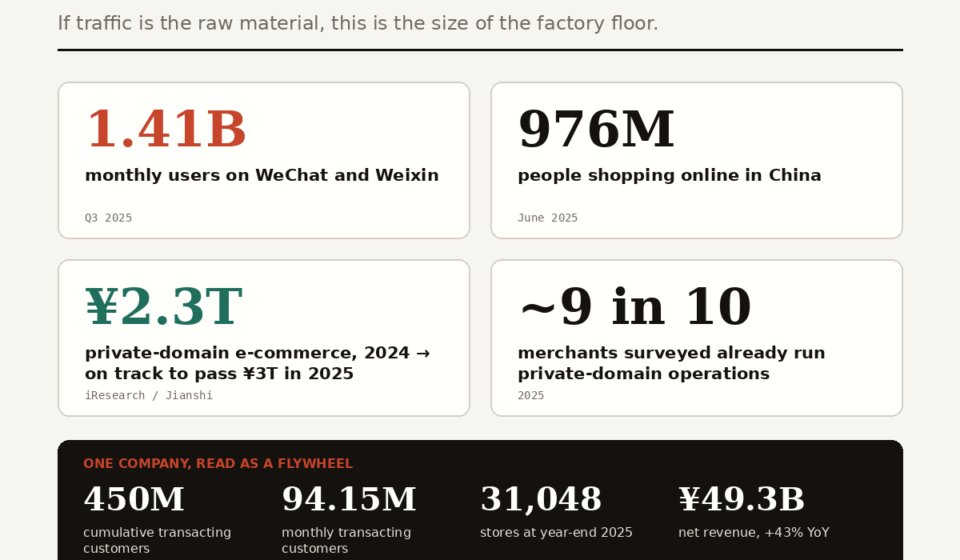
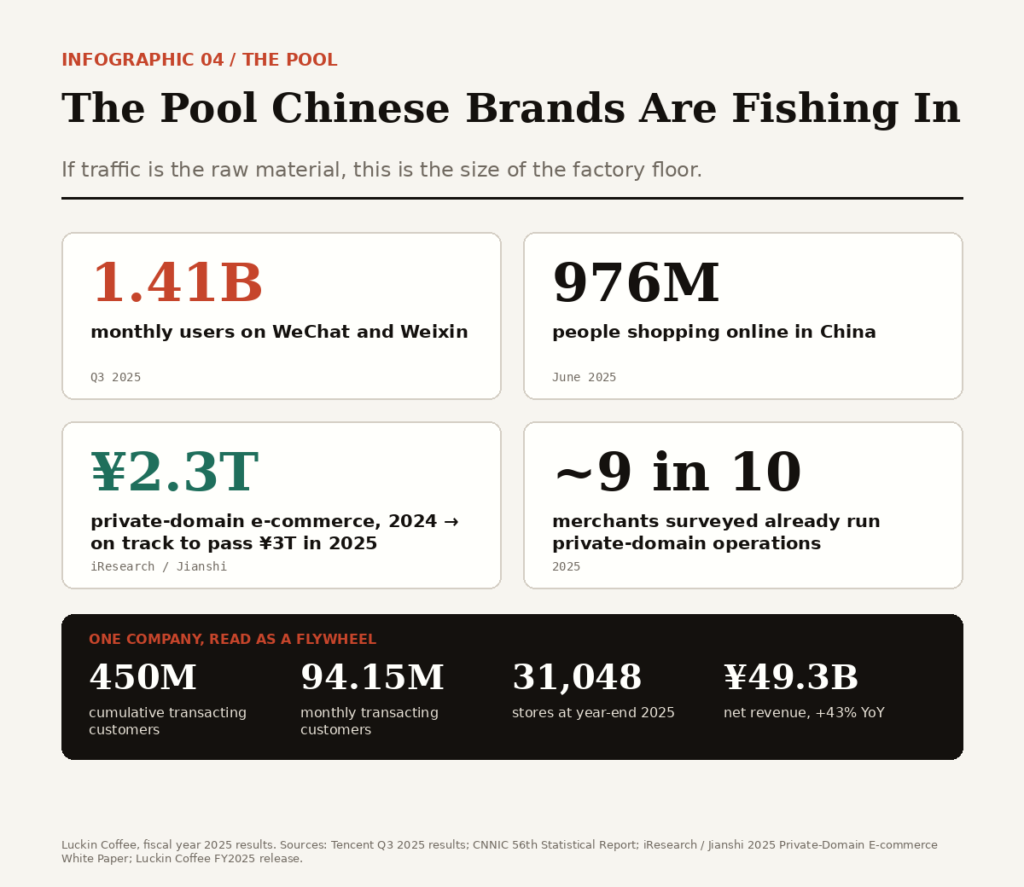
The audience stopped growing. CNNIC counted 1.123 billion internet users in China by June 2025 — 79.7% penetration, with 976 million of them shopping online. There is no untapped pool left. Growth now has to be taken from somebody else.
The auction got thinner at the top. Generative answers increasingly swallow informational queries before an ad slot is even rendered. iResearch’s Q1 2026 data has cost per thousand impressions on short video and search up 122% against the same quarter of 2024. You’re bidding for a smaller, dearer slice of attention.
The buyer got better at ignoring you. Which is how average enterprise acquisition cost reached roughly ¥486 per customer in 2026 — up 23.5% year on year and about 60% across five years, per iResearch’s 2026 digital marketing trends study. QuestMobile’s tracking tells the same story from another angle: roughly ¥380 in 2023, roughly ¥620 by the first quarter of 2026.
Hold both numbers together, because they measure different things. The ¥486 is a cross-industry average across every channel and category. The ¥1,000 at the top of this piece is what an online merchant pays for a genuinely new customer. The closer you stand to the auction, the worse the arithmetic gets.
Turn One: Buy Attention on Purpose
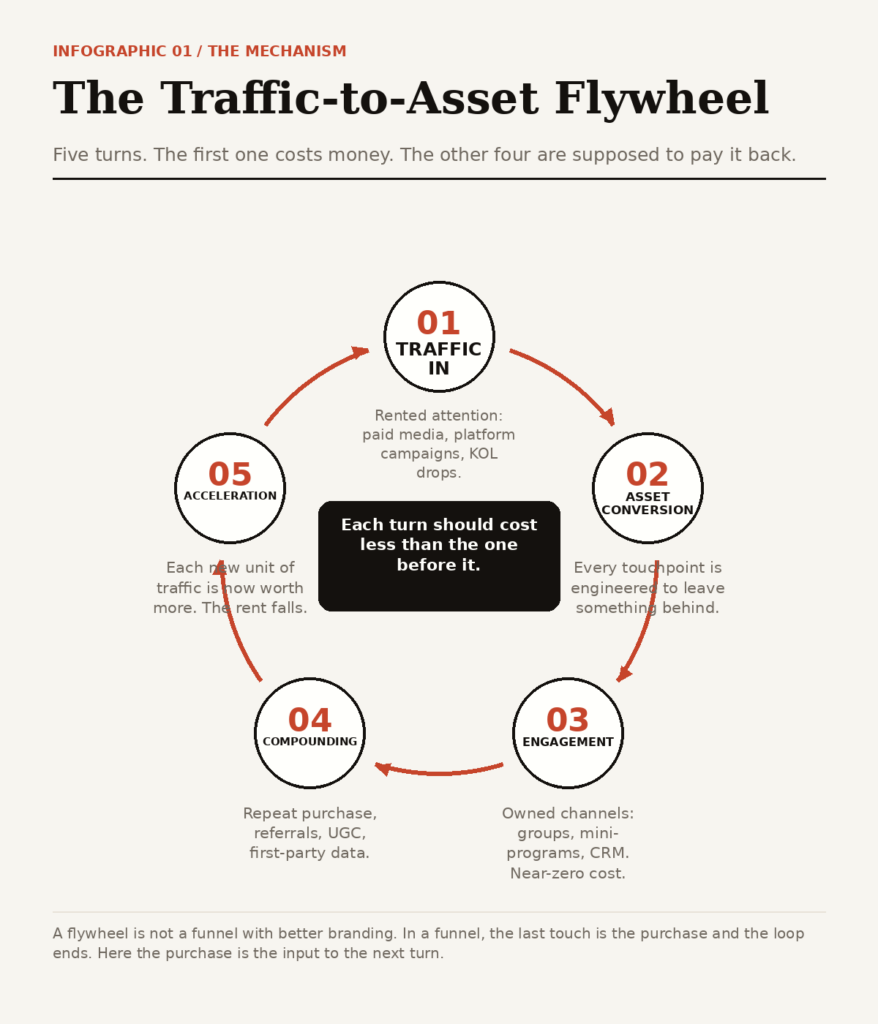
Every flywheel starts with a purchase, and pretending otherwise is how consultants lose clients. You still buy traffic. The difference is that a flywheel operator buys it with a destination in mind.
Before the brief, three questions: Where does this person land? What do we ask them to give us? What do we do with them in the next seventy-two hours?
Paid media isn’t the enemy. Undirected paid media is. A yuan spent pulling someone into a store, a group, a membership tier or a trial can still be working in eighteen months. A yuan spent on an impression that ends at an impression is gone by Friday.
Turn Two: The Conversion Nobody Budgets For
Here’s where most budgets leak, and it’s almost never the media buyer’s fault. Nobody owns the handoff.
The ad converts. The landing page converts. Then the customer sits in a list nobody messages — a customer you acquired from a platform that will charge you again to reach them. iResearch’s 2025 white paper on private-domain commerce found that nearly nine in ten merchants surveyed had started private-domain operations, and a large share were still running it as a coupon group rather than an asset.
Conversion isn’t the sale. Conversion is the moment a stranger leaves something behind that you can reach without paying: a group membership, an app account, a service record, a phone number with consent attached.
That’s a design problem, not a media problem. It belongs in the product brief, not the channel plan.
Turn Three: Reach That Costs Almost Nothing
WeChat is the reason this works at industrial scale in China. Combined monthly users hit 1.414 billion in the third quarter of 2025, per Tencent’s results. A brand that moves someone into a WeCom group — Tencent’s enterprise messaging app — or a mini-program membership can message them again at the marginal cost of a server.
Compare the arithmetic. In the public domain, every contact is a fresh invoice. In the private domain, the first contact is the invoice and the next hundred are overhead.
That’s the whole mechanism behind the eighteenfold gap. Private channels aren’t magic. One of them charges per hello and the other one doesn’t.
Turn Four: Where the Math Gets Weird
Assets compound, and compounding looks like nothing for a while and then looks like everything.
iResearch’s Q1 2026 survey data: paid-only stores repurchase below 11%, while merchants running private-domain groups, membership and community channels hold above 42%. Lifetime value for those customers runs more than three times that of a public-domain new customer.
A sanity check before you get excited. A 42% repurchase rate is not a law of nature; it is partly selection — the customers who join a group were already the ones likely to come back. The honest version of the claim is narrower and still large: managing the relationship adds revenue that a paid-only structure cannot book at all.
Turn Five: Acceleration
Now the part that makes finance people sit up.
Once assets exist, each new yuan of traffic is worth more than the last, because it lands on a base that can hold it. Same creative, same bid, higher yield. Marginal acquisition cost falls while volume rises — the opposite of the funnel, where every incremental customer costs more than the one before.
That is the definition of a flywheel, and it is why “we’ll get to retention later” is the most expensive sentence in a media plan.
The Asset Ledger
Chinese operators talk about assets with unusual specificity: 私域 (private domain), 会员 (membership), 内容资产 (content assets), 用户资产 (user assets). It sounds like jargon until you notice they are describing things you could, in principle, audit.
Six of them recur. Private-domain reach. First-party data. User-generated content. A KOC network — key opinion consumers, meaning ordinary customers and micro-creators who post on cue. Community identity. Brand IP.
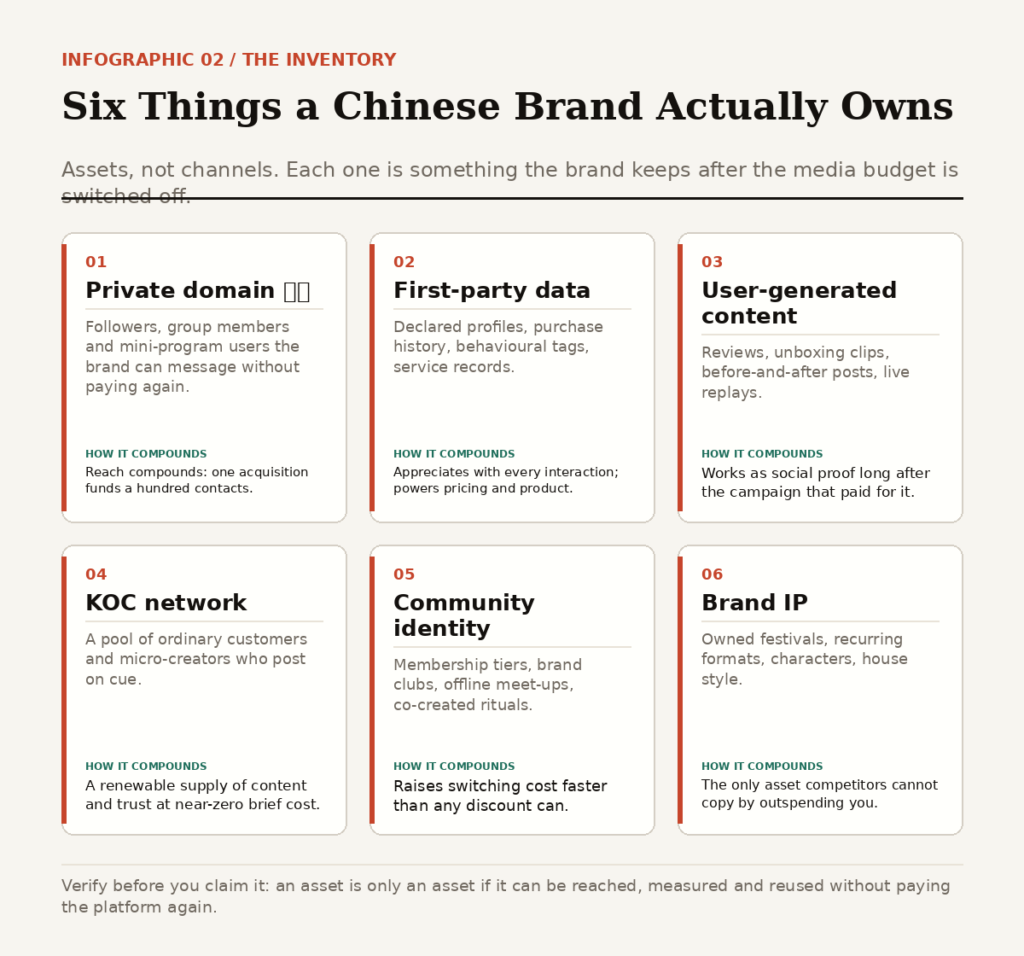
Private Domain Is a Balance-Sheet Item Nobody Books
Ask a CFO what the customer list is worth and you’ll get a shrug, because accounting has no line for it. Chinese operators built one anyway, in management reporting if not in GAAP.
Private-domain e-commerce in China moved ¥2.3 trillion in 2024 and was on track to pass ¥3 trillion in 2025, according to iResearch and Jianshi’s industry white paper. That is not a channel experiment. It is a parallel retail system with its own logistics, its own loyalty mechanics, its own vocabulary.
The strategic point isn’t the size. It’s the ownership. A follower inside your group is an asset you can value, defend and sell against. A follower inside someone else’s feed is a rental with a renewal date.
First-Party Data: The Asset That Appreciates
Everything else on the ledger decays. Data doesn’t. Every order, service ticket and group interaction makes the next decision cheaper.
Which is exactly why it is regulated. China’s Personal Information Protection Law, in force since November 2021, requires genuine consent and — under Article 24 — gives people a non-personalized option or an easy way to refuse automated marketing, along with a prohibition on unreasonable differential pricing.
For marketers, the translation is simple. The asset is real, and it comes with a maintenance contract. Consent hygiene isn’t compliance theater; it is what keeps the asset from being written off in a single enforcement action.
UGC and KOC: The Renewable Engine
Here is a cost line most Western plans don’t have: content supply.
Miaozhen Systems’ 2026 trends report found KOC and KOS deployment — key opinion consumers and staff-run key opinion sales accounts — up 16 percentage points year on year, with mid-tier and smaller creators producing roughly 64% of content volume. Brands stopped buying a few big voices and started cultivating a thousand small ones, because a thousand small ones keep posting after the invoice clears.
UGC compounds twice. It converts strangers, and it feeds the algorithm that finds more strangers. That is why it belongs on the asset ledger rather than the campaign P&L.
Two Cost Curves That Bend Opposite Ways
Put the two models on the same axis and the argument ends.
In the funnel, each customer is bought, consumed and replaced. Cost per customer rises as you exhaust the cheap inventory of attention.
In the flywheel, each customer is bought once, re-engaged at trivial cost, and occasionally recruits the next one. Blended cost per customer falls as the base grows.
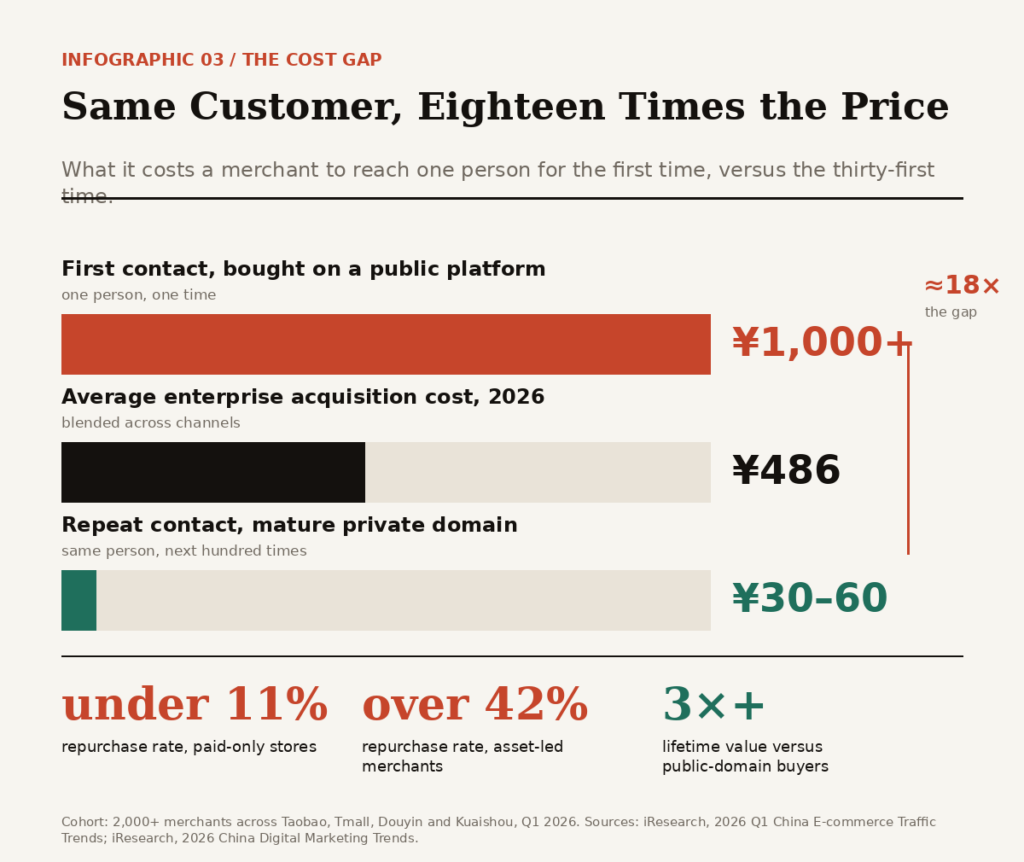
Same market, same product, same ad auction. Different structure. One of these businesses gets cheaper to run every quarter. The other gets more expensive and calls it “rising CAC.”
Luckin, Read as a Balance Sheet
Take the coffee chain everyone thinks they understand.
Luckin closed 2025 with ¥49.29 billion in net revenue, up 43%, and 31,048 stores after adding 8,708 in twelve months. Cumulative transacting customers passed 450 million, more than 110 million of whom arrived during the year. Monthly transacting customers averaged 94.15 million, and from June to October the company cleared 100 million a month, five months running. It served 4.1 billion cups.
Now the part that matters. Self-operated same-store sales went from −16.7% in 2024 to +7.5% in 2025. That swing happened while the company was opening roughly a store an hour — the opposite of what store density is supposed to do to cannibalization.
The mechanism is unglamorous: an app-first ordering habit, geofenced groups, a paid membership card, and a new-product cadence fast enough to give people a reason to open the app. Every cup is also a data point, and every data point sharpens the next coupon.
The caveat is real. Fourth-quarter net profit fell 39% to ¥518 million as delivery subsidies normalized and delivery expense nearly doubled to ¥1.63 billion. A flywheel doesn’t make you immune to a price war. It means you fight one with an owned base instead of renting one.
Why the West Struggles to Copy It
This isn’t ignorance. Nike ran the experiment.
Nike pulled off Amazon in 2019, then spent the next three years cutting wholesale and pushing everyone toward its own app and stores. The logic was textbook asset-building: own the customer, keep the margin, keep the data.
Then execution met reality. FY2025 revenue fell to $46.3 billion from $51.4 billion. Nike Direct slid to $18.8 billion from $21.5 billion. Gross margin dropped to 42.7% from 44.6%, and ROIC fell from 34.9% to 20.2%. In the second quarter of FY2026, wholesale grew 8% to $7.5 billion while Direct fell 8% to $4.6 billion. By the third quarter, Direct was down 4%, digital down 9%, and Greater China down 10% with another 20% decline guided.
Read that carefully, because the wrong lesson is circulating. Nike didn’t fail because owning customers is a bad idea. It failed because it withdrew from discovery faster than its own channels could generate demand, then found that most people fall in love with a shoe on a shelf, not in an app.
Four things trip up Western teams more generally. A campaign calendar with no line item for asset maintenance. Measurement built on reach and campaign ROI, which cannot see an asset appreciating. Silos that separate media, CRM, content and data — the flywheel needs them in one room. And patience: assets compound slowly enough that a two-year tenure ends before the curve bends.
The Honest Caveats
Distrust anyone selling you a flywheel without friction. Here is the friction.
It is slow. The first year looks like a worse version of normal marketing, because you pay for the traffic and the plumbing at the same time.
Assets decay. A group goes quiet, followers go dormant, a membership tier stops feeling like membership. Owned reach is not free reach; it is reach you have to keep earning.
The platform still owns the pipe. WeChat can change the rules on group messaging or mini-program distribution, and your “owned” asset becomes a permission you hold at someone else’s pleasure. Build a second channel before you need one.
And the retention literature is shakier than the slides suggest. The famous Bain finding — a 5% lift in retention producing a 25% to 95% lift in profit — began as a cross-industry estimate rather than a controlled study, and Byron Sharp has spent years arguing it misreads double jeopardy. The direction is right. The decimal points are not gospel.
What AI Actually Changes
Not the logic. The cost of running it.
The expensive part of asset management has always been human attention: someone has to segment, write, time and answer. That is the part getting cheap. Group content, coupon logic, service replies, creative variants, next-best-action — all of it is drifting toward software.
Two consequences. The flywheel becomes affordable for mid-sized brands, not just chains with data teams. And the bottleneck moves to judgment: knowing which message a customer should get, and which one they should never get. AI is very good at the first and completely indifferent to the second.
Four Numbers to Run the Thing
If you keep one page of this, keep this one. Retire campaign ROI as the primary metric and track:
Asset conversion rate — of every customer the media brought in this month, what share left something behind you can reach for free?
Cost per owned contact — media spend divided by new reachable assets. This is the number that should fall.
Asset revenue per contact — revenue from owned channels divided by the size of the base. This is the number that should rise.
Flywheel velocity — the share of new customers who arrive through assets rather than paid media. When that climbs, you have stopped renting.
Three Moves for Monday Morning
Map every touchpoint where a customer currently leaves nothing behind. Pick the two with the most volume. Instrument them. Then hire for the handoff: not another media buyer, but someone who owns the transition from click to relationship.
Cut one campaign’s reach budget by 15% and spend it on the conversion step. Measure repurchase at 90 days, not at the end of the flight.
Then write down what you own. Literally — a number, on a page, reviewed quarterly. The asset you don’t measure is the asset you don’t have.
The Takeaway
In China, traffic is a commodity and assets are a moat. The brands that won the last five years didn’t outbid anyone. They converted attention into something that stayed: a group, a profile, a habit, a piece of content that keeps selling while everyone sleeps.
The flywheel is not a campaign. It is an operating model, and the only real decision is whether you rent growth or own it.