Why Your Loyal Customer Pays More: Inside China’s AI Coupon Machine
The twenty-percent-off-for-everyone era is over. In China, the discount is now issued one shopper at a time — and a rule that took effect in April 2026 drew a line straight through the middle of that business model.
Three phones, three prices
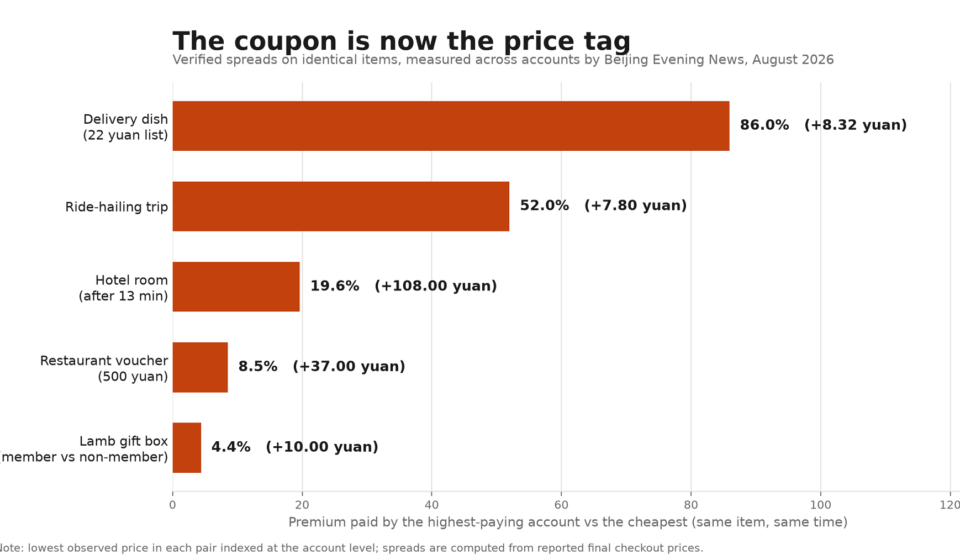
Liu sat down for barbecue with two friends and pulled up the same 500-yuan dining voucher on her phone. Her friend’s screen said 470. The next phone said 443. Hers said 433. Same restaurant, same voucher, same minute — thirty-seven yuan of daylight between the highest and the lowest.
The explanation wasn’t in the voucher. It was in a small add-on called a “divine coupon” (shen quan), a bonus subsidy the platform attaches to some accounts and not others. One account got five yuan off. Another got forty-two.
That story ran in the Beijing Evening News in August 2026, and it is the cleanest illustration of a shift most Western marketers still haven’t registered. The headline price has stopped being the price. The coupon — its size, its trigger, its expiry, its very existence — is where the pricing decision now lives.
This is not a small side market. China’s online retail sales reached 15.97 trillion yuan in 2025, up 8.6 percent year on year, with physical goods bought online accounting for 26.1 percent of all retail. When a market that size moves its discounting from a broadcast lever to a per-person dial, the margin consequences are enormous. So are the legal ones.
Why the flat coupon had to die
Start with the arithmetic nobody used to run.
A blanket 20-percent-off coupon is a blunt instrument pretending to be generous. For shoppers who would have paid full price anyway, the discount simply hands back margin. For shoppers who needed thirty percent off to commit, you offered too little and lost the sale anyway. One price fits nobody.
Coupon fatigue compounds it. When every app pushes a stack of red packets on every visit, the signal collapses into noise. Consumers stop reading the discount and start ignoring it. Redemption curves flatten. Marketers respond by shouting louder with bigger numbers, which accelerates the decay.
The fix is embarrassingly obvious once you say it out loud: stop guessing at the average shopper and price the incentive for the person in front of you. But that requires knowing something about that person — and knowing it in milliseconds.
What AI couponing actually is
Here’s the distinction that matters, and almost every article on this topic blurs it.
AI couponing is not dynamic pricing on the sticker. The listed price on a Taobao listing or a Meituan deal page is usually the same for you and for me. What differs is the stack of discounts the platform decides to hand each of us: a platform red packet here, a membership multiplier there, a limited-time subsidy that appears for one account and never for another.
That design choice is not cosmetic. It is the difference between a pricing policy a regulator can see and one it cannot. The sticker price is a public fact. The coupon is a private transaction between the platform and a single shopper — and its reasoning is buried in a model.
Call it what it is: the discount became the price tag, and it became personal.
The four things the machine reads
Reporters at the Beijing Evening News did what regulators rarely have time to do — they ran the experiment by hand.
Two phones, same hotel, same room, same minute: an iPhone showed 550 yuan, an Android handset showed 534. A black-gold member ended up paying 569.80 for a room while an ordinary member paid 551.99 — the higher-tier account was charged about eighteen yuan more. And when the reporter refreshed the same room after thirteen minutes of browsing, the price had climbed from 550 to 658.
The report pointed to four variables doing the work: the phone number on the account, the purchase history behind it, how long the user lingered, and where the user physically stood. Nothing exotic. No secret dossier. Just the exhaust trail every shopping session leaves behind.
Look at the delivery case in that same investigation: a 22-yuan plate of sweet-and-sour pork came to 18 yuan on one phone, 17 on the second, and 9.68 on the third. Nearly a two-to-one spread on lunch. The account that paid 9.68 had been handed a 12-yuan platform red packet and a 1.32-yuan “premium allowance card” nobody had requested.
The reservation-price problem
Every pricing team is chasing the same invisible number: your reservation price. The most you would pay before you walk away. If a model could read it, you would never be over-discounted and never be under-discounted. You would be charged exactly enough.
That’s the theory. In practice, the model guesses, and the guess is wrong in both directions. Guess too high and you lose the sale you could have had. Guess too low and you leave money on the table. The entire craft of AI couponing is minimizing the second error while protecting against the first.
Which is why the data exhaust matters so much. A model that watches you abandon carts, compare three listings, and open the app at 11 p.m. from the same office tower doesn’t need to know your income. It can infer your patience, and patience turns out to be a serviceable proxy for price sensitivity.
Where the discount is actually issued
Follow the stack. A checkout screen in China can carry half a dozen discounts at once: a platform-wide subsidy, a store coupon, a category voucher, a membership multiplier, a delivery allowance, and a “new customer” adjustment — each with its own eligibility rule and its own expiry clock.
The Beijing investigation found the stack working against loyalty in the most literal way. A JD PLUS member paid 238 yuan for a lamb gift box; his non-member spouse paid 228. The non-member had been handed a 20-yuan coupon valid on orders over 200. The paying member got 10 off 100.
On a ride-hailing app, a high-tier member was quoted 22.80 yuan for a trip after a 2.80 discount. The spouse, on a lower tier, saw a 10-yuan discount and paid 15. Same route. The more loyal customer — by the platform’s own ranking — paid more than half again as much.
None of this requires a conspiracy. It requires an objective function. If the model is trained to maximize contribution margin subject to a conversion target, then discounting a loyal, price-insensitive customer is simply waste — and the model is doing its job by not wasting.
The margin arithmetic, plainly
Set aside the real world for a moment and run a toy model, because the shape of the incentive is easier to see clearly.
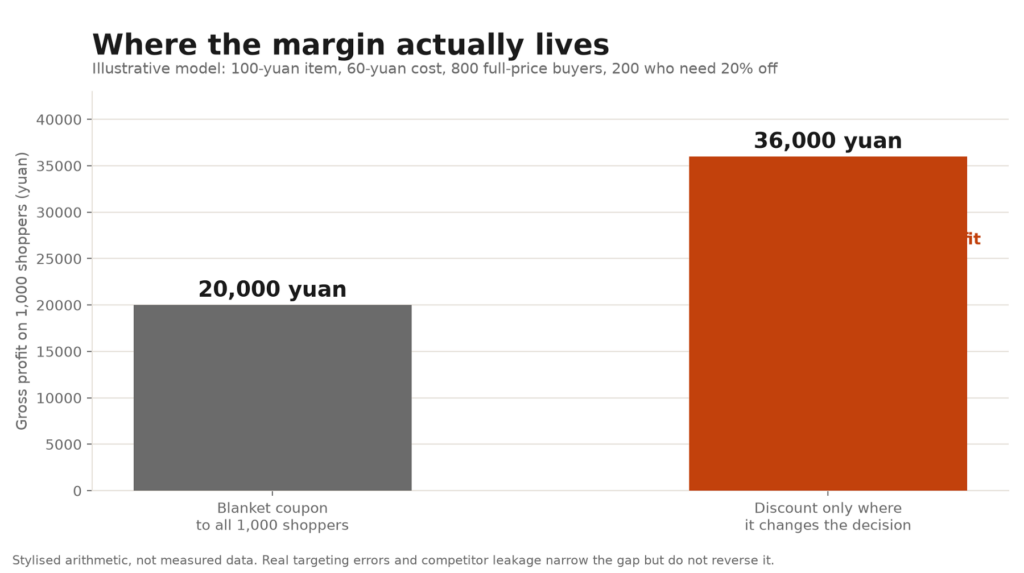
Take a hundred-yuan item with sixty yuan of cost. A thousand shoppers look at it. Eight hundred would buy at full price; two hundred need twenty percent off to commit. Hand everyone a twenty-percent coupon and you collect 80,000 yuan against 60,000 yuan of cost — 20,000 yuan of gross profit. Hand the discount only to the two hundred who need it and you collect 96,000 yuan against the same cost — 36,000 yuan of gross profit.
That is not an incremental improvement. That is the difference between a promotion budget and a profit center.
Real targeting is messier. Models misfire, some full-price buyers churn when they see no coupon, and competitors’ discounts leak into the comparison. But the direction of the effect is not in serious dispute, and it explains why Chinese platforms treat coupon decisioning as core infrastructure rather than a marketing tactic.
The rule that names willingness to pay
Here is where 2026 changed the game.
On 10 April 2026, the Rules on Platform Price Behaviour took effect — issued jointly by the National Development and Reform Commission, the State Administration for Market Regulation, and the Cyberspace Administration of China, under NDRC document No. 1607 of 2025, with a five-year term.
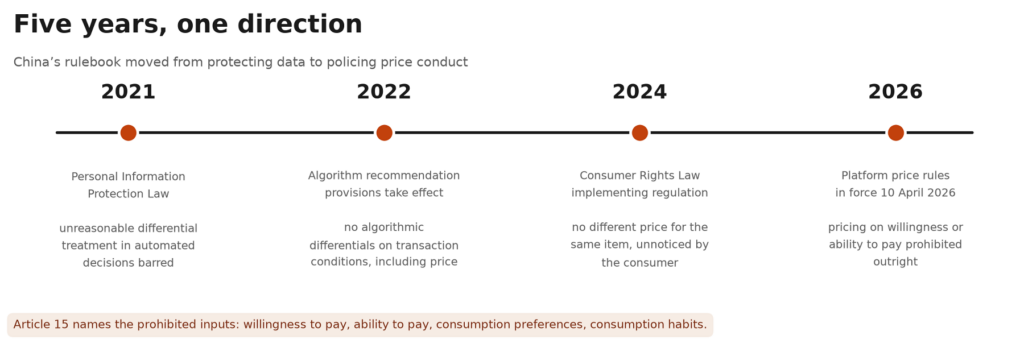
Article 15 is unusually specific. It prohibits platforms and merchants from setting different prices or fee standards for the same product under the same transaction conditions while the consumer is unaware — and it lists the prohibited inputs by name: willingness to pay, ability to pay, consumption preferences, consumption habits, expressed through data and algorithms.
Read that list again. Willingness to pay is the exact variable every couponing model is built to estimate. The regulation did not stumble into this. It walked straight at the mechanism.
The rule did not arrive out of nowhere. It sits at the end of a five-year chain: the Personal Information Protection Law in 2021, which barred unreasonable differential treatment in automated decision-making; the algorithm recommendation rules in force since March 2022, which told platforms not to use algorithms to apply unreasonable differentials to transaction conditions including price; and the 2024 implementing regulation of the Consumer Rights Protection Law, whose Article 9 forbids charging different prices for the same product under the same conditions without the consumer’s knowledge.
The clause carrying all the weight
Now read Article 15 the way a compliance team would, slowly.
The prohibition is conditional. It applies when the price differs while the consumer is unaware. Which means the same discount architecture, disclosed plainly and accepted, may fall outside the prohibition.
That single clause is the whole ballgame. An AI couponing engine is, functionally, a machine for monetizing an information asymmetry: the platform knows your reservation price, and you don’t know what the person next to you paid. The 2026 rules did not outlaw the machine. They attached a price to keeping it quiet.
So watch what happens next. Two paths are open. One is disclosure — publish the logic, tell shoppers their discount was computed, accept that some will game it. The other is obfuscation — bury the mechanism deeper, lean on the “discount amounts are random” disclaimers that the Beijing reporters found attached to hotel offers, and hope nobody builds a spreadsheet.
Only one of those paths survives a determined journalist with two phones.
Cat and mouse, consumer edition
The other reason obfuscation is a bad bet: shoppers already learned to play.
The same investigation documented a routine that would make any growth team wince. One consumer keeps three accounts — her own plus both parents’ numbers — and flips between them before ordering. Dormant accounts reliably trigger retention offers worth roughly fifteen percent, she said. She runs the phone in privacy mode to blunt tracking, and she comparison-shops the same bowl of noodles across Meituan, Taobao’s instant delivery, and JD’s, choosing whichever is cheapest that day.
Each of those behaviours feeds noise back into the training data. A model that reads dormancy as churn risk and rewards it with a big coupon is teaching its users to become dormant on purpose. The better the model, the faster the gaming.
Why this is so hard to police
Ask the obvious question: if the rule is this explicit, why does the practice keep mutating?
Because the evidence evaporates. Prices render dynamically, offers expire in minutes, and two shoppers cannot easily prove they saw the same item under the same conditions. A regulator would need to reconstruct a decision that existed for four hundred milliseconds.
Pan Tong, a researcher in Peking University’s sociology department, put the structural problem plainly: the practice has moved into a phase that is more concealed, more contextual, and more finely grained — platforms have largely stopped posting different sticker prices and now hide the differential inside coupons, threshold discounts, member benefits, and delivery subsidies where an ordinary shopper will never spot it.
That is the design brief of a modern pricing system, stated as a complaint. And it explains why the platform’s customer service answer in the investigation was a shrug dressed as an explanation: possibly a live campaign change, possibly a hotel adjustment, possibly an agent — the system itself can’t say which.
What this means if you sell outside China
If you run promotions in the US, the EU, or Southeast Asia, resist the urge to file this under China-only.
The forces that converged on the 2026 rules are not Chinese peculiarities. They are: a pricing model good enough to estimate individual willingness to pay; a disclosure regime that treats differential treatment as a consumer-protection question; and a press corps with two phones and a stopwatch. You already have the first. You are acquiring the second. The third is a Tuesday.
The practical implication is that the defensible version of personalization is the boring one. Differentiate on things you can explain — service tier, delivery speed, access, bundle, loyalty tenure with a published schedule — and keep your mouth shut about the shopper’s inferred wallet. The moment your discount depends on a variable you would not be comfortable printing on the product page, you have built a liability with a conversion rate attached.
The transparency premium
There is a commercial argument here, not just a legal one.
Once shoppers know discounts are computed, they start treating the first offer as an opening bid. Every large red packet teaches them to wait for a larger one. Platforms that train this behaviour end up in a discount arms race with their own customers, paying more each cycle for the same conversion.
Disclosed, rule-based personalization breaks that loop. If the rule is “members of two years get ten percent,” the shopper knows what to do to earn it, and the platform stops bidding against itself. Less theatrical. Considerably cheaper over a twelve-month horizon.
The 2026 rules also require platforms to file their pricing algorithms for record and to cooperate with security assessments. Filing is not the same as transparency to consumers, but it changes the internal conversation. A model you have to describe to a regulator is a model you build with an audit trail.
The bottom line
China did not stop price discrimination when it cracked down on big-data price gouging. It relocated the practice into the coupon layer, where a discount can be tuned to a single shopper and still look like a promotion.
Then, in April 2026, the regulator followed it there — and named willingness to pay as the thing you may not quietly price against.
The lesson for everyone else is not that personalization is dangerous. It is that personalization built on what the customer doesn’t know has a shelf life, and the shelf is shorter than most pricing roadmaps assume. The teams that win the next cycle will be the ones who can explain, in one sentence a shopper would accept, why this person got this price.
If you cannot say that sentence out loud, you do not have a pricing strategy. You have a countdown.
Frequently asked questions
What exactly is AI couponing?
It is per-shopper discount decisioning. The sticker price is usually the same; the stack of coupons, subsidies, and member adjustments on top of it is computed individually, often in real time, to hit a conversion target at the lowest give-away.
How is it different from dynamic pricing?
Dynamic pricing moves the posted price for everyone based on demand, inventory, or time. AI couponing leaves the posted price alone and varies the private discount instead — which is why it is harder to detect and harder to regulate.
Is it legal in China?
Conditional. The 2026 platform price rules prohibit charging different prices for the same product under the same conditions when the consumer is unaware, and explicitly list willingness to pay and ability to pay as prohibited inputs. Disclosed, rule-based differentiation is a different question — and largely untested.
Why are loyal customers sometimes charged more?
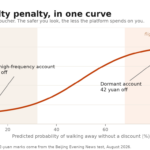
Because loyalty is read as low price sensitivity. A model optimizing margin will not spend a discount on someone it believes will buy anyway, so long-tenured, high-frequency accounts often see smaller coupons than dormant ones.
What should a brand do about it now?
Keep a decision log for every personalized offer, write the segmentation rule in language a customer could understand, and shift differentiation toward service, access, and tenure — variables you can defend in public without flinching.