AI Storefronts: The Virtual Shelves Brands Are Building
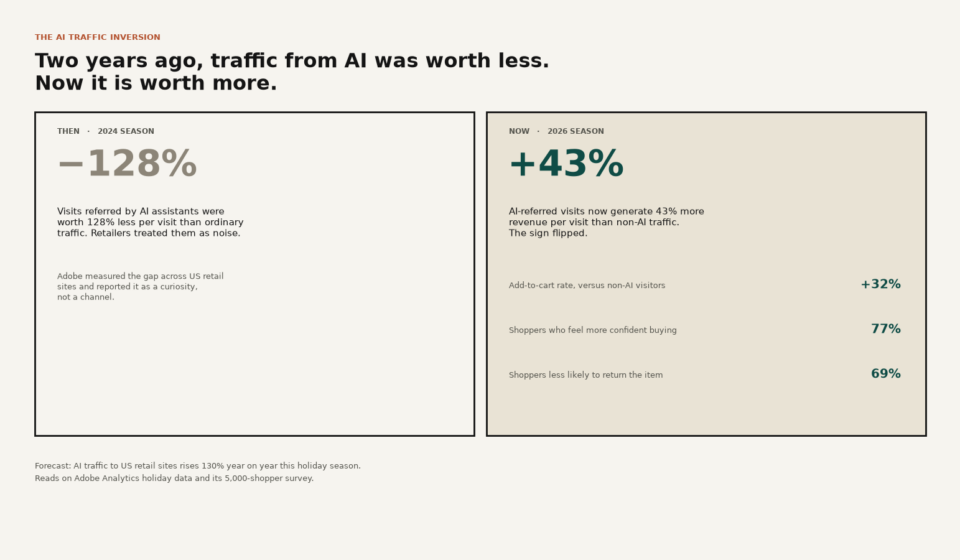
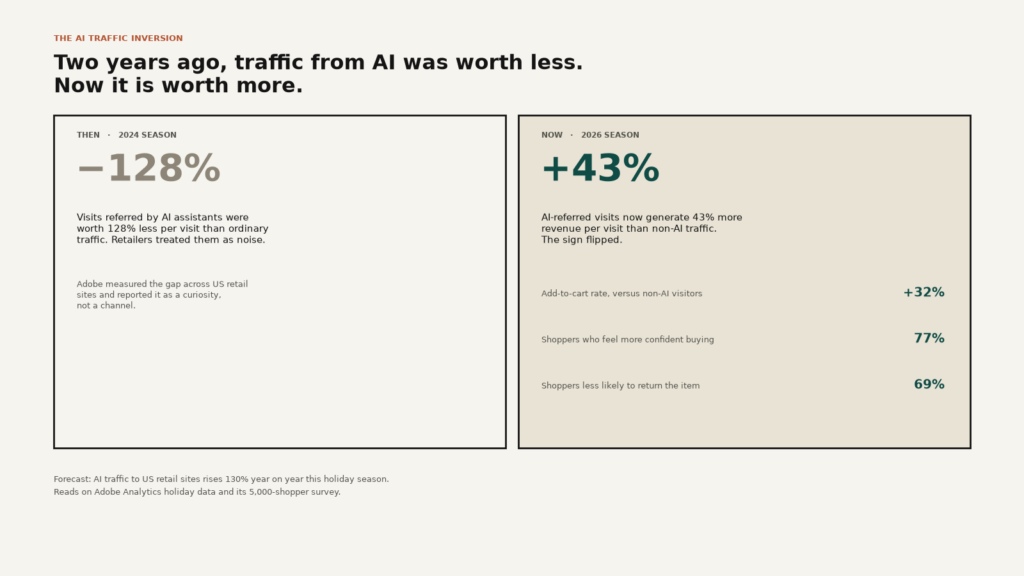
Two years ago, traffic referred by AI assistants was a punchline. Adobe measured the gap across US retail sites and found that a visit from an AI assistant was worth roughly half as much as an ordinary visit — a 128% discount, in Adobe’s framing. Retailers looked at the number and shrugged. Chatbots sent browsers, not buyers.
Then the sign flipped. In Adobe’s 2026 holiday data, AI-referred visits — clicks that arrive from a link inside an AI assistant — generate 43% more revenue per visit than non-AI traffic. Visitors sent by AI add items to their carts at a 32% higher rate. Seventy-seven percent say they feel more confident about buying. Sixty-nine percent say they are less likely to return it.
Same channel. Same measurement. Opposite conclusion. What changed was not the traffic. What changed was the thing the traffic landed on.
That landing page — the product page, the category grid, the flagship store — has been quietly rebuilt. In China, mostly. It now assembles itself around whoever is looking at it: images regenerated for this shopper’s skin tone or living room, copy rewritten for this shopper’s stated worry, product order reshuffled for this shopper’s price sensitivity, and a chat agent standing where the sales associate used to stand. Not personalized in the way a recommendation carousel is personalized. Personalized in the sense that the store itself is different.
The industry shorthand for this is the AI storefront. The shorthand is fine. The interesting part is what it costs, what it breaks, and why the build happened in Hangzhou before it happened in Seattle.
What an AI storefront actually is
Strip the marketing away and an AI storefront is a rendering pipeline. A shopper arrives with a signal — a search, a watch history, a saved address, a photo, a half-finished checkout. The platform reads that signal, generates assets against it, assembles a page, and serves it. The whole loop runs in the time it takes the page to load, which is to say, faster than a shopper can change their mind.
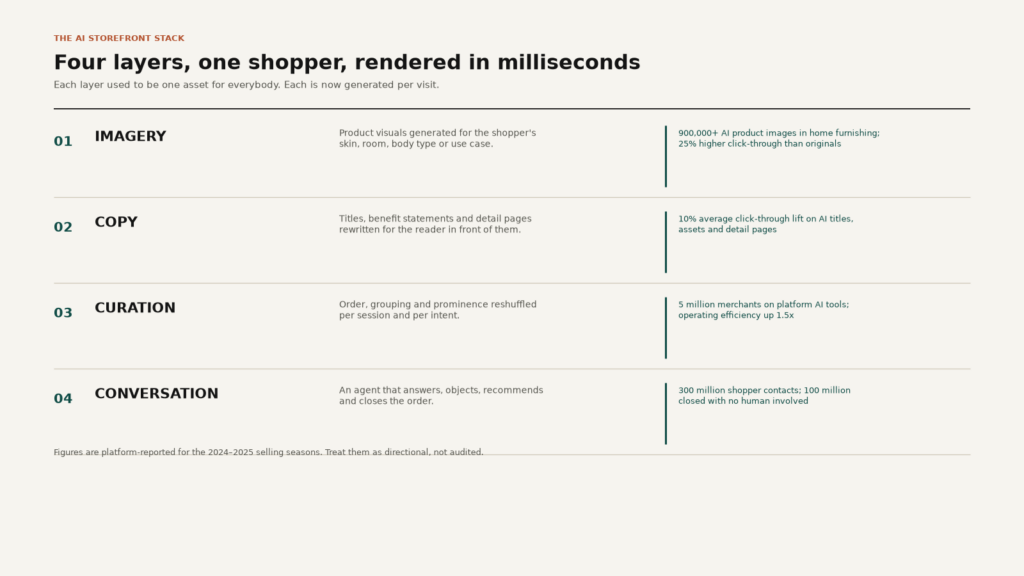
Four things get generated, and they are worth separating because they mature at different speeds:
Product imagery. Generative models place a sofa in a room that matches the shopper’s floor plan, a lipstick on a skin tone close to the shopper’s own, a jacket on a body type the shopper recognizes as theirs.
Product copy. Titles, benefit statements, comparison blocks and detail pages written for the reader in front of them — a first-time buyer and a category expert should not be reading the same paragraph.
Curation. The order, grouping and prominence of what is on the page. Which three products get the fold. Which are grouped as “complete the set.” Which are quietly demoted.
Conversation. An agent that answers questions, handles objections, recommends, and increasingly takes the order.
Any one of these, done badly, is a gimmick. Done together, they change what a store is: not a fixed asset that gets optimized, but a piece of software that gets executed.
Three things an AI storefront is not
It is not a recommendation engine with better PR. Recommendations decide which products appear. A storefront decides what the products look like, what they say, how they are arranged, and who answers the questions. That is a much bigger surface area, and a much bigger surface area to get wrong.
It is not a template with conditional logic. Merchandisers have been swapping hero banners by audience segment for a decade. The difference is authorship. A template is designed once and switched; a generated page is authored per visit, which means nobody has read every version before it goes live.
It is not the same thing in every market. In the US and Europe, the storefront mostly still lives on the brand’s own site, and the AI layer is bolted on by a vendor. In China, the storefront lives inside a platform, and the AI layer is part of the plumbing. That distinction explains almost everything that follows.
The stack: four layers, one shopper
This stack could be built in China, and not in, say, a mid-sized European brand’s Shopify admin, because all four layers depend on the same three inputs: a catalog big enough to learn from, behavioral data dense enough to personalize against, and model capacity cheap enough to run on every page view rather than on a test segment.
A single-brand retailer has one catalog and a few million sessions a month. Alibaba has a catalog of more than four billion products and a country’s worth of sessions. When your unit economics depend on inference cost per page view, scale is not a nice-to-have. It is the difference between a demo and a product.
Why this landed in China first
Three forces converged, and none of them were inevitable.
The first was content economics. Chinese e-commerce is photogenic in a way that Western e-commerce is not — live commerce, short video, image-heavy detail pages, influencer seeding. Rich storefronts were the norm long before generative models arrived, which meant the cost of content was already a line item executives cared about. When Taobao and Tmall released ten free merchant AI tools in late 2023 — scene images, model shots, retouching, even one-click store opening — they were attacking a cost that was already visible on the P&L.
The second was platform ownership. Taobao, JD and Douyin own the model, the catalog and the page. They do not need to integrate with a CMS, negotiate a data-sharing agreement, or persuade a merchant to install a script. They can ship a rendering change to five million stores in a single release.
The third was labor arithmetic. A store with 8,000 SKUs cannot write 8,000 bespoke product pages. It can, however, hire three people to prompt a model and review what comes out. That is a different job, and China had plenty of people already doing the adjacent version of it.
The growth math that makes it urgent
Here is the number that should be pinned above every e-commerce budget meeting. In the first nine months of 2026, China’s total retail sales of consumer goods grew 1.1% year on year. Online retail sales of goods and services grew 4.4%. Online retail of goods alone grew 3.8%, and online services grew 5.3%.
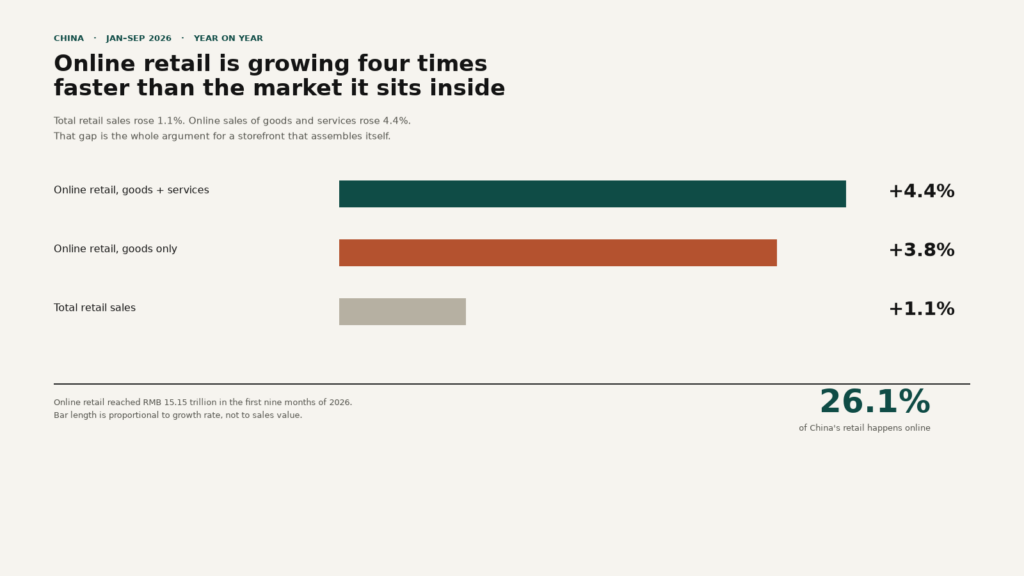
Four times the market’s growth rate sounds like a triumph until you remember what it implies: when total retail is growing at 1.1%, any retailer growing faster than the online average is taking share from somebody else. There is no tide left to lift the boat. Growth has to come from conversion, basket size and repeat rate — which is precisely the set of things a per-shopper storefront is supposed to move.
That is the strategic case, and it is more persuasive than any vendor deck. In a market growing double digits, personalization is a margin play. In a market growing 1%, it is the growth play. For scale: online channels took 26.1% of China’s retail sales in 2025, when the market was worth RMB 15.97 trillion.
Platform by platform, including the parts that are still hype
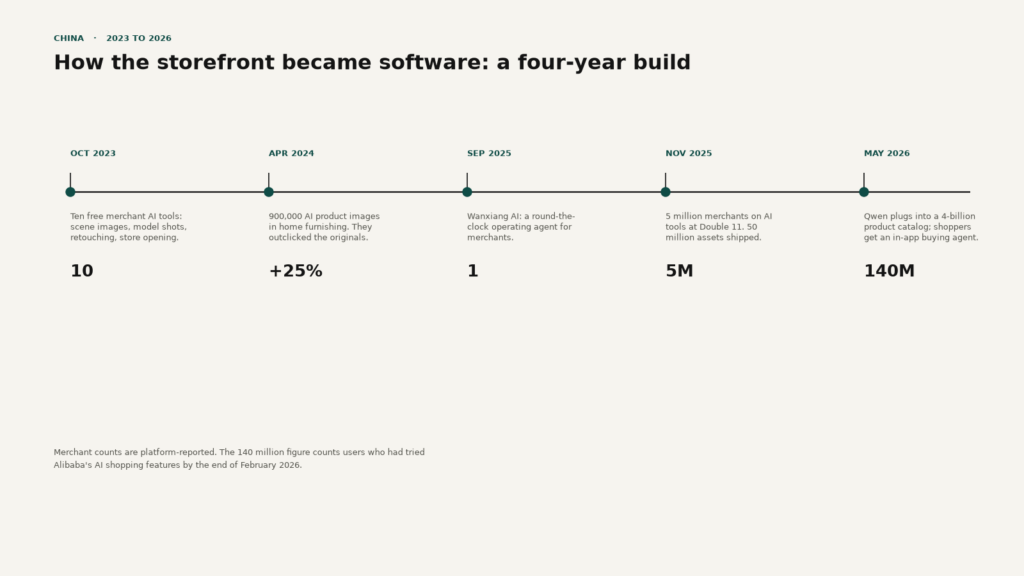
Alibaba (Taobao, Tmall). The most complete build. The 2023 tool drop was the opening move; the September 2025 launch of Wanxiang AI — formally Wanxiangtai AI Wujie — a round-the-clock operating agent that handles audience, keywords, product selection and creative, was the point where tools became infrastructure. By Double 11 — Singles’ Day — in November 2025, five million merchants were running the platform’s AI tools, with Alibaba reporting a 1.5x lift in operating efficiency, an average 10% click-through lift on AI-generated titles, assets and detail pages, and a 90% merchant approval score. Household-furnishing brands had already pushed past 900,000 AI-generated product images by April 2024, and those images were out-clicking the originals by 25%.
JD.com. A different bet: the avatar. JD gave its digital-human livestream hosts to merchants free in December 2025, and by March 2026 more than 70,000 vendors were using them. JD puts the cost of a digital host at roughly one-tenth of a human host’s and says the avatars generated GMV in the tens of billions of renminbi. Believe the headline number or not, the direction is clear: the storefront is being extended into a 24-hour sales floor staffed by software.
Douyin e-commerce. The purest expression of the interest-based model. The shelf is shaped by what a shopper watched, not what they typed, which makes the storefront a downstream artifact of the feed. Douyin does not publish merchant-tool adoption figures or GMV in a form that can be checked, so treat platform-level claims about it as directional.
WeChat mini shops. The quiet one, and possibly the most consequential for brands. Tencent’s 2026 interim report cites growth in mini-shop GMV as a driver of its business-services line and says it has upgraded its campaign-management system with AI-powered end-to-end execution for mini-shop advertisers. Tencent does not publish absolute mini-shop GMV. What it does publish is 1.44 billion combined monthly users of Weixin and WeChat in June 2026 — the distribution layer that makes a private-domain storefront worth building.
Pinduoduo and Temu. The honest answer is that this is the weakest evidence in the set. Pinduoduo’s model rewards price discovery and social aggregation more than rich merchandising, and neither PDD nor Temu publishes merchant AI-tool adoption. Do not repeat claims about AI listing generation at Pinduoduo. Nobody has shown the numbers.
The economics nobody puts in the press release
The cost side is where the case gets boring and convincing. At the 2025 Double 11 presale, Alibaba’s creative agent generated more than 50 million marketing assets for over two million merchants and, by the company’s own accounting, saved them more than RMB 900 million in production costs. A separate operating agent absorbed three million merchant queries on day one, saving an average of 1.79 hours per merchant.
Read those two numbers together and you see the actual product. It is not a prettier page. It is the removal of a bottleneck that used to cap how many SKUs a mid-sized merchant could merchandise properly. When a store can produce 50 variants of a product image for the price of one photoshoot, the constraint moves from production to judgment — which is a much better problem to have, and a much harder one to staff.
The conversation layer is the one that compounds
Images and copy are one-shot assets. A conversation is a data-generating loop, which is why the customer-service robot quietly became the most strategically interesting piece of the stack.
At Double 11 in 2025, Alibaba’s Dianxiaomi handled 300 million shopper contacts, of which 100 million were closed with no human involvement at all. The human-handover rate fell 20%, the conversion rate from inquiry to order rose 30%, and the cost of configuring merchant answers fell by more than 60%. Those are not vanity metrics. A 30% lift in inquiry-to-order conversion is the kind of number that reshuffles a category.
Then, in May 2026, the layer stopped being a support function. Alibaba connected Qwen to Taobao and Tmall, giving the model access to more than four billion products and putting a buying agent inside the shopping app — with AI try-on, AI question answering and, eventually, the ability to place the order. By the end of February 2026, close to 140 million users had already tried the platform’s AI shopping features.
That is the moment the storefront stops being a page and starts being an interface. More on that below, because it is where the Western build is heading too.
Meanwhile, the West is rewiring the checkout
The American version of this story is not about generating pages. It is about removing them.
In September 2025, OpenAI launched Instant Checkout inside ChatGPT, built on an open Agentic Commerce Protocol co-developed with Stripe. US users could buy from Etsy sellers without leaving the conversation; more than a million Shopify merchants were queued to follow. The strategic detail is not the button. It is that the protocol was open-sourced, which means the checkout is being standardized before anyone has decided what a storefront should look like in an agent-mediated world.
The numbers around it are no longer speculative. Amazon says more than 250 million customers used Rufus in a year, with monthly active users up 149% and interactions up 210% year on year, and that shoppers who use it are over 60% more likely to buy on that trip. Andy Jassy has said he expects Rufus to generate more than $10 billion a year in incremental sales. Google went the infrastructure route: conversational shopping in AI Mode drawing on 50 billion product listings, agentic checkout with a handful of launch retailers, then a Universal Cart that works across Sephora, Target, Wayfair and Walmart, plus an open Universal Commerce Protocol with Walmart, Shopify and Target at the table. Perplexity bundled a free agentic shopping product with PayPal, and won a Ninth Circuit reprieve after Amazon tried to block its browser from buying on users’ behalf.
Notice what all four have in common. None of them is redesigning the product page. They are making the product page optional.
What the numbers prove, and what they do not
Bain’s forecast is the one to keep in mind: US agentic commerce could reach $300–500 billion by 2030, or roughly 15–25% of e-commerce, counting only purchases initiated, influenced or completed by an AI agent — and excluding journeys that merely used AI-assisted search. Bain also finds that 30–45% of US consumers already use generative AI for product research and comparison.
Salesforce’s holiday numbers point the same way from the other end. Across $1.29 trillion in global online sales in the 2025 season, AI and agents influenced roughly 20% of retail sales — about $262 billion in revenue, on Salesforce’s attribution. Shoppers referred by AI-powered search converted nine times more often than shoppers referred by social. Retailers running their own AI agents grew 59% faster than those that did not — 6.2% versus 3.9% year on year.
Now the caveats, because this is exactly the kind of data that gets laundered into a sales deck.
Most of the China figures in this article are platform-reported, not audited. “Click-through lift” is measured against whatever baseline the platform chooses. “Efficiency up 1.5x” is a self-assessment, not a controlled experiment. Treat them as directional evidence that something real is happening, not as benchmarks you can put in a board paper.
The Western figures have a base-rate problem. AI traffic is still a small share of total traffic, so a 43% revenue-per-visit premium is easier to generate than it sounds — and it may partly reflect who is being referred (high-intent shoppers who asked a question and got an answer) rather than what they landed on. Both things can be true: AI referrals are better qualified, and AI-generated storefronts convert better. Separating the two is the measurement job nobody has finished.
And the counter-evidence is real. If every brand generates its product pages from the same handful of models, the pages converge. The differentiation that personalization was supposed to create may end up being the differentiation that personalization destroys, at least at the level of taste.
The risk stack: quality, disclosure, and the sameness trap
Quality control is now a merchandising function. An AI-generated image that puts a garment on the wrong body type, or a detail page that invents a material, is not a creative miss. In most jurisdictions it is a consumer-protection problem. The brands doing this well put a human review gate on anything that makes a factual claim.
Disclosure stopped being optional. China’s labeling rules for AI-generated synthetic content took effect on September 1, 2025, and require visible labels on generated images, video and virtual scenes, plus metadata labels underneath. The EU’s transparency obligations under the AI Act land in August 2026. In the US, the FTC’s rule on fake reviews — which explicitly covers reviews from people who do not exist — has been in force since late 2024. The era of quietly shipping a synthetic product photo is closing.
The sameness trap. Personalization optimizes for the shopper’s existing preferences, which is efficient and also a little claustrophobic. A storefront that only shows you what you were already going to buy removes the accident from shopping — the thing you did not know you wanted. Some platforms are already engineering deliberate randomness back in. Watch for that to become a design principle rather than an accident.
Platform dependency. If the storefront is platform infrastructure, then brands on platforms without it are structurally behind. That is a competitive problem with no marketing solution, and it is the strongest argument for building your own asset library and your own data model before you need them.
What this does to the merchandising job
Three shifts are already visible in how teams are organized.
Merchandisers stop designing pages and start designing rules. The deliverable of the job becomes a set of constraints — what the model may say, what it may never claim, which images are approved for which use, what the fallback is when confidence is low — rather than a fixed layout.
Content teams become asset librarians. The unit of work moves from “the campaign” to “the tagged, rights-cleared, model-ready asset,” because a generated page is only as good as the library it draws from. Brands with messy product data will discover this the hard way.
Measurement moves from the page to the decision. If every visitor sees a different page, then “the page” is no longer a testable unit. What you can measure is whether the system made a better call — which means logging prompts, outputs and outcomes, and being honest that attribution is now partly a modeling exercise.
A 90-day plan that does not require a platform rebuild
You do not need to own a foundation model to start. You need four things in order.
Weeks 1–3: audit the inputs. Take your top 200 SKUs and ask a blunt question: is the data clean enough that a model could describe this product without inventing anything? Most catalogs fail here. Fix that first, because everything downstream inherits the mess.
Weeks 4–6: build the asset library. Rights-cleared images, approved claims, banned phrases, tone rules and a review queue. This is unglamorous and it is the actual moat. Models are rented; your asset library is owned.
Weeks 7–9: run one narrow experiment. Pick a single category with high traffic and a real conversion problem. Generate variant imagery and copy for a defined segment. Hold back a control. Measure revenue per visit, not click-through, and pre-register what would count as a failure.
Weeks 10–12: ship the disclosure and the guardrails. Label generated assets. Write down which decisions the model is allowed to make unsupervised. Publish an internal standard for when a human must sign off. This is the part everyone skips and later regrets.
Where this goes next
The plausible 2027–2030 arc has three stages, and only the first is certain.
Now to 2027: the page gets better. Generation becomes continuous rather than campaign-based, and the storefront becomes a live system with quality scores attached to every generated asset.
2027–2028: the page becomes a conversation. As Alibaba’s Qwen–Taobao integration and the Western checkout protocols mature, more purchases begin with a question and end in an order, with the page as an intermediate artifact rather than a destination. The storefront’s job shifts from persuasion to supply — can your catalog answer the agent’s question, in a form the agent can use?
2028–2030: the store becomes a service. If agents do the browsing, the winning brands are the ones whose product data, pricing logic and availability are machine-readable and trustworthy at the SKU level. That is a far less glamorous ambition than a generative storefront. It is also the one that survives the hype cycle.
The takeaway
The AI storefront is not a design trend, and it is not really a personalization feature. It is what happens when the cost of producing a store falls close enough to zero that you can produce one per shopper. China got there first because the platforms owned every layer of the stack and the market was growing too slowly to ignore conversion. The West is taking a different route — not rebuilding the page, but routing around it, through protocols and agents and checkouts that live inside a chat window.
Both routes end in the same place. The store stops being a place you build once and starts being a system that answers, every time, for one person. The brands that treat that as an engineering and governance problem — data quality, asset rights, disclosure, measurement — will be the ones still standing when the novelty wears off. The ones that treat it as a content trick will produce a lot of pretty pages that nobody can explain.
FAQ
What exactly is an AI storefront?
A storefront where the page itself — imagery, copy, product order and the conversation layer — is generated per visitor at page-load speed, rather than designed once and served to everyone. The distinguishing feature is authorship per visit, not just personalized recommendations.
How is this different from the personalization tools brands already use?
Traditional personalization changes which products or offers appear inside a fixed template. An AI storefront changes the template’s content itself: a different product image, a different description, a different arrangement. That is a much larger surface area, and it needs a different review process.
Is there proof that it converts better?
Directionally, yes, with caveats. Alibaba reports a 1.5x efficiency lift, a 10% average click-through lift on AI-generated assets, and a 30% lift in inquiry-to-order conversion inside AI-handled service conversations. Adobe measures AI-referred visits at 43% more revenue per visit and 32% higher add-to-cart rates. None of these are independent audits, and part of the AI-traffic premium reflects who is being referred, not only what they land on.
What are the legal risks?
Disclosure, mainly. China’s AI-content labeling rules have applied since September 1, 2025; the EU AI Act’s transparency obligations arrive in August 2026; the US FTC has been enforcing its fake-review rule since late 2024. Accuracy is the second risk — a generated image or claim that misrepresents the product is a consumer-protection exposure, not a creative one.
Do brands need their own model to do this?
No, and most should not build one. What they need is clean product data, a rights-cleared asset library, a review gate and a measurement plan. The model is rented. The asset library and the governance are owned, and those are what compound.
Where is the weakest evidence in this space?
Platform-level adoption numbers for Douyin, Pinduoduo and Temu, and absolute GMV figures for WeChat mini shops. None of those companies publish figures that can be independently checked. Treat any specific number you see quoted for them as unverified.