Field Notes From the Avatar Floor: What Three Years of Digital Humans Taught Chinese Marketers
The economics behind brand safety: why control destroys the thing you were buying
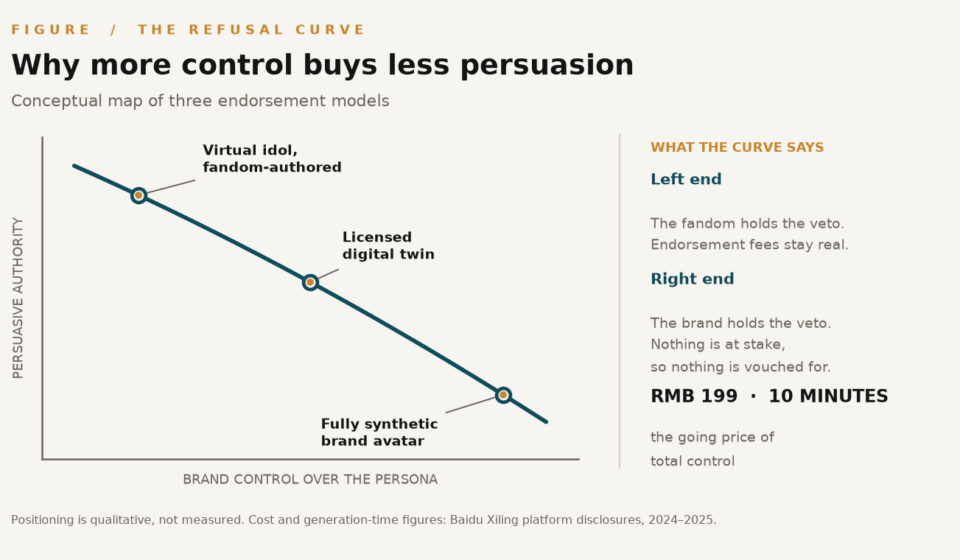
Baidu will sell you a photorealistic 3D human for RMB 199, generated from a text prompt in about ten minutes. That is the most consequential number in marketing right now, and almost everyone reads it backwards.
The industry reads it as a supply shock: spokespeople just became a rounding error in the media budget, so every brand can have one. That reading isn’t wrong. It is just answering a question nobody was asking. Supply was never the binding constraint. Persuasion was. The core market grew about 42% in a single year, from RMB 33.9 billion to RMB 48.1 billion — and the average campaign got no more believable.
Here is the mechanism. A spokesperson does not transfer attention to a product; attention is cheap and abundant. A spokesperson transfers risk — they stake something they could actually lose. When Luo Tianyi fronts a collaboration, the brand is not buying her face. It is buying the fact that her fans will complain, loudly and in public, if the product is bad. They wrote her songs. They own a piece of her. The stake is real because the crowd behind her can withdraw it.
Read that way, a professional endorser’s value is a function of their capacity to refuse. The celebrity who can walk away, who can decline the renewal, who can be embarrassed, is a credible voucher. The refusal is the product.
Now run the new economics. A fully synthetic persona has no capacity to refuse. It cannot decline, cannot be embarrassed, cannot lose anything — and that is precisely why it vouches for nothing. You have not bought an endorsement. You have bought a very good illustration of one.
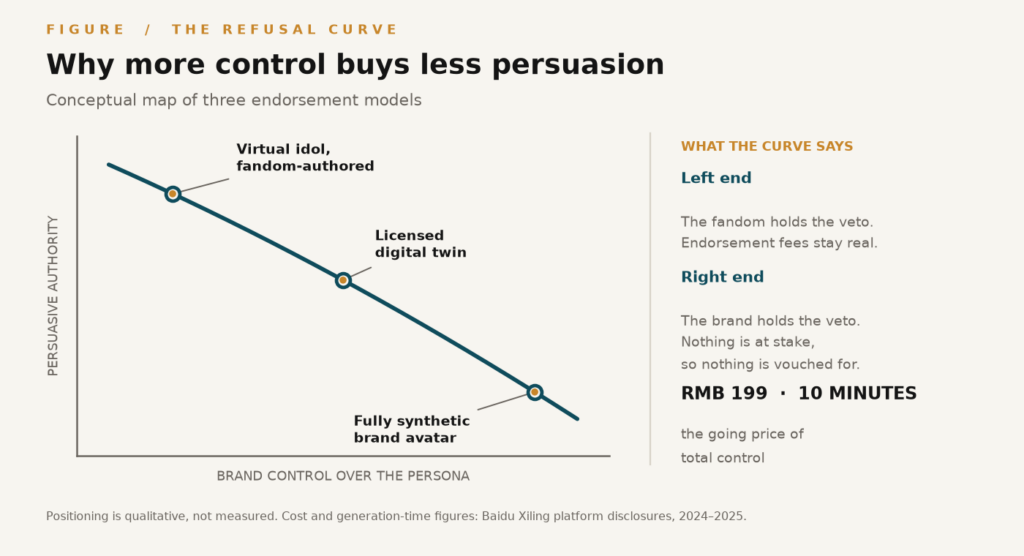
This explains why the market splits so cleanly, and why the split has nothing to do with realism. Photoreal avatars sell detergent at three in the morning: a job that requires availability, not conviction. Virtual idols with authored fandoms command real endorsement fees, because the fandom, not the brand, holds the veto.
The exception proves it. When the performers behind A-SOUL pushed back in 2022, the fandom read it as the avatar itself refusing, and the companies lost. Refusal exists whether or not you plan for it. If you do not own it, it turns on you.
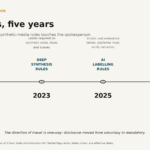
The disclosure rules sharpen the same logic. Once Article 37 forces a livestream to label an AI presenter continuously, a synthetic persona can no longer borrow credibility it has not earned. Regulation did not damage the category. It separated two businesses that had been sold as one: cheap labour, and expensive trust.
Which leaves a question worth asking before the next RFP. Not can we afford an avatar, but: who, exactly, is allowed to say no to us on its behalf?