China Just Became the World’s Largest AI Answer Engine. Here’s What That Means for Marketing
China Passes 700 Million Generative AI Users — Discovery Is Moving From Search to Answers
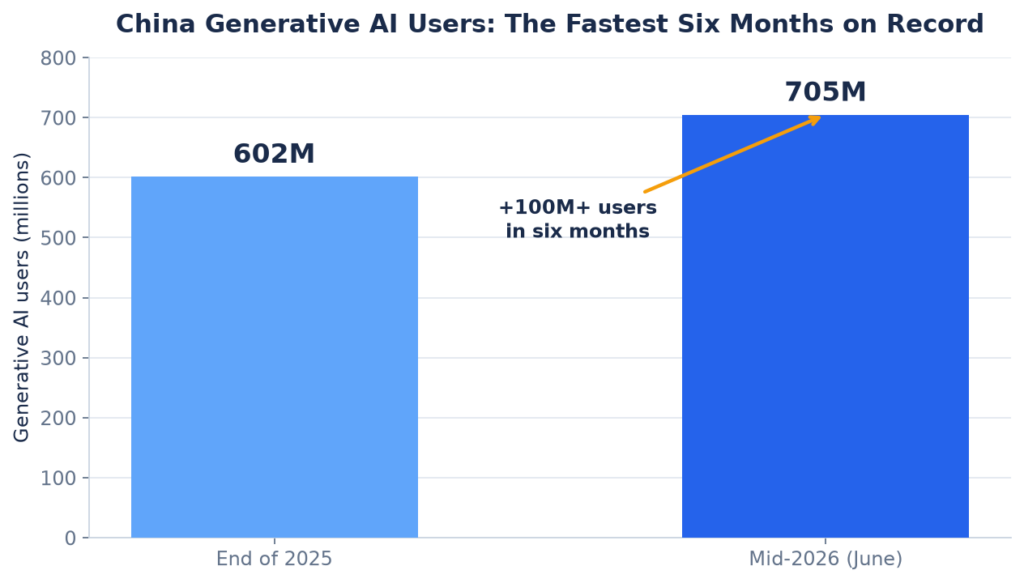
China now counts more than 700 million people using generative AI. That is over half the country’s population, and it happened in roughly six months.
The figure comes from CNNIC’s 2026 Generative AI Application Development Report, released on September 29, 2026. The number is striking on its own, but it matters for a deeper reason: it marks the moment a massive consumer market stopped treating AI as a novelty and started treating it as the place where questions get answered.
The Number Behind the Headline
At the end of 2025, China reported 602 million generative AI users. By the middle of 2026, the count had crossed 700 million — an increase of more than 100 million people in half a year — and penetration pushed past 50% of the population.
Put differently, China added roughly a New York City worth of new AI users every few days for six straight months. That is not incremental adoption. That is a platform shift.
For scale, consider that ChatGPT, the most widely used AI product globally, reached 900 million weekly active users in early 2026, up from 800 million in October 2025 and just 300 million in late 2024. China’s figure measures a slightly different thing, but the direction is identical. Both tell the same story: AI has crossed from early adopters into mass adoption, and the curve is steepening, not flattening.
What People Actually Do With It
The most important data point in the report is not the user count. It is the behavior.
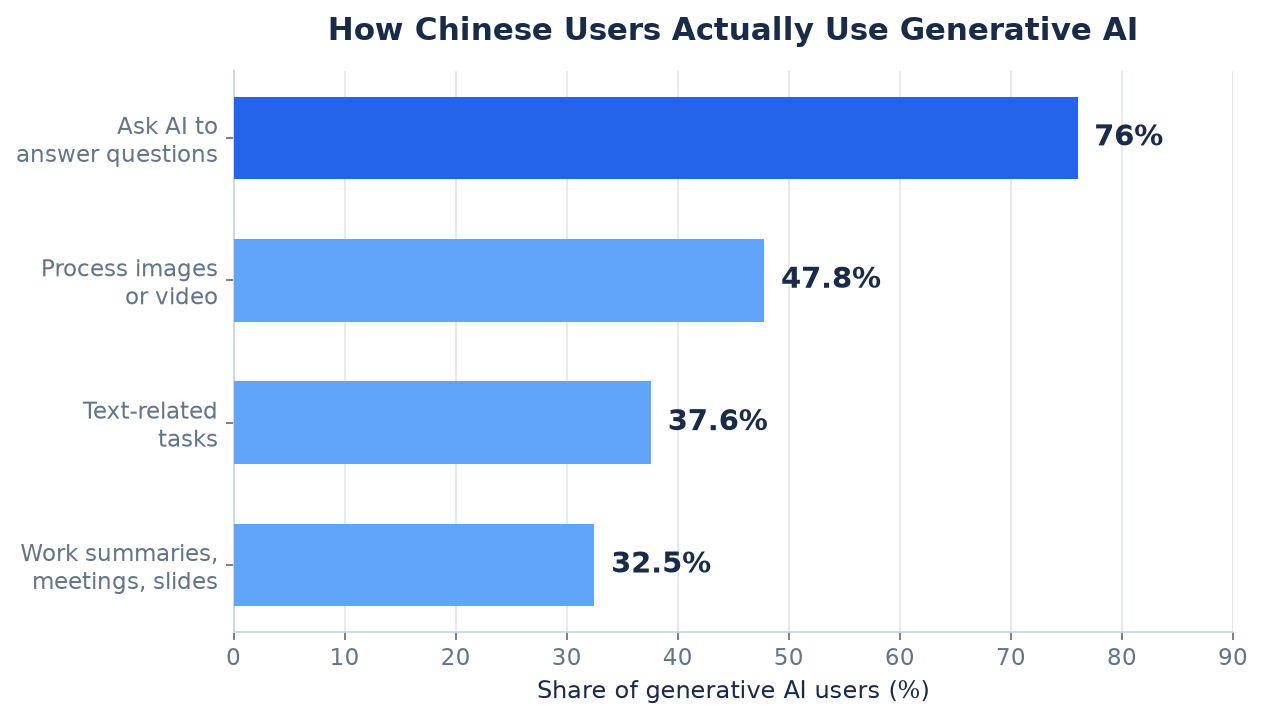
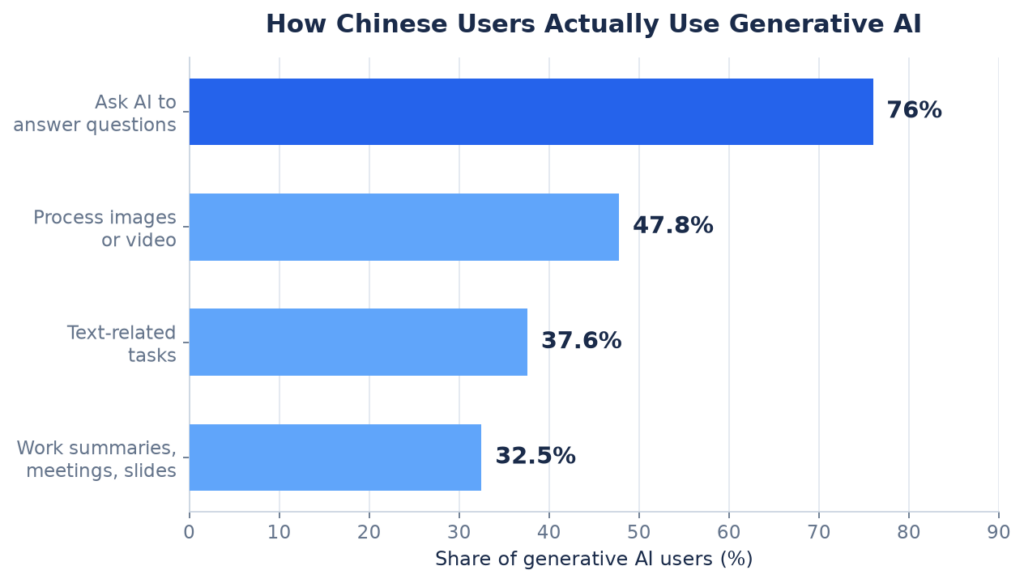
Seventy-six percent of Chinese users say they use AI to answer questions directly. That is the single most common use case — ahead of image and video generation at 47.8%, text work at 37.6%, and drafting work summaries, meeting notes, and slides at 32.5%.
Read that again. For three out of four Chinese users, AI is not a toy, a side tool, or a content generator. It is the first place they turn when they have a question. That is the textbook definition of an answer engine.
The momentum backs it up. Usage of general-purpose AI assistants and AI productivity tools both more than doubled year over year.
Why This Is a Search Story, Not Just an AI Story
This is easy to misread as a technology trend. It is really a discovery trend.
For two decades, when people had a question, they typed it into a search box and clicked a result. Now they type it into an assistant and read an answer. The click — the exact moment a brand used to get found — is becoming optional.
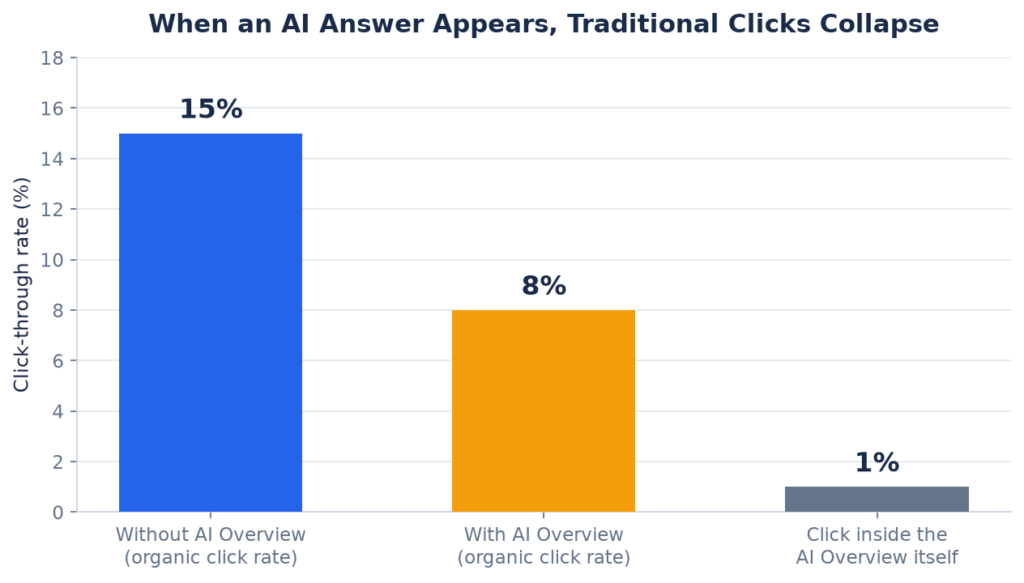
The shift is not unique to China. It is just further along there. In the United States, AI Overviews now appear on roughly 13% of searches, and when one is present, users click traditional results only about 8% of the time, versus 15% when no AI answer sits on top. And almost nobody clicks the links inside the overview itself.
China is not doing something exotic. It is simply the first market at this scale to treat AI as the default answer engine — a preview of where global discovery is heading.
What It Means for Marketers
The marketing consequence is blunt: visibility is no longer just about ranking in the blue links. It is about being the source an AI names in its answer.
When a user asks an assistant which product to buy or which vendor to trust, the assistant does not return a list of ten results. It returns one answer, assembled from a handful of sources it considers credible. Brands that are not in that set effectively do not exist for that query.
This is the core of what practitioners now call generative engine optimization, or GEO. It shifts the goal from “rank first” to “be named” — to show up as a cited source, with facts and figures an AI can pull, verify, and quote.
The practical implication is uncomfortable but clear. A brand can win the traditional search rankings and still lose the answer. The new measure of visibility is whether an AI will repeat your name, your data, and your position when it speaks for your category.
The Adoption Runs Much Deeper Than Chat
CNNIC’s report also shows the move is not confined to conversation. In the previous six months, 38.7% of Chinese internet users bought smart hardware online — wearables for 20.2%, and phones, tablets, and other consumer electronics for 18.2%. The AI habit is spilling into real purchasing behavior, which means the answer-engine shift is not theoretical; it is sitting inside the same devices people use to shop.
The enterprise side is moving faster still. More than 30% of large Chinese manufacturers now use AI across research, design, production, and quality control. AI-related investment deals reached 1,255 in the first half of 2026 — already 78% of the full-year total for 2025 — with deal value hitting roughly ¥250 billion, or 182% of what was raised in all of 2025.
None of this changes the central point. The consumer-facing shift is what reshapes how brands get found, and the scale of China’s answer-engine behavior makes the marketing implication impossible to ignore.
Bottom Line
China now has the largest single market treating AI as a default answer engine. Three-quarters of its generative AI users ask AI to answer questions directly, and assistant usage is doubling year over year. That does not just change how Chinese consumers find things — it previews how discovery will work everywhere.
For marketers, the lesson is simple. If your brand is not named inside the answer, it does not get found. The race is no longer for the top of the page. It is for a place in the sentence.