Private Domain Isn’t Just “Chinese CRM” — The Real Difference, Explained
Try explaining Private Domain to a Western colleague and you will watch the sentence stall.The literal translation is “private domain,” but that phrase means almost nothing in English. Say it to a marketer in London or Austin and they hear “a gated community for leads,” which is not it at all.
The stumble is real because the concept lives inside a different operating system. In most Western markets, “owning” a customer means capturing their email and stacking them into a CRM. In China, ownership feels less like a database row and more like a chat thread that stays open. You do not send a newsletter; you stay inside someone’s WeChat. The relationship lives where the person already is, not in a system you built.
So before we compare private domain with CRM, admit the obvious: they are not the same species. One is a philosophy of presence. The other is a philosophy of records.
CRM: Ownership by Database
Customer Relationship Management grew up around a simple promise. If you collect enough structured facts about a person — name, company, purchase history, support tickets — you can predict what they want next and automate the follow-up. The hub of that world is the database. The contact is a row. The relationship is a timeline of events the software logs.
This model fit the West because the West built its own channels. Brands owned websites, bought email lists, ran ad accounts on Google and Meta, and measured everything through pixels and cookies. A CRM sits at the center and answers one question: what do we know about this person, and what should we do next?
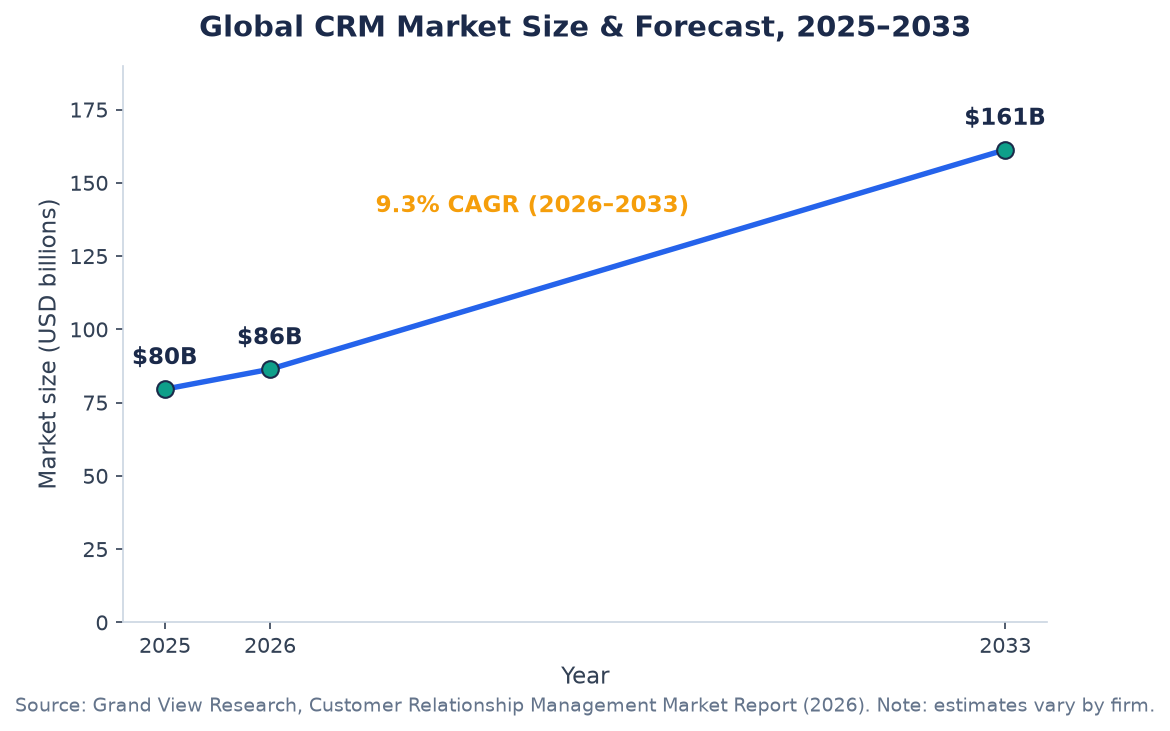
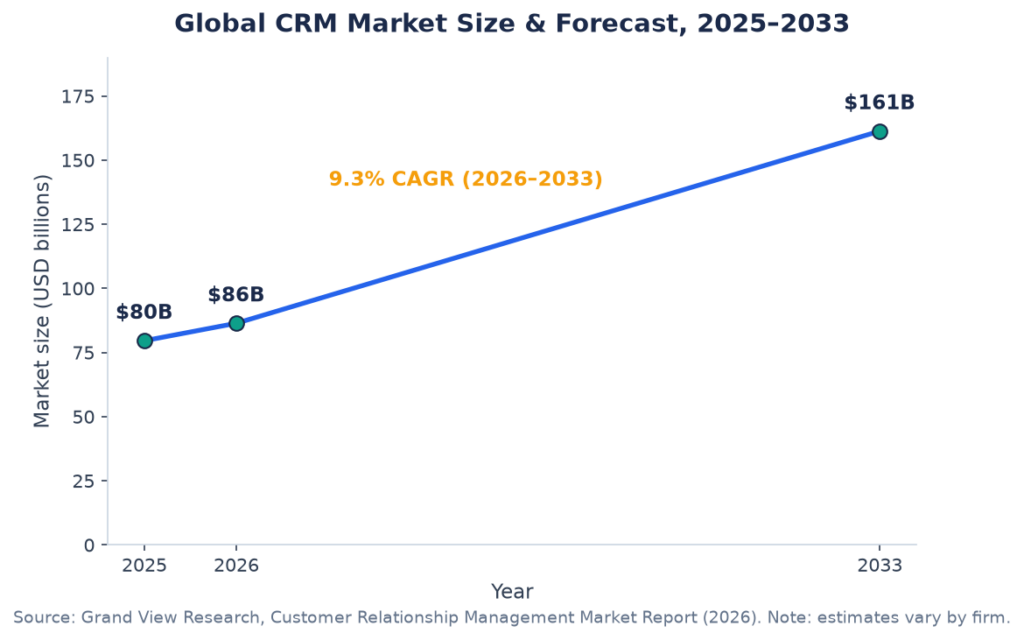
The global weight of that model is enormous. Grand View Research valued the worldwide CRM software market at USD 79.6 billion in 2025, rising to USD 86.4 billion in 2026 and toward USD 161.3 billion by 2033 at a compound annual growth rate of 9.3 percent. North America alone accounted for 40.4 percent of 2025 revenue. Worth noting: market-size estimates vary widely by firm — Fortune Business Insights puts 2025 closer to USD 112.9 billion, while Mordor Intelligence lands near USD 81.2 billion — so the honest takeaway is the direction and the order of magnitude, not any single precise dollar figure.
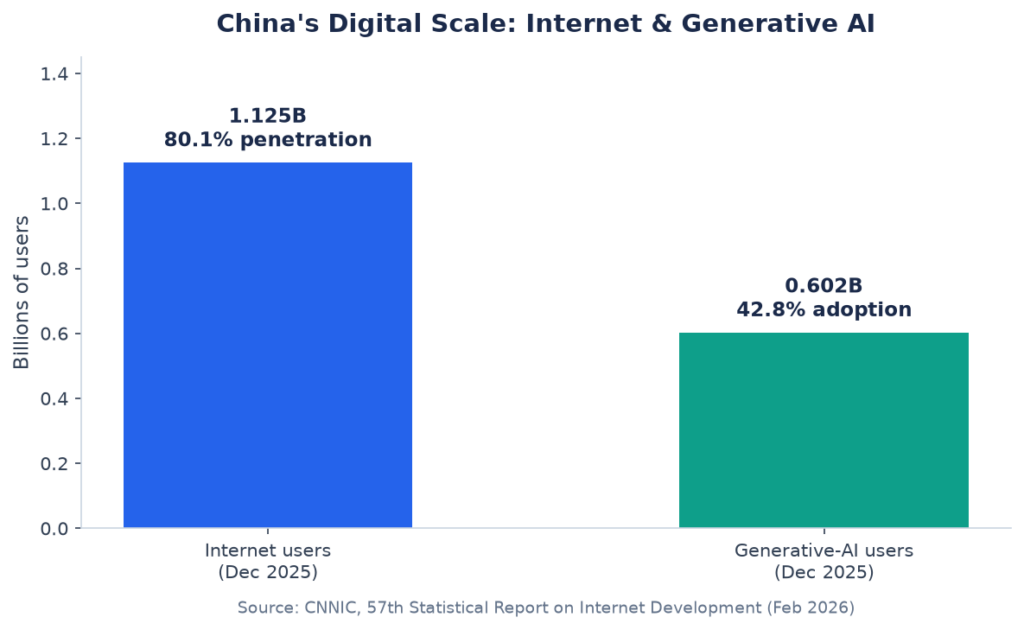
Grouped bar chart comparing 1.125 billion internet users (80.1% penetration) against 602 million generative-AI users (42.8% adoption). Source: CNNIC, 57th Statistical Report on Internet Development in China (Feb 2026).
Private Domain: Ownership by Relationship
Private domain flips the unit of ownership. Instead of treating the customer as a record you query, it treats the customer as a person you can still talk to tomorrow without paying a toll to reach them. The “domain” is private because the brand controls the channel and the audience directly. The catch is that the channel is not one the brand built — it is a super-app the customer already uses every day.
In China, that super-app is overwhelmingly WeChat. A brand’s private domain is the sum of its WeChat Official Account subscribers, its Mini Program visitors, its WeCom
customer connections, and the group chats where repeat buyers gather. None of these live on the brand’s own website. They live inside Tencent’s ecosystem, but the brand operates them as if they were its own front lawn.
The emotional core is closeness. A Western CRM wants to be efficient. Chinese private domain wants to be present. You are not a lead score; you are someone the store owner can message on a Tuesday to ask whether the winter coat fit.
Where They Overlap
The two are not enemies. Both are answers to the same problem: how do you keep a customer after the first sale without renting them back from an ad network every time?
Both store contact data. Both track behavior. Both aim for repeat purchases. Both lean harder on automation every year. A CRM and a private domain both let a business segment users and push targeted messages. In terms of cost versus outcome, they pursue identical business goals.
The overlap is why so many teams confuse them. They feel similar until you look at who controls the front door.
| Dimension | CRM (database model) | Private Domain (relationship model) |
|---|---|---|
| Primary channel | Email, owned site, ad platforms | WeChat, WeCom, Mini Programs, group chats |
| Unit of ownership | The contact record | The open conversation |
| Cost to reach again | Often near zero, but deliverability varies | Near zero once connected, inside the app |
| Relationship depth | Transactional and logged | Conversational and continuous |
| Core metric | Pipeline, retention, LTV | Repurchase rate, activity, response |
| Infrastructure | Licensed software | Super-app layers the brand operates |
Why China Built Private Domain
China did not invent private domain to be contrarian. It built it because the Western stack did not fit the local terrain.
First, the public internet in China is concentrated inside a handful of super-apps. Millions of daily interactions already happen inside WeChat, not on independent brand websites. A brand that waited for customers to visit its own homepage was waiting in an empty room. The audience was elsewhere.
Second, the numbers are staggering — and they keep compounding. CNNIC’s 57th Statistical Report on Internet Development, released on February 5, 2026, puts China’s online population at 1.125 billion as of December 2025, with penetration reaching 80.1 percent. More striking for marketers: generative-AI users reached 602 million by the same month, a 141.7 percent year-on-year jump and a 42.8 percent national adoption rate. The report also puts the added value of China’s core digital-economy industries at 10.5 percent of GDP — a reminder that the infrastructure private domain runs on is not a niche; it is the economy itself.
Horizontal bar chart: WeChat + Weixin MAU 1.432B, total Mini Program MAU 1.023B, WeChat Mini Programs MAU 962M, and WeCom daily served users 750M. Sources: Tencent Q1 2026 results; QuestMobile 2026 Panoramic Ecosystem Traffic Semi-Annual Report.
Third, the infrastructure made it cheap. QuestMobile’s 2026 Panoramic Ecosystem Traffic Semi-Annual Report shows total Mini Program monthly active users at 1.023 billion, with WeChat Mini Programs alone at 962 million. WeChat itself reported 1.432 billion combined monthly active users across Weixin and WeChat as of March 2026. WeCom, the enterprise layer, connects more than 14 million organizations and serves over 750 million WeChat users every day. That is not a fringe tactic; it is the mainstream rail system.
The WeChat-Native Stack
Private domain in China is not one tool. It is a stack of layers, each doing a different job, all riding on the same identity.
The Official Account is the broadcast layer — the place for posts, announcements, and a searchable home base. The Mini Program is the storefront and service layer — a brand can run a shop, a booking system, or a loyalty card without ever leaving WeChat. WeCom is the relationship layer for businesses, letting a real employee (or an AI assistant acting as one) talk to a customer one to one. Group chats are the community layer, where repeat buyers compare notes and the brand listens.
What makes this a “stack” rather than a pile of apps is the shared identity. The same person, with the same WeChat ID, flows from a public post to a Mini Program purchase to a WeCom conversation to a group chat. The brand sees one continuous human, not four disconnected logs.
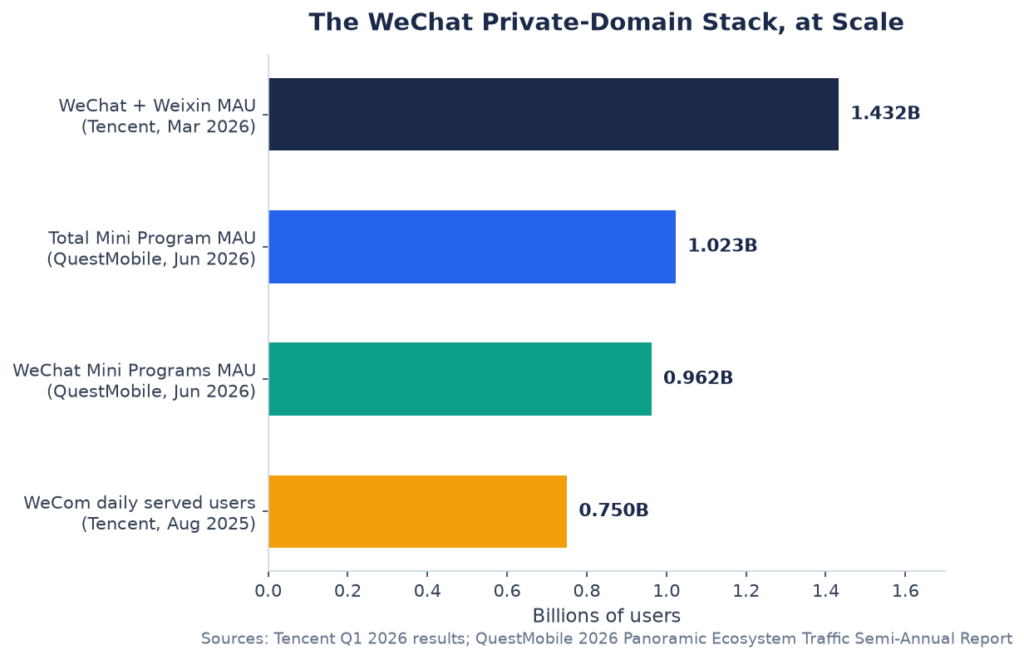
Horizontal bar chart: WeChat + Weixin MAU 1.432B, total Mini Program MAU 1.023B, WeChat Mini Programs MAU 962M, and WeCom daily served users 750M. Sources: Tencent Q1 2026 results; QuestMobile 2026 Panoramic Ecosystem Traffic Semi-Annual Report.
How AI Changed the Math
Here is where the story gets interesting for anyone tracking AI marketing on either side of the border.
In China, the surge in generative-AI adoption — 602 million users by late 2025 — did not stay in chatbots. It flowed straight into private domain operations. Brands began using AI to draft the conversational content that keeps a WeCom thread alive, to summarize group chatter for product signals, and to automate first-line replies without losing the feeling of a real person on the other end. The relationship stays human-shaped, but the labor behind it shrinks.
Globally, the same gravitational pull shows up inside CRM. Gartner’s 2025 market-share analysis for CRM marketing software notes that the category evolved precisely because AI became central to execution — vendors that shipped clear AI outcomes pulled ahead. The global CRM market’s steady growth is, in part, the price enterprises pay to embed intelligence into their records.
The punchline: both worlds are converging on the same realization. Owning the customer is no longer enough; you have to be able to talk to them at scale, and AI is the only thing that makes that affordable. China reached that point through super-app conversations; the West is reaching it through smarter databases.
Reactivation Without Ad Spend
One practical difference keeps Western marketers awake at night. In a pure CRM-plus-ad model, reaching a lapsed customer usually means buying attention again — another email blast, another retargeting pixel, another ad auction. Every reactivation has a media cost attached.
In a mature private domain, reactivation can be nearly free. The customer is already in the group, already following the account, already one tap from the Mini Program. A well-timed message, a restock reminder, or a group-exclusive drop can pull them back with zero incremental media spend. The cost was paid once, at the moment of connection, not at every subsequent touch.
This is why Chinese brands treat the first acquisition not as a conversion but as an enrollment. The sale is the beginning of the relationship, not the end of the funnel.
Metrics That Matter Here
If you measure a private domain with CRM lenses, you will misread it. Open rates and pipeline value tell you little about whether a community is alive.
The numbers that actually move in a private domain are activity-based. How many members in the group spoke this week? How fast did a WeCom message get a reply? What share of Mini Program visitors came back within thirty days? Repurchase rate among connected users matters more than first-order value. Response speed matters more than send volume.
Notice the shift: Western CRM obsesses over the record getting richer; private domain obsesses over the relationship getting warmer. Both are measurable. They are just not the same scoreboard.
What Western CRM Cannot Replicate
A Western CRM can import a WeChat ID, but it cannot live inside WeChat. That limitation is structural, not technical.
The super-app is the destination. A CRM is a back office. When the customer’s entire social, payments, content, and service life happens inside one app, the back office that lives outside it is always one step removed from the action. The CRM can note that a message was sent; it cannot feel the conversation the way the app that hosts it can.
There is also a cultural gap. Western CRM assumes the customer will come to a branded channel — a website, an app, an inbox. Chinese private domain assumes the brand must go to the customer’s channel and stay there. No amount of software licensing closes that gap; only presence does.
Risks of the Private Domain Model
Private domain is not free of danger, and the risks are worth naming before you commit.
The first risk is platform dependency. The relationship lives inside Tencent’s ecosystem. Rules change, reach changes, and a brand that built its entire customer base on borrowed land can lose access overnight if policy shifts.
The second risk is relationship fatigue. A private domain that messages too often, or sells too hard, feels like a pushy relative. Groups go silent; users mute accounts; WeCom friendships get archived. The closeness that makes the model work is also the thing most easily poisoned.
The third risk is measurement blur. Because the journey spans accounts, Mini Programs, chats, and groups, attribution gets messy. Was the repurchase caused by the group drop or the Mini Program coupon? Brands that cannot answer that question end up funding activity they cannot prove.
A Hybrid Operating Model
The smartest operators in 2026 are not choosing sides. They are running a hybrid.
Capture the record in a CRM so the business has a system of truth — pipeline, finance, cross-channel history. Then build the relationship in a private domain so the customer actually stays reachable and warm. The CRM answers “what do we know?”; the private domain answers “can we still talk to them tomorrow?”
For a Western brand entering China, this means treating WeCom and Mini Programs as a front-end layer on top of whatever global CRM already runs the back office. For a Chinese brand expanding outward, it means exporting the relationship discipline — continuous, conversational, presence-first — into the email and owned-app channels the West already uses.
When to Use Which
Use a CRM-first model when your customers live on channels you can own or rent cheaply, when transactions are high-value and infrequent, and when a clean record drives the next big sale. Enterprise software, B2B, and considered-purchase categories fit here.
Use a private-domain model when repeat purchase matters more than first purchase, when your audience already clusters inside a super-app, and when continuous conversation is the cheapest growth lever you have. Consumer retail, education, health, and daily-services brands in China fit here almost by default.
Most businesses reading this will need both. The error is pretending they are the same tool with a different accent.
Frequently Asked Questions
What exactly is private domain in China?
Private domain, is a marketing model where a brand operates its own audience inside a super-app — mainly WeChat — through Official Accounts, Mini Programs, WeCom connections, and group chats, rather than relying on public ad platforms to reach customers each time.
Is private domain just CRM with Chinese characteristics?
No. A CRM stores the customer as a record and reaches them through channels the brand controls or rents. Private domain keeps the customer in an open, conversational relationship inside an app they already use daily, so reactivation costs almost nothing once the connection exists.
Why do Chinese brands prefer private domain?
Because China’s internet audience is concentrated inside super-apps like WeChat, where 1.432 billion people are active each month. Building a separate brand website is far less effective than showing up where customers already are, and the infrastructure — Mini Programs at 962 million MAU, WeCom serving 750 million users daily — makes continuous operation cheap.
Can Western brands build a private domain?
Yes, by layering conversational, presence-first operations onto their existing CRM. Inside China, that means WeCom and Mini Programs. Outside China, the same discipline translates to owned communities, messaging apps, and first-party apps — the channel changes, the principle of ongoing relationship stays.
How do you measure private domain ROI?
Track activity and repurchase, not just open rates. Watch weekly group participation, WeCom response speed, thirty-day Mini Program return rate, and repurchase rate among connected users. The goal is a warmer relationship that converts into cheaper, more frequent repeat sales.
Summary
Private domain and CRM solve the same problem — keeping a customer after the first sale — but they own the customer differently. CRM owns the record; private domain owns the conversation. China built private domain because its 1.125 billion internet users (80.1 percent penetration) and 602 million generative-AI users already live inside super-apps, and because WeChat’s 1.432 billion monthly actives, 962 million Mini Program users, and WeCom’s 750 million daily served users made continuous relationship operation cheap. Globally, the CRM market’s rise to USD 79.6 billion in 2025 and its AI-driven future show the West solving the same puzzle through smarter databases. The winning move in 2026 is hybrid: keep the CRM as the system of truth, and run the private domain as the system of presence.