What Running a Chinese Loyalty Program Actually Feels Like
Something odd sits inside the numbers we verified. Alibaba’s 88VIP base grew from more than 25 million members in mid-2022 to roughly 64 million by mid-2026 — a paid membership, in a market famous for ruthless price comparison. JD keeps adding services to a tier customers already pay for. Warehouse clubs collect a fee before a single item reaches the trolley. On paper this should not work. Shoppers who chase a one-yuan discount should refuse an upfront charge. They do the opposite.
The discovery is that the fee is not a price. It is a frame.
The economics behind the frame
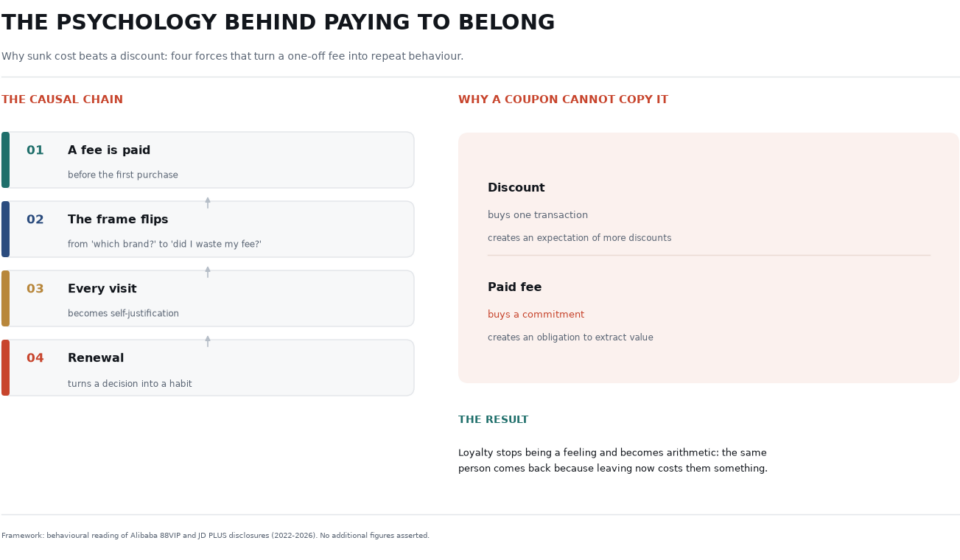
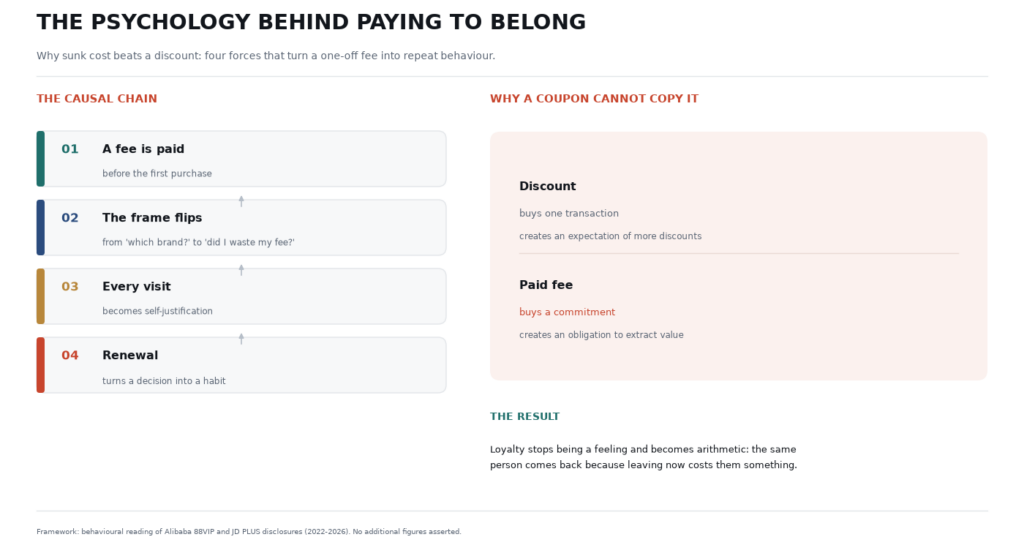
A discount and a membership both cost the brand money, but they buy completely different things. A coupon buys a transaction — and teaches the customer to wait for the next one. A paid fee buys a commitment the customer makes to themselves. Once the money is gone, the mental arithmetic changes: the shopper is no longer choosing between you and a competitor, they are choosing between “extract value from what I already paid” and “admit I wasted it”. Every repeat visit becomes a small act of self-justification.
That is the part a coupon structurally cannot copy. A discount creates an expectation of more discounts. A fee creates an obligation to extract value. One is a habit of waiting; the other is a habit of returning.
The incentive behind the bundle
Here is a second, quieter finding. 88VIP is not really a discount product; its 5 percent across 300-plus merchants is the least interesting line in the disclosure. The real device is the bundle — Youku, Ele.me, Amap, Fliggy, one-to-one service. JD PLUS does the same with shipping certainty, replacement-over-repair, and a seven-service lifestyle package.
Why bundle instead of just cutting price? Because cancellation cost is the product. A single perk is easy to replace with a competitor’s coupon. Six habits wired into one membership are not. Leaving means giving up your video, your food delivery, your maps and your free returns in one decision. The friction is the retention. This also explains a fact global teams miss when they try to copy 88VIP: you cannot reproduce the architecture without owning the architecture. A single-category brand has to invent a different currency — service, access, expertise — rather than imitating the bundle.
Field notes: what running one actually feels like
Talk to anyone operating a Chinese loyalty program and the recurring complaint is not acquisition. It is the reply. In private domain — WeChat groups, one-to-one messaging — the member talks back, constantly. An offer goes out Tuesday morning, the objection arrives Tuesday afternoon, and the offer is rewritten by Wednesday. Retention stops being a campaign with a start and end date and becomes an operating rhythm with no off switch.
That is the hidden cost of the “structural reason to stay” thesis. The channel is free; responsiveness is not. Most global brands are staffed for broadcasting, not for conversation — which is why their WeChat presence so often feels like email with a green icon. The membership fee funds the relationship, but the relationship still has to be staffed.
Why this keeps compounding
Stack the three forces and the trend explains itself. A saturated audience (1.125 billion users, 80.1 percent penetration) removes the acquisition escape route. A fee converts a one-off buyer into someone with something to lose. A bundle raises the cost of leaving without raising the price. Then AI-driven personalisation — 602 million generative-AI users and 250 million first Qwen shopping experiences — makes it cheap to tune each member’s benefits individually.
None of this required a better discount. It required changing what the customer thinks they are buying. The moment loyalty becomes arithmetic rather than affection, repeat purchase stops being a marketing goal and becomes the path of least resistance. That is the why behind the whole playbook — and the reason a coupon, however generous, can never get there.