Trust Is the Product: Financial Marketing in China in the Regulated AI Era
A Chinese bank can now produce the best-performing advertisement of its life and still be barred from running it. The creative is sharp. The targeting is clean. The budget is approved. The problem is that the payment button sits four pixels too close to the loan offer.
That is where financial marketing in China stands in late 2026. The craft has never been better resourced, the data has never been richer, and the room to improvise has never been smaller.
The short version
Three changes arrived at once, and they compound.
First, China compressed the rules of online financial selling into a single enforceable code, effective September 30, 2026, covering payment pages, livestream selling, recommendation algorithms and who may sell at all.
Second, generative AI became ordinary. More than 700 million people in China now use it, and the labeling regime that followed turned undisclosed synthetic content into a compliance problem rather than a creative one.
Third, the distribution layer was cleaned up from the outside. Platforms began deleting financial accounts faster than brands could hire them.
Brands that read this early stopped treating compliance as a tax on creativity and started treating trust as the thing being marketed.
Why financial marketing in China is a different sport
Selling lipstick is a persuasion problem. Selling a wealth-management product is a custody problem: someone hands you money and expects it back.
That asymmetry imposes three constraints that beauty, auto and travel brands never face.
The first is licensing. A firm either holds a license to distribute a financial product or it does not, and no amount of performance marketing turns an unlicensed intermediary into a legitimate seller.
The second is disclosure. Returns cannot be promised, risk cannot be buried in a footnote, and suitability has to be assessed before a recommendation is issued.
The third is memory. Chinese households watched peer-to-peer lending platforms collapse between 2015 and 2019, taking savings with them, and they watched Ant Group’s listing be pulled in 2020. A generation learned to read the small print. Any brand that markets as if that memory does not exist is marketing to a customer who no longer exists.
Put the three together and you have the central tension of this market. The mechanism that builds trust fastest, AI-driven personalization at scale, is also the one that destroys it fastest, because it can produce a confident wrong answer faster than any relationship manager could.
September 30, 2026: the day the funnel was redrawn
The Online Financial Product Marketing Rules took effect on September 30, 2026, after five years of drafting, and they did what the industry had been dreading and needing at once: they wrote the funnel into law.
Four provisions matter to marketers.
Payment pages and credit offers must be visibly separated. The dark pattern that turned a checkout into a loan application is gone, and with it a large share of consumer-credit lead generation.
Only licensed institutions may market financial products. Platforms must verify the credentials of the advertiser behind an account, which shifts the burden of proof from the regulator to the traffic broker.
Livestream selling and short-video selling require named, qualified presenters. The anonymous host reading a script about annualized returns no longer has a legal place to stand.
Recommendation algorithms are explicitly in scope. A feed that pushes a high-risk product to a low-risk customer is a marketing act, not a neutral ranking decision.
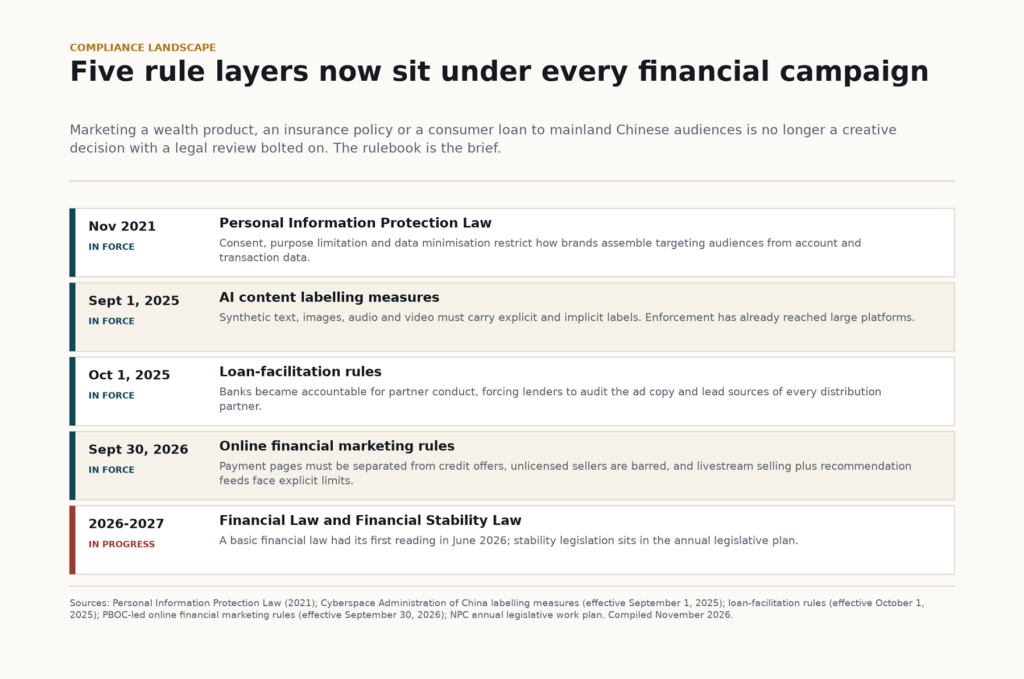
The rules landed on an earlier layer. Loan-facilitation rules that took effect in October 2025 made banks accountable for the conduct of their distribution partners, and a year on, banks were keeping partner rosters tight rather than expanding them. Compliance stopped being a document and became a procurement decision.
The labeling layer nobody budgeted for
China’s rules on labeling AI-generated content took effect on September 1, 2025, and they cover text, images, audio and video. Synthetic material must carry both an explicit label a person can see and an implicit mark a machine can read.
For financial marketing this is not an abstract obligation. It lands on three things brands had already industrialized: AI-written market commentary published under a strategist’s name, digital-human presenters fronting insurance explainers, and generated service scripts that answer product questions.
Enforcement has teeth. In April 2026 the cyberspace regulator publicly warned ByteDance over labeling failures on its apps and website, which is the regulatory equivalent of a shot across the bow for every platform that hosts brand content.
The practical consequence: the disclosure line in a financial ad is no longer only about risk. It is also about authorship. A campaign that says nothing about how it was made is now making a claim by omission.
Where the money actually is
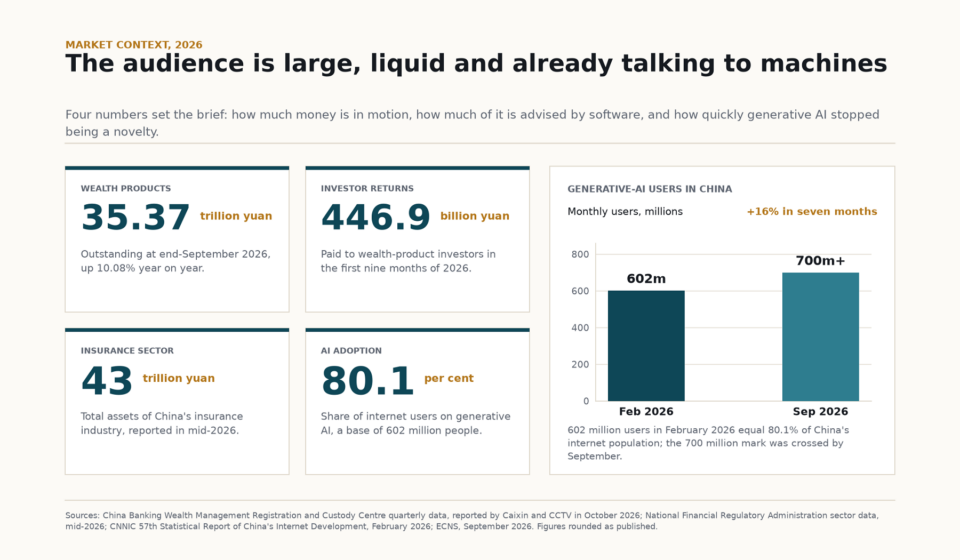
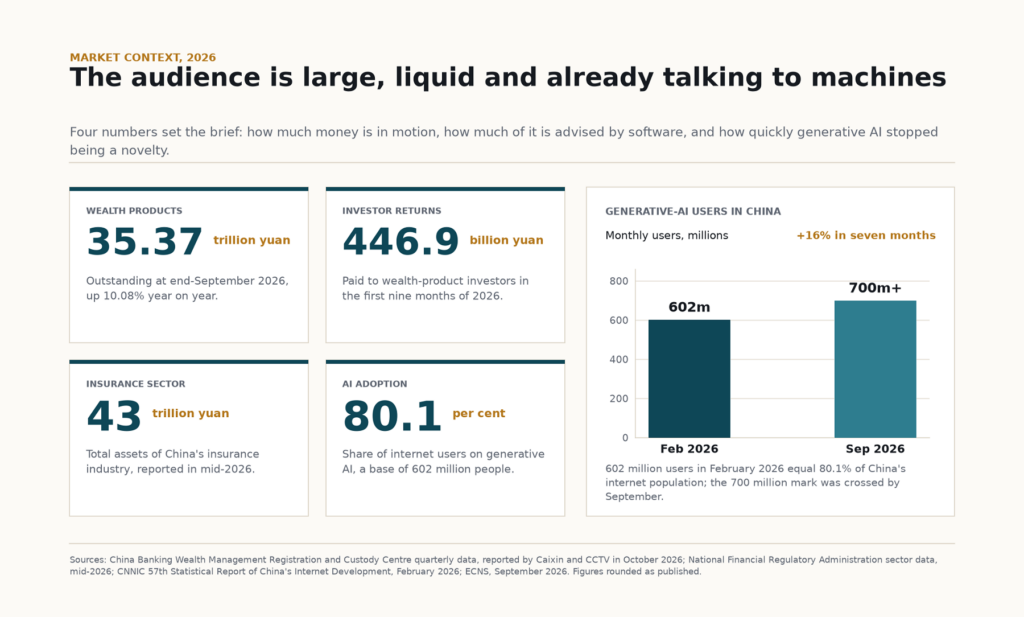
The opportunity is not speculative. Outstanding bank wealth-management products reached 35.37 trillion yuan at the end of September 2026, up 10.08 percent year on year, after adding roughly 1.7 trillion yuan in the third quarter alone. Those products returned about 446.9 billion yuan to investors in the first nine months of the year.
Insurance tells a more complicated story. Sector assets passed 43 trillion yuan by mid-2026, but premium growth slowed through the year: life insurers’ premium growth turned negative by August, and the reference rate used to set guaranteed pricing has slipped toward 1.9 percent. Growth is no longer something a marketing team can assume; it has to be manufactured product by product.
On the demand side, the audience is already fluent with machines. The 57th CNNIC report, published in February 2026, counted 602 million generative-AI users in China, a penetration rate of 80.1 percent, and by September the total had passed 700 million.
One cross-border footnote is worth noticing. In 2026 Hong Kong overtook Switzerland as the world’s largest cross-border wealth hub, on mainland inflows. Trust built in one market now travels.
How AI is rewriting the marketing job
Four shifts are visible inside Chinese financial institutions, and each one casts a compliance shadow.
Personalization moved inside the walls. After the data law and the marketing rules, the interesting work happens on first-party data inside a bank or insurer’s own app, not on rented audiences. Recommendation quality now depends on consented, explainable signals rather than scraped ones.
Content became an assembly line with a customs checkpoint. Models draft explainers, fund commentary and product comparisons; compliance reviews them; the survivors get labels. Leading banks run hundreds of live model use cases and burn tens of billions of tokens a day. The bottleneck is no longer writing; it is review capacity.
Service turned into marketing. Service agents answer pre-purchase questions about fees, exclusions and lock-in periods, which is the moment trust is actually decided. Under the new rules, a service script that recommends a product is marketing content, so the line between the contact center and the campaign team has effectively dissolved.
Compliance became a growth function. Regulatory technology that used to sit in risk now sits in the campaign workflow, checking claims, presenter credentials and disclosure completeness before a creative leaves the building.
The advisory paradox
Here is the uncomfortable part. AI advice is cheap, fast and available at two in the morning. Trust is none of those things.
The framing that dominated the 2026 Bund Summit in Shanghai was that trustworthy AI had become the new credential for market access. That is a marketing statement dressed as a technology statement. Consumers do not need a model that sounds confident; they need an institution that can be held responsible when the model is wrong.
Which is why the hybrid model keeps winning at the moments that matter. AI carries education, comparison and routine servicing. A relationship manager carries the moment money moves, because that moment needs a suitability judgment, a signature and someone to call when markets fall.
The marketing lesson: do not advertise the algorithm. Advertise the accountability behind it.
The channel map
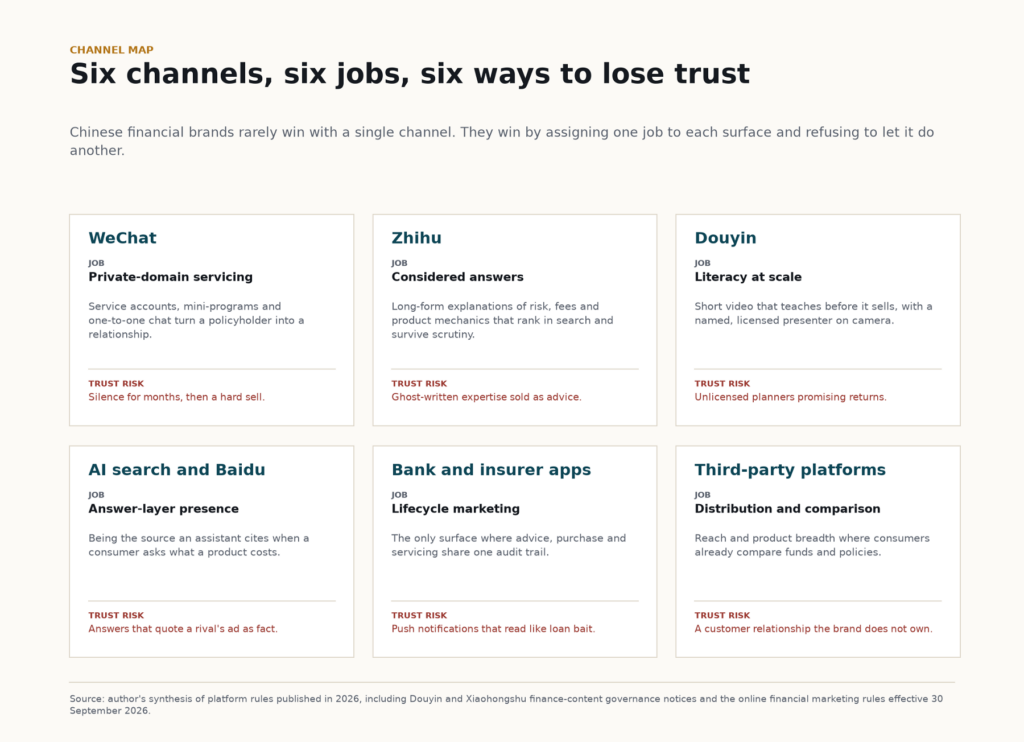
Chinese financial brands rarely win on one channel. They win by giving each surface a single job.
WeChat is the servicing layer: service accounts, mini-programs and one-to-one chat that turn a policyholder into a relationship. Its failure mode is silence followed by a hard sell.
Zhihu is the credibility layer: long-form answers on fees, risk and product mechanics that rank in search and survive a second reading. Its failure mode is ghost-written expertise sold as advice.
Douyin is the literacy layer: short video that teaches before it sells, with a licensed presenter on camera. Its failure mode is the unlicensed planner promising returns.
AI search and Baidu are the answer layer: the source an assistant cites when a consumer asks what a product actually costs. Their failure mode is having no structured facts to cite.
Bank and insurer apps are the accountability layer: the only surface where advice, purchase and servicing share an audit trail.
Third-party platforms are the distribution layer: reach and comparison, at the price of a relationship the brand does not own.
The influencer cleanup
The distribution layer is being rebuilt from the outside in.
Through 2026, Douyin and Xiaohongshu tightened rules on financial accounts, requiring verified credentials from anyone presenting themselves as an adviser. In one enforcement push reported in early November, Douyin removed more than 6,000 accounts that had posed as financial planners. State media spent the spring going after finance influencers who charged for stock-tipping groups; one case ended with a 15 million yuan penalty.
For brands the implication is clarifying: credibility cannot be rented. If a creator cannot show a license, the campaign is a liability with a media plan attached.
The playbook that survives the rules
Five moves separate brands that are growing from brands that keep rewriting disclosures.
Teach before you sell. Fee tables, exclusion lists and worked examples of what a product does not do. Literacy content converts slowly and compounds, which is the profile a regulated category needs.
Build a disclosure system, not a disclaimer. Risk warnings that appear in the same place, in the same format, on every surface read as institutional confidence rather than legal residue.
License your creators. Named presenters with verifiable credentials, on camera, wherever the rules require it.
Design for the answer layer. Publish machine-readable facts: what the product costs, who it suits, what it excludes. When an assistant answers a question about your category, you want it quoting your numbers.
Keep a human at the decision point. AI can carry the customer to the threshold. A person should walk them across it.
Where brands get it wrong
Four mistakes recur.
Treating compliance as a final checkpoint rather than a design input, so campaigns die at the last gate. Running AI content at scale without a labeling workflow. Buying traffic from intermediaries nobody vetted. And measuring clicks instead of suitability, which optimizes for precisely the customers who should not be sold to.
What foreign entrants misread
Foreign financial brands tend to assume three things that are not true.
That global brand equity transfers. It does not: a licensed local entity has to carry the product.
That English-language content reaches Chinese high-net-worth buyers. They read Chinese, on WeChat and Zhihu.
That a strong app is a channel strategy. Here the app is the transaction layer; the relationship layer lives in private domain.
Risks and honest caveats
Regulatory risk is existential rather than incremental. One violation can suspend a product line, and in a trust business that suspension outlives the fine.
AI risk is asymmetric. Customers forgive a slow app; they do not forgive a confident wrong answer about retirement money.
Data risk is irreversible. Financial data is the most sensitive category a marketer can touch, and one breach ends the argument.
Platform risk is structural. Distribution partners own the customer relationship unless the brand builds private domain of its own.
What to watch in 2027
A basic Financial Law had its first reading in June 2026, and stability legislation sits in the annual legislative plan, which will eventually give marketing rules a statutory roof.
Rules governing AI in financial services are still forming, and the first enforcement cases will draw the line between advice and information.
Agentic commerce is the sleeper. Once an agent compares insurance policies on a customer’s behalf, the contest moves from the feed to the API, and brands with clean structured product data win by default.
The takeaway
In China’s financial marketing, AI is the instrument, regulation is the boundary, and trust is the product. The winners will not be the institutions with the best models. They will be the ones whose models make products easier to understand, cheaper to compare and safer to buy, in a category where a single breach of trust can erase a decade of advertising.
FAQ
What changed on September 30, 2026?
China’s Online Financial Product Marketing Rules took effect. Payment pages must be separated from credit offers, marketing is restricted to licensed institutions, livestream and short-video selling require qualified presenters, and recommendation algorithms are explicitly in scope.
Can foreign financial brands market directly in China?
Not the product itself. Distribution runs through a licensed domestic entity or partner, and the marketing content faces the same disclosure and presenter rules as local institutions.
Does AI content need a label in China?
Yes. Rules effective September 1, 2025 require both visible labels and machine-readable marks on synthetic content, and enforcement has already reached major platforms.
Is AI advice replacing relationship managers?
In routine education and comparison, largely yes. At the point where money moves, suitability obligations and customer psychology keep a human in the loop.
Which channel should a financial brand start with?
Owned private domain, usually on WeChat, because it is the only surface where the brand controls the audit trail, the relationship and the disclosure.
Key terms
Private domain: channels the brand owns, typically WeChat groups and service accounts, rather than rented platform traffic.
Suitability: the obligation to match a product to a customer’s risk profile before recommending it.
Answer layer: the AI-generated summary a consumer reads instead of clicking through to a website.